
Can You Buy US Stocks on Weekends? Binance bStocks vs Brokers (2026)
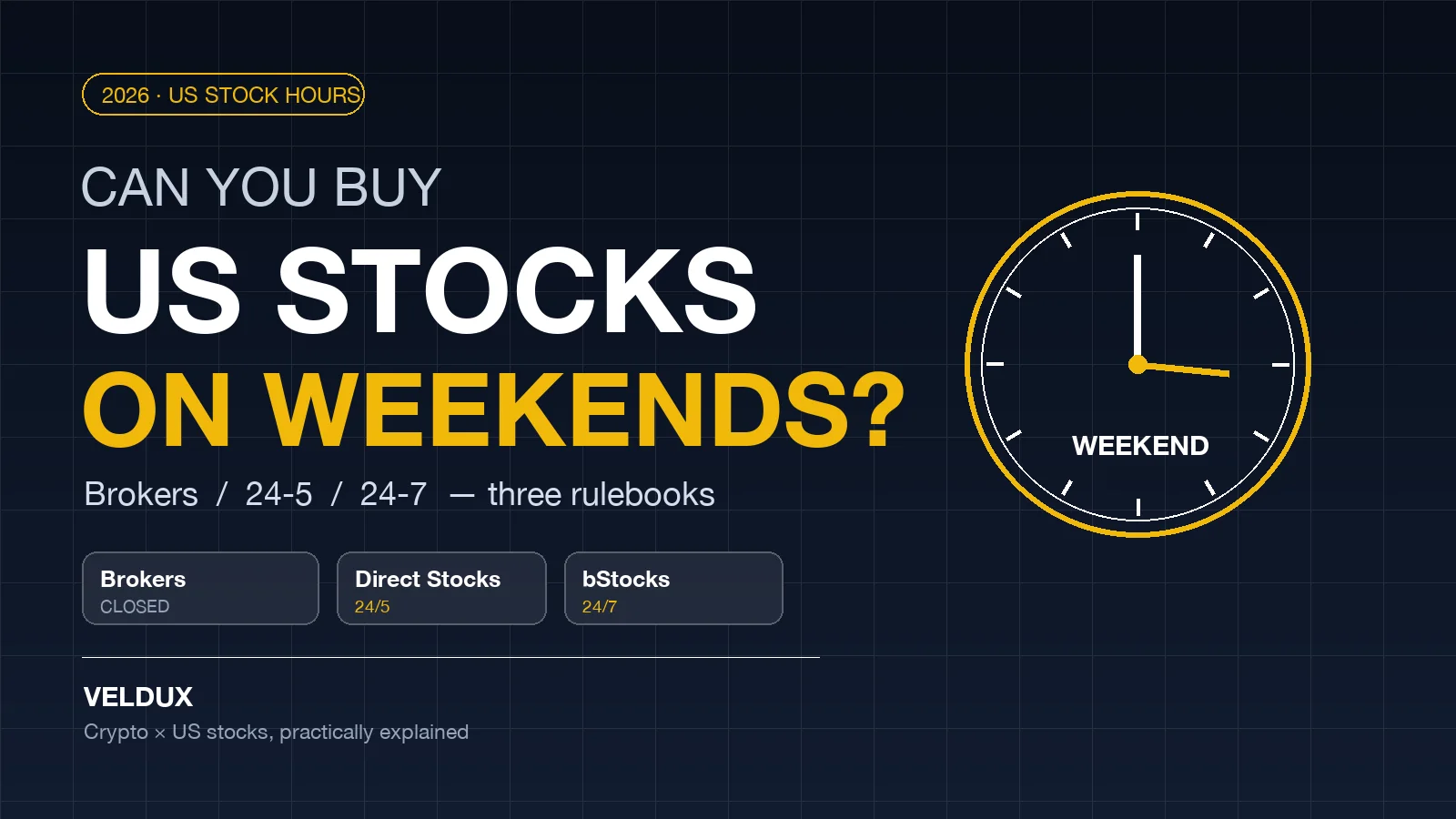
Table of contents

Binance new-user benefit
20% fee rebate
Official Binance sign-up · You must complete identity verification (KYC) to trade and withdraw
Can you buy US stocks on a Saturday?
Not the shares themselves. The New York Stock Exchange and Nasdaq are closed, and most brokers will simply queue your order until Monday.[10]
What does keep trading is a set of products that track US share prices: Binance's tokenized bStocks, stock perpetual futures, and similar tokenized offerings on other crypto platforms.
That difference matters more than the convenience. You may be buying the stock, or you may be buying a certificate that tracks it. The ownership, the price source and the risk are not the same.[1][2]
This guide takes about 12 minutes to read. It answers four questions: what is actually open on a weekend, what you own in each case, where the weekend price comes from, and what a Monday gap can do to your position.
Two traps up front:
- Treating a weekend quote as a live exchange price. There is no exchange matching on Saturday. Prices come from market makers, platform indices or an on-chain order book.
- Treating tokenized stock as share ownership. bStocks are certificates issued by an SPV. They carry no shareholder vote and no SIPC or FDIC protection.[3]
1. Quick answer: what is open on a weekend?
| Route | Weekend trading | What you actually own |
|---|---|---|
| US brokerage account | No, exchanges are closed | Shares or fractional shares held through the broker |
| Binance Direct Stocks | No immediate execution | Beneficial ownership of US shares |
| Binance bStocks | Yes, 24/7 | Tokenized certificate issued by an SPV |
| Binance stock perpetuals | Yes, 24/7 | Leveraged contract position settled in USDT |
| Other tokenized stocks | Platform-dependent | Depends on the issuer and legal structure |
This table answers "can I", not "should I". Three distinctions explain most of the confusion.
Submitting an order is not the same as getting a fill. Some brokers accept weekend orders and hold them until the next session. The price you get is Monday's, not Saturday's.
24/5 is not 24/7. Binance markets Direct Stocks as 24/5, but its FAQ still says market orders execute only from 9:30 AM to 4:00 PM ET, extended sessions accept limit orders only, and overnight coverage is ticker-specific.[1]
A weekend quote is not an exchange price. bStocks and perpetuals form their own prices. Those prices do not have to match the next US open.[3]
2. The three routes, and what each one gives you
Route 1: A US brokerage account
Regular US equity trading runs Monday to Friday, 9:30 AM to 4:00 PM ET, and the market is closed on weekends and US holidays.[10]
Many brokers offer pre-market, after-hours and, increasingly, overnight sessions. Those extend the trading day, not the trading week. A Saturday order sits until Monday.
For a long-term holder, this is usually the right route: you own shares through a broker and custody chain, with the rights that come with that structure.
Route 2: Binance Direct Stocks
Binance Direct Stocks gives eligible users access to US stocks and ETFs. Trades are executed through a partner broker, with clearing and custody handled by the underlying service providers.
The key point is ownership: Direct Stocks corresponds to beneficial ownership of shares, not a price-tracking contract.
Trading hours follow the US market and the partner broker's capabilities: regular hours from 9:30 AM to 4:00 PM ET, pre-market and after-hours for part of the session, overnight trading for selected tickers, and no normal weekend execution.[1]
Order type matters too. Market orders execute only during regular hours; a market order placed outside them is queued for the next open, and extended sessions are limit-order only.[1]
Seeing the stock tab in your Binance app on a Saturday does not mean you can buy real shares on a Saturday.
Route 3: bStocks, Binance's tokenized shares
bStocks are BEP-20 tokens on BNB Smart Chain that give economic exposure to US-listed stocks. They trade 24/7 on Binance Spot, settle in about a second, and start from around $5.[2]
The trade-off is ownership:
| Feature | Direct Stocks | bStocks |
|---|---|---|
| Legal nature | Beneficial ownership of shares | Tokenized certificate |
| Trading hours | US market and extended sessions | 24/7 |
| Voting rights | Per the underlying share arrangement | None |
| Dividends | Handled under share rules | Reinvested through a multiplier mechanism |
| Protection | Broker and securities-account rules | Issuer, custody and product documents |
The third column is the one that matters: bStocks give you price exposure, not a shareholder identity.
Binance's FAQ says bStocks are issued by BTech Holdings Limited, a bankruptcy-remote SPV registered in Abu Dhabi Global Market (ADGM). Holding a bStock does not make you a direct shareholder and does not give you a vote.[3]
Dividends and splits are reflected by adjusting the token's effective balance through a multiplier. The same FAQ states plainly that SIPC and FDIC coverage do not apply to bStocks.[3]
That conclusion is specific to bStocks. Do not apply it automatically to every tokenized product.
Route 4: Stock perpetual futures
Stock perpetuals are neither shares nor tokenized shares. They are margin-traded derivatives that track an equity price.
Binance's TradFi perps trade 24/7, including when the US market is closed. That introduces three extra risks:[5]
Leverage amplifies the move. With $1,000 of margin controlling a $5,000 notional position, a 5% adverse move is a $250 loss, or 25% of your margin, before fees and funding. A further move can trigger liquidation.
Funding is a running cost. Binance settles funding every 4 or 8 hours depending on the contract. Positive funding means longs pay shorts; negative funding reverses it. The rate is not fixed.[5]
Leverage limits vary by contract. Do not assume one number for every market. Binance's FAQ gives a range of 5x to 75x, set per contract and subject to change.[5]
For someone new to US equities, a perpetual is not a substitute for owning the stock.
3. Time zones: how long is the weekend gap?
US markets move to standard time on the first Sunday of November. The table below uses ET and UTC.
| Session | US Eastern | UTC |
|---|---|---|
| Pre-market | 04:00-09:30 | 09:00-14:30 |
| Regular | 09:30-16:00 | 14:30-21:00 |
| After-hours | 16:00-20:00 | 21:00-01:00 (next day) |
| Weekend gap | Friday 20:00 to Sunday 21:00 | Saturday 01:00 to Monday 02:00 |
Those extended-session times are the common arrangement, not a guarantee that every broker or every ticker supports them.
There are two ways to measure the gap.
Regular hours only: Friday 4:00 PM ET to Monday 9:30 AM ET is about 65.5 hours.
Under the planned 23/5 schedule: Friday 8:00 PM ET to Sunday 9:00 PM ET is about 49 hours.[8]
The second number applies only if Nasdaq's 23/5 plan launches as scheduled. Either way, the practical question for a weekend trader is not the exact hour count. It is whether your account can actually execute during the hours you plan to trade.
4. Nasdaq 23/5 does not close the weekend gap
Nasdaq plans to launch 23/5 trading on 6 December 2026 at 9:00 PM ET, subject to DTCC and SIP readiness and SEC approval.[8]
Under the plan, the trading week runs from Sunday 9:00 PM ET to Friday 8:00 PM ET, with a one-hour pause from 8:00 to 9:00 PM ET each day.
One detail is widely misreported.
The 23/5 session applies to Nasdaq Stock Market. It also applies to venues such as NYSE Arca, Cboe EDGX, MEMX and 24X. Nasdaq Texas and Nasdaq PSX will not implement 23/5 and keep their existing hours.[9]
Nasdaq's Data News lists Nasdaq, Nasdaq Texas and PSX as "markets impacted" because the new Plus data products consolidate quotes from all three. That is a data-feed scope, not a trading-hours scope.[8]
The NYSE itself is not extending its hours; NYSE-listed stocks are expected to trade overnight on NYSE Arca.[9]
So 23/5 adds overnight hours to the working week. It does not add Saturday or Sunday trading.
5. Where does a weekend price come from?
This is the part that decides whether weekend trading is worth it.
Suppose Nvidia closed at $180 on Friday. On Saturday, the corresponding bStock might trade at $182, or $176. Neither price is a new Nvidia exchange print.
Binance's FAQ describes the mechanism: secondary-market prices are set by supply and demand on each platform, the issuer does not control them, and a bStock may trade at a premium or discount to the underlying. Outside US market hours, quotes are generated from Binance's internal reference index with multiple fallback layers.[3]
That gives you three different prices to track:
- the last exchange close;
- the token market's execution price;
- the next US open.
They do not have to agree.
Other weekend venues
| Platform | Weekend access | Price source |
|---|---|---|
| Bitget | 21 symbols, from Saturday 09:00 UTC+8 in winter | Friday close plus market-maker quotes |
| OKX | Tokenized stock spot, 7x24 | Latest close plus a market estimate, within price bands |
| Robinhood | 24/7 announced, still under review | Not live, rules not final |
The takeaway is that weekend access exists beyond Binance, but each venue sets prices differently. A quote on one platform does not tell you what another platform will fill at.[11][12][13]
A worked example
Nvidia closes at $180 on Friday. On Saturday you buy the bStock at $184. On Monday the stock opens at $179 and the bStock converges to about $179.
Ignoring fees, the position is down:
(179 - 184) / 184 = -2.72%
The stock did not fall 2.72%. You paid a weekend premium to Friday's close, then absorbed the convergence back to the equity market's price.
If Monday gaps higher, the same mechanism can work for you. But when the weekend price has already priced in the good news, the upside may be smaller than it looks.
Trading early is not the same as getting a better price.
6. What does weekend trading cost?
| Route | Explicit cost | Hidden cost |
|---|---|---|
| Binance Direct Stocks | $0.17 up to $340; 0.05% above $340 | No weekend execution, so no weekend entry |
| Binance bStocks | Standard spot fee by VIP tier; 1:1 conversion is free | Bid-ask spread, BSC withdrawal fee |
| Stock perpetuals | Trading fee plus funding every 4 or 8 hours | Funding drag, slippage, liquidation |
| Other tokenized stocks | Platform spot fee | Off-hours spread and price bands |
The visible fee is rarely the whole cost. The spread usually matters more on a weekend.
Direct Stocks: $0.17 or 0.05%
Binance's fee page says orders up to $340 pay a $0.17 platform fee and orders of $340 or more pay 0.05%. The page lists the promotion as running until 31 December 2026.[7]
On a $1,000 order, 0.05% is about $0.50. The page presents this as a trading spread rather than a separate commission line.
bStocks: spot fees plus spread
This is where a lot of content gets it wrong.
Binance's buying guide states that trading bStocks on Spot follows standard Binance spot fees, which are tiered by VIP level. The "zero fee" language applies to the 1:1 conversion between a bStock and the underlying share.[14]
So the real cost has three parts: the spot fee, the bid-ask spread, and any network fee when you withdraw tokens to a wallet.[3]
If the midpoint is $100, the best bid is $99.75 and the best ask is $100.25, the spread is $0.50, or 0.5%. On a $1,000 round trip, that is about $5 in spread cost before fees and slippage.
A 0.5% spread is a 0.5% round-trip cost. You do not multiply it again.
Stock perpetuals: funding is the number to watch
Take a $1,000 notional position and a funding rate of +0.01% per settlement. If longs pay, that is $0.10 per settlement.
At three settlements a day (every 8 hours), the example costs about $0.30 a day. At four-hour funding, it doubles. The rate itself moves, and it can flip in the other direction.[5]
Funding is charged on notional, not on margin. With 5x leverage, $200 of margin controls $1,000 of notional, but funding is still calculated on the $1,000.
For a position held for weeks, funding and price movement will matter far more than the opening fee.
7. Can you convert between Direct Stocks and bStocks?
Yes, if your account and the specific stock qualify.
Binance's FAQ says eligible users can convert between a stock position and the matching bStock through Nest Trading at 1:1 with no conversion fee, generally around the clock.[4]
Four conditions matter.
Conversion is not a spot trade. Converting shares into tokens is a different operation from buying the token on the order book. A zero conversion fee does not mean a zero spread.
Converting back requires a Stock Account. The FAQ states that token conversion to the underlying asset requires a Stock Account and acceptance of the terms.[4]
Conversion can pause. Deposits, withdrawals and conversions may be suspended during corporate-action processing or maintenance. Spot trading itself is not suspended for dividend processing; dividends are reinvested through the multiplier and splits adjust the balance.[4]
Rounding leaves a residual. Shares are recorded to 9 decimals and tokens to 8. The excess cannot be tokenized and is retained by the issuer as a rounding difference, not a fee.[4]
"Convertible in theory" is not the same as "convertible at any moment, for any account".
8. The three risks that actually bite on a weekend
Risk 1: You buy the weekend premium, then it converges
A stock closes at $100 on Friday. Good news pushes the token to $108 over the weekend. On Monday the stock opens at $104. Even though the news was right, the buyer at $108 is underwater.
Being right about direction is not the same as being right about price.
What helps: compare the token quote with the last close, check the premium and the order-book depth, and avoid market orders when the spread is unusually wide.
Risk 2: Thin books make stops unreliable
Weekend liquidity is thinner. A displayed quote does not guarantee that a large order fills anywhere near it. Common symptoms:
- spreads widen sharply;
- small orders move the price;
- stop orders fill well past the trigger;
- limit orders sit unfilled.
A stop is an instruction, not a guarantee. Perpetuals add liquidation risk if margin runs short.[6]
Risk 3: A tokenized certificate is not a brokerage account
If you hold $1,000 of bStocks, you carry the stock's price risk plus issuer, custody, platform and transfer rules.
The existence of real shares in a custody account does not give token holders the same legal position as brokerage customers. Binance's FAQ says trading, conversion, redemption and transfer may be subject to eligibility checks, compliance restrictions and smart-contract controls, and that restricted addresses may lose the ability to trade or redeem.[3]
SIPC and FDIC coverage do not apply.[3] If you plan to hold for a long time, understand what claim you own and how you would enforce it if the issuer or platform ran into trouble.
9. Which route fits which investor?
Weekend access is a feature, not a strategy.
| Your main goal | Route to research first |
|---|---|
| Hold US stocks or ETFs for years | Brokerage account or Direct Stocks |
| Get unleveraged weekend exposure | Eligible tokenized stock |
| Go long or short over the weekend | Stock perpetual, with higher risk |
| Invest a fixed amount monthly | Regular-session shares or funds |
| Need shareholder rights | Traditional securities structure |
| Not comfortable with leverage or funding | Avoid perps as a stock substitute |
My view: if you plan to hold for a year, taking on a new product structure just to trade two days earlier is rarely worth it.
For long-term investors, earnings, valuation, cash flow and holding costs matter more than whether you can fill on a Saturday morning. If the goal is a short hedge or a temporary exposure, weekend tools do offer something a broker cannot — provided you understand the counterparty, the price mechanism and the risks.
Four checks before you place the order
Name the product. Shares, bStocks or a perpetual — three different things.
Name the price. Compare the token quote with the last exchange close, not just the percentage change on the screen.
Add up every cost. Spot fee, spread, funding, slippage, conversion and network fees.
Confirm eligibility. Product access depends on your jurisdiction, account status and local law. Do not use a VPN or false address to get around restrictions.
10. FAQ
Can you trade US stocks on weekends?
Not on the exchanges. NYSE and Nasdaq are closed on Saturday and Sunday. Tokenized stocks and stock perpetuals can trade 24/7, but they are not the same instrument as a listed share.[10]
Can you trade US stocks on Binance over the weekend?
It depends on the product. Direct Stocks does not offer normal weekend execution; bStocks trade 24/7 on Spot; stock perpetuals trade 24/7 with leverage. Availability depends on your jurisdiction and account.[1][2]
If I buy Nvidia on Saturday, can I sell before Monday's open?
If you bought a tokenized product that trades around the clock, you can place a sell order at any time. Whether it fills, and at what price, depends on the order book, platform status and the product's rules. A real share order waits for the next session.
Are bStocks real US stocks?
No. They are tokenized certificates that provide economic exposure and a conversion mechanism, not direct ownership of the underlying company.[3]
Is the weekend bStock price a real price?
If a trade executes, that is a real token price. It is not an exchange price for the underlying stock, and it can trade at a premium or discount to the last close.[3]
Is weekend trading more expensive?
Not necessarily in explicit fees. Spreads and slippage tend to widen when liquidity is thin, and perpetuals add funding costs. Judge the total cost, not the commission line.[5]
Will Nasdaq's 23/5 launch make weekend trading possible?
No. The planned session runs from Sunday 9:00 PM to Friday 8:00 PM ET, leaving about a 49-hour weekend gap. It also does not cover Nasdaq Texas or Nasdaq PSX.[8][9]
Do weekend limit orders survive until Monday?
It depends on the venue. Bitget says unfilled weekend limit orders lapse when regular trading resumes. Check each platform's order terms before relying on a weekend order.[11]
Can bStocks be converted into real shares?
Eligible users can convert at 1:1 with no conversion fee through Nest Trading. Converting tokens back to shares requires a Stock Account, and the service can pause during corporate actions.[4]
Can US persons use these products?
bStocks are not offered, sold or made available in the United States or to US persons. Other jurisdictions are also restricted. Eligibility is determined by your account and location, not by whether the app opens.[3]
11. The bottom line
The US trading week is getting longer. Nasdaq's 23/5 plan, extended broker sessions and tokenized stocks all push access beyond the traditional 9:30-to-4:00 window.
None of that removes the weekend. It moves the risk: from "I cannot trade" to "I can trade, but at a price that may not survive Monday's open".
The question worth asking is not "can I buy Nvidia on Saturday?" It is: why does this need to happen on Saturday, and what do I give up by waiting until Monday?
If the only answer is fear of missing a gap, waiting for the regular session is usually the cheaper choice.
Data verification notes
This article reflects public product documents and official sources reviewed on 21 November 2026. Fees, trading hours, eligibility and planned market-structure changes can all change.
1. Binance stock trading FAQ
Official source: https://www.binance.com/en/support/faq/detail/7ae9ef8636e74e8b9c3b625677b83310
What was checked: regular hours are 9:30 AM to 4:00 PM ET Monday to Friday; pre-market and after-hours are available and selected tickers may trade overnight; market orders execute only during regular hours; extended sessions are limit-order only.
2. Binance Academy - What are bStocks
Official source: https://www.binance.com/en/academy/articles/what-are-bstocks-a-guide-to-tokenized-stocks-on-binance
What was checked: bStocks trade 24/7 on Spot, settle in about one second and start from around $5; they represent an interest in a financial instrument rather than direct ownership of the underlying shares.
3. Binance bStocks FAQ
Official source: https://www.binance.com/en-NG/support/faq/detail/f0c03cd6509a4085b4cce1636f16be38
What was checked: secondary prices are set by supply and demand; off-hours quotes use Binance's internal reference index with fallback layers; zero custody, management and conversion fees apply, while network fees and spreads may still be charged; BTech Holdings is a bankruptcy-remote ADGM SPV; SIPC and FDIC do not apply; the product is not offered to US persons, and restricted addresses can be frozen.
4. Binance bStocks deposit, withdrawal and conversion FAQ
Official source: https://www.binance.com/en/support/faq/detail/f0d41139fadc4790bf9a4c0c7bce2e88
What was checked: BSC-only deposits and withdrawals; network fee and token-specific minimum on withdrawal; 1:1 conversion through Nest Trading with no fee; converting tokens back to shares requires a Stock Account; corporate actions can pause conversion; 9-decimal shares versus 8-decimal tokens leave a residual with the issuer.
5. Binance TradFi perpetuals FAQ
Official source: https://www.binance.com/en-TR/support/faq/detail/1b88e951ee42414396b0c3a86ba4be4f
What was checked: 24/7 trading; funding every 4 or 8 hours; maximum leverage from 5x to 75x depending on the contract; restrictions in Hong Kong, the UK, Taiwan and parts of the EEA.
6. Binance Academy - How to trade stock perpetual contracts
Official source: https://www.binance.com/en/academy/articles/how-to-trade-stock-perpetual-contracts-on-binance
What was checked: USDT settlement; funding costs accumulate; price gaps can trigger liquidation; contract specifications can change. Current parameters are shown on the trading page.
7. Binance Stocks fee page
Official source: https://www.binance.com/en/fee/stocks
What was checked: $0.17 platform fee up to $340; 0.05% at $340 and above; the promotion is listed as running until 2026-12-31. Confirm the current rate on the order confirmation screen.
8. Nasdaq Data News #2026-3
Official source: https://nasdaqtrader.com/TraderNews.aspx?id=DN2026-3
What was checked: 23/5 targeted for 2026-12-06, subject to DTCC and SIP readiness and SEC approval; Sunday 21:00 to Friday 20:00 ET with a 20:00-21:00 pause; Plus data products consolidate Nasdaq, Nasdaq Texas and PSX quotes.
9. Gibson Dunn - What 23/5 trading means
What was checked: Nasdaq Stock Market, NYSE Arca, Cboe EDGX, MEMX and 24X have rules for 23/5; Nasdaq Texas and Nasdaq PSX will not implement 23/5; the NYSE is not extending its own hours, and NYSE-listed stocks are expected to trade overnight on NYSE Arca.
10. NYSE trading hours and holiday calendar
Official source: https://www.nyse.com/trade/hours-calendars
What was checked: regular trading Monday to Friday, 9:30 AM to 4:00 PM ET; closed on weekends and US holidays.
11. Bitget weekend US stock trading
Official source: https://www.bitgetapp.com/zh-CN/support/articles/12560603885756
What was checked: 21 symbols initially; winter session starts Saturday 09:00 UTC+8; weekend quotes are reference prices based on Friday's close plus market-maker quotes; unfilled limit orders lapse when regular trading resumes.
12. OKX unified tokenized stock listing
Official source: https://www.okx.com/zh-hans/help/okx-to-list-unified-tokenized-stocks-xminimax-xzhongji-and-more-for-spot-trading
What was checked: 7x24 spot trading including weekends; off-hours pricing uses the latest close plus a market estimate within price bands; not offered to US persons.
13. Robinhood weekend trading announcement
What was checked: announced on 2026-09-29; weekend orders routed to a Bruce Markets venue; still under regulatory review at announcement. This article does not describe it as live.
14. bStocks spot fees versus conversion fees
Official source: https://www.binance.com/en/blog/markets/7938718877635190290
What was checked: "Trading bStocks on Spot follows Binance's standard trading fees, which are tiered by VIP level"; the zero-fee treatment applies to 1:1 tokenization conversion; direct stock trades cost $0.17 minimum or 0.05% above $340.
Verification boundary
This article is based on public product rules and official documents. It does not claim that live orders were tested on every platform, account or session.
Eligibility, legal structure, fees, liquidity and execution conditions vary by jurisdiction. The price, fee, funding and P&L examples are illustrative and are not quotes for any specific product on 21 November 2026.
Disclaimer
This article is educational content about product structure, trading hours and risk. It is not investment, trading, legal or tax advice.
Stocks, ETFs, tokenized securities and derivatives can lose value. Leveraged derivatives can be liquidated. Check your local rules, product eligibility and the current terms before trading.
Related reading
- How to buy US stocks on Binance: Direct Stocks steps, fees and settlement (2026) — the full purchase flow and what you own.
- Binance Direct Stocks vs bStocks: real shares or tokenized stocks? — ownership, custody and settlement compared.
- Binance US stock fees: what a $100 trade actually costs — the cost side of a trade.
- Binance US stock T+1 settlement: why sold cash is locked — why weekend sales settle later.
- US stocks broker vs crypto exchange: where should you buy? — brokerage access versus crypto-funded products.
Exchange operations · USDT · Wallet security
Responsible for researching and organizing content on Binance, OKX, USDT transfers, withdrawals and wallet security. The steps and key data in this article are verified according to the content type, using real operation records, official platform documentation and public sources. Interfaces, fees and regional rules may change, so the article is reviewed and updated continuously.
Status: manual review · Last verified 2026-11-22
Reviewed by: Veldux editorial team
- Binance Stock Trading FAQRegular hours are 9:30 AM to 4:00 PM ET Monday to Friday; pre-market and after-hours are available and selected tickers may support overnight trading; market orders execute only during regular hours; extended sessions are limit-order only
- Binance Academy - What Are bStocks?bStocks trade 24/7 on Binance Spot, settle in about one second and start from around $5; they are certificates representing an interest in a financial instrument, not direct ownership of the underlying shares
- Binance bStocks FAQSecondary-market prices are set by supply and demand on each platform; outside US market hours quotes are generated from Binance's internal reference index with fallback layers; the product carries zero custody, management and conversion fees, but network fees and trading spreads may apply; BTech Holdings is a bankruptcy-remote ADGM SPV; SIPC and FDIC coverage do not apply; not offered to US persons
- Binance bStocks deposit, withdrawal and conversion FAQDeposits and withdrawals use BNB Smart Chain only; withdrawals carry a network fee and a token-specific minimum; conversion runs through Nest Trading at 1:1 with no conversion fee; converting tokens back to shares requires a Stock Account; conversion can pause during corporate actions; shares are recorded to 9 decimals and tokens to 8, with the remainder retained by the issuer
- Binance TradFi Perpetuals FAQTradFi perps trade 24/7; funding settles every 4 or 8 hours; maximum leverage ranges from 5x to 75x depending on the contract; access is restricted in Hong Kong, the UK, Taiwan and parts of the EEA
- Binance Academy - How to Trade Stock Perpetual ContractsStock perps are settled in USDT; funding costs accumulate over time; price gaps can trigger liquidation; contract specifications may change
- Binance Stocks fee pageOrders up to $340 pay a $0.17 platform fee; orders of $340 or more pay 0.05%; the promotion page says it runs until 2026-12-31
- Nasdaq Data News23/5 trading is targeted for 2026-12-06, subject to DTCC and SIP readiness and SEC approval; the session runs Sunday 21:00 to Friday 20:00 ET with a one-hour pause from 20:00 to 21:00; the Plus data products consolidate Nasdaq, Nasdaq Texas and PSX quotes
- Gibson Dunn - What 23/5 trading meansNasdaq Stock Market, NYSE Arca, Cboe EDGX, MEMX and 24X have rules to offer 23/5 trading; Nasdaq Texas and Nasdaq PSX will not implement 23/5; the NYSE itself is not extending hours, and NYSE-listed stocks are expected to trade overnight on NYSE Arca
- NYSE trading hours and holiday calendarRegular trading runs Monday to Friday, 9:30 AM to 4:00 PM ET; the market is closed on weekends and US holidays
- Bitget - weekend US stock trading21 symbols initially support weekend trading; the session starts at 09:00 UTC+8 on Saturday in winter time; weekend quotes are reference prices based on Friday's close plus market-maker quotes, not exchange executions; unfilled weekend limit orders lapse when regular trading resumes
- OKX - unified tokenized stock listingTokenized stock spot pairs trade 7x24 including weekends; outside US hours prices use the latest close plus a market estimate, with price bands; not offered to US persons
- Reuters/Investing - Robinhood weekend tradingOn 2026-09-29 Robinhood announced it would extend 24/5 to 24/7, routing weekend orders to a venue operated by Bruce Markets; the feature was still under regulatory review when announced
- Binance Blog - Guide to buying bStocksTrading bStocks on Spot follows Binance's standard trading fees, which are tiered by VIP level; the zero-fee treatment applies to 1:1 tokenization conversion; direct stock trades cost $0.17 minimum or 0.05% above $340
- 2026-11-21UpdateFirst English edition, rewritten for non-US readers rather than translated. Includes the 23/5 scope correction (Nasdaq Stock Market only; Nasdaq Texas and PSX do not implement it), the 4-or-8-hour funding interval and 5x-75x leverage range for TradFi perps, and the split between bStocks spot fees and free 1:1 conversion.
- 2026-11-21CorrectionCorrected an earlier draft that described bStocks as commission-free across the board. Binance's buying guide states that Spot trading of bStocks follows standard VIP-tiered spot fees; only the 1:1 conversion is fee-free.
Editorial principles ineditorial policy,corrections policy。