
Binance Direct Stocks vs bStocks: real shares or tokenized stocks? (2026)
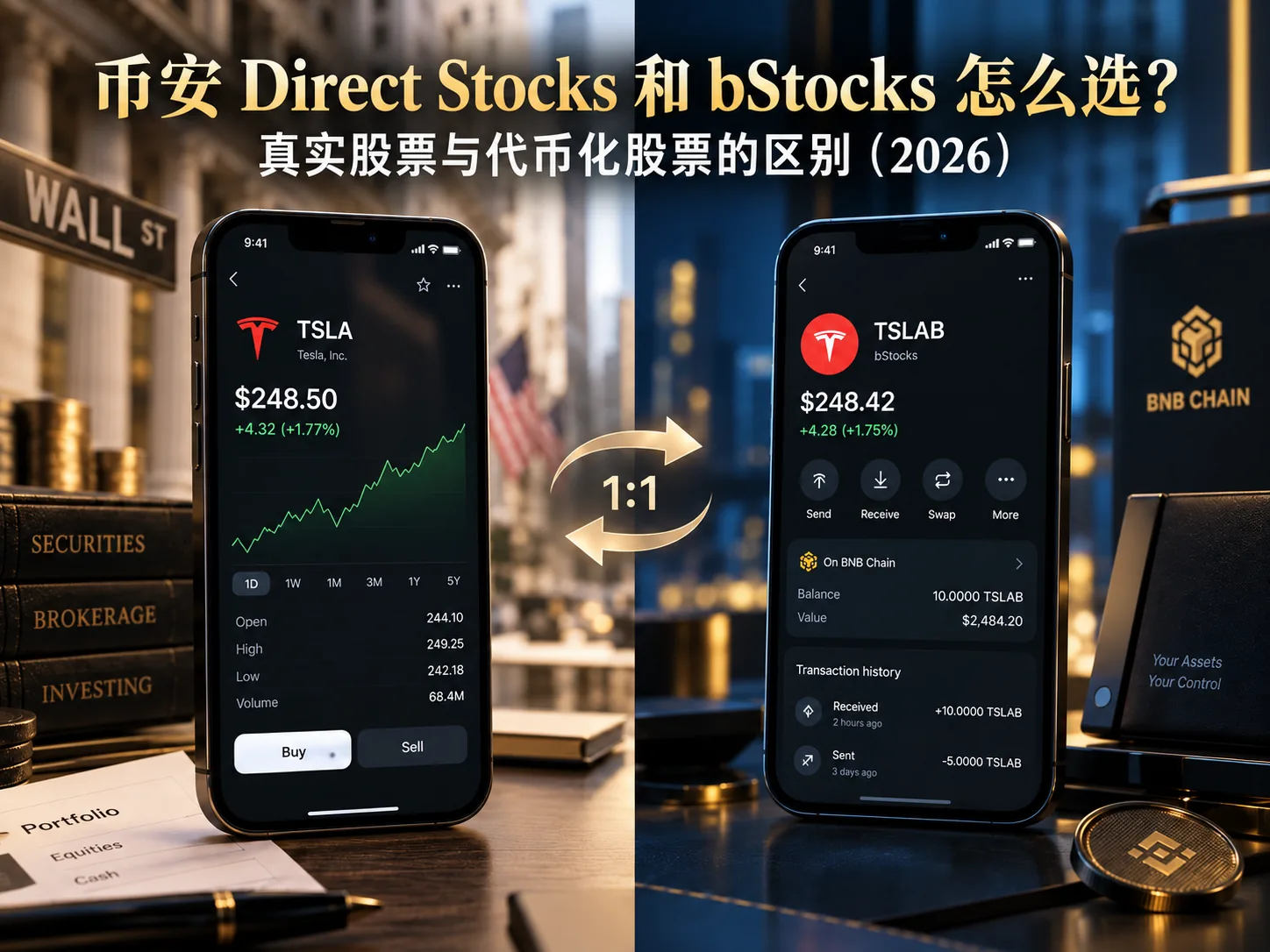
Table of contents

Binance new-user benefit
20% fee rebate
Official Binance sign-up · You must complete identity verification (KYC) to trade and withdraw
You open Binance to buy a little US stock, and many people get stuck at the first step:
Search for Tesla and the page may show both TSLA and TSLAB, one called Direct Stocks and one bStocks. Both have "US stocks" in the name — which one do you buy?
The conclusion first, then we break it down:
Direct Stocks means you bought real shares inside a securities account; bStocks means you bought a tokenized certificate backed 1:1 by real shares. Both track the same US stocks, but "what you legally own" is different — and because they can be converted 1:1 for free in both directions, this isn't an either/or choice. It's "the same exposure, in which form do you hold it".
The full comparison takes about eight minutes. If you remember only two things, make them these: a bStock is backed by real shares but is not the share itself, and the two products do not deliver dividends in the same way.
This article only explains the product structure and how to use it, and is not investment advice. Stocks, tokenized securities and crypto assets all carry risk, and product availability varies by your region and account eligibility.
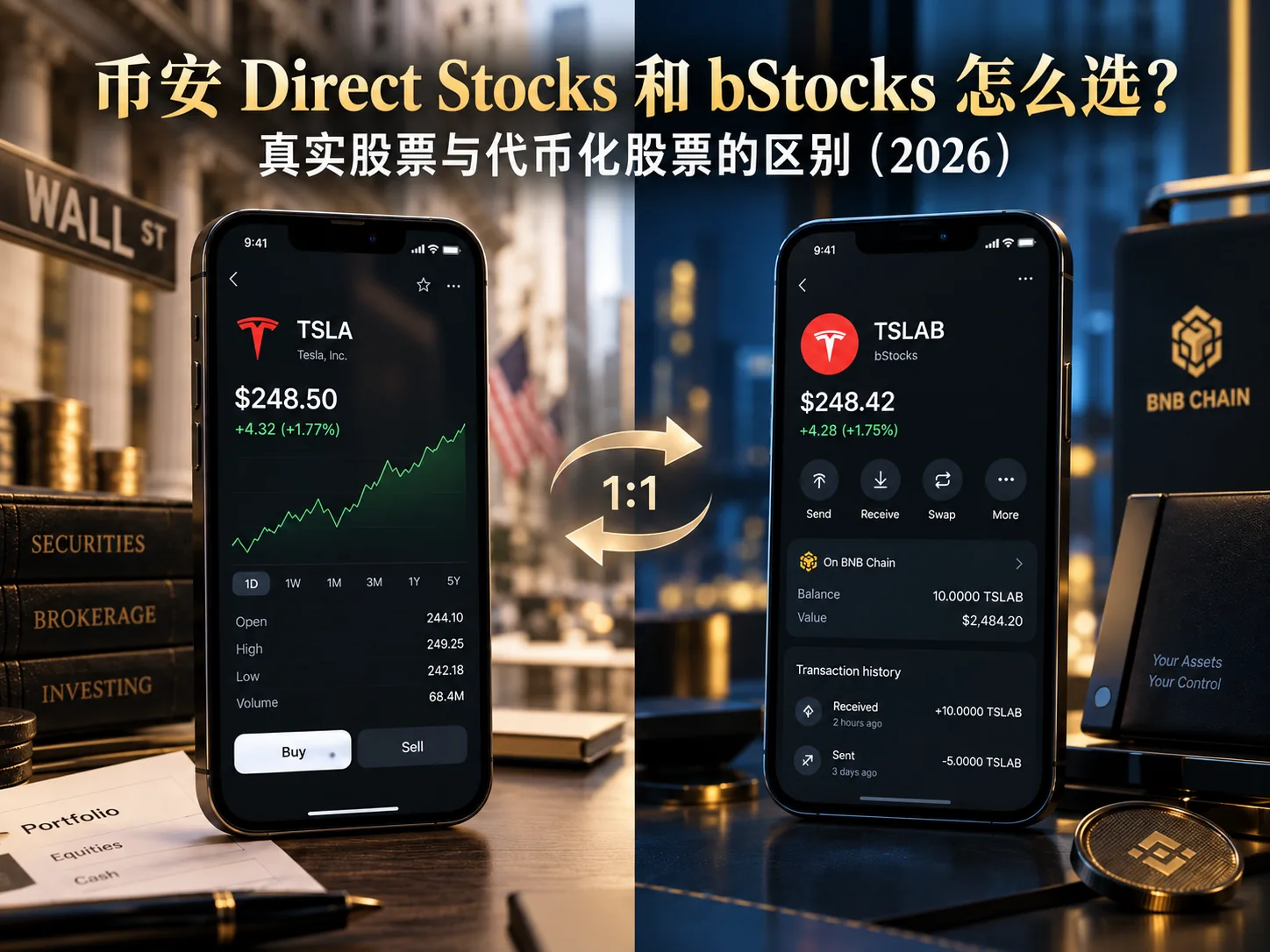
Figure: Binance has two entries for buying US stocks — Direct Stocks (real shares) and bStocks (tokenized securities). This article explains the difference and how to choose.
Why Binance has two "buy US stocks" entries
This starts with Binance re-entering US stocks in 2026.
Binance ran a round of stock tokens in 2021 and later stopped them as the regulatory environment changed. When it returned to the US stock market in 2026, it didn't build a single product but two lines:
- Direct Stocks, launched on 1 June 2026: connected to the real brokerage system, using a traditional stock account and covering 7,000+ US stocks and ETFs.[1]
- bStocks, launched on 11 June 2026: US stocks turned into on-chain tokens, traded 24/7 and withdrawable to your own wallet.[2]
By the way, there is a third stock-adjacent thing inside Binance — stock perpetual futures — which is a pure derivative and completely separate from these two lines. I broke down how to tell the three products apart at a glance in this article; here I focus only on Direct Stocks and bStocks.
These two lines are not "which is better" but serve two different groups. The people who really buy the wrong thing aren't the ones who can't tell real from fake, but the ones who aren't clear about what they own after buying — and that determines a lot downstream: how dividends arrive, whether you can withdraw to your own wallet, and who to turn to if something goes wrong.
First, separate the legal nature of the two
This is the most important layer of the whole article and deserves its own section.
Direct Stocks: real shares inside a securities account
Direct Stocks is not "Binance issuing a coin that tracks the stock price", but stock trading connected to the real brokerage system. Public information shows its structure is "introducing broker + clearing broker":
| Role | Entity | What it does |
|---|---|---|
| Introducing broker | Nest Trading (ADGM-licensed, Abu Dhabi) | Order referral, front-end compliance |
| Clearing / custody broker | Alpaca Securities (US-registered broker) | Execution, clearing, settlement, custody, dividends, corporate actions |
In other words, your shares are custodied by Alpaca Securities, not sitting in the Binance wallet. After buying, you hold beneficial ownership in a securities account, with shareholder rights such as cash dividends and voting rights — subject to the account agreement.[3]
bStocks: a tokenized certificate backed by real shares
bStocks works differently. Binance classifies it as a tokenized security (Tokenized Securities / Certificates), issued by Binance Group affiliate BTech Holdings Limited. Each unit is backed by one real share held by a regulated custodian — but the certificate you receive "represents rights in certain financial instruments", not direct ownership of the listed company's shares.[4]
It trades more like a crypto asset: it runs on BNB Chain (BEP-20), trades spot 24/7, can be withdrawn to Trust Wallet, Binance Wallet or a hardware wallet, and can be used in DeFi. The cost is a more complex legal relationship — covered below.
The difference in one sentence:
Direct Stocks is "a stock"; bStocks is "a token backed by a stock". Same economic exposure, different holding form.
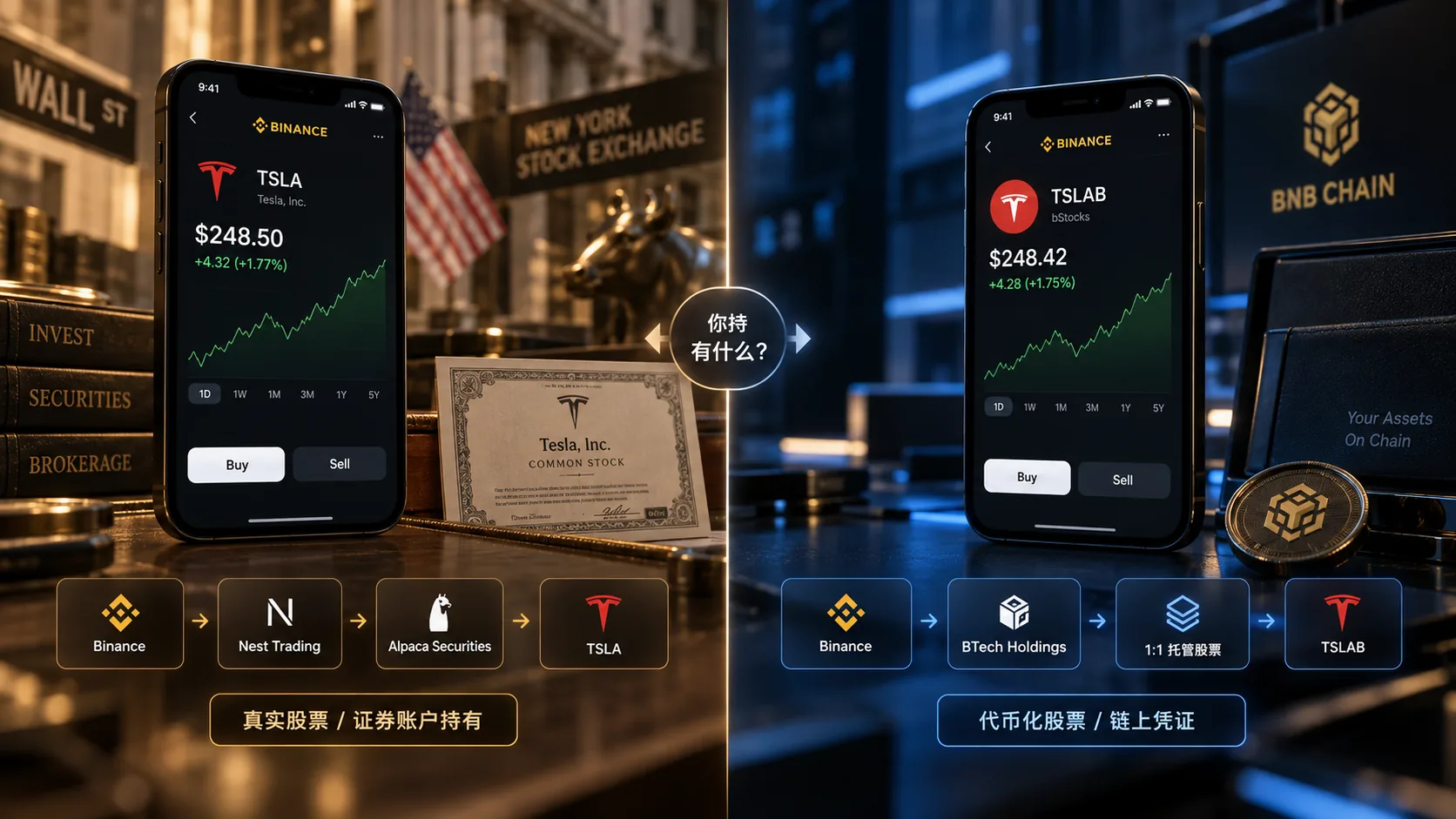
Direct Stocks holds real shares through a securities account; bStocks is an on-chain tokenized certificate backed 1:1 by real shares.
The key differences in one table
| Dimension | Direct Stocks (real shares) | bStocks (tokenized securities) |
|---|---|---|
| What you own | Beneficial ownership in a securities account | A tokenized certificate representing beneficial rights |
| Underlying | Real shares, custodied by Alpaca | 1:1 backing by real shares, issued by BTech Holdings |
| Number of instruments | 7,000+ US stocks / ETFs | Selected US stocks and ETFs, growing (Tesla, NVIDIA, Apple and others) |
| Trading hours | US sessions (about 24/5) | 24/7 on-chain spot |
| Dividends | Cash dividends, with W-8BEN to lower withholding | No cash distribution; automatic reinvestment through the Multiplier mechanism |
| Voting rights | Yes (depending on account structure) | Usually no |
| Withdraw to own wallet / DeFi | Not supported | Supported (BEP-20) |
| Settlement asset | Mainly USDC, convertible from USDT and others | Binance spot balance |
| Minimum amount | Fractional shares from about $5 | From about $5 (lower through the conversion channel) |
| Regional restriction | For eligible non-US users | Not available to US persons or inside the US |
In this table, the two most underrated rows are "dividends" and "withdraw to own wallet" — those are the real dividing line for which one you choose.
How dividends are actually handled (the most overlooked difference)
Buying US stocks for dividends is treated completely differently on each side, and many people only find out after buying.
Direct Stocks follows the traditional route: cash dividends go straight into the securities account. US-source dividends paid to non-US tax residents are generally withheld at 30%; if you're in a country covered by a US tax treaty, meet the treaty conditions and file a valid W-8BEN with the withholding agent, a lower treaty rate may apply.[5] The exact withholding rate depends on the actual tax status and tax documents of the securities account. That means dividends are credited in cash to the securities account, and the withholding and tax records follow the documents that account provides.
bStocks does not distribute cash. It has a built-in mechanism called Multiplier (multiplier / rebase): after the 30% US withholding, the dividend is reinvested automatically by adjusting the number of tokens to reflect that economic right, and stock splits are handled by the same mechanism. What you see is "the number of tokens changed", not "cash appeared in the account".
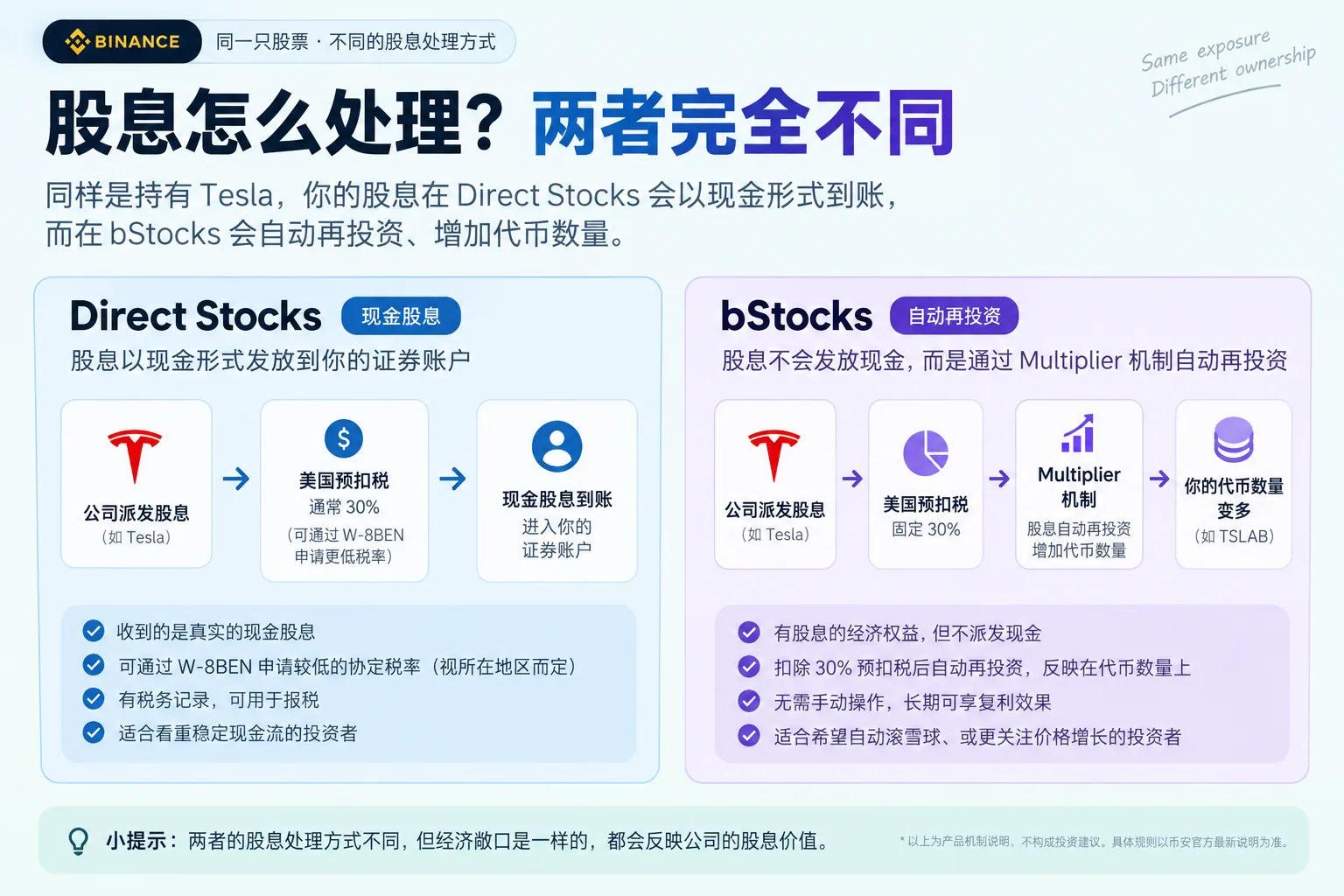
Direct Stocks dividends enter the securities account as cash; bStocks pays no cash and instead reinvests the after-tax dividend through the Multiplier mechanism, reflected in the token balance.
So don't use the old line "tokenized stocks have no dividends" to judge 2026 products. bStocks does carry the economic right to dividends, it just doesn't arrive as a cash dividend the way Direct Stocks does, and withholding is fixed at 30% — which matters a lot if you collect dividends long term.
If you particularly value "cash dividends + a lower treaty rate with W-8BEN", Direct Stocks fits better; if you don't care about the cash form and want "exposure that compounds automatically", bStocks' Multiplier also keeps the dividend invested.
Free 1:1 conversion means this isn't either/or
This is the most easily missed and most useful rule of these two products:
Eligible positions can be converted 1:1 both ways on Binance, instantly and with no fee — Direct Stocks to bStocks or the reverse, with no lock-up period.[6] When a bStock is converted back to a Direct Stock, the token is burned and the corresponding shares enter the securities position.
But scope this properly: not all 7,000+ Direct Stocks have a corresponding bStock. bStocks started with fewer instruments and has been expanding, but the number is still clearly smaller than the 7,000+ US stocks and ETFs in Direct Stocks. Whether you can convert depends on the convertible instruments your account actually shows.
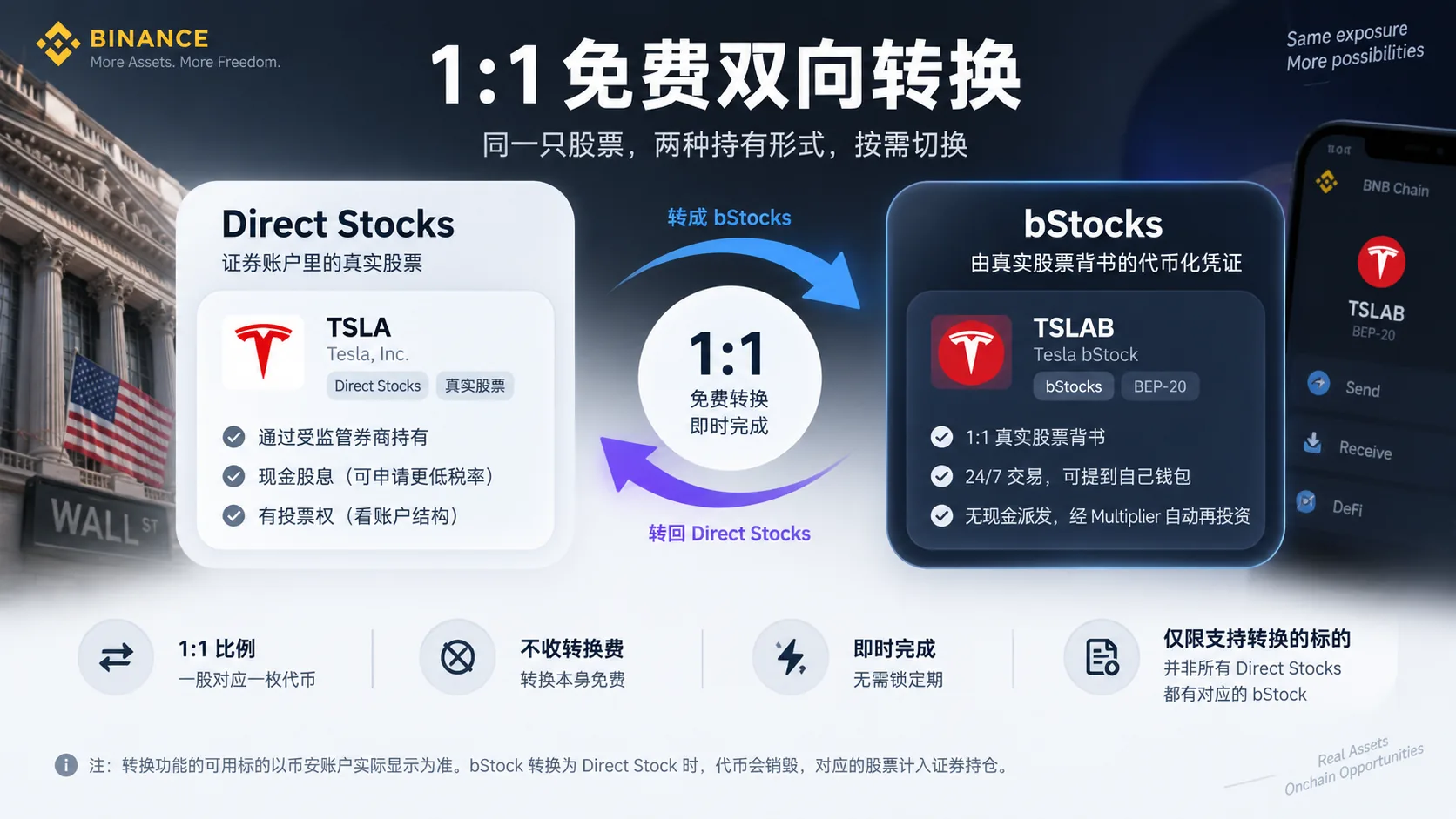
Supported instruments can be converted 1:1 both ways between Direct Stocks and bStocks, with no conversion fee; not every Direct Stock has a corresponding bStock.
So the more accurate way to use them is: normally, if you care more about the shareholder rights in a securities account, hold Direct Stocks; when you need 24/7 trading, self-custody or compatible on-chain apps, convert the supported instruments to bStocks.
So the real question isn't "Direct Stocks or bStocks", but:
For this US stock exposure, do you want the rights of "a stock" or the flexibility of "a token" right now?
The fees, side by side
Both products emphasize "low threshold, save on fees", but a low threshold doesn't mean zero trading cost.
| Item | Direct Stocks | bStocks |
|---|---|---|
| Stock commission | Standard rate: 0 commission | Spot buy/sell fees and temporary waivers follow the trading page; the 1:1 conversion between Direct Stocks and the matching bStocks charges no conversion fee |
| Platform fee / spread | Orders ≤$350 pay $0.35; orders >$350 pay a 0.1% spread[7] | As shown on the order page in real time |
| Settlement asset | Mainly USDC, convertible from USDT and others | Binance spot balance |
| Hidden costs | Asset conversion, spread and so on | On-chain withdrawal may involve a network fee |
Note that fee rules and temporary promotions change; check the order preview before trading rather than memorizing an old table.
It's also worth asking "where does the money come from on a zero-commission platform". Binance has disclosed that it may receive payment for order flow (PFOF) — an order-execution model that exists in the US market and isn't itself a violation, but it shows that "commission-free" usually has another revenue source behind it. Understanding the mechanism is enough; there's no need to pass judgment for it.
Safety and boundaries: what to watch in each product
The risks differ, so look at them separately.
Direct Stocks risk sits mainly in the "indirect account opening" layer. Your shares are custodied by Alpaca, a US SEC-registered broker, SIPC member and holder of additional excess SIPC coverage.[8] But SIPC has boundaries that must be spelled out: it doesn't cover investment losses, only the return of securities and cash if the broker fails; crypto assets themselves are outside SIPC; and when you open an account indirectly through a third-party platform, how the protection applies to you depends on the specific securities account agreement. Don't see "SIPC Member" and assume everything is covered — what SIPC does and doesn't cover is set out in the comparison with traditional brokers.
bStocks risk sits mainly in the "issuer" layer. You hold a certificate issued by BTech Holdings, not shares in the listed company itself. It is backed 1:1 by real shares held by a custodian and can be verified on Binance's Proof of Collateral page, but that isn't "exactly the same as holding the shares directly": if the issuer or the custodian runs into trouble, your remedy path and legal position differ from those of a direct shareholder.
Regional restrictions also matter: Direct Stocks is for eligible non-US users; bStocks is explicitly not available to US persons or inside the US and is only available in approved jurisdictions. Whether you can use them depends on the available regions your registration and KYC actually show.
Choose by your situation: a selection table
| Your situation | My recommendation |
|---|---|
| You want to build a long-term US stock position, collect cash dividends and maybe transfer later | Direct Stocks, for fuller rights through the securities account |
| You want 24/7 trading, not limited by the US close | bStocks, on-chain spot you can trade any time |
| You want to withdraw shares to your own wallet for self-custody, or use DeFi | Only bStocks can be withdrawn on-chain |
| You just want a small position with minimal hassle | Tell the entries apart first, then order; both thresholds are low |
| You want shareholder rights and occasionally on-chain flexibility | Use the free 1:1 conversion and switch form as needed |
The core judgment is one sentence: do you want "a stock" or "a token" — the rest is handled by the free conversion.
Common mistakes
1. Treating bStocks as real shares. Its price follows the real stock and the underlying has 1:1 backing, but it is a tokenized certificate, not direct shareholding. The biggest difference isn't the price, but "if the issuance or custody rules change, what rights do you have".
2. Assuming bStocks pays no dividends. bStocks in 2026 reinvests dividends automatically through the Multiplier mechanism; it just doesn't pay cash and withholding is fixed at 30%. Having an economic right ≠ receiving a cash dividend.
3. Assuming dividends are always withheld at only 10%. The default is 30%; a lower treaty rate may apply only if US treaty conditions are met and a valid W-8BEN is filed. bStocks dividend reinvestment is always processed after 30% withholding, so the two are not calculated the same way; don't mix them.
4. Assuming "zero commission" means no cost. Spreads, platform fees, asset conversion and on-chain withdrawal fees can all be costs, and fixed fees weigh especially heavily on small orders.
5. Seeing SIPC and assuming bStocks is protected too. SIPC protects the securities and cash in a broker account; crypto assets are outside its scope. bStocks is an on-chain token, so its safety logic depends on the issuer, custody and proof of reserves, not on SIPC.
6. Ignoring regional restrictions. Both products have regional limits, and bStocks explicitly excludes US persons. Whether you can use them depends on the available regions shown during registration and KYC.
FAQ
Is bStocks a real share?
No. bStocks is issued by Binance Group affiliate BTech Holdings Limited, with the underlying real shares held 1:1 by a regulated custodian, but what you receive is a certificate representing beneficial rights, not direct equity. It trades 24/7, starts from about $5, can be withdrawn to an on-chain wallet, and dividends are reinvested automatically through the Multiplier mechanism.
Can Direct Stocks and bStocks be converted into each other?
Yes. Eligible positions can be converted 1:1 both ways on Binance, instantly and with no fee, and with no lock-up period. That lets you switch between "shareholder rights" and "token flexibility" as needed.
Does bStocks pay dividends?
It carries an economic right, but it doesn't distribute cash. After the 30% US withholding, the dividend is reinvested automatically through the Multiplier mechanism and adjusts the number of tokens; stock splits are also handled by that mechanism. It is not the same as the cash dividend from Direct Stocks.
How much is dividend tax on Direct Stocks?
US-source dividends paid to non-US tax residents are generally withheld at 30%; if you're in a country covered by a US tax treaty, meet the conditions and file a valid W-8BEN, a lower treaty rate may apply. The exact withholding rate depends on the actual tax status and tax documents of the securities account.
Can bStocks be withdrawn to my own wallet?
Yes. bStocks is a BEP-20 token on BNB Chain and can be withdrawn to Trust Wallet, Binance Wallet or a compatible hardware wallet, and used in some DeFi scenarios.
Is it safe to buy US stocks with Binance?
Look at each product separately. Direct Stocks shares are custodied by Alpaca Securities (an SIPC member), but how protection applies to an indirectly opened account depends on the account agreement; bStocks safety depends on the issuer, custody and proof of reserves. Neither is "absolutely safe", and both stocks and crypto assets carry risk.
Is it available in my region?
Regional policy for each product changes quickly, and this article does not discuss any way to bypass regional restrictions. The most reliable approach is to check the available regions shown during registration and KYC, and the securities account terms.
How to choose in the end
If you don't have USDT yet, first see how to buy USDT on Binance and solve the funding step before coming back.
If you care more about real share positions in a securities account, cash dividends and shareholder rights under the traditional broker system:
Direct Stocks is closer to the traditional way of buying US stocks.
If you care more about 24/7 trading, self-custody and bringing US stock exposure on-chain:
bStocks fits that need better.
If you'll use both forms, there's no need to treat it as a permanent either/or from the start — supported instruments can be converted 1:1 both ways between Direct Stocks and bStocks, with no conversion fee. Just note that not all 7,000+ Direct Stocks already have a matching bStock; ultimately, rely on the convertible instruments your Binance account actually shows.
What's really worth settling first isn't which app button is more convenient, but three things:
What legal asset you ultimately hold, how dividends and corporate actions are handled, and at which layer your rights sit if something goes wrong.
Once you understand those three, the difference between Direct Stocks and bStocks becomes clear.
Related reading
If you're interested in RWA — "turning real assets into tokens" — here's another line:
How to buy gold tokens: PAXG vs XAUT, differences, fees and which to choose (2026)
Before buying US stocks, think through the fees:
Binance vs OKX fees: which is cheaper? A 2026 comparison of spot, futures and real trading costs
If you haven't registered on Binance yet:
Binance registration tutorial: the complete 2026 account-opening and KYC steps
Data verification note
The key facts in this article were checked on 2026-10-16, one by one:
- Direct Stocks launch and instruments: launched on 2026-06-01, connected to the real brokerage system, covering 7,000+ US stocks and ETFs. Source: Binance official announcement (Direct Stocks launch).
- bStocks launch and trading method: launched on 2026-06-11, 24/7 on-chain spot trading, withdrawable to self-custody wallets. Source: Binance official blog (bStocks launch).
- Direct Stocks holding structure: uses an "introducing broker Nest Trading + clearing broker Alpaca Securities" structure; the user holds beneficial ownership in a securities account, including cash dividends and voting rights. Source: Binance Academy "What Is Binance Stocks Trading".
- bStocks issuer and legal nature: issued by Binance Group affiliate BTech Holdings Limited; a tokenized security (Certificates), each unit backed 1:1 by real shares held by a regulated custodian, but not direct ownership of the listed company's shares. Source: Binance Academy bStocks guide.
- Dividend withholding tax: US-source dividends paid to non-US tax residents are generally withheld at 30%; a lower treaty rate may apply only if US treaty conditions are met and a valid W-8BEN is filed, subject to the tax status of the securities account. Source: US IRS guidance on withholding on US-source income paid to nonresidents.
- Free 1:1 conversion both ways: eligible positions can be converted 1:1 between Direct Stocks and the matching bStocks, with no fee, instantly and without a lock-up; on conversion back, the bStock is burned and the shares enter the securities position. Source: Binance official blog (Direct Stocks and bStocks 1:1 conversion).
- Direct Stocks fee rules: standard rate is 0 commission; orders of $350 or less pay a $0.35 platform fee; orders above $350 pay a spread of about 0.1% of the order value. Source: Binance official explanation (Direct Stocks fee rules).
- Clearing broker qualifications: Alpaca Securities is a US SEC-registered broker and SIPC member; SIPC does not cover investment losses or crypto assets. Source: Alpaca official site.
Disclaimer
This article is only an explanation of product structure and how crypto users can buy US stocks with Binance, and does not constitute investment, legal or tax advice.
Stocks, ETFs, tokenized securities and crypto assets all carry risk. The legal nature and remedy path of a tokenized security differ from direct shareholding; read the issuance terms before deciding.
The availability of different securities products depends on your location and account eligibility; comply with the laws of your jurisdiction and the platform's regional rules.
Exchange operations · USDT · Wallet security
Responsible for researching and organizing content on Binance, OKX, USDT transfers, withdrawals and wallet security. The steps and key data in this article are verified according to the content type, using real operation records, official platform documentation and public sources. Interfaces, fees and regional rules may change, so the article is reviewed and updated continuously.
Status: manual review · Last verified 2026-10-16
Reviewed by: Veldux editorial team
- Binance official announcement (Direct Stocks launch)Direct Stocks launched on 2026-06-01, covers 7,000+ US stocks and ETFs and settles in USDC
- Binance official blog (bStocks launch)bStocks launched on 2026-06-11 with 24/7 on-chain trading and withdrawal to self-custody wallets
- Binance Academy "What Is Binance Stocks Trading"Direct Stocks uses an "introducing broker Nest Trading + clearing broker Alpaca Securities" structure, and the user holds beneficial ownership in a securities account
- Binance Academy bStocks guidebStocks is issued by BTech Holdings Limited and is a tokenized security (Certificates), not direct ownership of the listed company's shares
- US IRS guidance on withholding on US-source income paid to nonresidentsUS-source dividends paid to non-US tax residents are generally withheld at 30%; a lower treaty rate may apply with an applicable treaty and a valid W-8BEN
- Binance official blog (1:1 conversion between Direct Stocks and bStocks)Eligible positions can be converted both ways 1:1 with no fee and no lock-up period
- Binance official explanation (Direct Stocks fee rules)Standard rate is 0 commission; orders ≤$350 pay a $0.35 platform fee, and orders >$350 pay a spread of 0.1% of the order value
- Alpaca official siteClearing broker Alpaca Securities is a US SEC-registered broker and an SIPC member
- 2026-10-16UpdateAdded the evidence-chain superscripts and the "Data verification note", and updated the fact-check date.
Editorial principles ineditorial policy,corrections policy。