
Buying US stocks with USDT: crypto exchange or traditional broker? (2026)
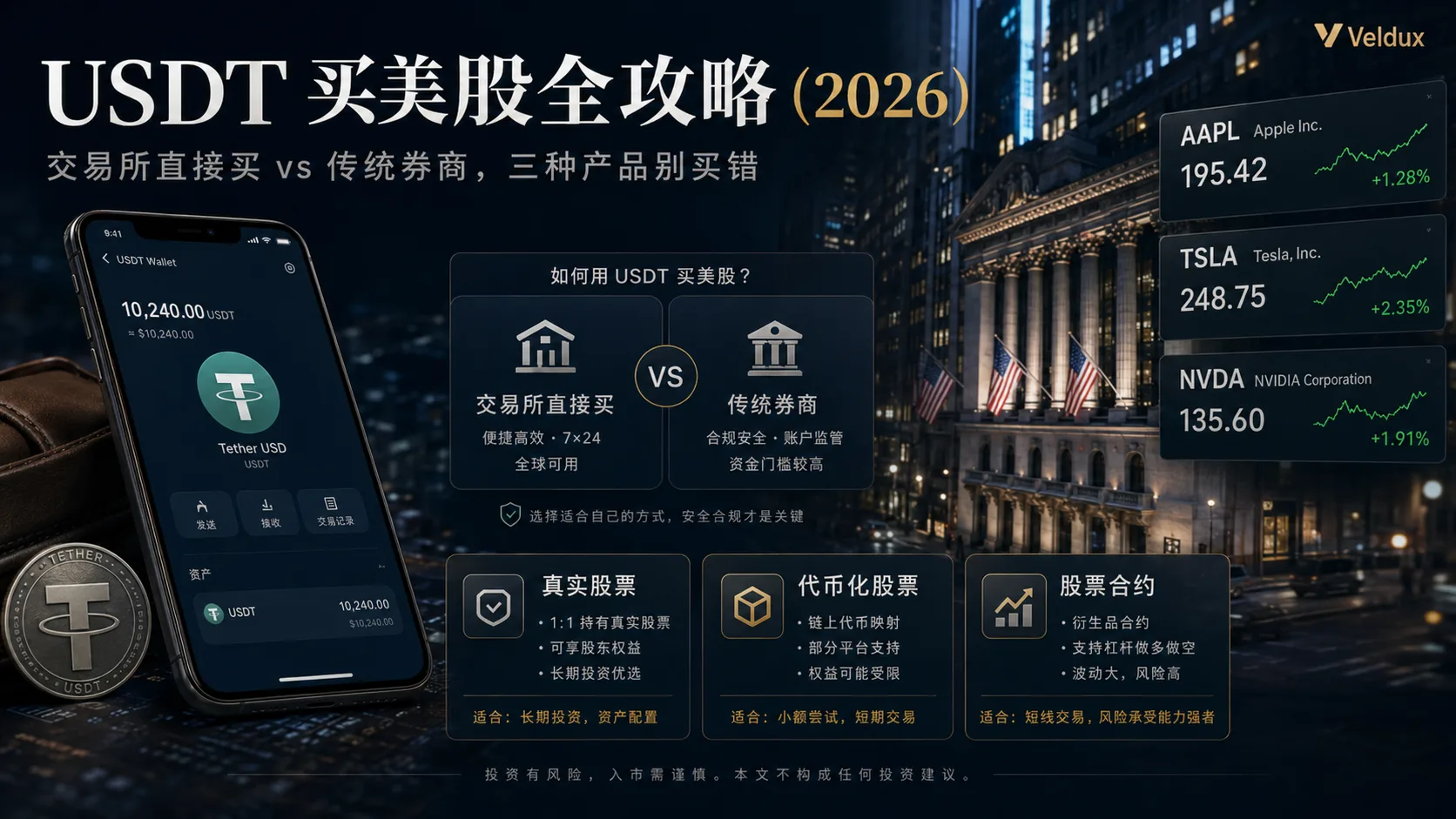
Table of contents

Binance new-user benefit
20% fee rebate
Official Binance sign-up · You must complete identity verification (KYC) to trade and withdraw
You already hold USDT, so converting it back to fiat, moving it to a bank and waiting for a broker to credit the funds is genuinely a hassle.
By 2026, some crypto platforms already offer direct access to US stock trading. Some accept USDT, others convert it to USDC automatically when you place the order, and the experience increasingly resembles buying crypto.
But there's a question more important than the fee:
Is what you clicked into actually a stock?
On the same platform today, searching TSLA, AAPL or NVDA may show real shares, tokenized stocks and stock perpetual futures at the same time.
Their names look alike, but their legal nature and risk are completely different.
That's the real problem this article solves.
The full breakdown takes about ten minutes. The two traps to keep in mind throughout: searching a ticker doesn't tell you which product you're buying, and "0 commission" doesn't mean zero cost.
This article only discusses product structure and how to operate it, and is not investment advice. Stocks, crypto assets and leveraged derivatives all carry risk, and the products actually available vary by location and account eligibility.
First, the conclusion: check only three things before ordering
If you don't want to read the whole article, at least remember these three points.
| What to check | Why |
|---|---|
| Product type | Direct Stocks, Stock+ and RealStocks are not the same as Tokenized or Perpetual |
| What rights you actually hold | Dividends, corporate actions, voting rights and transferability determine what you really bought |
| Region and account eligibility | The same stock service may only be open to some countries and regions |
Above all, don't look only at the ticker.
The page saying Tesla doesn't mean:
TSLA
TSLAB
TSLAUSDT
are the same thing.
Why is it easier to buy the wrong thing in 2026?
Binance's history makes this clearest.
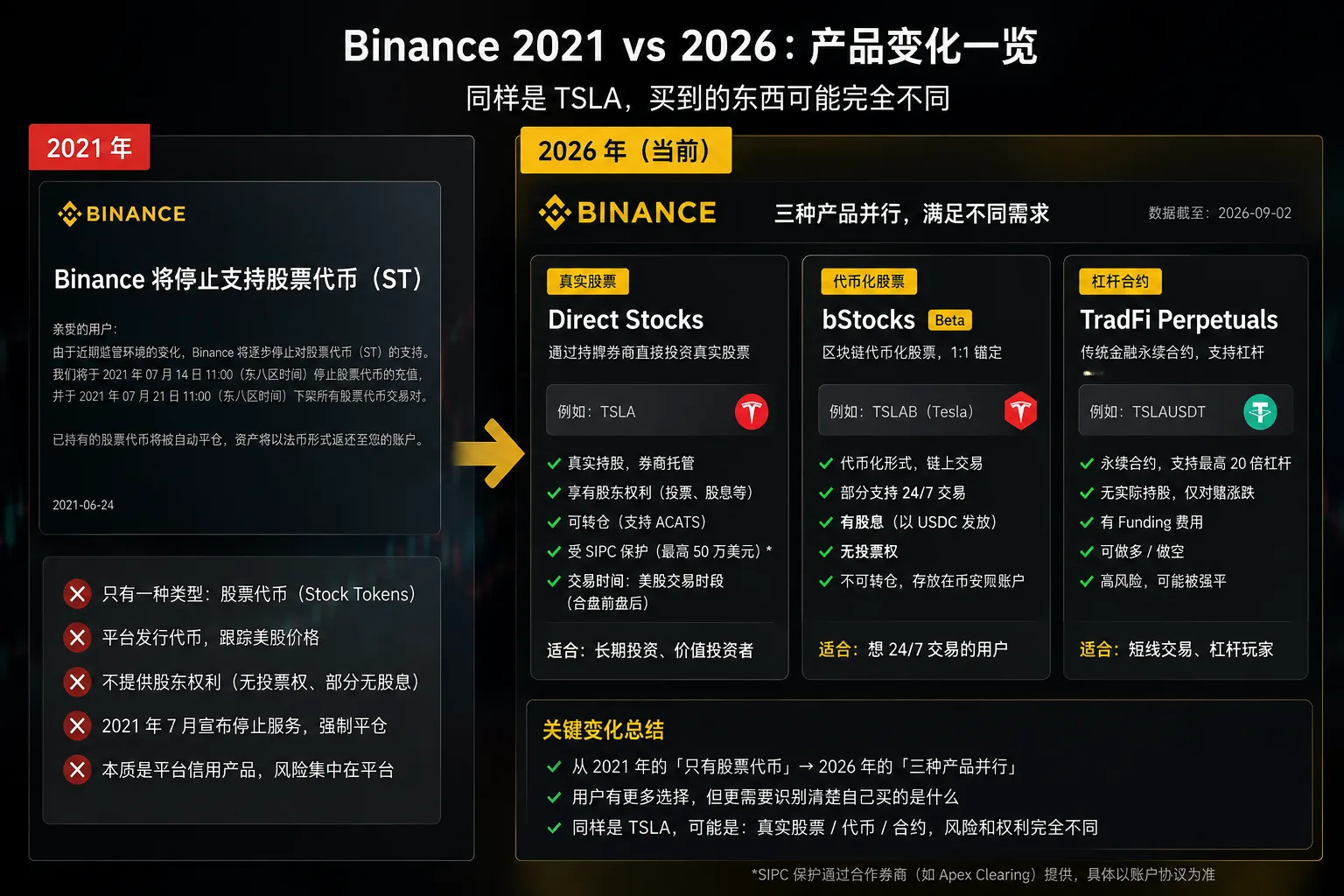
In 2021, Binance offered stock tokens. Later, as the regulatory environment changed, it stopped supporting the Stock Tokens of that period and existing users had to deal with their positions within a set deadline.
That history doesn't mean "stock tokens must never be touched". What it really shows is:
A stock's name and ownership of the stock are not the same thing.
In 2026, Binance re-entered the US stock market, but this time the products split into completely different lines.
Today you can see:
- Direct Stocks: the real stock trading entry
- bStocks: tokenized securities backed by shares
- TradFi Perpetuals: perpetual contracts that track stock prices
That is, searching Tesla may put you in front of three different products.
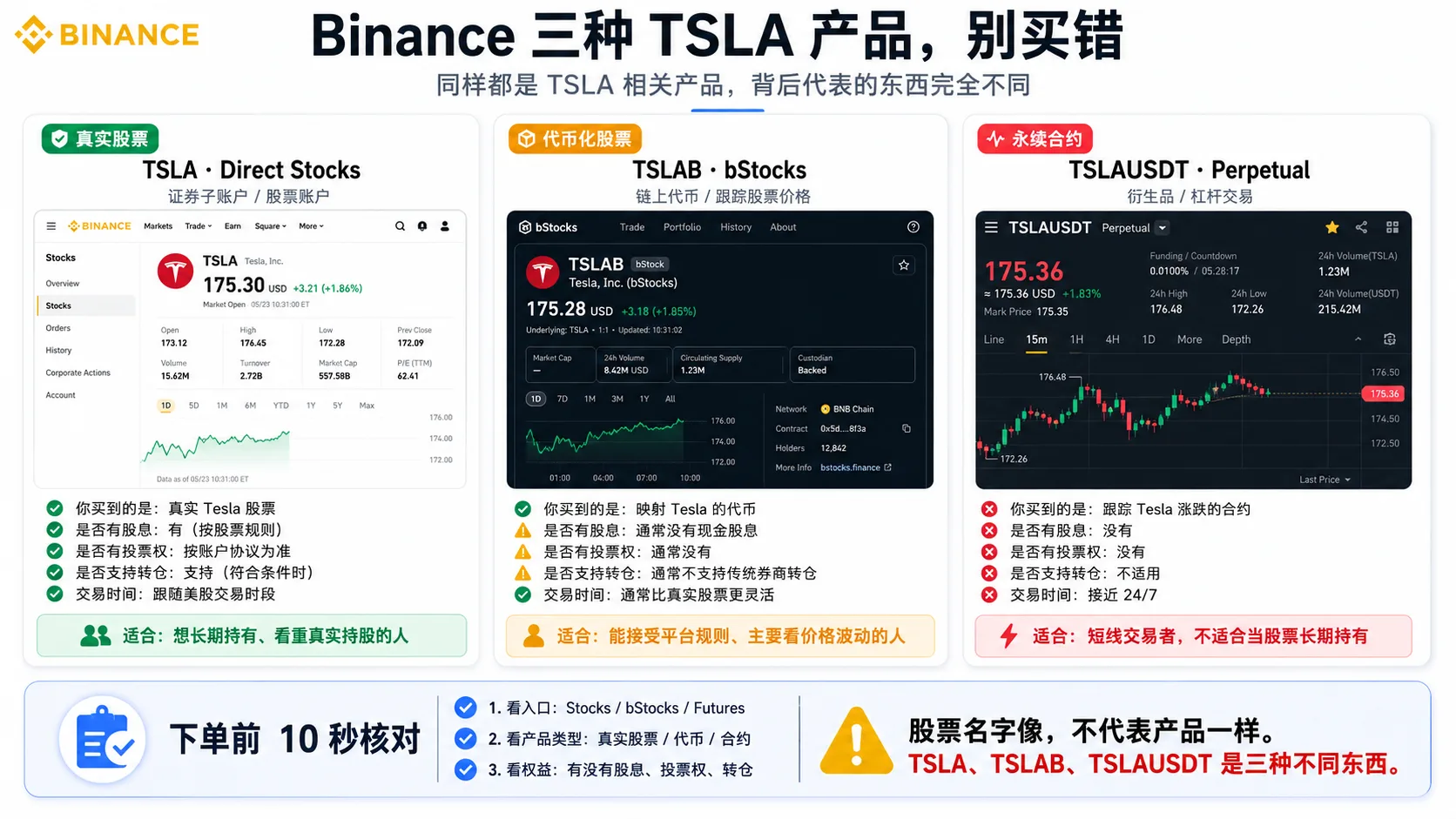
If you're going to buy US stocks through Binance, it's best to read its official stock trading explanation first and confirm whether you're in a stock account, a tokenized stock page or a Futures page.
This is also the most important principle in the whole article:
Confirm the product first, then talk about whether to buy.
First type: real shares
Real shares are the closest thing to a traditional broker.
The platform usually completes the purchase and custody through a licensed securities company, execution broker or custodian.
For example, Binance's current stock trading business is provided by Nest Trading Limited (an ADGM-licensed introducing broker), and orders are passed to clearing broker Alpaca Securities for execution, clearing, settlement and custody; Binance itself does not process or custody user securities.[1]
What you buy is not a token that merely tracks the stock price, but share rights inside a securities account system.
Depending on the specific account agreement, that may include:
- Cash dividends
- Stock splits
- Corporate actions
- Some shareholder rights
- Securities transfers
One boundary needs noting here.
"The underlying is real shares" does not mean the securities account inside the trading platform is exactly the same as opening an account directly with IBKR, a local broker or another brokerage.
You still need to check:
- Who custodies the shares
- How the account is opened
- Who clears the trades
- How client assets are segregated
- Whether you can transfer positions
- Whether fractional shares can be transferred out
For long-term, large positions, these questions matter far more than "0 commission".
Second type: tokenized stocks
Tokenized stocks are often simplified as "fake stocks", but it's not that simple.
Some products really are backed by real shares, but what you receive is still a securities token, not a share position registered directly in a traditional securities account.
Take Binance's bStocks: it is issued by ADGM-registered special-purpose entity BTech Holdings Limited, with the corresponding US shares held 1:1 by a regulated custodian, but what you receive is a "certificate" representing beneficial rights, not the listed company's shares themselves.[2]
The biggest feature of this product is that it trades more like crypto:
- Extended trading hours, some supporting 24/7
- Fractional purchases
- Some products can be withdrawn to an on-chain wallet
- Can be combined with some on-chain use cases
The cost is a more complex legal relationship.
In particular, don't summarize every product with the line "tokenized stocks have no dividends".
In 2026 some stock tokens already reflect the economic right to dividends through reinvestment, token-supply adjustments or other methods — for example, the Multiplier mechanism built into bStocks automatically reinvests dividends after 30% US withholding and handles stock splits, but it isn't the cash a traditional broker deposits straight into your account.[3]
So the real question is:
How exactly are dividends and corporate actions handled in this product?
Not simply:
Does it pay dividends or not?
If you plan to hold long term, read the issuance terms rather than only the platform's homepage marketing.
Third type: stock perpetual futures
This is the type most easily confused with shares, but it is the furthest from shareholding.
For example, if you see on the Futures page:
TSLAUSDT
it usually represents a perpetual contract tracking the Tesla share price, not Tesla stock.
You don't have:
- Ownership of Tesla shares
- Stock dividends
- The right to transfer shares
- Shareholder voting rights
You hold a derivative position.
This type of product usually also involves:
- Leverage
- Funding rates
- Forced liquidation
- Long and short
- Weekend price deviations
So if your idea is:
"I want to buy a little Nvidia and hold it for two or three years."
don't go placing that order in a stock perpetual.
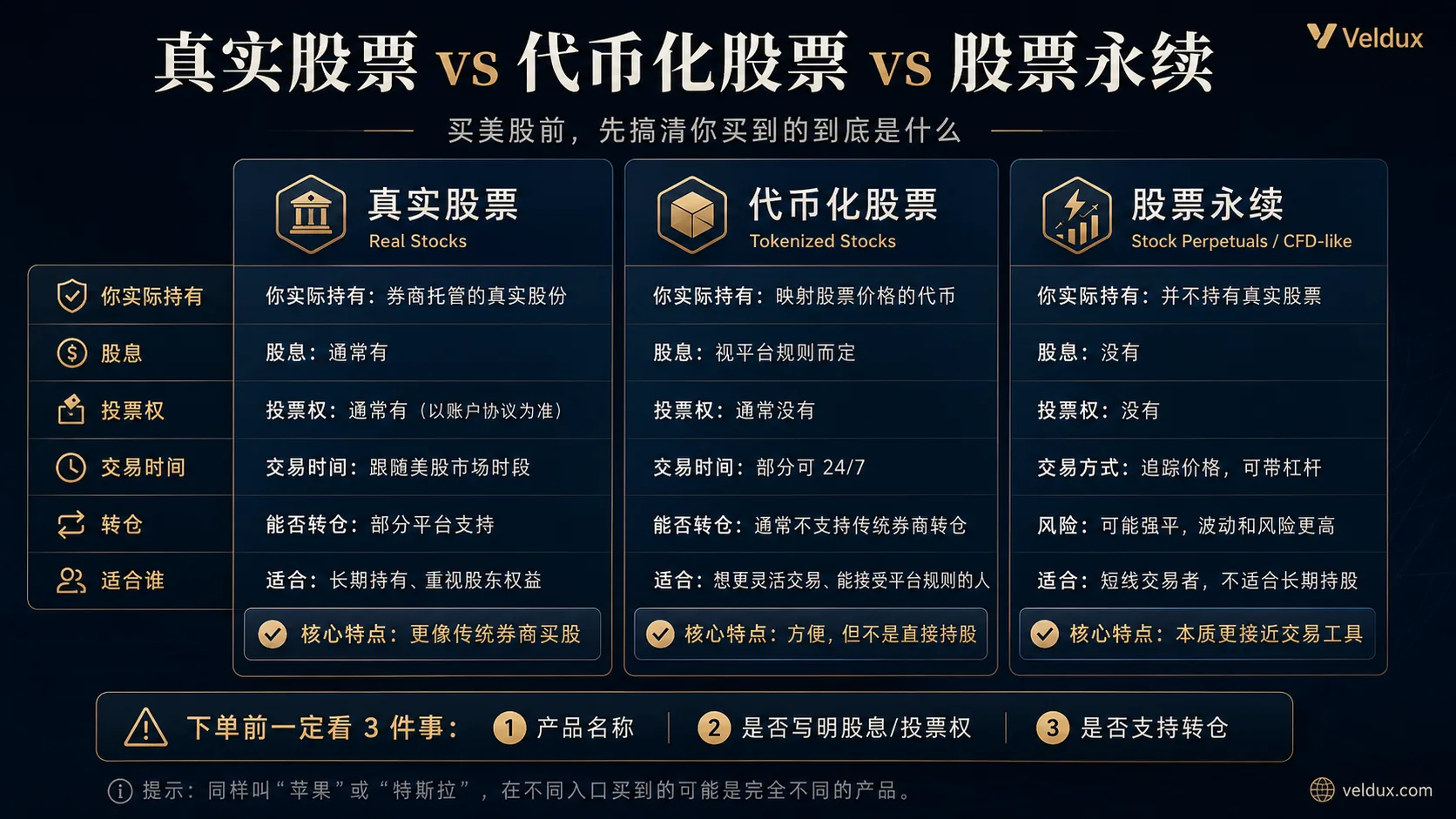
The three products side by side
| Item | Real shares | Tokenized stocks | Stock perpetuals |
|---|---|---|---|
| Underlying | Real shares in a securities account | Securities token linked to shares | A derivative of the share price |
| Direct share rights | Yes | Usually no direct share ownership | No |
| Dividends | Usually yes | Depends on the issuance rules | Usually no |
| Voting rights | Depends on the securities account structure | Usually no direct voting rights | No |
| Corporate actions | Handled under securities rules | Handled under the issuance terms | Handled under contract rules |
| Transfers | Some platforms support | Not a traditional securities transfer | Not applicable |
| On-chain withdrawal | Not supported | Some support | Not supported |
| Leverage | Usually none | Usually none | Yes |
| Forced liquidation | Ordinary cash shares have no leverage liquidation | Usually no leverage liquidation | Yes |
| Better suited to | Long-term US stock allocation | Those who want on-chain liquidity | Short-term and derivatives trading |
How do you tell whether the "stock" on a platform is real?
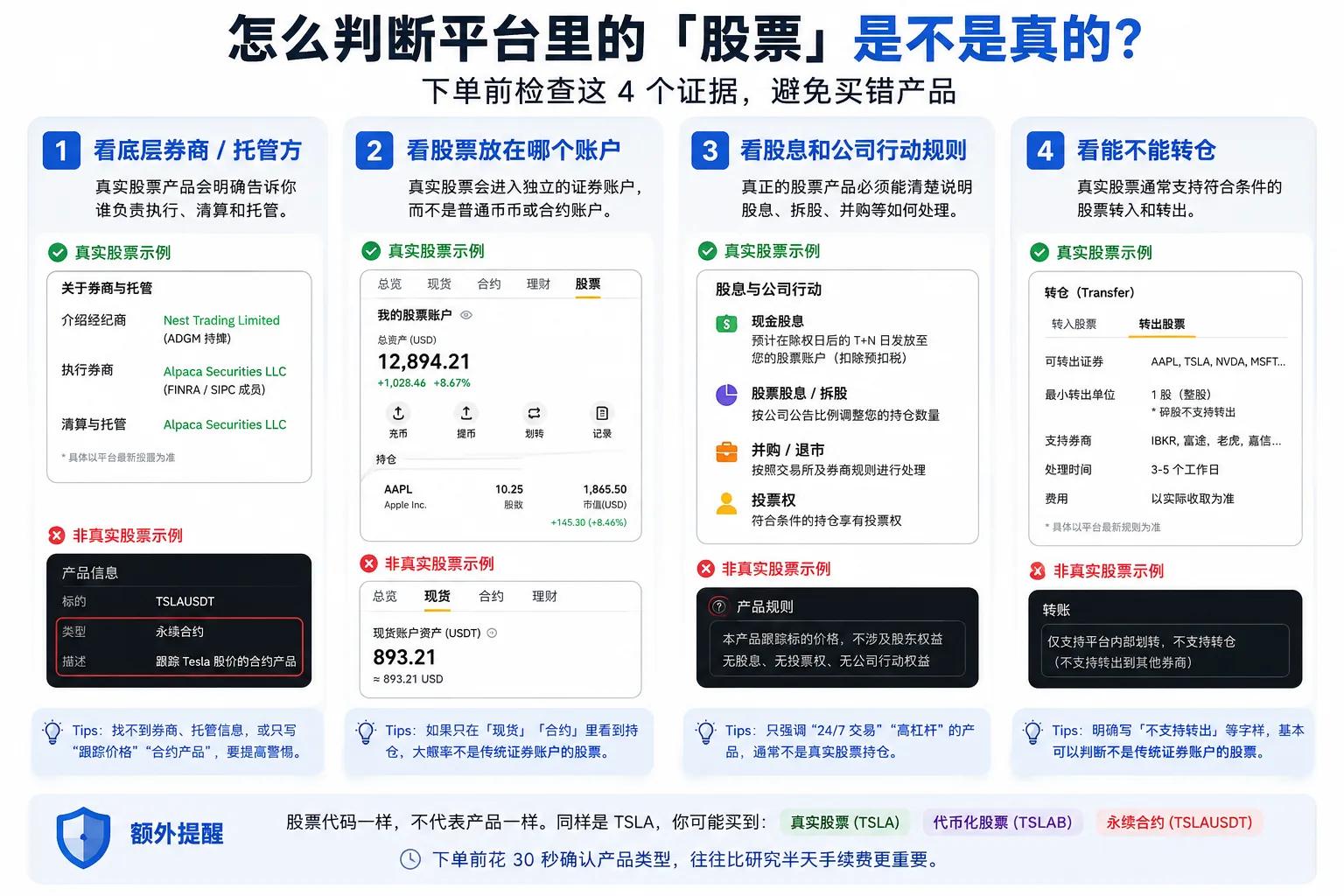
I don't go by the product name alone.
Before actually ordering, check these four pieces of evidence.
First, who is the underlying broker
A real stock product usually discloses:
- Execution broker
- Custodian
- Clearing Broker
- Brokerage Account
- Securities Account
A genuine stock product usually tells you clearly who executes, clears and custodies. For example, Binance currently provides the securities entry through Nest Trading Limited, with Alpaca Securities handling execution, clearing and custody; Bitget Stock+ connects to licensed institutions such as RQD Clearing and Atomic Vaults Securities.
Alpaca Securities itself is a US-registered broker and SIPC member; you can verify the details on the Alpaca official site.[4]
But don't stop judging just because you see "SIPC Member".
When you open an account indirectly through a trading platform, how the protection applies to you still depends on the specific securities account agreement.
Second, which account the shares sit in
Real shares usually don't sit directly in an ordinary Spot Wallet.
Common names include:
- Securities Account
- Stock Account
- Stock+ Account
- RealStocks Account
If the product appears under:
- Futures
- Perpetual
- Derivatives
then you should check again.
Third, the dividend and corporate-action rules
A real stock product must be able to answer a few basic questions:
- What happens after the company pays a dividend
- What happens with a stock split
- What happens if the company is acquired
- What happens if the stock is delisted
- How voting rights are handled
If the page only emphasizes:
"24/7"
"High leverage"
"Long and short"
and says nothing about these, it's most likely not a traditional share position.
Fourth, can the position be transferred
This one is very useful in 2026.
Many people used to think:
"US stocks bought on an exchange definitely can't be transferred out."
That's no longer accurate.
Binance Direct Stocks, Gate and other stock services already have securities transfer mechanisms for eligible positions.
But supporting transfers doesn't mean any stock can be moved freely.
Look especially at:
- Fractional-share limits
- Supported broker range
- Supported securities range
- Transfer-in and transfer-out direction
- Processing time
- Third-party fees
If you plan to hold for years, it's worth reading the transfer rules once before buying.
Several real-stock entries worth knowing in 2026
This isn't a "who's best" ranking; it only looks at each platform's current product structure.
Binance Direct Stocks
Binance's 2026 stock business is not a simple revival of the 2021 Stock Tokens.
Binance Direct Stocks is a real stock trading service and currently gives access to 7,000+ stocks and ETFs. Stock orders settle mainly in USDC, and if the account holds supported assets such as USDT, they can be converted automatically during the order. The service is currently open only to eligible non-US users.[5]
The biggest advantage:
if you already hold crypto assets on Binance, you don't need to withdraw USDT to a bank and fund a broker again.
Before using it, though, check the regions Binance currently shows, the brokerage partner, the fees and the transfer rules.
Gate
Gate's path is fairly direct for USDT users.
Its stock service covers 10,000+ US stocks and ETFs and provides real stock trading through securities infrastructure such as Alpaca, with shares held independently through the DTC system and fractional trading from as little as 0.01 shares.
For users who already hold USDT, the biggest advantage is not having to convert assets into bank fiat first.
Gate also offers stock transfer in and out for eligible positions, and since 31 July 2026 has charged zero commission on eligible instruments (the base rate was 0.1% before).[6]
If you plan to use it long term, beyond the trading fee it's worth checking its securities account agreement and transfer conditions.
You can see the current stock service rules on the Gate official site.
Bitget Stock+
Bitget is a perfect example of why you have to distinguish products — the same ecosystem contains Stock+ (real shares), rToken (tokenized stocks) and stock perpetuals (leveraged contracts), and all three names can be attached to Tesla, Apple or Nvidia; before buying, make sure you're in Stock+.
Stock+ covers 10,000+ US stocks and ETFs, has a standard trading fee starting at 0.1%, and supports pre-market, regular, post-market and overnight sessions, close to 24/5. It also states that it offers shareholder rights such as cash dividends, stock dividends and voting rights.[7]
Product details follow the current Bitget official site explanation.
MEXC RealStocks
MEXC's RealStocks is also a real stock service.
It uses FINRA-licensed Atomic Vaults Securities (AVS) as the underlying broker, covers 7,000+ US stocks and ETFs, lets you enter the stock trading system directly with USDT, and the platform charges no commission (though third-party fees from the SEC, FINRA, clearing and exchanges still apply).[8]
Dividend treatment needs particular attention on the tax side.
For US securities dividends, the actual withholding currently follows MEXC's latest account rules and your tax status; don't simplify it to "the platform doesn't withhold, you declare it yourself later".
If you compare platforms, tax treatment should be considered alongside commission and trading hours.
The specific rules are in the RealStocks explanation on the MEXC official site.
Quick comparison
| Platform | Product | Main settlement asset | Real shares | Transfers | Most notable feature |
|---|---|---|---|---|---|
| Binance | Direct Stocks | USDC (convertible from USDT and others) | Yes | Supported for eligible positions | 7,000+ stocks and ETFs, non-US users |
| Gate | Stocks | USDT | Yes | Some support transfer in/out | 10,000+, from 0.01 shares, zero commission since July |
| Bitget | Stock+ | USDC | Yes | Some support | 10,000+, from 0.0001 shares, 24/5 |
| MEXC | RealStocks | USDT | Yes | Depends on current rules | 7,000+, 0 platform commission |
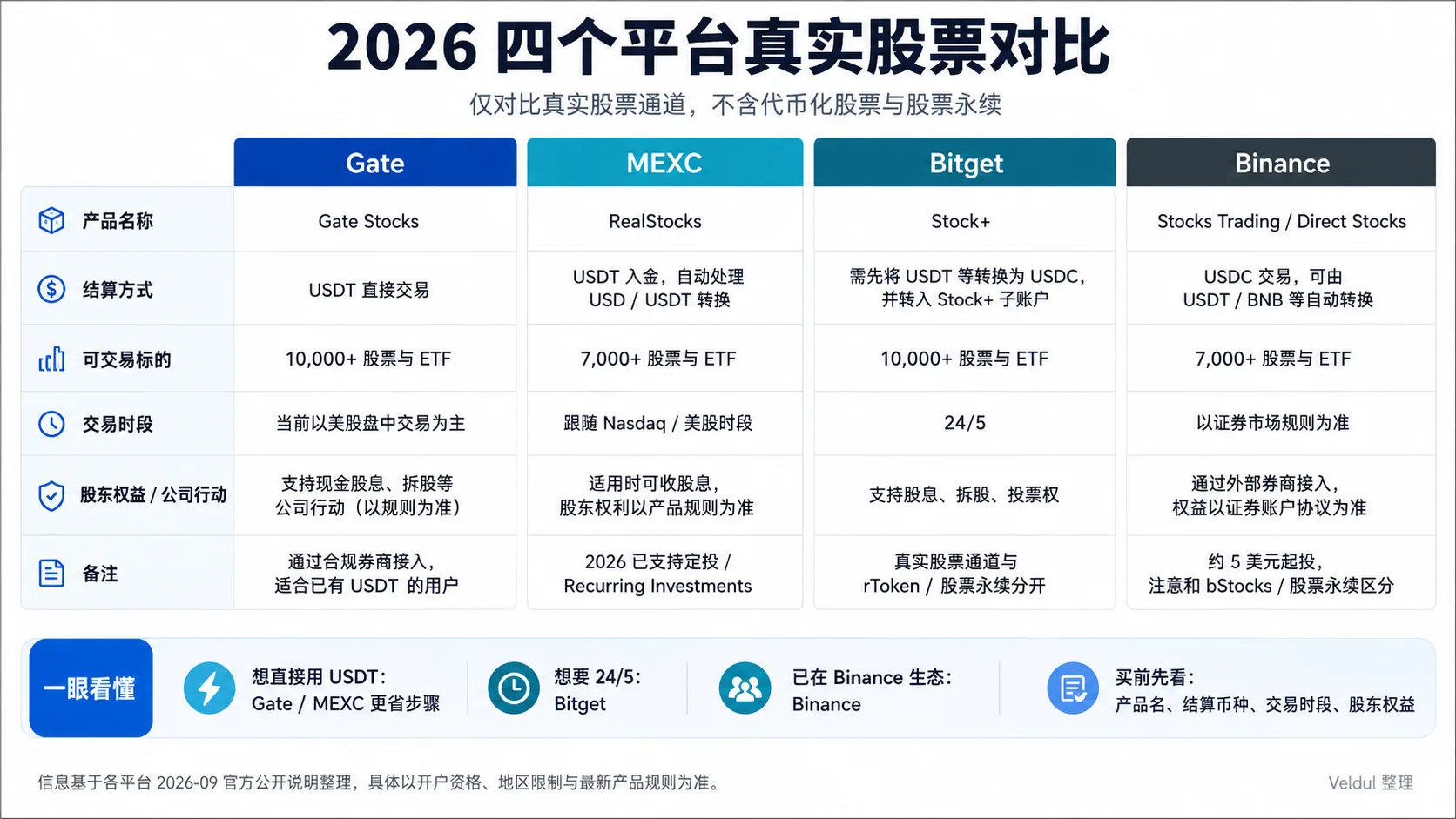
Features here change very fast.
So what's really worth remembering isn't "how many stocks a platform will always have", but what legal structure its current product actually has.
With USDT, how do you actually buy real shares?
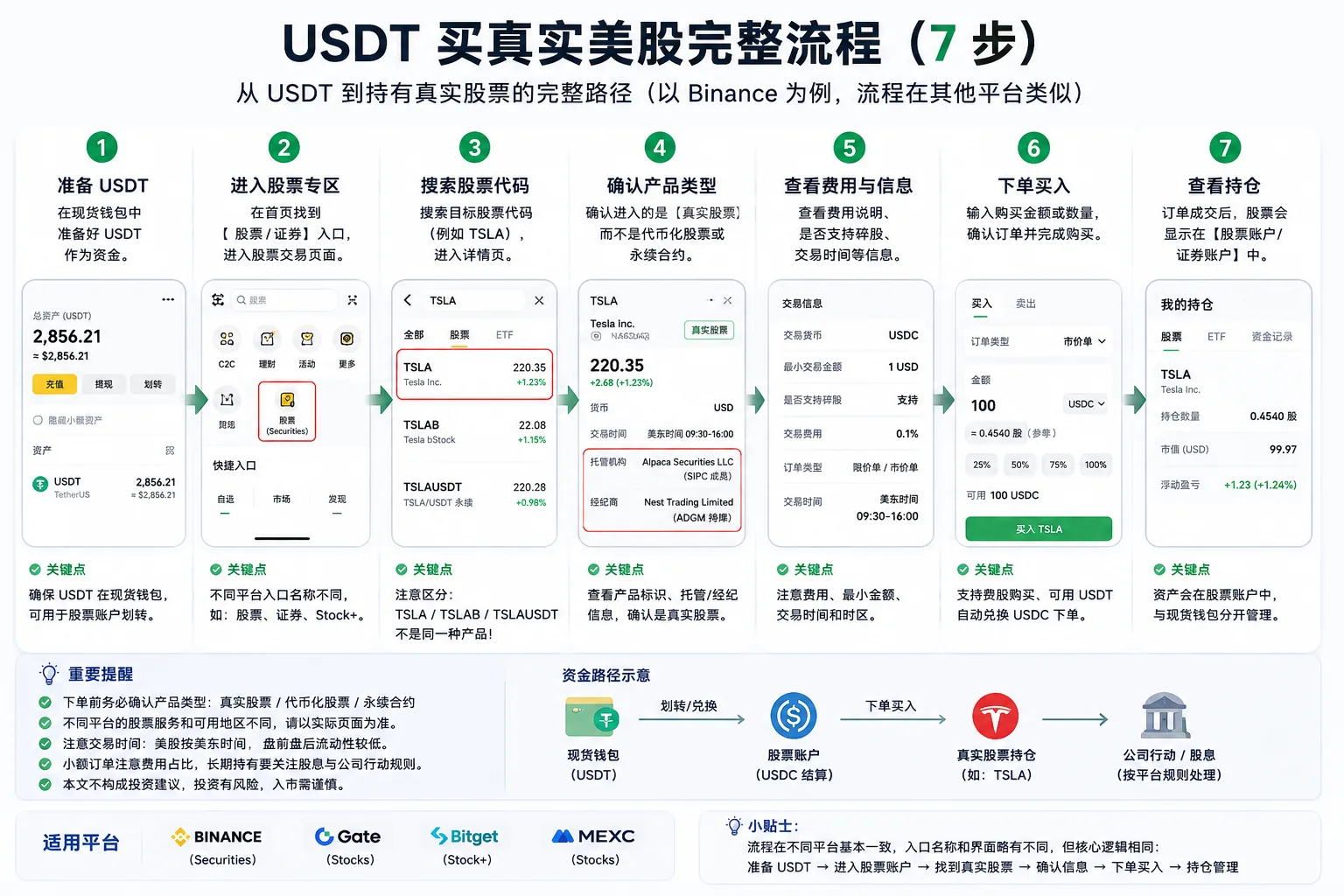
Interfaces differ between platforms, but the overall flow is very similar.
Step 1: find the stock section
Go to:
Stocks
Stock+
RealStocks
Direct Stocks
or a similar securities product entry.
Don't start from the Futures page.
Step 2: search the stock
For example, search:
TSLA
At this point, don't rush to tap buy.
Confirm whether the page labels it:
Direct Stock
Stock+
RealStocks
or:
Tokenized
bStock
rToken
Perpetual
Step 3: look at the securities account information
At least confirm:
- Who provides the securities service
- Who custodies the shares
- How dividends are handled
- Whether transfers are supported
If you can't find an answer to any of these four questions, don't order just because the button says "Buy Stock".
Step 4: confirm the settlement asset
Each platform differs.
The USDT path at Gate and MEXC is fairly direct.
Bitget Stock+ mainly uses USDC.
Binance Direct Stocks securities orders are also mainly in USDC, but support conversion from some account assets.
So "buying US stocks with USDT" doesn't necessarily mean the stock order is ultimately booked in USDT.
Step 5: check the fees
"0 commission" doesn't mean the cost is necessarily 0.
There may also be:
- Bid-ask spread
- Regulatory fees
- ADR custody fees
- Asset-conversion costs
- Transfer fees
- Corporate-action-related fees
Especially on very small orders, the weight of fixed fees can matter more than the commission itself.
It's also worth asking "where does the money come from on a zero-commission platform". According to public reports, Binance holds a minority stake in Alpaca and shares in payment for order flow (PFOF) and securities-lending revenue — which isn't itself a violation, but shows that "commission-free" usually has another revenue source behind it.
Step 6: confirm where the position sits
After buying, check inside the securities sub-account.
Don't spend ages looking in the ordinary spot wallet.
If it's a real share, it usually shows in a separate stock or Securities Account.
When is a traditional broker actually the better fit?
Just because an exchange can buy real shares doesn't mean traditional brokers have lost their advantages.
In the following cases, I lean toward a traditional broker instead.
Planning to hold for many years
If you plan to hold for 5 or 10 years, the most important things are:
- Account stability
- Tax documents
- Corporate actions
- Transfers
- Shareholder services
- Historical records
Traditional brokers are still more mature on these points.
Needing to transfer often
Although Binance, Gate and other platforms already support stock transfers, limits remain on fractional shares, broker range and instruments between platforms.
The securities transfer system between traditional brokers is usually more mature.
Needing a fuller securities product range
If later you also want to do:
- US stock options
- Bonds
- Global markets
- Portfolio Margin
- Complex orders
- Professional research
traditional brokers such as IBKR still have a clear advantage.
When the position size keeps growing
The larger the amount, the more you should care about:
- The legal account relationship
- Custody arrangement
- Bankruptcy segregation
- Securities protection mechanisms
- Transferability
and not just "how convenient the funding is".
Real shares on an exchange vs a traditional broker
| Dimension | Exchange stock account | Traditional broker |
|---|---|---|
| USDT convenience | Very high | Lower |
| Speed to get started | Fast | Relatively complex |
| Fractional shares | Widely supported | Widely supported |
| Long-term holding system | Workable | More mature |
| Dividends | Supported, subject to account rules | Supported |
| Corporate actions | Supported, depending on platform and underlying broker | More mature |
| Stock transfers | Some already support | More mature |
| Tax documents | Depends on the platform | Usually fuller |
| Global markets | Relatively limited | Some brokers are very broad |
| Professional trading tools | Relatively simple | Stronger |
| Crypto asset integration | Very convenient | Weaker |
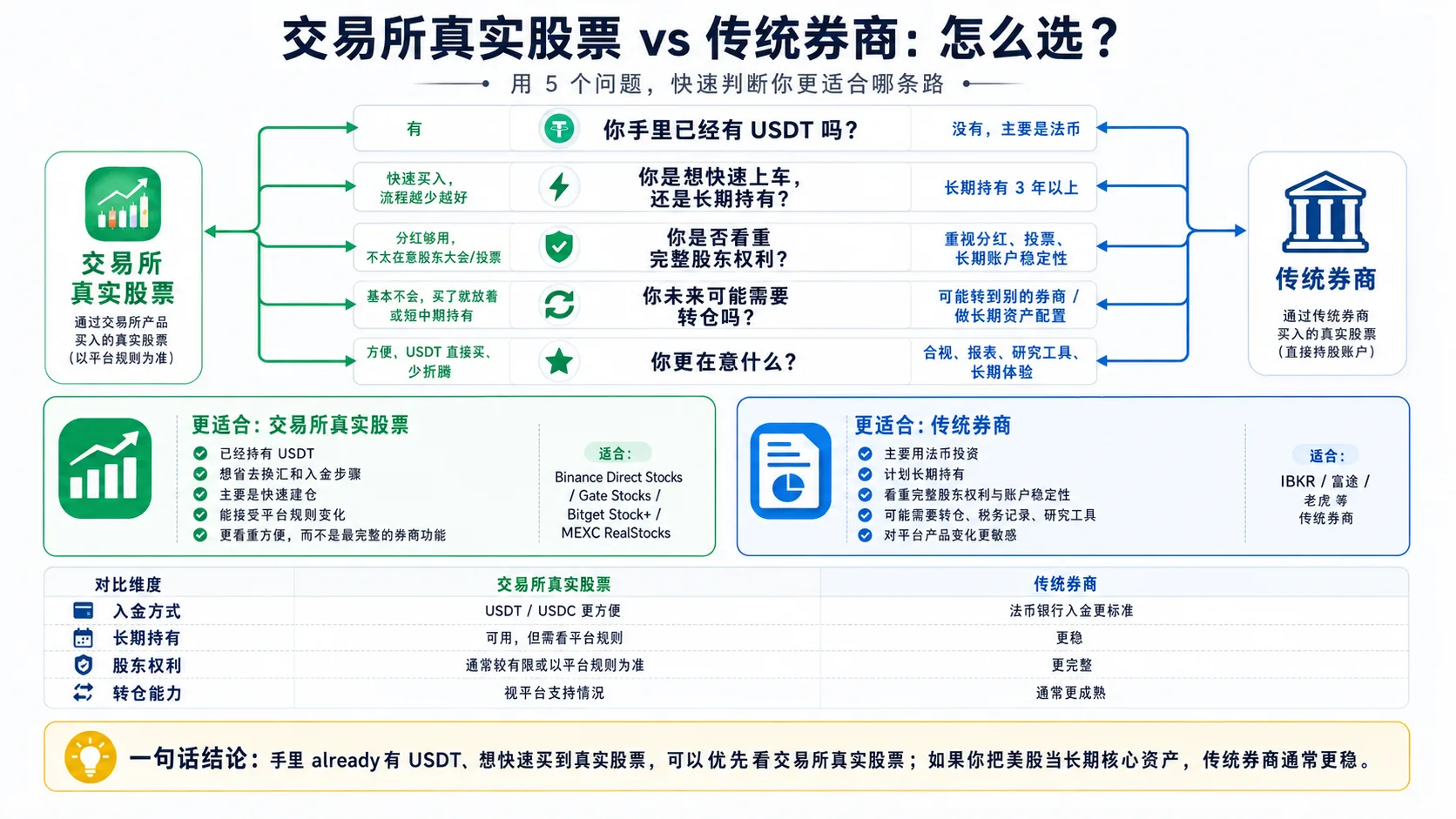
So the two paths are not substitutes.
If you already hold USDT and just want to allocate a small amount to US stocks:
the exchange's real stock entry is very convenient.
If you're going to make US stocks a long-term core asset:
a traditional broker usually works better as the main account.
If you want to go deeper on "broker or exchange" — comparing account eligibility, custody, SIPC, dividend tax and transfers dimension by dimension — see this article: Buying US stocks: crypto exchange or traditional broker? (2026).
The most common mistakes
Treating tokenized stocks as real shares
Tokenized stocks may have real-asset backing and may carry economic dividend rights.
But they are still not direct shareholding in the traditional sense.
The biggest difference is usually not the price, but:
If the issuance rules change, what rights do you have?
Treating stock perpetuals as shares
When you see names like TSLAUSDT or NVDAUSDT, first check whether it's on a Futures page.
If it is, understand it as a derivative.
It is not a position in a stock account.
Using trading hours to judge what's real
People used to say:
"Anything you can trade 24 hours a day definitely isn't a real stock."
That's no longer accurate in 2026.
Some real stock products already support pre-market, regular, post-market and even overnight sessions, close to 24/5.
So trading hours are only a reference, not evidence of the product's nature.
Assuming tokenized stocks definitely pay no dividends
Also inaccurate.
Some tokenized products reflect the economic value of dividends to holders through reinvestment or token mechanisms.
But an economic right and legal ownership of shares are still two different things.
Assuming exchange shares can definitely not be transferred
That's an old belief.
In 2026 some platforms' real shares already support securities transfers for eligible positions.
What actually matters is:
- Whole shares or fractions
- Whether they can be transferred out
- Which brokers they can go to
- Whether a fee applies
Looking only at the three letters "SIPC"
SIPC matters, but don't misunderstand it.
It isn't share-price insurance and doesn't protect investment losses.
If a stock falls from $100 to $50, SIPC won't compensate you.
And when you access a securities broker through a third-party platform, how the protection applies still depends on the account structure.
FAQ
Can USDT really buy US stocks directly?
Yes, but the path differs by platform.
Some platforms use USDT directly; others require or automatically convert it to USDC.
So the accurate statement is:
Users who already hold USDT can now access US stock trading fairly conveniently on some crypto platforms, without necessarily going through traditional bank funding first.
Are Binance's current US stocks real shares?
It depends on the product.
Binance in 2026 has several different stock-related products at once.
Direct Stocks is a real stock service.
bStocks is a tokenized security.
TradFi Perpetuals is a stock derivative.
They cannot be lumped together.
Can Binance Direct Stocks transfer positions?
Eligible shares may have a transfer path, but not every position can be transferred out without conditions.
In particular, fractional shares, the destination broker, the securities range and fees are subject to the account's current rules.
Is bStocks a real share?
No. bStocks is issued by ADGM-registered special-purpose entity BTech Holdings Limited, with the corresponding US shares held 1:1 by a regulated custodian, but what you receive is a "certificate" representing beneficial rights, not direct equity.
It trades 24/7, starts from $5, and can be converted 1:1 for free into the underlying shares; dividends are reinvested automatically through the built-in multiplier mechanism (after 30% US withholding), not paid as direct cash.
Do tokenized stocks pay dividends?
It depends on the product.
Some don't; others reflect the economic right through cash equivalents, reinvestment or token-supply adjustments.
So always read the issuance rules.
Can real shares bought on an exchange be held for years?
Yes, but before holding long term, confirm:
- The securities account structure
- How corporate actions are handled
- Dividend rules
- Transfers
- Tax documents
- The platform's regional policy
If these factors matter a lot to you, the long-term holding experience at a traditional broker is often more mature.
Is it available in my region?
Regional policy for each platform and product changes quickly.
The most reliable method is to check the available regions shown during registration and KYC, and the securities account terms.
This article does not discuss any way to bypass regional restrictions.
How to choose in the end?
If you already hold USDT and just want to buy a little US stock quickly:
find the real stock section first.
If you plan to hold long term, collect dividends and maybe transfer later:
prioritize a real stock account, and carefully compare the platform's stock service with a traditional broker.
If you want 24/7 on-chain trading:
then go and study tokenized stocks.
If you just want leverage to bet on short-term moves:
that's a stock perpetual, and it is no longer "buying US stocks as a long-term investment".
What really matters isn't whether the app says Apple, Tesla or Nvidia.
It's:
After buying, what do you legally own?
If you're going to register
| Your choice | What to do |
|---|---|
| Register through this site's link (20% rebate) | Register on Binance; the referral code AMY568 is filled in automatically |
| No referral code | Go directly to binance.com and register; same features, just without the rebate |
The first row of the table is an affiliate link: registering through it may generate revenue for us, but it does not affect the objective conclusions of this article. See Advertising and affiliate disclosure.
Related reading
If you don't have USDT yet, start here:
How to buy USDT on Binance: a complete P2P tutorial
To move USDT to another platform:
How to transfer USDT: TRC20, ERC20 or BEP20?
If you haven't decided between Binance and OKX:
Binance vs OKX: which is better for beginners? A 2026 comparison
If you're ready to register on Binance:
Binance registration tutorial: account opening and KYC, complete steps (2026)
Data verification note
The key facts in this article were checked on 2026-10-16, one by one:
- Direct Stocks securities architecture: Binance stock trading takes orders through ADGM-licensed Nest Trading Limited as introducing broker and passes them to clearing broker Alpaca Securities for execution, clearing, settlement and custody; Binance itself does not process or custody user securities. Source: Binance official announcement on the Direct Stocks product.
- bStocks issuer and backing: bStocks is issued by ADGM-registered special-purpose entity BTech Holdings Limited; the underlying US shares are held 1:1 by a regulated custodian, and the holder receives a certificate representing beneficial rights, not direct equity. Source: Binance Academy bStocks guide.
- Dividend treatment for tokenized stocks: bStocks uses the built-in Multiplier mechanism to reinvest dividends automatically after 30% US withholding and to handle stock splits, rather than paying cash directly. Source: Binance official blog on the bStocks launch.
- Alpaca's broker and SIPC status: Alpaca Securities is a US-registered securities broker and a FINRA and SIPC member. Source: Alpaca official account protection explanation.
- Direct Stocks instruments and settlement: covers 7,000+ US stocks and ETFs, offers fractional shares from about $5, uses USDC as the main settlement asset with automatic conversion from USDT/BNB, and is available only to eligible non-US users. Source: Binance Academy "What Is Binance Stocks Trading?".
- Gate stock service custody and fees: covers 10,000+ US stocks and ETFs, holds them independently through the DTC system, supports fractions from 0.01 shares, and has charged zero commission on eligible instruments since 2026-07-31 (the base rate was 0.1% before). Source: Gate official stock service explanation.
- Bitget Stock+ fees and shareholder rights: covers 10,000+ US stocks and ETFs, standard trading rate from 0.1%, supports pre-market, regular, post-market and overnight sessions (close to 24/5), and states that it offers cash dividends, stock dividends and voting rights. Source: Bitget official Stock+ explanation.
- MEXC RealStocks underlying broker and commission: FINRA-licensed Atomic Vaults Securities (AVS) provides the underlying broker service, covers 7,000+ US stocks and ETFs, allows direct entry to the stock trading system with USDT, and the platform charges no commission (third-party fees from the SEC, FINRA, clearing and exchanges still apply). Source: MEXC official RealStocks explanation.
The number of supported stocks, regions, trading hours, settlement assets, fees, transferability and tax treatment all change; before ordering, rely on the securities account and the official pages in real time.
Disclaimer
This article is only an explanation of product structure and how crypto users buy US stocks, and does not constitute investment, legal or tax advice.
Stocks, ETFs, tokenized securities and stock derivatives all carry risk. Perpetual contracts using leverage also carry forced-liquidation risk.
The availability of different securities products depends on the user's location and account eligibility; comply with the laws of your jurisdiction and the platform's regional rules.
Exchange operations · USDT · Wallet security
Responsible for researching and organizing content on Binance, OKX, USDT transfers, withdrawals and wallet security. The steps and key data in this article are verified according to the content type, using real operation records, official platform documentation and public sources. Interfaces, fees and regional rules may change, so the article is reviewed and updated continuously.
Status: manual review · Last verified 2026-10-16
Reviewed by: Veldux editorial team
- Binance official announcement (launch of the Direct Stocks product)Direct Stocks takes orders through ADGM-licensed introducing broker Nest Trading Limited and passes them to clearing broker Alpaca Securities for execution, clearing, settlement and custody; Binance itself does not process or custody user securities
- Binance Academy "What Are bStocks? A Guide to Tokenized Stocks on Binance"bStocks is issued by ADGM-registered special-purpose entity BTech Holdings Limited; the underlying is held 1:1 by a regulated custodian, and the holder receives a certificate representing beneficial rights
- Binance official blog (bStocks launch)The Multiplier mechanism automatically reinvests dividends after 30% US withholding and handles stock splits, rather than paying cash directly
- Alpaca official site (account protection)Alpaca Securities is a US-registered securities broker and a FINRA and SIPC member
- Binance Academy "What Is Binance Stocks Trading?"Direct Stocks covers 7,000+ US stocks and ETFs, offers fractional shares from about $5, uses USDC as the main settlement asset with automatic conversion from USDT/BNB, and is available only to eligible non-US users
- Gate official site (stock service)Gate's stock service covers 10,000+ US stocks and ETFs, holds them independently through the DTC system, supports fractions from 0.01 shares, and has charged zero commission on eligible instruments since 2026-07-31 (the base rate was 0.1% before)
- Bitget official site (Stock+)Bitget Stock+ covers 10,000+ US stocks and ETFs, has a standard rate starting at 0.1%, supports pre-market, regular, post-market and overnight sessions (close to 24/5), and states that it offers cash dividends, stock dividends and voting rights
- MEXC official site (RealStocks)MEXC RealStocks uses FINRA-licensed Atomic Vaults Securities (AVS) as the underlying broker, covers 7,000+ US stocks and ETFs, can be accessed with USDT, and the platform charges no commission
- 2026-10-16UpdateAdded the evidence-chain superscripts and the "Data verification note", and updated the fact-check date.
Editorial principles ineditorial policy,corrections policy。