
What is ONDO? Is it worth buying? It is not Ondo Treasury exposure or USDY (2026)
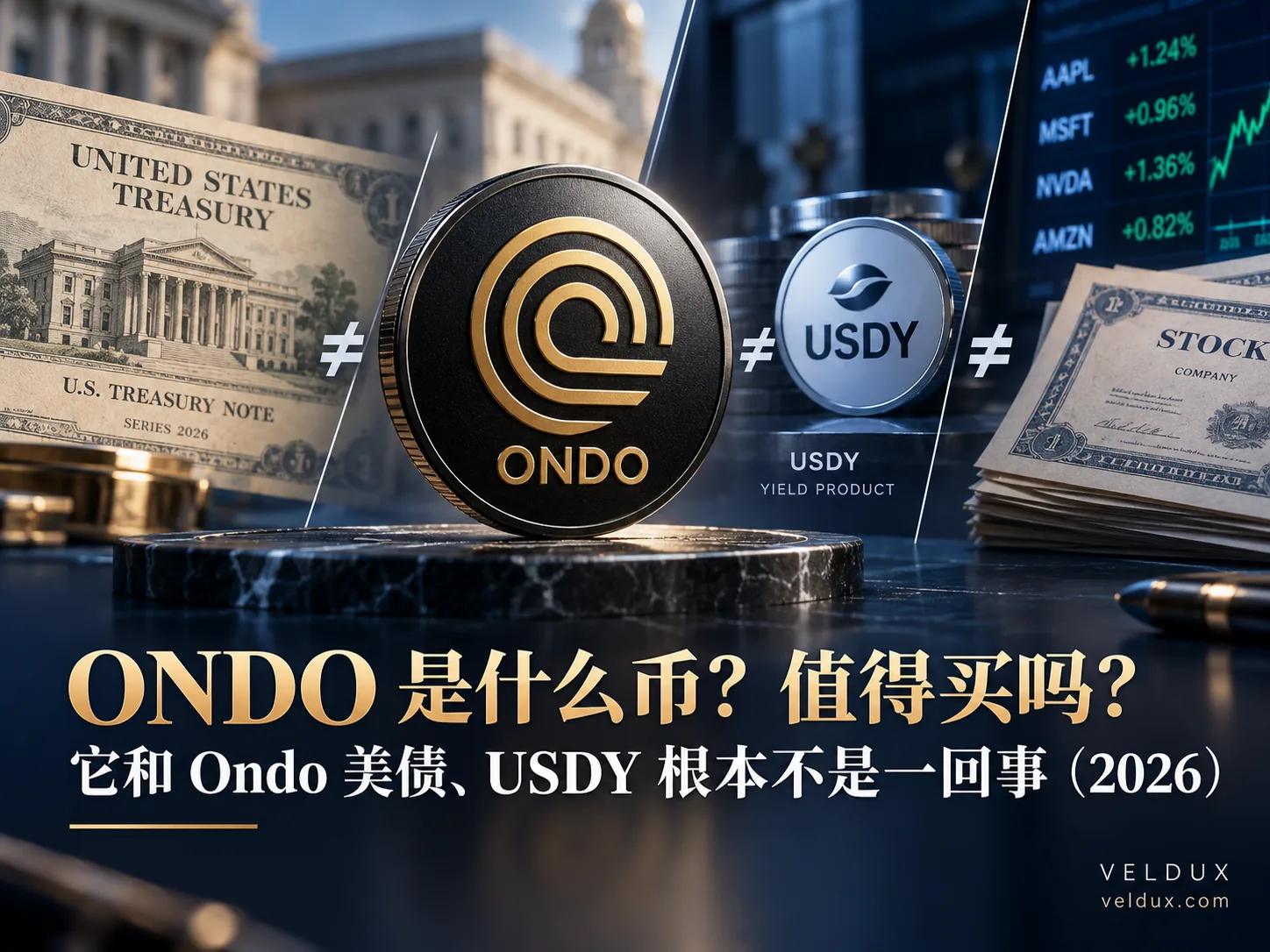
Table of contents

Binance new-user benefit
20% fee rebate
Official Binance sign-up · You must complete identity verification (KYC) to trade and withdraw
Most people first search for ONDO because of claims like these:
- "Ondo is an RWA leader"
- "Ondo put US Treasuries on-chain"
- "Ondo is tokenizing US stocks"
Then they open an exchange, see ONDO/USDT and buy ONDO along the way, assuming they have now bought Treasury yield — or even that ONDO is something like "stock in the Ondo company".
That is the layer where the most common mistake happens.
The short answer: ONDO is the governance token of the Ondo ecosystem. It is not a US Treasury, not USDY, and not Ondo Finance stock.
The Ondo Foundation officially defines ONDO as the governance token of Ondo DAO and Flux Finance.[1] ONDO has an initial total supply of 10 billion tokens, and the foundation currently says no inflationary issuance is planned.[2]
Holding ONDO also does not automatically give you the underlying asset yield of USDY, OUSG or Ondo Stocks just because Ondo runs a Treasury RWA business or tokenized stocks.
If what you are actually looking for is:
- Treasury yield: study USDY and OUSG;
- On-chain US stock / ETF exposure: study Ondo Stocks;
- ONDO's own price and governance value: then ONDO is what you are researching.
So "is ONDO worth buying" is not only a question about how well Ondo's RWA business is doing.
You also need to look at:
What value ONDO itself captures, how much of the supply is still locked, how heavy future unlocks will be, and what you actually want from it.
This is a 15-minute read, and it saves you from two expensive mistakes: buying ONDO for Treasury yield, and buying it without checking the unlock schedule.
Note: this article explains the nature of ONDO, USDY, OUSG and Ondo Stocks, their tokenomics and main risks. It is not investment advice and does not predict ONDO's price. Product eligibility, yields, regional restrictions and trading venues can all change; always rely on the latest official materials.
The essentials
| What you want to know | One-line answer |
|---|---|
| What is ONDO? | The governance token of Ondo DAO / Flux Finance |
| Does buying ONDO mean buying Treasuries? | No. ONDO does not correspond to a US Treasury security |
| Is ONDO the same as USDY? | No. USDY is a yield-bearing product backed by underlying assets |
| Is ONDO Ondo Finance stock? | No. It represents no equity in Ondo Finance |
| Does ONDO pay Treasury interest? | Holding ONDO does not automatically give you USDY / OUSG underlying yield |
| What is ONDO's total supply? | An initial total supply of 10 billion tokens |
| Will it keep inflating? | The foundation currently says no inflationary issuance is planned |
| Is all of it in circulation? | No. As of October 2026 a large share is still locked |
| When is the next major unlock? | Current third-party data points to January 18, 2027 |
| Is ONDO worth buying? | Look at use case, value capture, supply and unlocks together, not just Ondo's RWA business |
One sentence to remember:
Ondo's business is RWA, but ONDO itself is first of all a governance token.
If your only goal is relatively low-volatility short-term Treasury yield, ONDO does not directly match that goal.
What exactly is ONDO?
ONDO is the governance token of Ondo DAO.
According to official Ondo Foundation materials, ONDO holders can take part in Ondo DAO governance, and Ondo DAO is currently connected to the governance of protocols such as Flux Finance.
Governance covers some protocol parameters, market management, the DAO treasury and related governance operations.
The key point to understand here is:
Governance rights and asset ownership are not the same thing.
Holding ONDO does not mean:
- you hold a US Treasury security;
- you own USDY or OUSG;
- you own the underlying securities behind Ondo Stocks;
- you become a shareholder of Ondo Finance;
- Ondo Finance's revenue is automatically paid out to you.
So when you buy ONDO/USDT on an exchange such as Binance, what you get is the ONDO token itself.
Not a Treasury security, and not Ondo Finance equity.
ONDO, USDY, OUSG and Ondo Stocks in one table
What really confuses beginners is that the Ondo ecosystem contains several completely different products at the same time.
Put them in one table and it becomes clear:
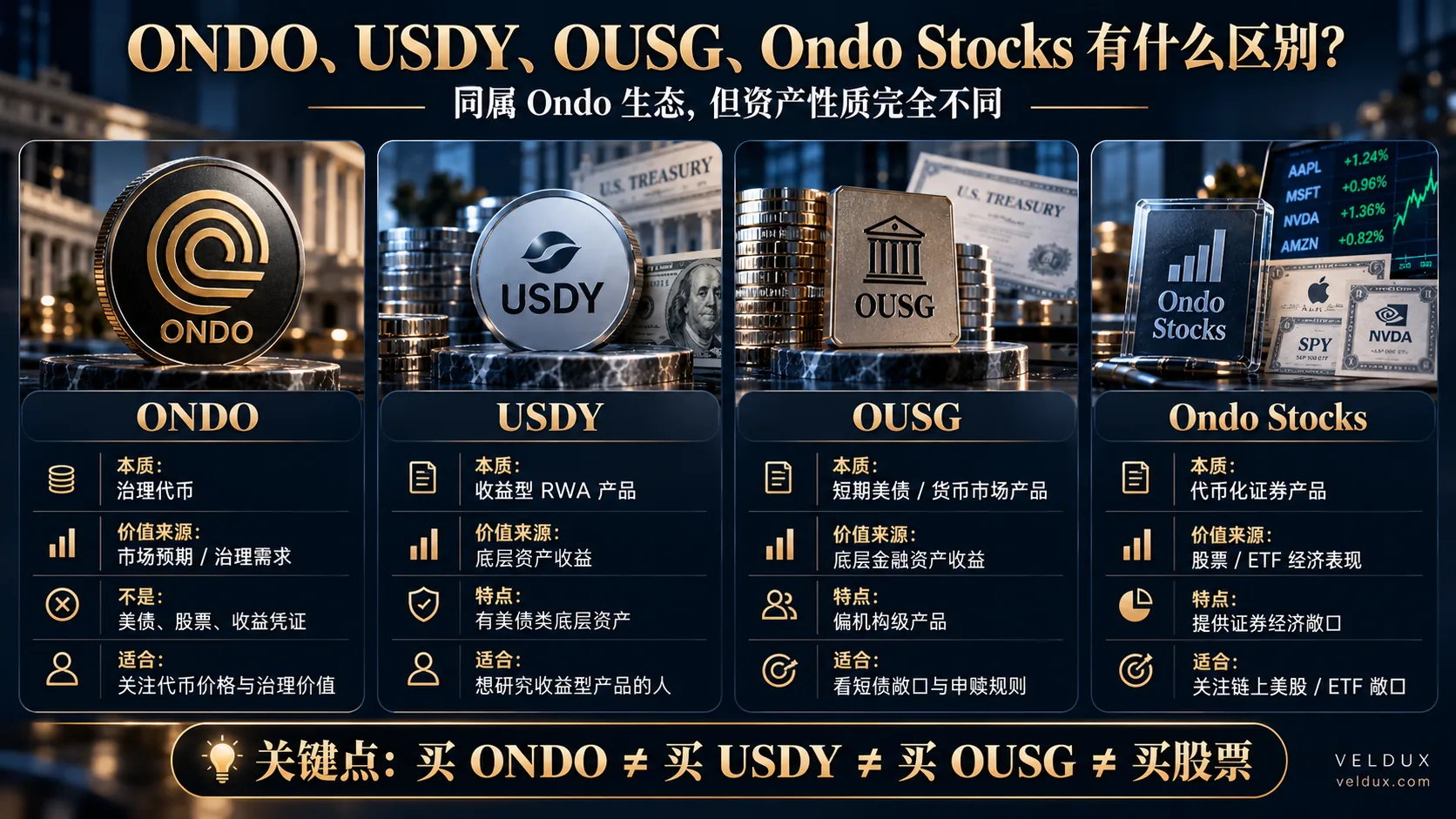
Chart: ONDO is a governance token, USDY and OUSG are yield-bearing RWA products, and Ondo Stocks provides on-chain economic exposure to stocks and ETFs. All four have different asset characteristics.
| Product | ONDO | USDY | OUSG | Ondo Stocks |
|---|---|---|---|---|
| What it is | Governance token | Yield-bearing RWA product | Short-term Treasury / money-market product | Tokenized securities product |
| Main source of value | Market supply and demand, governance demand, market expectations | Yield on underlying assets | Yield on underlying Treasuries and money-market assets | Economic performance of the corresponding stock / ETF |
| Is it a US Treasury? | No | No | No | No |
| Does it have Treasury-like underlying assets? | No | Yes | Yes | Usually not |
| Is it Ondo Finance stock? | No | No | No | No |
| Does it automatically pay ONDO holders? | — | No | No | No |
| What to watch | Supply, unlocks, governance, value capture | Underlying assets, yield, eligibility | Portfolio, eligibility, subscriptions and redemptions | Underlying securities, legal rights, regional restrictions |
The easiest mistake is to see:
Ondo = RWA
and then conclude:
ONDO = the underlying RWA asset.
That logic does not hold.
A project working on RWA does not mean the governance token it issues is itself an RWA.
How are ONDO, USDY and OUSG different?
ONDO, USDY and OUSG all belong to the Ondo ecosystem, but their asset nature is completely different.
What is USDY?
USDY is a yield-bearing product launched by Ondo.
As verified in October 2026, USDY's underlying assets consist mainly of short-term US Treasuries, and may also include a small amount of cash and other assets that fit its structure.[3]
USDY's yield comes from those underlying assets, not from ONDO.
And USDY itself should not be simplified into "a US Treasury security".
More precisely:
USDY is a yield-bearing on-chain product backed by the corresponding assets.
It is not a Treasury security issued directly by the US Treasury.
What is OUSG?
OUSG is closer to short-term US Treasuries and institutional money-market exposure.
Ondo currently positions it as a short-term US Treasury product for eligible investors, with the underlying portfolio using institutional money-market and US Treasury-related assets.[4]
Therefore:
OUSG's yield logic comes from the underlying financial assets it holds or corresponds to.
ONDO has no such direct link.
So remember the three like this
ONDO = governance token
USDY = yield-bearing RWA product
OUSG = short-term Treasury / money-market product
That is also why:
Buying ONDO ≠ buying USDY ≠ buying OUSG.
Why can Ondo's Treasury business grow without ONDO rising?
This is the most important layer for understanding ONDO.
Suppose Ondo's USDY and OUSG continue to grow.
That tells you:
- Ondo's products may be getting more use;
- more assets are flowing into Ondo products;
- Ondo's business in the RWA market may be expanding.
But one step is still missing:
Through what mechanism does that growth reach ONDO holders?
This is what people call:
Value capture
Many investors mix up two ideas:
the project's fundamentals are growing
and
the token captures the economic value generated by that growth.
They are not the same thing.
As of this fact-check, the Ondo Foundation's official positioning of ONDO is still centered on:
a governance token.
Official materials do not describe ONDO as:
- a claim on USDY interest;
- a claim on OUSG yield;
- a claim on Ondo Finance dividends;
- a revenue-share claim on Ondo Stocks.
So even if the Ondo ecosystem grows, you cannot conclude:
The more money Ondo makes → the more ONDO holders get paid → ONDO must rise.
That simple equation does not currently exist.
Does Ondo's revenue go directly to ONDO holders?
This is also a question worth asking before buying ONDO.
Under the currently public ONDO design, holding ONDO is not the same as holding dividend-paying stock in a company.
ONDO's clearest use is governance.
Ondo DAO can manage some governance matters and the DAO treasury, but:
having governance rights does not automatically give you a right to Ondo Finance's profit distribution.
This is one of the biggest differences between a governance token and a stock.
A stock usually represents equity in a company, and may come with voting rights, residual claims or dividends under corporate law.
ONDO is not Ondo Finance stock.
So if someone's entire investment case is:
"Ondo's business will make more money over time, so ONDO will earn profits like a company stock."
One layer is missing:
How exactly does ONDO capture that economic value?
If the governance mechanism, fee distribution, buybacks, burns or other tokenomics change materially in the future, that judgment should be re-evaluated.
ONDO's tokenomics: 10 billion is not a small detail
You cannot analyze ONDO by looking only at Ondo's Treasury volume.
You also have to look at ONDO's own supply structure.
According to official Ondo Foundation materials:
ONDO has an initial total supply of 10,000,000,000 tokens, i.e. 10 billion.
The foundation also says no inflationary issuance is planned at present.
The initial tokens fall roughly into four categories:
| Allocation | Amount | Share of total supply |
|---|---|---|
| Ecosystem Growth | About 5.211 billion | About 52.1% |
| Protocol Development | 3.3 billion | 33.0% |
| Private Sales | About 1.29 billion | About 12.9% |
| Community Access Sale | About 199 million | About 2.0% |
| Total | 10 billion | 100% |
This table is more directly relevant to ONDO holders than "is Ondo an RWA leader".
Because a large part of that supply did not enter the market immediately.
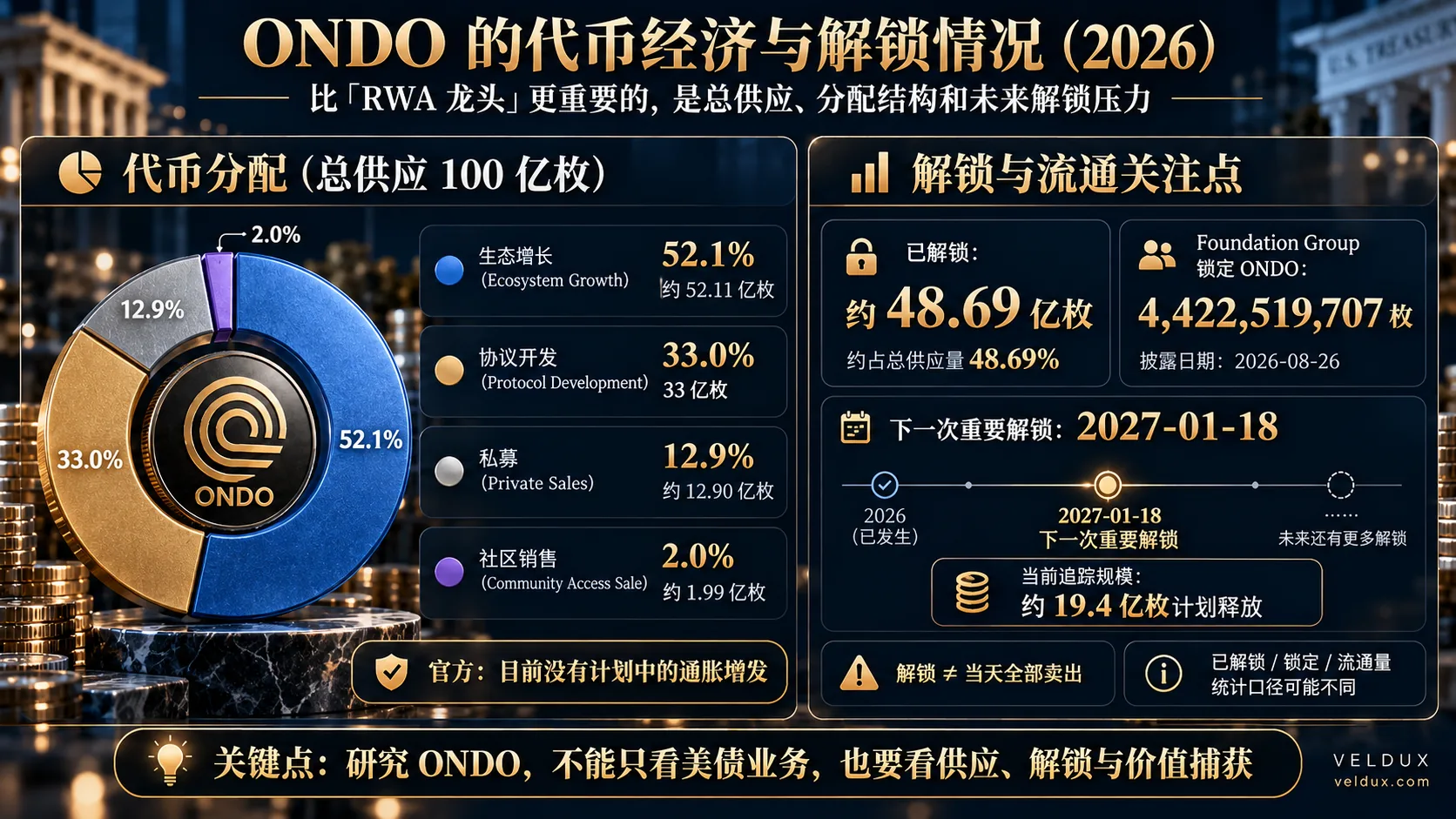
Chart: ONDO's initial total supply is 10 billion tokens. The allocation, the share already unlocked and future large unlocks all affect future market supply. An unlock does not mean everything is sold that day, but it deserves attention.
How much ONDO is still locked in 2026?
This is also a fact worth adding to any current article.
According to data tracked by Tokenomist as of October 2, 2026:
- ONDO total supply: about 10 billion tokens
- Unlocked: about 4.869 billion tokens
- Unlocked share: about 48.69%
- A large amount of supply is still subject to future release
In addition, the Ondo Foundation disclosed that as of August 26, 2026, a public address controlled by the Ondo Foundation Group still held about:
4,422,519,707 locked ONDO.
One caveat:
Different data sites do not use exactly the same definitions for "circulating supply", "unlocked supply" and "Foundation-controlled locked supply".
So you cannot simply subtract two numbers and treat the result as an exact circulating supply.
But together they show one thing:
In 2026, ONDO is still not a token whose supply has been fully released.
Future supply changes still deserve attention.
Why the January 2027 unlock matters
ONDO's unlocks are not a finished issue.
Under Ondo's originally published lock-up structure, part of the Ecosystem Growth, Protocol Development and Private Sales tokens are released over a multi-year schedule.
Third-party unlock platform Tokenomist showed, as of October 2, 2026:
The next major unlock is on January 18, 2027.
Its current tracking data shows that this event involves the planned release of about 1.94 billion ONDO.[5]
That is a substantial share of ONDO's total supply.
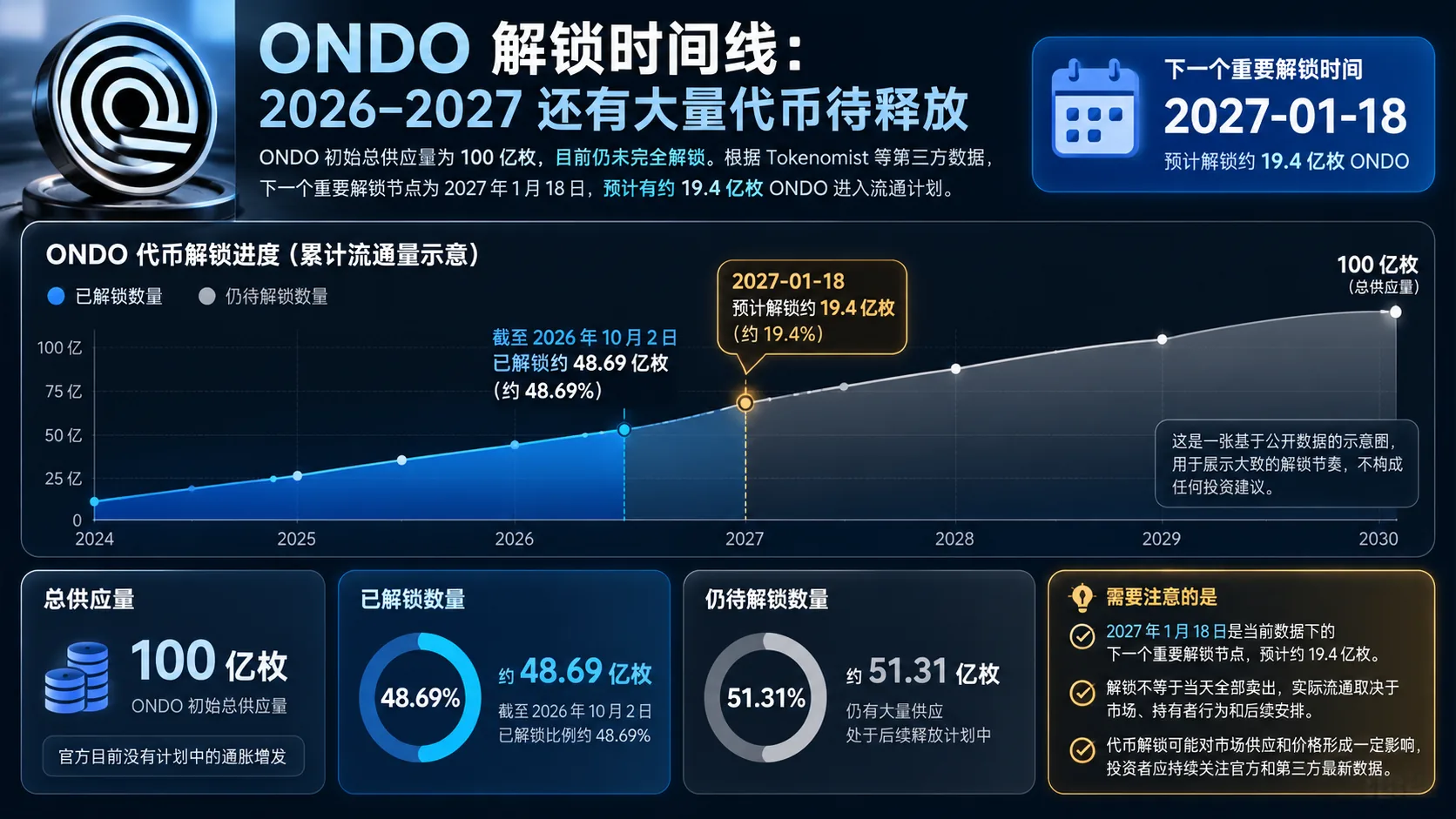
Chart: As of October 2026, a large amount of ONDO is still subject to future release; current third-party data points to January 18, 2027 as the next major unlock. An unlock means potential new supply, not that everything is sold that day.
But you also cannot directly conclude:
A large unlock = the price must fall.
Because:
an unlock does not mean those tokens will all be sold that day.
What actually affects the market also includes:
- who receives the unlocked tokens;
- whether the tokens go straight to exchanges;
- whether the recipients sell;
- market liquidity at the time;
- demand for ONDO;
- the overall crypto market.
So the more accurate reading is:
An unlock means potential circulating supply increases and belongs in your risk assessment, but it is not a price-prediction tool.
Why unlocks matter more to ONDO than Treasury yield
If you are buying USDY, one of the core questions may be:
What is the yield on the underlying Treasuries?
But if you are buying ONDO, what you should really care about includes:
How much ONDO is already circulating?
How much has not been released?
Who holds the tokens that will unlock?
How much new supply could reach the market after the unlock?
This again shows:
ONDO and Ondo's Treasury products should be analyzed with completely different methods.
How does ONDO relate to Ondo Stocks?
Ondo has another very important product line:
Ondo Stocks.
Ondo Stocks brings the economic exposure of US-listed stocks and ETFs on-chain.
According to official Ondo materials, these products are backed by the corresponding stocks, ETFs and any necessary cash in transit, and are designed to track the economic performance of the underlying securities, including price changes and dividend treatment that fits the product structure.[6]
But note:
An Ondo Stocks token is not the same as directly holding the underlying US stock.
The specific legal rights, issuer, redemption and regional eligibility depend on the relevant product documents.
As of 2026, Ondo Stocks covers hundreds of stocks and ETF assets.
For example, when you see:
- NVDAon
- TSLAon
- SPYon
- QQQon
you are looking at the corresponding Ondo Stocks product.
That is a completely different logic from the ONDO governance token.
Is ONDO worth buying? Start with your reason
Now back to the real question in the title:
Is ONDO worth buying?
There is no single answer that fits everyone.
The more practical approach is to start from your goal.
| Your goal | What to study | Does ONDO directly match? |
|---|---|---|
| Earn short-term Treasury yield | USDY / OUSG / T-bills / Treasury ETFs | No |
| Get US stock / ETF exposure | Ondo Stocks / a broker, etc. | No |
| Own equity in Ondo Finance | The equity itself | No |
| Take part in Ondo DAO governance | ONDO | Yes |
| Trade ONDO's market price | ONDO | Yes |
| Bet on how the market values the Ondo ecosystem within RWA | ONDO can be a candidate | Not exactly: it does not give you direct ecosystem revenue |
So do not go from:
"Is Ondo a good project?"
straight to:
"Then ONDO must be worth buying."
At least three things still need a judgment:
What rights does the token have?
How does the token capture ecosystem value?
Will future supply change materially?
Five questions to ask before buying ONDO
If you are seriously considering ONDO, these five questions are more useful than reading a price prediction.
1. Why am I buying ONDO?
If the answer is:
Because Ondo does US Treasuries.
then it is worth re-reading the difference between ONDO and USDY / OUSG.
Ondo doing Treasuries does not make ONDO itself a Treasury.
2. Do I want yield or price upside?
If what you really need is relatively stable yield from underlying assets, what you should compare is:
- USDY;
- OUSG;
- US Treasuries;
- Treasury ETFs;
- other compliant RWA products.
Not treat a governance token as a fixed-income product.
3. Have I looked at ONDO's unlock schedule?
If not, this step matters a lot.
As of October 2026, a large amount of ONDO supply has still not been released.
When buying a governance token, looking only at the current market cap and ignoring future supply is an easy layer to miss.
4. Can I explain how ONDO captures value from the Ondo ecosystem?
If your logic is only:
Ondo's business keeps getting bigger, so the token must keep getting more expensive.
that logic is incomplete.
Keep asking:
Through what mechanism does ecosystem growth reach ONDO?
If you cannot explain it, treat that as uncertainty instead of assuming it is a positive.
5. If Ondo's business keeps growing but ONDO falls hard, can I live with that?
This is a stress test.
Because:
project growth and governance-token prices can diverge completely.
If your investment case cannot accept that, you may be tying project fundamentals and token price too tightly together.
How to buy ONDO
If you have understood the differences above and still want to trade ONDO, the process is similar to any other spot crypto asset.
Using Binance as an example:
- Open the Binance app or website;
- Log in and complete the identity verification the platform requires;
- Prepare USDT or another trading asset;
- Go to spot trading;
- Search for ONDO/USDT;
- Choose a market or limit order according to your needs.
One reminder:
What you are buying here is the ONDO governance token.
Not USDY, not OUSG, and not Ondo Finance stock.
If you actually want Ondo's Treasury products, go study the eligibility, purchase, subscription and redemption rules for USDY / OUSG.
If you're planning to sign up for Binance or OKX
Binance registration (code AMY568): https://www.binance.com/join?ref=AMY568
OKX registration (code AMY568): https://www.okx.com/join/AMY568
These are affiliate links. If you register through them, you may receive the benefits available under the promotion at the time, and this site may earn a commission; it does not cost you extra. The exact benefits are shown on the registration page.
See our affiliate disclosure.
The 3 most common mistakes when buying ONDO
Mistake 1: buying ONDO because "Ondo is an RWA leader"
RWA is Ondo's business sector.
ONDO is a governance token.
Both statements can be true at the same time, but they are not equivalent.
Before buying, ask:
What rights does ONDO actually have over the underlying assets?
Do not just look at which sector the project belongs to.
Mistake 2: treating ONDO as Ondo Finance stock
ONDO does not represent equity in Ondo Finance.
Holding ONDO does not automatically make you a shareholder of Ondo Finance.
So you cannot simply apply:
Revenue growth → profit growth → shareholder dividends
the way you would with a traditional stock.
Mistake 3: watching the RWA business but ignoring ONDO unlocks
This is the easiest layer to miss.
ONDO's long-term supply was not fully released in 2026.
Even if the Ondo ecosystem keeps growing, new circulating supply can still affect market supply and demand.
So when studying ONDO:
Business fundamentals and tokenomics have to be looked at together.
What are ONDO's main risks?
1. Ecosystem growth diverging from token price
Ondo's product volume growing does not mean ONDO must rise in tandem.
Ecosystem fundamentals and token value capture are two separate questions.
2. Token unlocks and rising supply
ONDO's total supply is 10 billion tokens, and as of October 2026 a significant share has not been released.
Future large unlocks may change the tradable supply.
But an unlock does not mean the tokens will definitely be sold.
3. Crypto market price volatility
ONDO trades on the public crypto market.
Its price can be affected by:
- BTC and the overall market;
- market risk appetite;
- RWA sector sentiment;
- market liquidity;
- ONDO supply and demand;
- the macro environment;
and other factors.
You cannot think about ONDO using the risk level of short-term US Treasuries.
4. Uncertainty around governance value
Whether governance rights have enough market value depends on:
- how important DAO governance actually is;
- what ONDO holders can decide;
- how the protocol develops;
- whether governance rights expand further;
- whether new value-capture mechanisms appear.
All of these can change.
5. On-chain security risk
If you withdraw ONDO to a self-custody wallet, you also face:
- seed-phrase leaks;
- losing your private key;
- malicious approvals;
- phishing sites;
- sending on the wrong network;
- sending to the wrong address.
These are the risks of using on-chain assets themselves.
FAQ
Q1: How are ONDO and USDY related?
Both belong to the Ondo ecosystem, but they are completely different in nature.
ONDO is a governance token.
USDY is a yield-bearing RWA product backed by corresponding underlying assets.
Holding ONDO does not mean holding USDY.
Q2: Does buying ONDO earn Treasury interest?
Holding ONDO does not automatically give you the yield generated by the US Treasuries behind USDY / OUSG.
If your goal is Treasury-style yield, study the corresponding yield-bearing products.
Q3: Is ONDO Ondo Finance stock?
No.
ONDO is a governance token and does not represent equity in Ondo Finance.
Q4: What is ONDO's total supply?
Official Ondo Foundation materials show:
ONDO's initial total supply is 10 billion tokens.
The foundation currently says no inflationary issuance is planned.
But total supply is not the same as the amount currently circulating.
Q5: Is ONDO fully unlocked now?
No.
As of October 2, 2026, third-party unlock tracking showed about 4.869 billion ONDO unlocked, with a large amount of supply still subject to future release.
Q6: When is ONDO's next large unlock?
At the time of this fact-check, Tokenomist showed the next major scheduled unlock as:
January 18, 2027.
The currently tracked amount is about 1.94 billion ONDO.
The actual release and circulation can change; re-verify as the date approaches.
Q7: Does a large unlock mean ONDO must fall?
No.
An unlock means some previously restricted tokens become able to enter circulation, but:
an unlock ≠ everything is sold that day.
The price still depends on holder behavior, market demand, liquidity and the overall market.
Q8: Is USDY a US Treasury?
Strictly speaking, no.
USDY is a yield-bearing product backed mainly by short-term US Treasuries and similar assets.
US Treasuries are one of the underlying assets; USDY itself is not a Treasury security issued directly by the US Treasury.
Q9: Are Ondo Stocks and ONDO the same thing?
No.
Ondo Stocks provides on-chain economic exposure to stocks and ETFs.
ONDO is a governance token.
They belong to the same ecosystem, but the economic rights are different.
Q10: I already have USDT and want Treasury exposure. How should I choose?
Work through this order first:
- Confirm whether your location qualifies for the product;
- Distinguish the nature of products such as USDY, OUSG, BUIDL and BENJI;
- Look at the underlying assets;
- Look at investor eligibility;
- Look at the minimum amount;
- Look at the subscription and redemption mechanics;
- Look at custody and issuance structure;
- Then decide which channel to use.
Do not treat ONDO as a Treasury entry point just because it is listed on an exchange.
Q11: How is ONDO different from PAXG?
Very different.
PAXG is a token backed by physical gold.
ONDO is a governance token.
So even if both can be discussed under the broad "RWA" topic, their asset backing and source of value are completely different.
In one sentence
If you remember only one sentence from this article:
ONDO is the governance token of the Ondo ecosystem, not Ondo's Treasury product itself.
When analyzing ONDO properly, look at four things at the same time:
governance rights, value capture, token supply and future unlocks.
Not just:
How much Ondo's RWA business has grown.
If you want Treasury-style yield, study products such as USDY / OUSG;
if you want on-chain US stock or ETF exposure, study Ondo Stocks;
if you want to trade ONDO, treat it as a governance token with its own supply and demand, unlock schedule and crypto-market price risk.
Before buying, ask yourself:
Do I want the yield of the underlying assets, or price exposure to ONDO itself?
Getting that distinction right matters more than guessing whether ONDO goes up or down next.
Related articles
- How to buy Treasury RWA: BUIDL, USDY and ONDO, the differences, thresholds and how not to buy wrong (2026) — if you want Treasury-style yield, first separate BUIDL / USDY / BENJI / ONDO
- What is RWA and how do you buy it? Tokenized gold, US stocks and Treasuries explained (2026) — understand RWA through underlying assets and legal rights, not just "RWA concept coins"
- Binance Direct Stocks vs bStocks: real stocks and tokenized stocks (2026) — if you want US stocks, understand the different rights behind each product
- Buying US stocks with USDT (2026): exchange or traditional broker? Don't buy the wrong product — separate real stocks, tokenized stocks and other price-exposure products
- How to buy gold tokens: PAXG vs XAUT, fees and which to choose (2026) — compare another RWA product with a clear underlying-asset structure
Data verification note
The key facts in this article were checked on 2026-10-16, one by one:
- Nature of ONDO: the Ondo Foundation officially defines ONDO as the governance token of Ondo DAO (and associated with Flux Finance); holders get voting power in proportion to their balance, and governance rights are not asset ownership. Source: Ondo Foundation official docs, "The Ondo DAO".
- ONDO supply: ONDO has an initial total supply of 10 billion tokens, and the foundation says no inflationary issuance is planned; total supply is not current circulating supply. Source: Ondo Foundation official docs, "The ONDO Token".
- USDY underlying assets: USDY is a yield-bearing token backed by assets such as short-term US Treasuries. It is not a Treasury security issued directly by the US Treasury, nor a share in a Treasury fund. Source: Ondo Finance official USDY product page.
- OUSG positioning: OUSG is aimed at eligible investors and offers exposure to short-term US Treasuries and institutional money markets. Source: Ondo Finance official OUSG product page.
- ONDO unlock data: third-party unlock tracking shows about 48.69% already unlocked; the next major unlock is 2027-01-18, involving about 1.94 billion ONDO. Different platforms use different definitions, so the figures should not simply be subtracted. Source: Tokenomist ONDO unlock data.
- Ondo Stocks structure: Ondo Stocks is backed by the corresponding stocks, ETFs and any necessary cash in transit, and tracks the economic performance of the underlying securities, but the token itself is not direct ownership of the underlying stock. Source: Ondo Finance official Ondo Stocks product page.
Disclaimer
This article only explains the nature, differences, tokenomics and risks of ONDO and of Ondo ecosystem products such as USDY, OUSG and Ondo Stocks. It is not investment, financial, legal or trading advice, nor a prediction of ONDO's future price.
Crypto assets and RWA products may involve risks related to price volatility, liquidity, token unlocks, the issuer, custody, smart contracts, legal structure, regulatory compliance and cybersecurity.
Growth in the Ondo ecosystem's business, TVL or products does not guarantee that the ONDO token price will rise.
This article contains affiliate links. Registering through them may generate revenue for this site, but does not charge you extra. Specific benefits, product eligibility and availability are governed by the platform's live page.
Check the official product documents and make your own judgment based on your location, identity, risk tolerance and actual needs.
Exchange operations · USDT · Wallet security
Responsible for researching and organizing content on Binance, OKX, USDT transfers, withdrawals and wallet security. The steps and key data in this article are verified according to the content type, using real operation records, official platform documentation and public sources. Interfaces, fees and regional rules may change, so the article is reviewed and updated continuously.
Status: manual review · Last verified 2026-10-16
Reviewed by: Veldux editorial team
- Ondo Foundation official docs, "The Ondo DAO"ONDO is the Ondo DAO governance token; holders get voting power in proportion to their balance and can delegate it
- Ondo Foundation official docs, "The ONDO Token"ONDO has an initial total supply of 10 billion tokens, and the foundation says no inflationary issuance is planned (the "10 billion / no planned inflation" facts in the body)
- Ondo Finance official USDY product pageUSDY is a yield-bearing token backed by short-term US Treasuries and similar assets, not a Treasury security issued by the US Treasury itself
- Ondo Finance official OUSG product pageOUSG is a product for eligible investors that offers exposure to short-term US Treasuries
- Tokenomist ONDO unlock dataAbout 48.69% already unlocked; the next major unlock is 2027-01-18, involving roughly 1.94 billion ONDO
- Ondo Finance official Ondo Stocks product pageOndo Stocks is backed by the corresponding stocks, ETFs and any necessary cash in transit; the token itself is not the underlying stock
- 2026-10-16UpdateAdded the evidence-chain superscripts and the "Data verification note", and updated the fact-check date.
Editorial principles ineditorial policy,corrections policy。