
What is RWA and how do you buy it? Tokenized gold, stocks and Treasuries (2026)
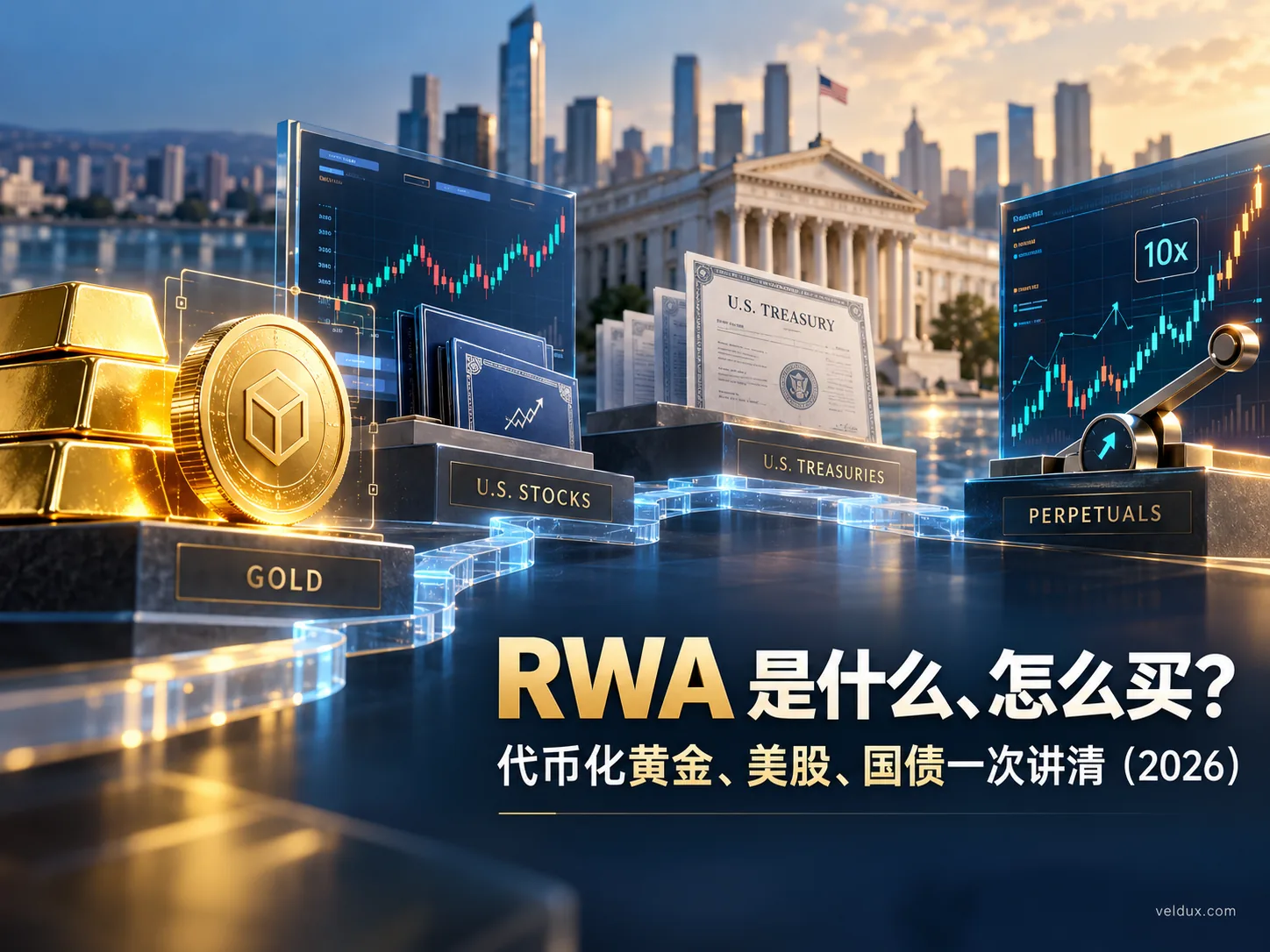
Table of contents

Binance new-user benefit
20% fee rebate
Official Binance sign-up · You must complete identity verification (KYC) to trade and withdraw
Over the past two years, "RWA" has appeared more and more often in crypto.
RWA stands for Real World Assets. In simple terms, it means taking assets or economic rights from the real world — gold, stocks, US Treasuries, funds — and using blockchain to make them something that can be held, transferred or traded on-chain.
But when you actually get ready to buy, the problem appears:
Are you buying the asset itself, an on-chain claim on the asset, or a derivative that only tracks the price?
All three can be called "gold", "US stocks" or "RWA", yet their legal structures and risks are completely different.
The short answer first:
For ordinary users, the most common RWA / TradFi on-chain entry points fall into four groups: tokenized gold, tokenized stocks, tokenized US Treasuries, and TradFi derivatives on stocks or gold.
Within the first three there are further structures such as "direct securities", "asset-backed tokens", "fund shares" and "debt claims"; the last group is only a price derivative and does not mean you own gold or stocks.
So this article will not tell you "which one is most worth buying". It first solves the most important question:
Before you place an order, figure out what you are actually buying.
This is an 11-minute read that saves you from two common mistakes: assuming a stock token means owning the stock, and treating a leveraged TradFi derivative as a spot asset.
This article is for education about product structures and operational thresholds and is not investment advice. Product availability, fees, yields and legal structures change by region and over time; rely on the official page and your account at the time of ordering.
The essentials: how are the four product types different?
Look at this chart first. The most confusing thing in RWA is not the asset name, but whether what you end up with is "the asset itself, an asset-backed right, or a price contract".
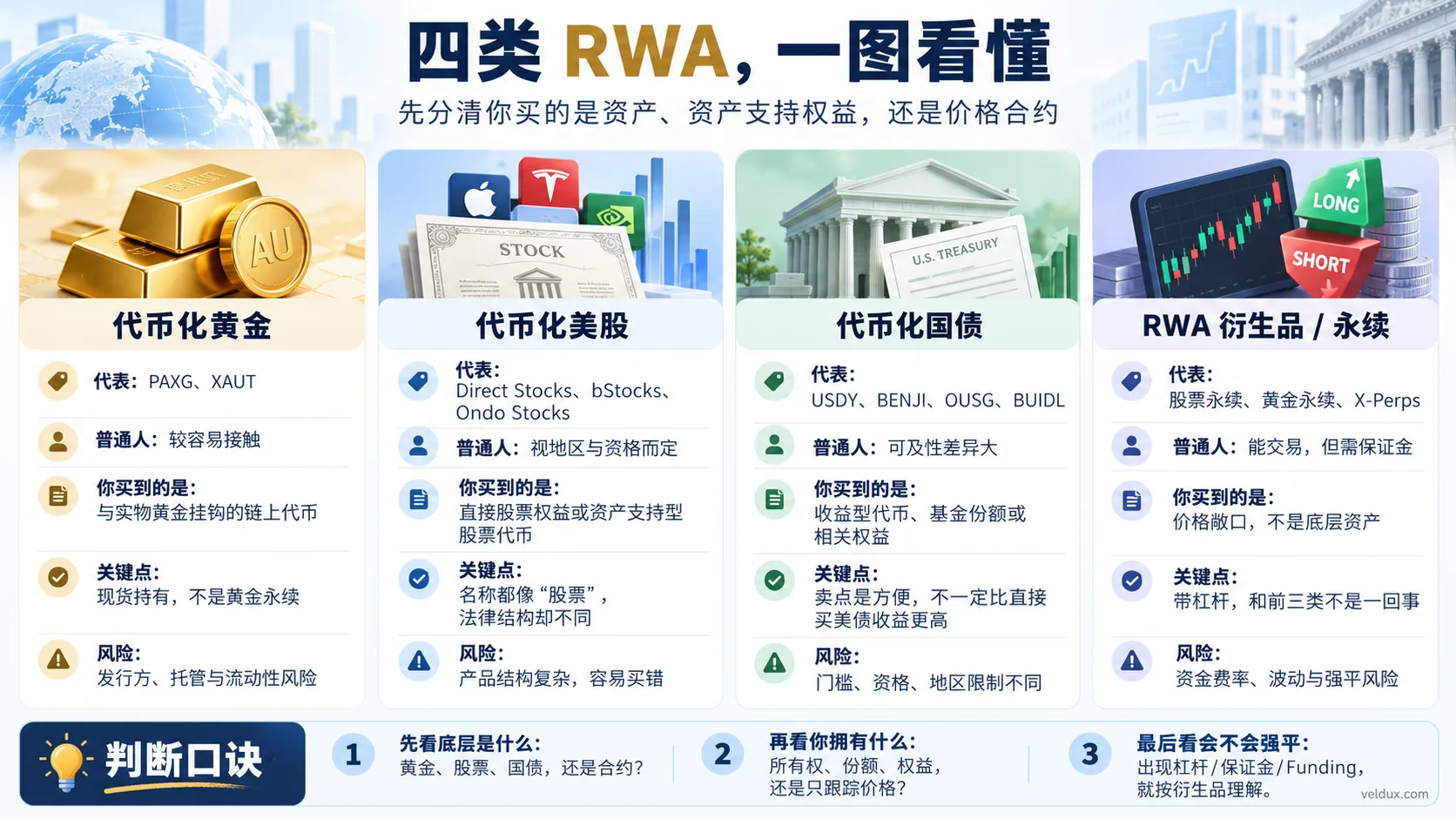
Chart: product structure, retail accessibility, rights held and main risks for the four RWA types. Actual availability depends on your region and the product page.
Now the table.
| Type | Representative products | Retail accessibility | What you mainly get | Can leverage liquidate you? |
|---|---|---|---|---|
| Tokenized gold | PAXG, XAUT | Relatively high, depending on exchange and region | An on-chain token linked to physical gold | Spot itself: no |
| Direct stocks | Binance Direct Stocks | Only users in eligible regions | Stock rights held through a regulated broker system | No |
| Tokenized stocks | Binance bStocks, Ondo Stocks | Depends on region and eligibility | Tokenized securities or economic-right certificates backed by underlying securities | Spot itself: no |
| Tokenized Treasuries / money-market products | USDY, BENJI, OUSG, BUIDL | Varies widely | Debt claims, fund shares or similar on-chain rights | Usually no leverage liquidation in the product itself |
| TradFi derivatives | Binance TradFi Perps, OKX X-Perps | Depends on region and derivatives eligibility | Contract exposure to price changes in stocks, gold and other assets | Yes, possibly |
The most important thing to remember here:
"There is a real asset backing it on-chain" does not equal "you directly own the underlying asset"; "the name contains a stock or gold" does not mean you actually hold a stock or gold.
Every product has to be checked against its specific issuance terms.
What exactly is RWA?
One-sentence explanation:
RWA connects the value, ownership, income rights or other economic rights of a real-world asset to a blockchain token through some legal structure.
A typical process has roughly three layers:
1. Off-chain assets and legal relationships
First there is something in the real world, such as:
- US Treasuries;
- stocks;
- gold;
- money-market funds;
- corporate loans;
- real estate.
The issuer also has to determine who holds the asset, what rights users receive, and what happens to the asset if the issuer fails.
Many projects use structures such as SPVs, trusts, funds and broker custody accounts.
2. Custody, valuation and data
Someone has to custody the underlying assets, and information such as prices, net asset value, interest and corporate actions has to feed into the on-chain system.
So you will see:
- custodians;
- brokers;
- auditors or attestation providers;
- oracles;
- transfer agents;
- security agents.
RWA is not as simple as "issue a token"; what really determines safety is often this off-chain part.
3. On-chain issuance and transfer
Only then is the token issued on a blockchain such as Ethereum, BNB Chain or Solana.
Some tokens can:
- transfer 24/7;
- be withdrawn to a self-custody wallet;
- trade on a DEX;
- be used as DeFi collateral.
Others can only trade inside the issuer's platform or a designated venue.
How big is the RWA market now?
Pay close attention to the definitions here.
RWA.xyz showed in late September 2026 that on-chain Distributed Asset Value had reached about $38.5 billion, excluding the large stablecoin assets it tracks separately; tokenized US Treasuries and related money-market products accounted for about $15 billion.[1]
So do not mix "all RWA", "tokenized Treasuries" and "tokenized stocks" into one number.
More importantly:
RWA is not only gold, US stocks and Treasuries.
Private credit, real estate, funds, corporate bonds and other commodities are also RWA.
This article focuses on gold, US stocks and Treasuries because those are the closest to ordinary crypto users.
Type 1: Tokenized gold
Gold is the easiest RWA category to understand.
The most common representative products are:
- PAX Gold (PAXG)
- Tether Gold (XAUT)
What is PAXG?
PAXG is issued by Paxos.
According to Paxos's official documentation, each PAXG corresponds to 1 fine troy ounce (about 31.1 grams) of London Good Delivery gold, held in LBMA-approved vaults in London.[2]
Paxos also publishes gold reserve and third-party attestation reports.
So you can think of PAXG as:
physical gold rights turned into a token that can be split, transferred and traded on a blockchain.
It is not the same product as a perpetual contract that merely tracks the gold price.
What is XAUT?
XAUT is Tether Gold's gold token.
It is also designed around one token per troy ounce of gold and backed by physical gold.[3]
The biggest difference between PAXG and XAUT is not whether they track gold, but:
- the issuer;
- custody arrangements;
- the regulatory framework;
- reserve disclosure;
- supported networks;
- physical redemption conditions;
- exchange liquidity.
If you only buy a little through an exchange, the experience may feel very similar; if you plan to hold long-term or in size, you should study the issuance terms and redemption mechanics. I wrote a separate article on the detailed differences, fees and redemption thresholds between PAXG and XAUT.
How do you buy gold tokens?
The simplest route is usually an exchange's spot market.
For example, if your region supports it:
Spot → search PAXG / XAUT → choose the pair → place the order
Whether USDT or USDC is supported and whether a pair is open depends on what your account shows at the time.
Do not confuse:
PAXG / XAUT spot
with
XAUUSDT, Gold X-Perp and other gold derivatives
The first is a gold-backed token; the second is a price contract.
Type 2: Tokenized US stocks — the easiest product structure to misread
On-chain stocks in 2026 are far more complex than a few years ago.
On platforms such as Binance and Ondo, users may encounter:
- direct stocks;
- asset-backed stock tokens;
- stock-related derivatives.
They cannot all be called "stock tokens" and then left undistinguished. If you want the overall picture of "buying US stocks with USDT", see this article.
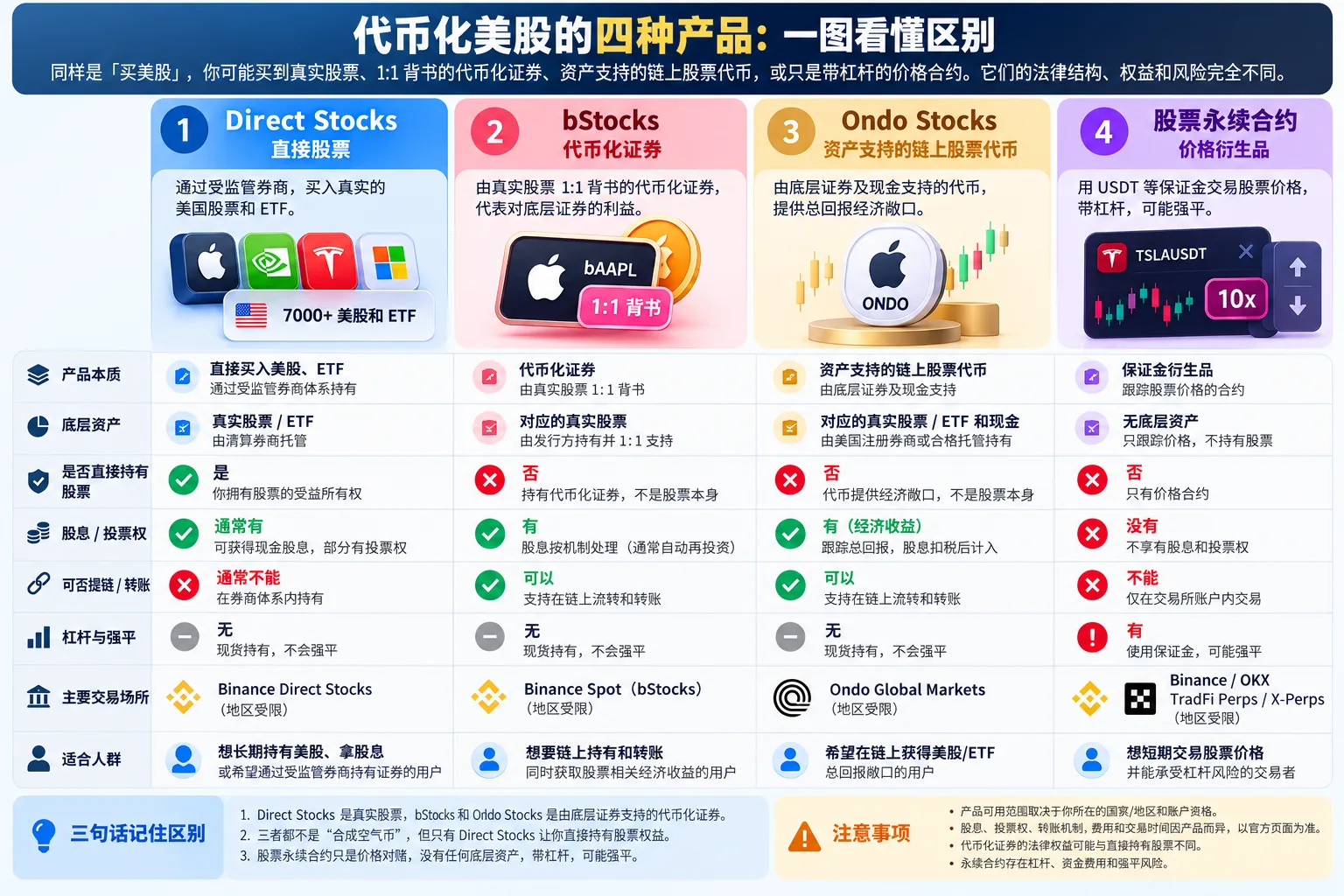
Chart: how Direct Stocks, bStocks, Ondo Stocks and stock perpetuals differ in underlying assets, stock rights, on-chain transfer and liquidation risk. Product eligibility and available regions depend on the official page.
First the table:
| Product | What it is | Direct stock ownership? | Dividends / economic return | Withdrawable on-chain? | Leverage liquidation |
|---|---|---|---|---|---|
| Binance Direct Stocks | Direct stocks | Yes, held through the securities and clearing system | Handled under product rules | Normally not the ordinary stock itself withdrawn to a wallet | No |
| Binance bStocks | Tokenized security | No direct ownership of the underlying stock | Provides economic rights linked to the underlying stock; dividends handled through the mechanism | Supported bStocks can move on-chain | No for spot |
| Ondo Stocks | On-chain token fully backed by underlying securities | The token itself is not a stock | Tracks the total return of the underlying securities, with dividends included after withholding tax | Supported | No for spot |
| Binance stock perpetuals, etc. | Derivatives | No | No shareholder rights | No | Yes |
| OKX X-Perps | TradFi derivatives | No | No stock ownership, dividends or voting rights | No | Yes |
What is Binance Direct Stocks?
Binance launched Direct Stocks in 2026.
Official materials show that it offers thousands of US stocks and ETFs, handled through the regulated securities system and clearing brokers; users receive direct stock rights, not a crypto token that merely mimics the price.[4]
So it is a different product from bStocks.
Roughly:
Direct Stocks: buying traditional securities through a Binance entry point.
bStocks: turning securities-backed economic rights into a tokenized security that can move on-chain.
What is bStocks?
bStocks is issued by BTech Holdings Limited.[5]
Binance states clearly:
bStocks is not the underlying listed company's common stock, and it does not mean the user becomes a registered shareholder of that company.
Each bStock is backed by the corresponding underlying security and represents an interest in that security held by the issuer.
This point matters a lot.
So an article cannot simply claim:
bStocks = I directly own shares in this company.
The more accurate statement is:
bStocks is a tokenized security backed by real underlying securities, but it is not the underlying stock itself.
Its advantage lies in on-chain properties: eligible products can, for example:
- trade on Binance Spot;
- move 24/7;
- be withdrawn to supported on-chain wallets;
- be converted to and from the underlying security under the applicable rules.
But eligibility is still limited by jurisdiction.
And what is Ondo Stocks?
Ondo Stocks also cannot simply be categorized as "synthetic stocks with no asset backing".
Official Ondo materials show that its tokenized stocks and ETFs are backed by the corresponding underlying securities and any necessary cash in transit, with the assets held by a US-registered broker or a qualified custody arrangement.[6]
It offers economic and total-return exposure to the underlying securities, including the effect of dividends after applicable withholding tax.
But:
the Ondo Stocks token itself is still not the underlying stock or ETF, and it does not mean you directly receive that share.
This is exactly why, when judging a stock RWA, you cannot only ask:
"Is it 1:1 backed?"
You should also ask:
"What is the legal relationship between me and the underlying stock?"
Type 3: Tokenized US Treasuries
This is one of the largest RWA categories today.
The reason is easy to understand.
Traditional investors already put cash into:
- short-term US Treasuries;
- Treasury repo;
- government money-market funds.
What RWA does is turn part of those products into a form that can be held and settled on-chain.
But this is also where different products are most easily lumped together.
BUIDL, OUSG, USDY and BENJI are not the same structure
| Product | Main positioning | Retail accessibility | What to watch |
|---|---|---|---|
| BlackRock BUIDL | Institutional tokenized fund | Very low | High investor eligibility and minimum thresholds |
| Ondo OUSG | Institutional short-term Treasury product | Relatively low | Aimed at eligible investors |
| Ondo USDY | Yield-bearing token backed by Treasuries and other assets | Accessible to eligible non-US users | Not a US Treasury itself |
| Franklin BENJI-related fund shares | On-chain registered money-market fund shares | Depends on country and fund version | Regional rules vary widely |
One common misunderstanding needs correcting here:
USDY is not "a share of a US Treasury fund that you hold directly on-chain".
Under Ondo's product structure, USDY is a yield-bearing token backed by short-term US Treasuries, bank deposits and similar assets; its legal structure differs from fund shares.
As of September 2026, Ondo's website showed USDY at about 3.60% APY, and states clearly that direct subscriptions and redemptions are mainly for eligible non-US individuals and institutions.[7]
Yields change; 3.60% should not be written as a long-term fixed rate.
Why is BUIDL hard for ordinary people to buy directly?
BlackRock USD Institutional Digital Liquidity Fund (BUIDL) is aimed mainly at institutions and eligible investors.
Market materials have long shown high investor eligibility and subscription thresholds, so even if you can see BUIDL on-chain:
that does not mean an ordinary wallet user can subscribe directly with the issuer.
This is an easy RWA misunderstanding:
Visible on-chain ≠ open to anyone.
BENJI's $20 threshold also needs a regional qualifier
Franklin Templeton's on-chain money-market fund system uses the Benji platform.
Some retail products do lower the minimum investment to about $20, but that does not mean:
"Any ordinary person anywhere in the world can buy BENJI for $20."
For example, the on-chain funds Franklin Templeton launches in different countries and regions do not all have the same issuer, investor eligibility or distribution channels.
So the more accurate statement is:
some BENJI / Benji-platform retail funds have minimum investments as low as about $20, but whether you can buy depends on the specific product and your location.
Do tokenized Treasuries yield more than buying Treasuries directly?
Usually you cannot read it that way.
Take USDY: in September 2026 the official site showed about 3.60% APY, while its underlying Treasury portfolio also has a corresponding market yield.
Issuing and operating an RWA product also involves:
- management costs;
- custody costs;
- legal-structure costs;
- platform fees;
- bid-ask spreads.
So tokenization does not create higher risk-free yield out of thin air.
What it mainly solves is something else:
letting some eligible users access yield assets that sit inside the traditional financial system, using stablecoins and on-chain wallets.
In other words:
RWA's core selling point is putting assets and settlement on-chain, not "yield magic".
If someone markets it only as "Treasuries on-chain = higher yield", look more closely at the product structure.
Type 4: TradFi derivatives on stocks and gold
This category must be kept separate from real RWA assets.
For example, Binance has launched TradFi Perpetual Contracts covering:
- gold;
- silver;
- several US stocks;
- ETFs and other traditional financial instruments.
They are derivatives settled in USDT and other margin assets.
What you trade is the price change.
You do not thereby receive:
- stock ownership;
- shareholder voting rights;
- the underlying stock;
- physical gold.
And leverage and forced liquidation risk may exist.
OKX X-Perps are not stocks either
OKX Europe's X-Perps also track traditional assets such as stocks, ETFs, gold, silver and crude oil.
But note one detail:
As of September 2026, OKX Europe officially defines its stock and commodity X-Perps as expiry futures with a maximum term of five years and a funding mechanism, not the ordinary perpetual contract that traditionally "never expires".
The official documentation also states clearly that holding a stock X-Perp:
- does not mean owning the underlying stock;
- gives no shareholder voting rights;
- does not pay traditional stock dividends;
- has maximum leverage that depends on the product and account rules.
So when you see:
TSLA
and
TSLA X-Perp / TSLAUSDT TradFi Perp
stop and confirm which page you have opened.
The simplest test: are you buying an asset or a price?
If the page is too complex, start with this chart. Before ordering, answer four questions and you can basically tell whether you are buying an asset, an asset-backed right, or a pure price contract.
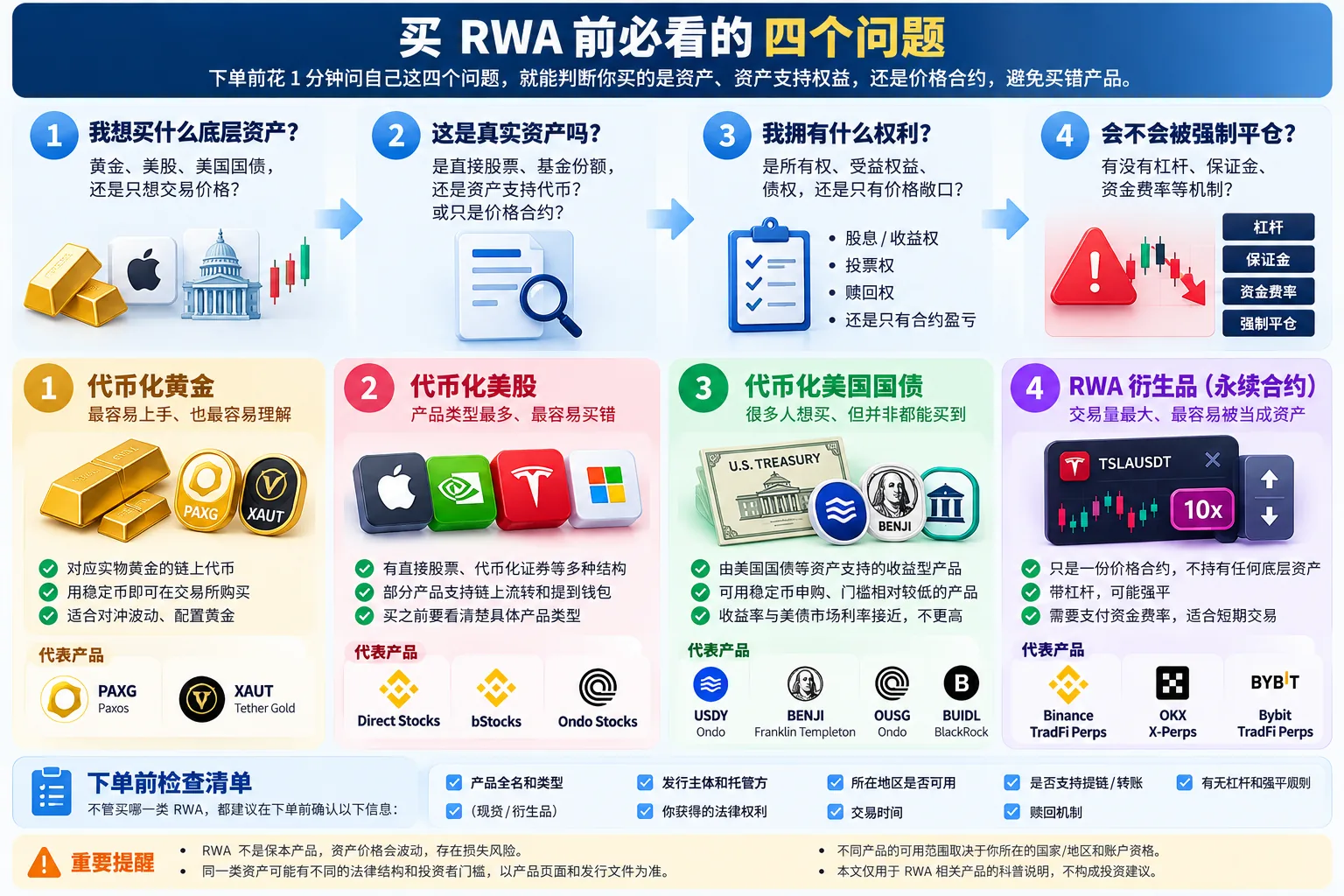
Chart: before buying RWA, confirm the underlying asset, product structure, rights held and whether leverage and liquidation risk exist. Regional restrictions and account eligibility depend on the official page.
Here are the four questions:
1. Who issues it?
Is it a securities firm, a fund, a trust, an SPV, or an exchange derivatives platform?
2. Is there a real underlying asset?
Is there real gold, a stock, a Treasury or a fund asset backing it?
3. What legal rights do you get?
Is it:
- direct stock rights;
- fund shares;
- a debt claim;
- an asset-backed security;
- or only contract profit and loss?
4. Can you be forced to close if the price falls?
An ordinary spot asset can fall a long way, but without borrowing and margin mechanics it will not be automatically liquidated at some price.
Derivatives are different.
When you see "leverage, margin, funding, liquidation", you should realize you are no longer in a simple hold-type RWA.
How do ordinary users buy RWA?
The path depends on what you want to buy.
Path 1: Buy tokenized gold
If your region supports it, search the exchange's spot market for:
- PAXG
- XAUT
Confirm it is Spot before trading.
Do not mix gold spot tokens with XAU perpetual contracts.
Path 2: Buy stocks
If your Binance account has stock services enabled, go to the stock entry point and confirm you have chosen:
- Direct Stocks;
- bStocks.
The two structures are different.
If you use Ondo Stocks, you also need to confirm eligibility in your location and read the relevant token's issuance documents.
Path 3: Buy Treasury-type RWA
Products such as USDY are usually accessed through the issuer, a wallet, a DeFi app or a supported platform.
Do not assume every tokenized Treasury can be found directly in Binance / OKX spot.
In particular:
- BUIDL;
- OUSG;
you cannot judge that you are eligible to subscribe directly just because "a token exists on-chain".
Path 4: Trade TradFi derivatives
Binance TradFi Perps, OKX X-Perps and similar products are a different route.
If you enter:
Futures / Derivatives / Perpetual / X-Perp
you should treat it as a derivative, not as "buying an asset".
These products may involve:
- margin;
- leverage;
- funding;
- forced liquidation;
- liquidity and price deviations outside trading hours.
They are not a replacement for a genuine long-term stock or gold holding.
Always check the order preview before buying
Whatever type of RWA you are buying, do not memorize an old fee table and order.
Check in particular:
| Item | Why it matters |
|---|---|
| Full product name | Prevents buying a derivative when you meant spot |
| Issuer | Identifies the real counterparty |
| Jurisdiction | Determines whether you are eligible |
| Fees | Costs differ by entry point |
| Bid-ask spread | The hidden cost of niche RWA can exceed the fee |
| Trading hours | Traditional securities and 24/7 tokens work differently |
| Withdrawal network | Determines whether you can move it to a self-custody wallet |
| Redemption rules | Being able to trade does not mean being able to redeem the underlying asset |
| Dividend mechanics | Cash payout, reinvestment and no dividend are three different things |
| Liquidation rules | Mandatory for derivatives |
What are the risks of RWA?
RWA does not automatically become a "low-risk asset" just because a real-world asset was moved on-chain.
At least the following layers matter.
1. Underlying asset risk
Gold falls, stocks fall, and US Treasury prices change with interest rates.
Going on-chain does not eliminate the asset's own risk.
2. Issuer and custody risk
Many RWA products depend on:
- the issuer;
- brokers;
- vaults;
- custodians;
- banks;
- security agents.
The blockchain may run normally while an off-chain institution still fails.
3. Legal rights risk
This is the easiest layer to miss.
"1:1 backed" only means there is asset backing; it does not automatically mean:
you are the direct owner of the underlying asset.
You have to read the issuance documents to see whether users hold:
- ownership;
- beneficial interest;
- a debt claim;
- a redemption right;
- a security interest;
- or merely economic exposure.
4. Smart contract and cross-chain risk
RWA that can be withdrawn on-chain adds another layer:
- smart-contract risk;
- private-key risk;
- bridge risk;
- network errors;
- DeFi protocol risk.
5. Liquidity risk
Traditional stocks are very liquid, but that does not mean the corresponding on-chain token has the same depth.
Before ordering, still check:
- the bid-ask spread;
- depth;
- redemption mechanics.
6. Regional restrictions
This is especially important.
The same product may be:
- completely unavailable in some countries;
- limited to professional investors in others;
- open to retail in some regions;
- governed by completely different rules for US and non-US users.
So do not assume your account can buy it just because someone else's screenshot shows a purchase.
What changed in US tokenized-stock regulation in 2026?
Here you also cannot keep using the old line from a few months ago that "regulation is completely unclear".
On September 17, 2026, the US SEC issued an Innovation Exemption for certain tokenized NMS stock trading.[8]
The arrangement gives eligible Tokenized Securities Venues a temporary, conditional exemption to conduct certain tokenized stock trading on-chain within a defined framework.
One important requirement is that tokenized NMS stocks under the framework must give holders the same relevant rights and benefits as the corresponding traditional securities; there are also conditions on trading volume, disclosure and smart-contract audits.
However, this is a five-year, conditional temporary exemption framework, and it does not mean every tokenized stock automatically gets the same regulatory status in the US.
So the more accurate description is:
The US regulatory framework for tokenized stocks clearly moved forward in 2026, but each product still has to be judged by its issuance method, trading venue and applicable rules.
Which type fits which need?
Do not start from product names; start from the need.
| Your need | What to study first |
|---|---|
| On-chain gold exposure | Gold-backed tokens such as PAXG / XAUT |
| Direct ownership of stock rights | Direct Stocks or stocks at a traditional broker |
| Put stock economic exposure on-chain | Tokenized securities such as bStocks and Ondo Stocks |
| Hold stablecoins and want short-term Treasury yield | Retail or semi-retail products such as USDY |
| Study institutional on-chain Treasury funds | BUIDL, OUSG, etc., but check eligibility first |
| Just trade short-term stock or gold prices | TradFi derivatives, but understand leverage and liquidation first |
The core is still this sentence:
Do you want an asset, an asset-backed on-chain right, or a price contract?
Once that is clear, most RWA products are hard to buy wrong.
FAQ
What does RWA stand for?
RWA stands for Real World Assets.
Broadly, it includes products that connect real-world assets or related economic rights — stocks, bonds, US Treasuries, gold, real estate, private credit — to a blockchain.
Are PAXG and XAUT real gold?
They are not gold bars in your hand; they are on-chain tokens backed by physical gold.
In PAXG's official structure, each token corresponds to one troy ounce of London Good Delivery gold.
If your goal is to obtain physical bars, you still need to check the issuer's physical redemption conditions and minimum thresholds.
Is a tokenized stock the same as a stock?
Not necessarily.
For example:
Direct Stocks is a direct stock product;
bStocks is a tokenized security backed by underlying securities, but Binance clearly states it is not the underlying company's stock itself;
Ondo Stocks is backed by underlying securities and provides related economic exposure, but the token itself is not the underlying stock;
stock perpetuals / X-Perps are simply derivatives.
So do not assume you have become a shareholder just because you see a ticker.
Are Ondo stock tokens synthetic assets?
You cannot simply describe them that way anymore.
As of September 2026, official Ondo materials state that Ondo Stocks is backed by the corresponding stocks, ETFs and any necessary cash in transit, with asset verification and collateral mechanisms.
But the Ondo Stocks token itself is still not the underlying stock and does not automatically give holders direct ownership of the corresponding underlying security.
So the more accurate description is:
it is an asset-backed tokenized stock product, not a pure price-synthetic token with no underlying asset backing.
Can ordinary people buy BlackRock BUIDL?
For the vast majority of retail investors, direct subscription is not realistic.
BUIDL is aimed at eligible institutions and investors and has high access requirements.
Being able to look up BUIDL on-chain does not mean any wallet can buy directly from the issuer.
Is USDY a US Treasury?
No.
USDY is a yield-bearing token issued by Ondo, backed by short-term US Treasuries, bank deposits and similar assets.
So it provides yield related to those underlying assets, but USDY itself is not a Treasury security issued by the US Treasury.
What is USDY's yield?
At the time of verification in September 2026, Ondo's website showed about 3.60% APY.
That number changes.
Do not treat 3.60% in an article as a future fixed rate; check the official page again before subscribing.
Is BENJI really only $20?
Some Franklin Templeton retail on-chain fund products have minimum initial investments as low as about $20.
But eligibility requirements differ by country, fund version and distribution channel.
So the correct understanding is:
the existence of a $20-level retail product does not mean users worldwide can buy it unconditionally.
Can RWA perpetual contracts get liquidated?
Yes.
Any margin derivative carries forced-liquidation risk.
Binance TradFi Perps and OKX X-Perps do not become spot assets just because the name contains a stock or gold.
Is OKX X-Perp really perpetual?
As of September 2026, OKX Europe's official specifications define its stock and commodity X-Perps as expiry futures with a maximum five-year term and a funding-rate mechanism.
So do not simply treat them as ordinary crypto perpetual contracts.
Check the specific contract specifications for expiry dates, leverage and trading rules.
So how do you choose?
If you remember only three things from this article, remember these:
First, look at the underlying.
Gold, stocks, US Treasuries or another asset?
Second, look at the rights you get.
Direct ownership, fund shares, a debt claim, an asset-backed token, or only a price contract?
Third, check whether you can actually buy the product.
Confirm KYC, location, investor eligibility, minimum amount and trading entry point.
The hard part of RWA has never been memorizing a list of project names.
It is being able to look at a new product and immediately judge:
Is there an asset underneath? Who holds it? What rights do I have? Who do I go to if something goes wrong?
If you can answer those four questions, you actually understand an RWA product.
If you're planning to sign up for Binance or OKX
Binance registration (code AMY568): https://www.binance.com/join?ref=AMY568
OKX registration (code AMY568): https://www.okx.com/join/AMY568
These are affiliate links. If you register through them, you may receive the benefits available under the promotion at the time, and this site may earn a commission; it does not cost you extra. The exact benefits are shown on the registration page.
See our affiliate disclosure.
Related reading
If you want to compare gold and Bitcoin further:
Can Bitcoin replace gold? BTC, gold or PAXG (2026)
If you want to understand the risks of stablecoins themselves:
Could USDT collapse? Is Tether safe? Reserves, audits and freeze risk explained (2026)
If you are preparing to buy tokenized stocks:
Binance Direct Stocks vs bStocks: real stocks and tokenized stocks (2026)
Data verification note
The key facts in this article were checked on 2026-10-16, one by one:
- RWA market size: in late September 2026, on-chain Distributed Asset Value was about $38.5 billion (excluding separately tracked stablecoins), of which tokenized US Treasuries and related money-market products were about $15 billion; different definitions should not be mixed. Source: RWA.xyz data platform.
- PAXG structure: each PAXG corresponds to 1 troy ounce of London Good Delivery gold, held in LBMA-approved London vaults; it is not a gold-price perpetual contract. Source: Paxos PAX Gold official page.
- XAUT structure: designed around one token per troy ounce of gold and backed by physical gold. Source: Tether Gold official page.
- Nature of Direct Stocks: Binance Direct Stocks offers thousands of US stocks and ETFs, and users receive direct stock rights through the regulated securities system. Source: Binance Academy, "What is Binance Stocks Trading".
- bStocks issuer: bStocks is issued by BTech Holdings Limited and is a tokenized security, not the underlying listed company's stock itself. Source: Binance Academy bStocks guide.
- Ondo Stocks backing structure: backed by the corresponding stocks, ETFs and any necessary cash in transit, held by a US-registered broker or qualified custody arrangement; the token itself is not the underlying stock. Source: Ondo Finance official Ondo Stocks product page.
- USDY yield and eligibility: Ondo's website showed about 3.60% APY in September 2026; direct subscriptions and redemptions are mainly for eligible non-US individuals and institutions, and yields change. Source: Ondo Finance official USDY product page.
- SEC tokenized-stock exemption: on 2026-09-17 the SEC issued the Tokenized NMS Stock Innovation Exemption, giving eligible Tokenized Securities Venues a five-year conditional temporary exemption; it does not mean all tokenized stocks are automatically compliant in the US. Source: US SEC press release 2026-90.
Disclaimer
This article is for education and structural explanation of real-world assets (RWA), tokenized securities and related products. It is not investment advice, a securities recommendation, legal advice or tax advice.
Gold tokens, tokenized stocks, tokenized US Treasury products, funds and derivatives all carry risk of loss.
The legal rights of an asset-backed token may differ from directly holding the underlying security; margin derivatives such as TradFi Perpetuals and X-Perps also carry leverage, funding and forced-liquidation risk.
Product availability depends on location, KYC information, investor eligibility and platform rules. Before trading, read the relevant issuance documents, risk disclosures and the product terms shown in your account.
Exchange operations · USDT · Wallet security
Responsible for researching and organizing content on Binance, OKX, USDT transfers, withdrawals and wallet security. The steps and key data in this article are verified according to the content type, using real operation records, official platform documentation and public sources. Interfaces, fees and regional rules may change, so the article is reviewed and updated continuously.
Status: manual review · Last verified 2026-10-16
Reviewed by: Veldux editorial team
- RWA.xyz data platformIn late September 2026, on-chain Distributed Asset Value was about $38.5 billion, of which tokenized US Treasuries and related money-market products accounted for about $15 billion
- Paxos PAX Gold official pageEach PAXG corresponds to 1 troy ounce of London Good Delivery gold, held in LBMA-approved vaults
- Tether Gold official pageXAUT is designed around one token per troy ounce of gold and is backed by physical gold
- Binance Academy, "What is Binance Stocks Trading"Binance Direct Stocks offers thousands of US stocks and ETFs, and users receive direct stock rights
- Binance Academy bStocks guidebStocks is issued by BTech Holdings Limited and is a tokenized security, not the underlying listed company's stock itself
- Ondo Finance official Ondo Stocks product pageOndo Stocks is backed by underlying securities and any necessary cash in transit; the token itself is not the underlying stock
- Ondo Finance official USDY product pageUSDY offers about 3.60% APY, and direct subscriptions and redemptions are mainly for eligible non-US individuals and institutions
- US SEC press release 2026-90Issued 2026-09-17, the Tokenized NMS Stock Innovation Exemption is a five-year conditional temporary exemption
- 2026-10-16UpdateAdded the evidence-chain superscripts and the "Data verification note", and updated the fact-check date.
Editorial principles ineditorial policy,corrections policy。