
Is USDT safe? Tether reserves, audit and freeze risk (2026)
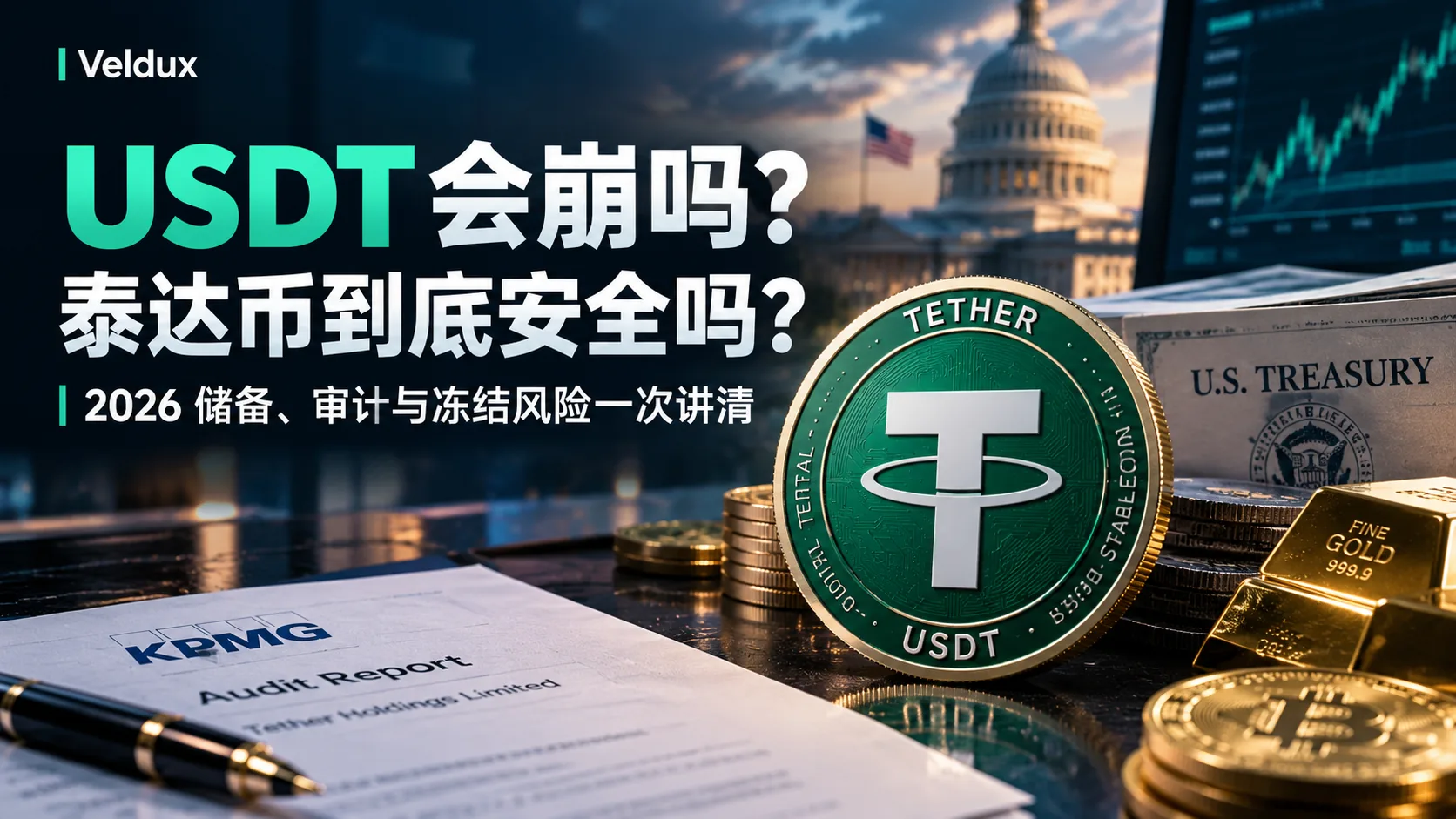
Table of contents

Binance new-user benefit
20% fee rebate
Official Binance sign-up · You must complete identity verification (KYC) to trade and withdraw
Most people start thinking seriously about USDT risk not because it moved, but because a question suddenly lands:
Is the 10,000, 100,000 or more USDT in my account really worth that many dollars, all the time?
That question can't be answered with "USDT is safe" or "USDT will blow up any minute".
As of September 2026, the picture behind USDT is much clearer than a few years ago. Tether has moved most of its reserves into US Treasuries, and in 2026 it completed its first full financial statement audit with an opinion from KPMG. On that evidence, there is no sign that USDT is in a death spiral like UST in 2022.
But that doesn't make holding USDT the same as a bank deposit.
What you actually need to know is why it holds $1, when it might depeg, and one frequently overlooked point: even if USDT itself doesn't collapse, your USDT can be temporarily stuck because of an address freeze, an exchange risk control or a cash-out problem.
This is a 12-minute read. If you only have two minutes, the two traps most likely to cost you money are assuming a cold wallet protects you from an issuer freeze, and confusing a frozen bank account from a P2P trade with Tether freezing your coins.
This article explains all of it.
This article discusses USDT's reserves, issuance mechanism and use risks; it is not investment advice. Stablecoins are not bank deposits, are not covered by deposit insurance, and no stablecoin is "guaranteed never to have a problem".
USDT and UST back then are not the same thing
When people hear "stablecoin collapse", many think first of UST in 2022.
That easily creates confusion.
UST's core problem was that it didn't have enough dollar assets sitting there waiting for users to redeem. It held its $1 peg mainly through minting, burning and arbitrage between UST and LUNA.
When the market stopped believing in that mechanism, selling grew, LUNA collapsed too, and the whole system entered a death spiral.
USDT doesn't work that way.
Tether's model is closer to:
For every USDT issued in the market, the issuer holds a corresponding amount of reserve assets.
Those reserves aren't all cash in bank accounts. A large share is short-term US Treasuries and other liquid assets, and they also include gold, bitcoin and other holdings.
So don't stop at the word "stablecoin". The more useful question is: does Tether hold enough assets, and if a wave of redemptions comes, can it turn them into dollars in time?
What does Tether actually hold now?
Tether's Q1 2026 disclosure is worth looking at.
As of 31 March 2026, Tether reported:
| Item | Approximate figure |
|---|---|
| Total assets | $191.77 billion |
| Total liabilities | $183.54 billion |
| Liabilities linked to tokens issued | $183.44 billion |
| Assets in excess of liabilities | $8.23 billion |
| Direct and indirect US Treasury exposure | about $141 billion |
| Gold | about $20 billion |
| Bitcoin | about $7 billion |
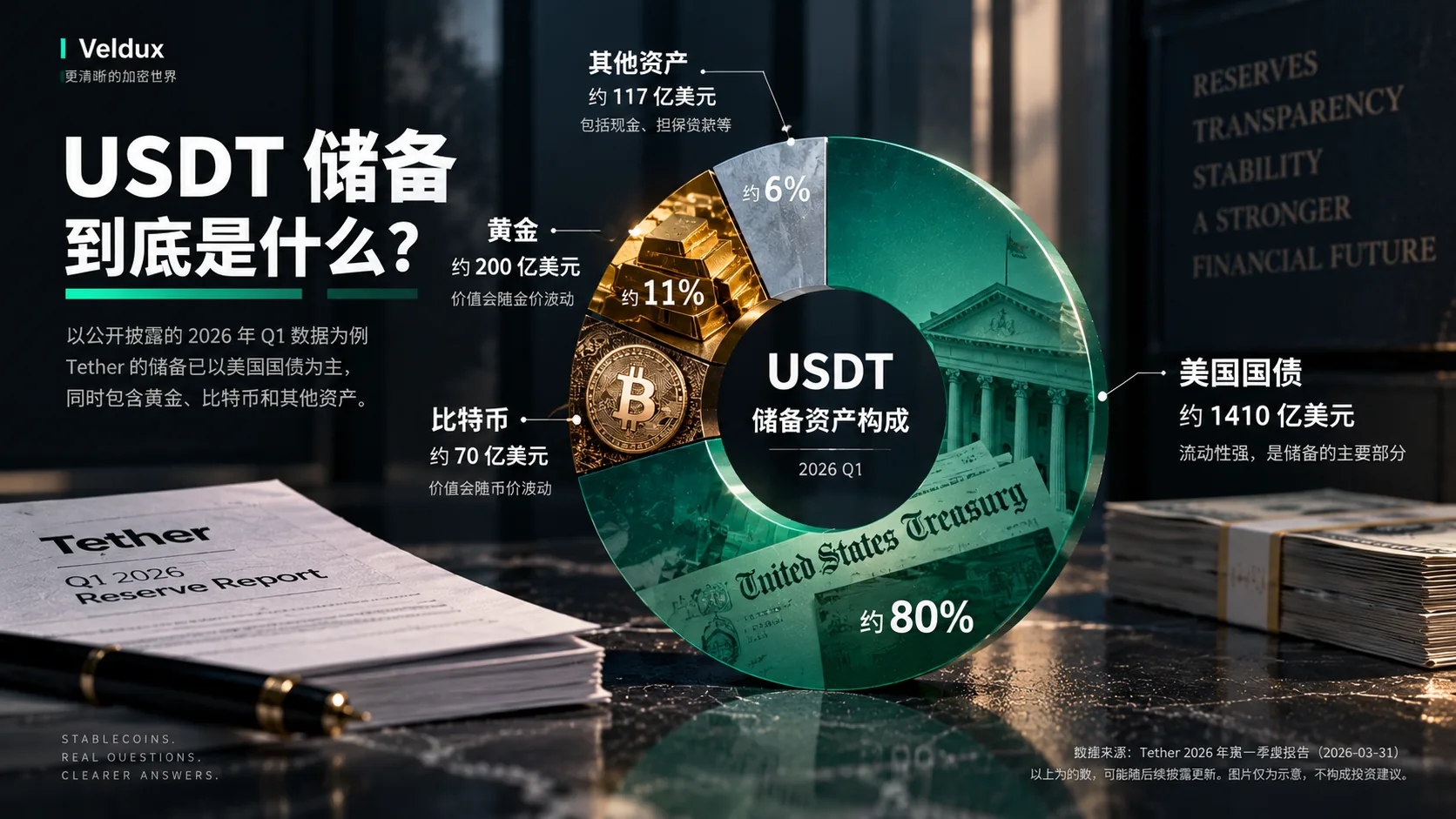
At least from this balance sheet, the situation is not "they issued over $180 billion of USDT and nobody knows where the money is".
US Treasuries have become the dominant part of the reserves. For a stablecoin, that matters more than "how large total assets are", because in a redemption wave, how fast assets can be liquidated directly determines whether the issuer can pay dollars out.[2]
But don't swing to the other extreme either:
Assets exceeding liabilities doesn't mean nothing can ever go wrong.
Tether's reserves still include gold, bitcoin and other assets whose prices move. If those fall sharply in the short term, the buffer shrinks.
So I prefer to understand today's USDT as:
The asset backing is clearly stronger than it used to be, but it is still a centralized stablecoin issued by a private company.
That's much more accurate than simply saying "safe" or "unsafe".
An important change: Tether finally completed a full audit
The criticism USDT faced most over the years was:
Why, for so many years, was there only an attestation and never a full audit?
Those two things are not the same.
What Tether used to publish periodically were reserve proofs or attestation reports. An accounting firm checked assets and liabilities at a point in time and confirmed whether the disclosed figures matched reality.
A full financial statement audit covers a much wider scope: the financial statements, transaction records, valuations, asset ownership, internal evidence and more.
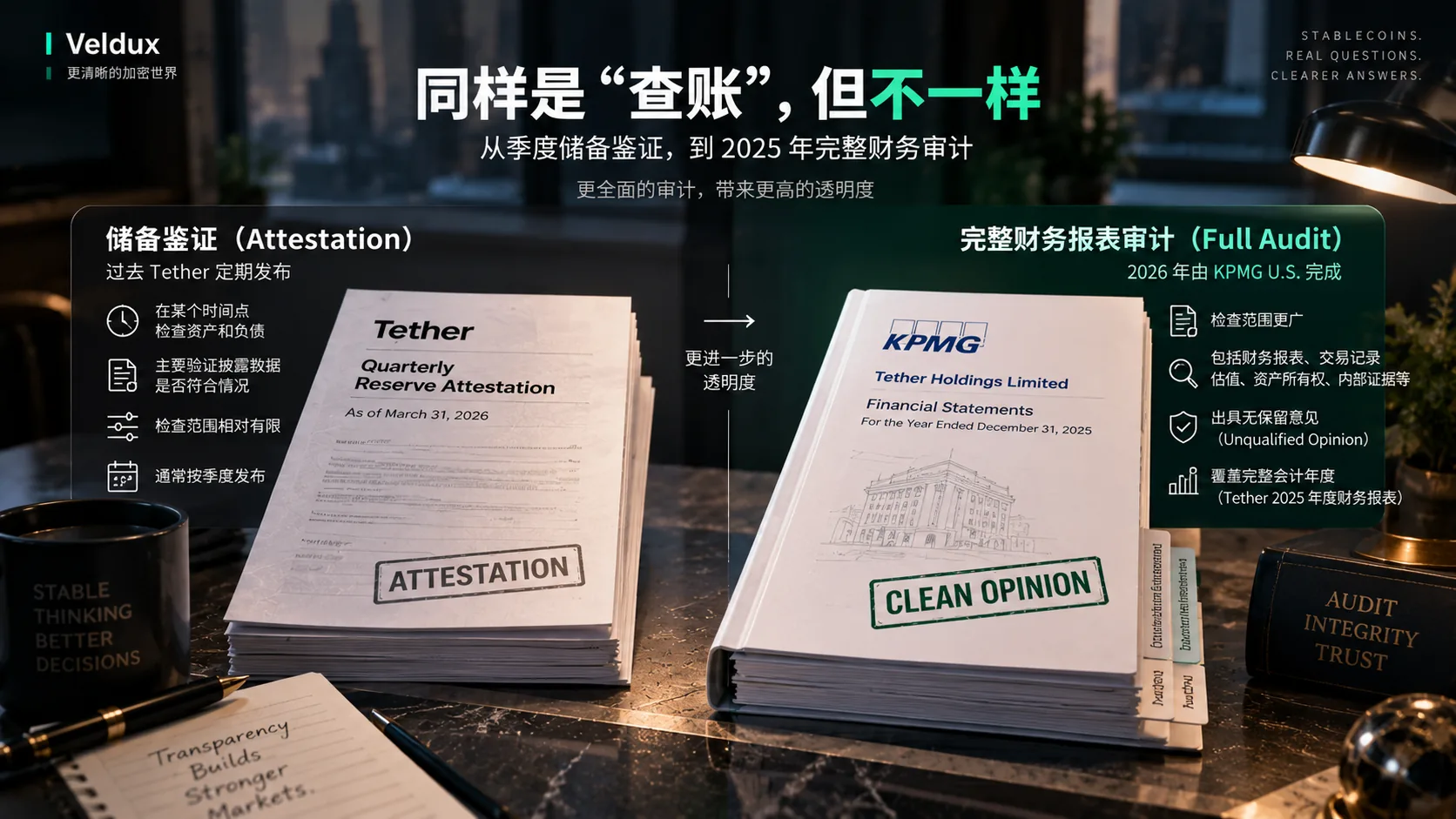
That long-criticized gap finally saw a real change in 2026.
In August 2026, Tether announced that KPMG U.S. had completed the first full independent audit of its 2025 financial statements, with an unqualified opinion.
KPMG's opinion holds that the financial statements fairly present, in all material respects, Tether's financial position at the end of 2025. In the audited figures Tether disclosed, reserves exceeded related liabilities by about $6.814 billion.[1]
This should be viewed objectively.
It does not prove:
"USDT is absolutely safe from now on."
But it does change the old situation:
"Tether has never had a full audit."
So if you still see articles in 2026 saying "USDT has never had a full audit", that source is out of date.
So can USDT still depeg?
Yes.
A stablecoin being called "stable" doesn't mean its market price is always exactly $1.0000.
USDT has deviated from $1 several times in its history.
One of the more serious episodes was in 2018. The market was deeply worried about Tether's banking relationships and reserves, and on some trading venues USDT fell to roughly $0.90.
There was another, smaller stress episode in 2023. The USDT share in a Curve stablecoin pool became clearly unbalanced, and USDT briefly fell to about $0.997.
Note that in the 2023 Silicon Valley Bank episode, the asset that depegged sharply to about $0.87 was USDC, not USDT. USDT at the time briefly traded above $1 on safe-haven flows, so don't mix the two events up.[3]
That history shows one thing:
USDT can depeg, but depegging and going to zero are completely different concepts.
If panic hits the market, USDT trading at 0.99, 0.98 or lower on exchanges isn't surprising.
The genuinely serious scenario is the market starting to doubt that Tether can handle large-scale redemptions at close to $1.
Only at that point does it make sense to discuss a systemic run.
The publicly available reserve data and the full audit do not currently show that happening.
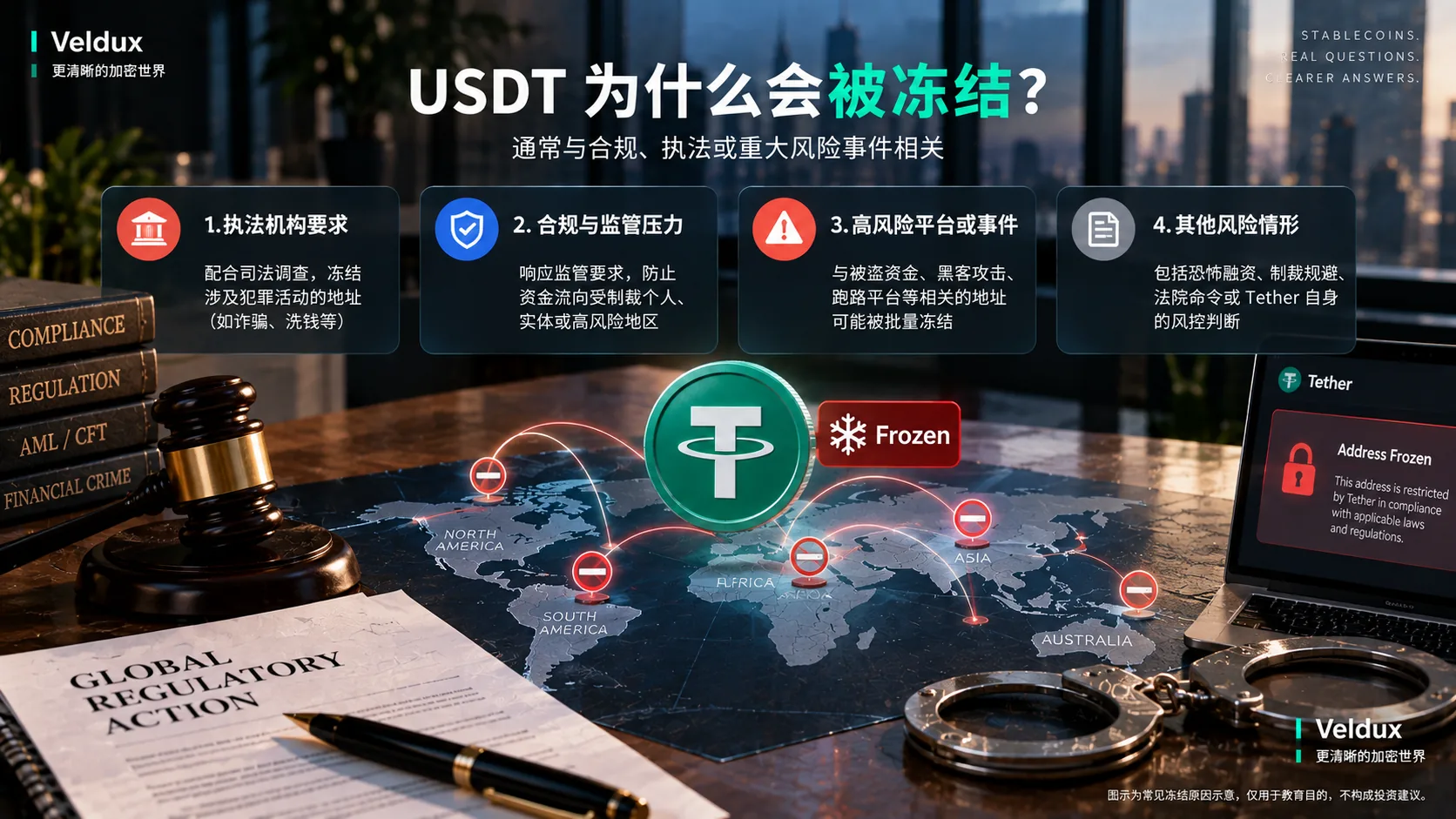
A more realistic risk many people ignore: USDT can be frozen
If you only ask "will USDT go to zero", it's easy to miss the most important feature of a centralized stablecoin:
Tether has the ability to freeze specific on-chain addresses.
This is completely different from bitcoin.
There is no "Bitcoin company" on the Bitcoin network that can make the BTC in an address untransferable because it received a notice from law enforcement.
USDT has an issuer.
Tether can blacklist specific addresses on sanctions, law-enforcement investigation or anti-money-laundering grounds.
In December 2023, Tether publicly announced an expanded voluntary freeze policy, applying freezes to addresses linked to the OFAC SDN sanctions list.[4] In April 2026, Tether announced that, in coordination with the US government, it had frozen more than $344 million in USDT across two addresses.[8]
That doesn't mean "ordinary people will be confiscated by Tether at any moment".
The vast majority of these actions involve fraud, money laundering, hacks, sanctions or law-enforcement investigations.
But it reveals an unavoidable property of USDT:
You can hold the private keys to your USDT yourself, but the USDT asset itself is still controlled by its issuer.
That is one of the biggest differences between "self-custodied USDT" and "self-custodied BTC".
Your own wallet doesn't put you beyond the issuer's reach
Many beginners think:
"If I move my USDT from Binance to a cold wallet, nobody can touch my coins."
That's only half true.
A cold wallet does solve exchange custody risk.
If the exchange fails, restricts withdrawals or your account is hacked, then as long as the coins are in your wallet and you've protected the private key, the exchange can't reach them.
But a cold wallet does not solve a freeze by the USDT issuer.
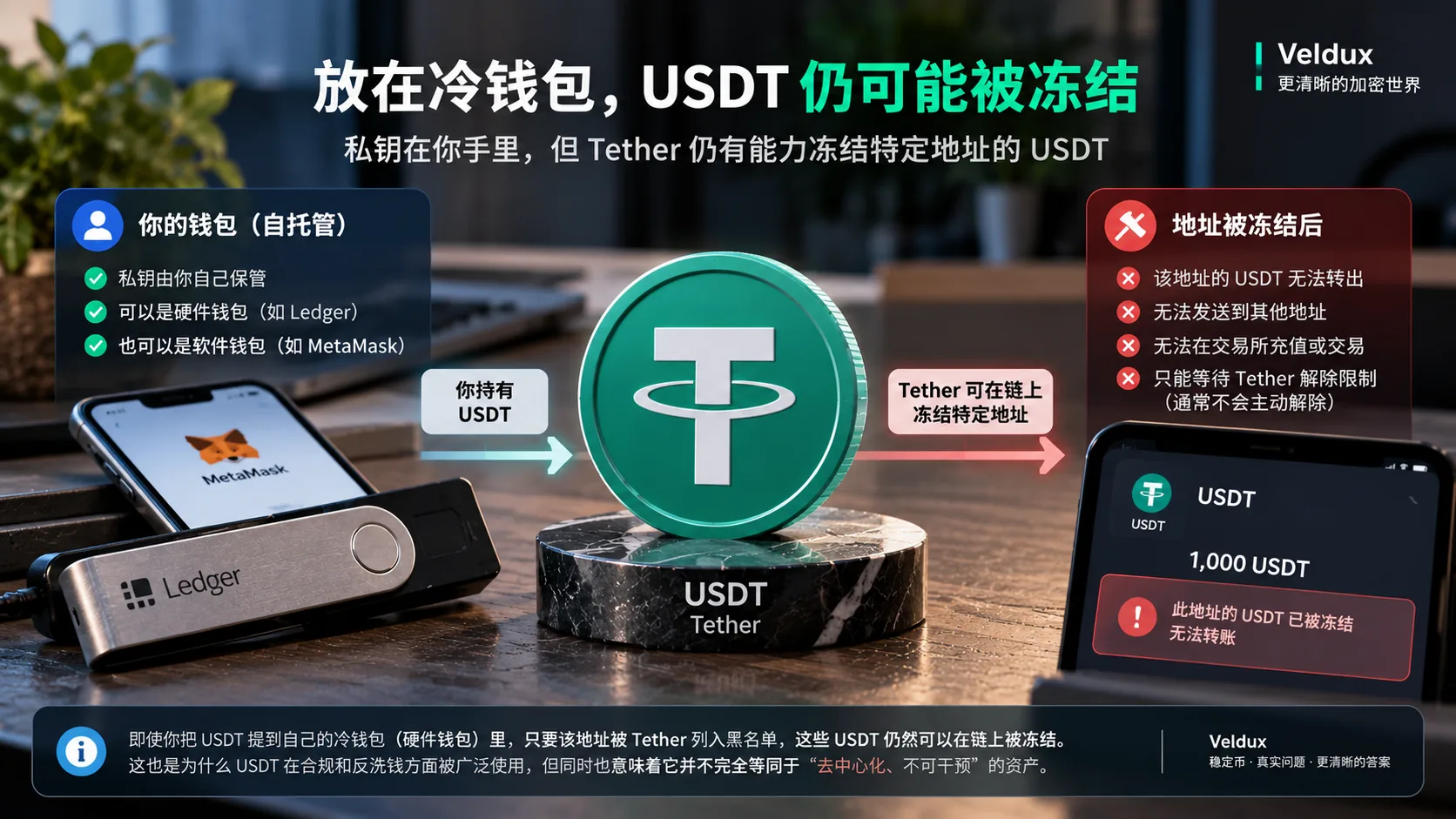
If Tether blacklists a USDT address, those USDT may not be transferable even if the seed phrase is still in your hands.
So:
"The coins are in my own wallet" and "this asset is fully decentralized" are two different concepts.
This is worth getting clear as a beginner.
What ordinary users actually run into isn't a USDT collapse
If you just buy and transfer coins normally, a sudden collapse of Tether's reserves isn't what you should fear every day.
More common losses usually happen elsewhere.
Getting tainted money when cashing out through P2P
For example, you sell USDT and the counterparty sends money to your bank account or to a payment app you use.
Nothing was wrong with the USDT, but if the other side's money is tied to fraud or an investigation, your receiving account can end up under a risk control.
That's why in a P2P trade you can't just look at:
"who pays the most".
Trading history, volume, completion rate, registration date, merchant identity and payment method often matter more than that small difference in price.
Those indicators only help you rule out some clearly abnormal counterparties; they can't prove the money the counterparty pays you is clean.
I wrote about this separately: how to cash out USDT to your bank: Binance / OKX selling and frozen-account risk.
Sending on the wrong network
Another common problem is choosing a withdrawal network the receiving platform doesn't support, or a mismatched address and network. An on-chain transaction usually can't be reversed once confirmed; whether it can be recovered depends on whether the receiving platform offers manual recovery, and some cases involve a recovery fee.
If you still can't tell TRC20, ERC20 and BEP20 apart, start here: which network to use for USDT transfers.
Private-key and exchange-account risk
Keep USDT on an exchange and you carry platform custody and account security risk.
Move USDT to a wallet and you carry seed-phrase, private-key, approval and phishing risk.
No approach removes all risk; it just moves the risk from one place to another.
Why do you see less and less USDT in Europe?
This is another kind of risk: not USDT going to zero, but a region making it inconvenient to use.
After MiCA took effect in the EU, stablecoin issuers and crypto asset service providers faced clearer licensing and regulatory requirements. On 1 July 2026, the relevant transitional period for CASPs ended across the EU.[5]
Because USDT hasn't obtained the compliance arrangement Circle's USDC has for issuing e-money tokens under MiCA, some platforms serving European users have restricted or delisted USDT-related services.
This isn't a signal that "USDT is about to collapse".
More precisely, it's:
regulatory availability risk.
If you operate mainly in Asia, Latin America or other markets where USDT is heavily used, you may not notice it.
But if you live in the EU and need to hold or trade stablecoins on licensed platforms over the long term, USDC is often more convenient.
The US now has a stablecoin law; next comes implementation
The US situation differs from Europe. The GENIUS Act was signed into law on 18 July 2025, creating a federal regulatory framework for payment stablecoins covering reserves, disclosure and issuer eligibility. The question has shifted from "will there be legislation" to "how will the specific rules be enforced", and in 2026 the US Treasury is still drafting implementing rules.[6]
For USDT, what's really worth watching isn't one day's headline, but:
how US rules for "foreign stablecoin issuers" will ultimately be enforced.
That may determine how usable USDT is in US regulated trading platforms, payment institutions and the financial system.
So regulatory risk and reserve risk need to be looked at separately.
Even with sufficient reserves, USDT can become inconvenient in some markets because of regulatory change.
How do I look at USDT and USDC?
If you have to pick one, there's no need to turn it into "which one is absolutely safe".
Both are centralized dollar stablecoins, and both give the issuer control capability.
The difference is mainly in the use case.
| Dimension | USDT | USDC |
|---|---|---|
| Issuer | Tether | Circle |
| Biggest advantage | Deep global trading liquidity and broad exchange support | Stronger compliance framework and reserve disclosure |
| Reserve disclosure | Quarterly reserve reports; completed its first full financial audit in 2026 | Monthly third-party attestation plus higher-frequency reserve information |
| EU MiCA | Some European platforms restrict related services | Has established a MiCA-compliant issuance framework |
| Address freeze capability | Yes | Yes |
| Common uses | Trading, transfers, P2P | Regulated platforms, institutions and some DeFi use cases |
Circle currently obtains a monthly third-party attestation on USDC reserves and publishes reserve information more frequently; Tether, for its part, closed one of its biggest transparency gaps in 2026 with its first full financial audit.[7]
So using:
"USDT has no audit, USDC does."
to distinguish the two is no longer accurate.
If I'm just buying coins temporarily, trading or moving funds between platforms, USDT's liquidity remains very convenient.
If I'm parking a dollar stablecoin position for a long period, I care more about the issuer, the regulatory environment, redemption channels and diversification than about which coin has the largest volume.
If you're torn between the two, read this next: USDT vs USDC: which one suits you.
So should you hold USDT long term?
There's no amount that suits everyone.
But I distinguish between "using USDT" and "saving in USDT".
For example:
Today I deposit 5,000 USDT to buy BTC, and the USDT sits in the account for a few days.
Versus:
I convert my entire savings of several years into 200,000 USDT and plan to leave it there for three years.
These are completely different risk levels.
In the first case, you're mainly using USDT's liquidity.
In the second, you're effectively taking on Tether's credit, regulatory, reserve and freeze rules over the long term.
So the question was never:
"Can I hold USDT?"
but:
"Do I really need to keep this large a share of my assets parked long-term with a single stablecoin issuer?"
The larger the amount and the longer the horizon, the more seriously that question deserves.
If someone says "USDT is about to collapse" tomorrow, what do I check first?
My first reaction wouldn't be to see who shouts loudest in a group chat, but to open the major markets and look at the price. One small exchange suddenly printing 0.97 is a completely different thing from Binance, OKX and Coinbase all deviating clearly from $1 at the same time.
Next comes redemption. A brief dip to 0.99 doesn't necessarily mean reserves are broken; what deserves real alarm is a large number of users demanding redemption while Tether's redemptions start behaving abnormally.
If the pressure persists, then go to the latest reserve report. At that point "total assets exceed total liabilities" isn't enough; you need to see what the assets are. Short-term Treasuries, cash, loans, gold and BTC don't have the same liquidity under stress.
Finally, confirm whether it's a regulatory event. Sometimes an exchange delists USDT simply because the rules in its region changed, with no direct link to the health of Tether's reserves.
FAQ
Does USDT really have dollar backing?
More precisely: USDT is backed by reserve assets, but not by one dollar bill sitting quietly in a bank account for every USDT issued.
The reserves consist mainly of US Treasuries and other assets.
As of Q1 2026, Tether reported total assets of about $191.77 billion, total liabilities of about $183.54 billion, and direct and indirect US Treasury exposure of about $141 billion.[2]
Does USDT now have a full audit?
Yes.
KPMG U.S. completed the first full independent audit of Tether's 2025 financial statements in 2026, with an unqualified opinion.
This is not the same as the quarterly reserve attestations of the past.[1]
Could USDT suddenly go to zero like UST?
No one can guarantee that any stablecoin will never experience an extreme event.
But USDT and UST work differently.
UST held its price mainly through an algorithm and LUNA arbitrage; USDT holds large-scale reserve assets behind it. Their risk structures can't be compared directly.
What matters is the quality of Tether's reserves, its redemption capacity and market confidence.
Can USDT be frozen?
Yes.
Tether's contract includes blacklist and freeze capability, and it has repeatedly coordinated with law enforcement to freeze addresses.
Normal use doesn't mean you're likely to be frozen, but if funds are tied to fraud, money laundering, sanctioned addresses or another investigation, the issuer does have the power to intervene.
Can USDT in a cold wallet still be frozen?
Yes.
A cold wallet solves who controls the private key; it doesn't remove the USDT contract's freeze function.
So USDT is an asset you can self-custody, but not one without a central issuer, the way BTC is.
Is USDT suitable for long-term saving?
As an intermediate tool for buying coins, trading and transfers, USDT is very convenient.
If you plan to put a large share of family savings into a single stablecoin for the long term, you need to weigh issuer, regulatory, freeze, reserve and single-asset concentration risk.
"A stable price" doesn't mean "no credit risk".
So how should you view USDT?
If you force me to sum it up in one sentence, I wouldn't say "USDT is very safe", nor "USDT will go to zero eventually".
I'd say:
By 2026, USDT is far more transparent than it used to be and has large-scale real assets behind it, but it is still a centralized dollar stablecoin issued by a private company, able to freeze addresses, and exposed to regulatory change.
Those characteristics have to be read together.
Its advantages are obvious: deep liquidity, broad exchange support, convenient transfers and large global usage.
Its limits are just as clear: you have to trust Tether's reserve management, trust that it can keep processing redemptions, and accept that the issuer has the power to freeze assets.
So for most ordinary users, the most reasonable approach probably isn't worrying every day about whether USDT collapses tomorrow, but:
Use it when you need to trade, use it when you need to transfer, but don't mistake a permanent $1 display for the same thing as a dollar in the bank.
If you're going to keep using USDT, continue with:
- How to buy USDT on Binance
- How to buy USDT on OKX: complete P2P tutorial
- How to cash out USDT to your bank: withdrawal and frozen-account risk
- Which network to use for USDT transfers?
- Where to keep your coins after buying: exchange vs wallet
Data verification note
The key facts in this article were checked on 2026-10-16, one by one:
- KPMG's first full financial audit: in August 2026 Tether announced that KPMG U.S. had completed the first full independent audit of its 2025 financial statements with an unqualified opinion, disclosing reserves above related liabilities by about $6.814 billion. Source: Tether official announcement — first full financial audit.
- Q1 2026 reserves and balance sheet: as of 2026-03-31, Tether reported total assets of about $191.77 billion, total liabilities of about $183.54 billion, direct and indirect US Treasury exposure of about $141 billion, gold of about $20 billion and bitcoin of about $7 billion. Source: Tether Q1 2026 results and reserve disclosure.
- The 2023 depeg was USDC, not USDT: in the Silicon Valley Bank episode, the stablecoin that depegged sharply to about $0.87 was USDC; USDT briefly traded above $1 on safe-haven demand. Source: The Block — Data & Insights (2023-06).
- Address freeze policy: in December 2023 Tether expanded its voluntary freeze policy, applying measures to addresses linked to the OFAC SDN sanctions list. Source: Tether freeze policy announcement (2023-12).
- EU MiCA transitional period: the MiCA transitional period for CASPs ended across the EU on 2026-07-01. Source: ESMA statement on the end of the MiCA transitional periods.
- US GENIUS Act: signed into law on 2025-07-18, creating a federal regulatory framework for payment stablecoins. Source: White House statement on signing S.1582.
- USDC reserve disclosure: Circle obtains a monthly third-party attestation on USDC reserves and publishes higher-frequency reserve information. Source: Circle transparency and reserve disclosure.
- 2026 enforcement freeze case: in April 2026 Tether coordinated with the US government to freeze more than $344 million in USDT across two addresses. Source: Tether announcement on freezing $344 million in USDT with OFAC.
Disclaimer
This article is for education on stablecoin mechanics and risk only. It is not investment, trading or financial advice, and it is not a guarantee of the safety of USDT, USDC or any other digital asset.
Stablecoins carry depeg, issuer, reserve, regulatory, freeze, trading-platform and operational risk. For large amounts, judge according to your own circumstances and comply with the laws of your jurisdiction.
Exchange operations · USDT · Wallet security
Responsible for researching and organizing content on Binance, OKX, USDT transfers, withdrawals and wallet security. The steps and key data in this article are verified according to the content type, using real operation records, official platform documentation and public sources. Interfaces, fees and regional rules may change, so the article is reviewed and updated continuously.
Status: manual review · Last verified 2026-10-16
Reviewed by: Veldux editorial team
- Tether official announcement — first full financial auditIn August 2026 KPMG U.S. completed the first full independent audit of Tether's 2025 financial statements with an unqualified opinion; reserves exceeded related liabilities by about $6.814 billion
- Tether — Q1 2026 results and reserve disclosureAs of 2026-03-31, total assets of about $191.77 billion and total liabilities of about $183.54 billion; direct and indirect US Treasury exposure of about $141 billion, gold of about $20 billion and bitcoin of about $7 billion
- The Block — Data & Insights (2023-06)In the 2023 Silicon Valley Bank episode, the stablecoin that depegged sharply to about $0.87 was USDC, not USDT; USDT briefly traded above $1 on safe-haven demand
- Tether freeze policy announcement (2023-12)In December 2023 Tether expanded its voluntary freeze policy, applying freezes to addresses linked to the OFAC SDN sanctions list
- ESMA statement on the end of the MiCA transitional periodsThe MiCA transitional period for CASPs ended across the EU on 2026-07-01
- White House statement on signing S.1582The GENIUS Act was signed into law on 2025-07-18, creating a federal regulatory framework for payment stablecoins
- Circle — transparency and reserve disclosureCircle obtains a monthly third-party attestation on USDC reserves and publishes reserve information at a higher frequency
- Tether announcement on freezing $344 million in USDT with OFACIn April 2026 Tether coordinated with the US government to freeze more than $344 million in USDT across two addresses
- 2026-10-16UpdateAdded the evidence-chain superscripts and the "Data verification note", and updated the key-fact verification date.
Editorial principles ineditorial policy,corrections policy。