
USDT vs USDC: differences, reserves, freeze risk and cash out (2026)
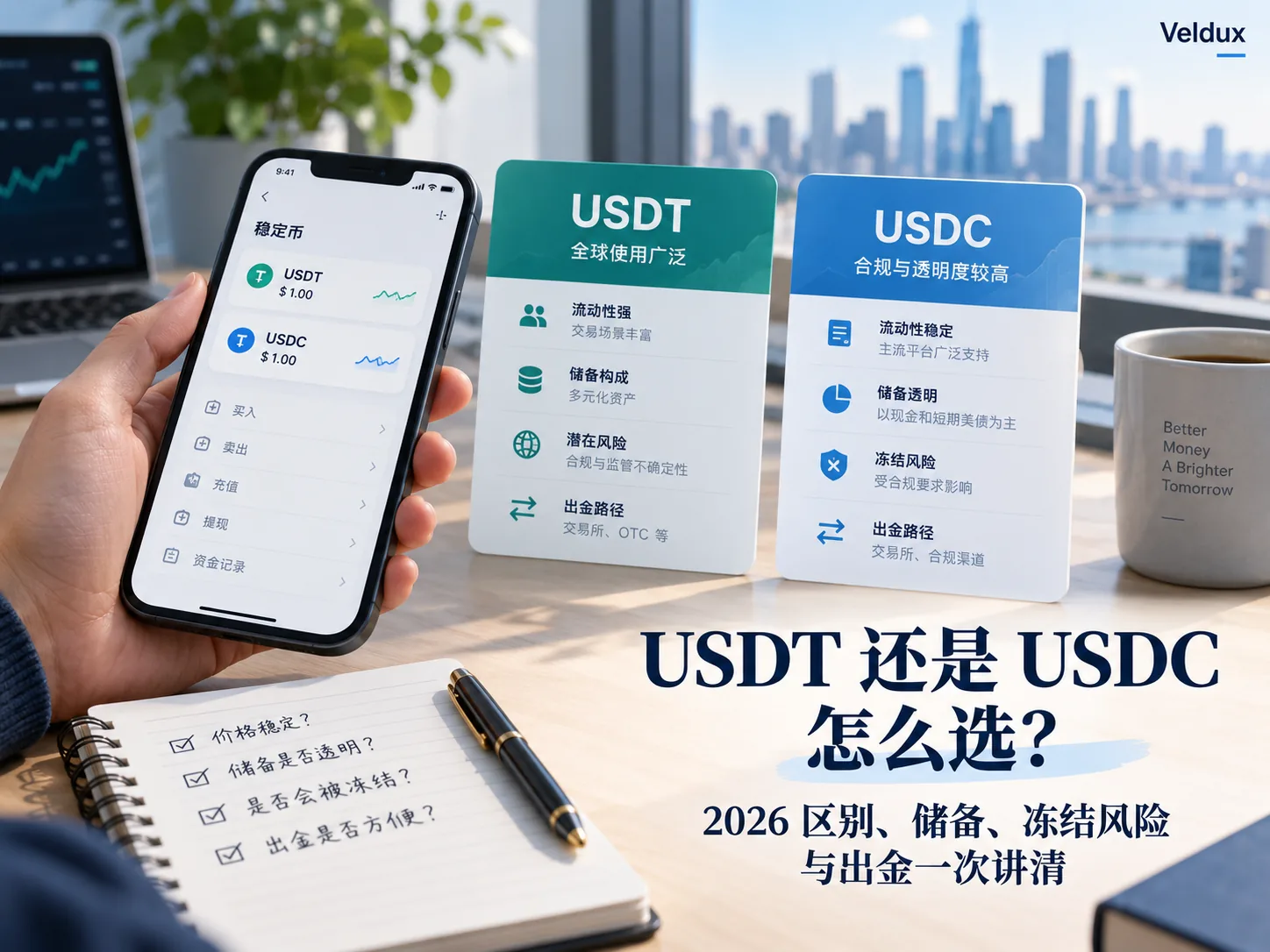
Table of contents

Binance new-user benefit
20% fee rebate
Official Binance sign-up · You must complete identity verification (KYC) to trade and withdraw
USDT or USDC: how to choose? Start with the conclusion
USDT and USDC are both centralized dollar stablecoins targeting a $1 price, but they are not the same asset: USDT is issued by Tether and USDC by Circle, and they differ in reserve structure, disclosure, regulatory environment, trading liquidity and use cases.
If you only want to know which one to pick, judge by use first:
| Use case | Better fit | Main reason |
|---|---|---|
| Trading BTC, ETH and other assets | USDT | Trading pairs and liquidity are usually deeper |
| Buying and selling through P2P | USDT | More merchants and deeper fills in many markets |
| Valuing reserve disclosure | USDC | Reserve information is disclosed more frequently |
| Using licensed platforms in the EU | USDC | A clearer MiCA compliance path |
| Holding a larger amount long term | Diversify | Avoid concentration in one issuer or platform |
USDT's main advantage is liquidity and trading coverage; USDC's main advantage is reserve disclosure frequency and the regulatory framework.
If the goal is trading and moving funds, look at USDT first; if you care more about reserve disclosure and the regulatory framework while holding long term, compare USDC closely. With larger amounts, there's no need to concentrate all the risk in a single issuer.
As of October 2026, USDT and USDC remain the two largest dollar stablecoins by market size.
But a stablecoin is not a bank deposit, and no stablecoin is absolutely safe. This is a 12-minute read, and the two traps worth remembering are a frozen bank card after a P2P sale and a frozen on-chain address — they are not the same thing. This article discusses risk structure and use cases; it does not promise that USDT or USDC will never depeg, be frozen or carry issuer risk.
What are USDT and USDC? Let's get the definitions clear
What is USDT?
USDT (Tether) is a centralized fiat-reserve stablecoin issued by Tether, aiming to keep 1 USDT ≈ 1 dollar.
It is not the dollar itself, nor dollars in a bank account.
Holding USDT means holding a digital asset issued by Tether that maintains its dollar peg through its reserve assets and redemption mechanism.
USDT's biggest real-world advantage isn't "being safer", but:
High trading volume, many trading pairs, broad support across global platforms, and deeper liquidity in some P2P markets.
What is USDC?
USDC (USD Coin) is a centralized fiat-reserve stablecoin issued by entities affiliated with Circle, also aiming to keep 1 USDC ≈ 1 dollar.
USDC is likewise not a bank deposit.
Its biggest differences are in reserve structure, disclosure frequency and the regulatory path.
Circle publishes USDC reserve information and continuously provides third-party attestation; in the European Economic Area, USDC is also issued as an e-money token under the MiCA framework.
So:
What USDT and USDC have in common is that both aim to hold $1; the real differences are who stands behind them, which assets back the reserves, how they disclose, and where you end up using them.
What's the difference between USDT and USDC?
Start with the differences an ordinary user cares about most.
| Stablecoin | Core characteristics |
|---|---|
| USDT | Issued by Tether; larger scale; strong trading liquidity; reserves mainly in US Treasuries and other assets |
| USDC | Issued by Circle; frequent disclosure; reserves relatively concentrated in highly liquid dollar assets; clearer EU MiCA path |
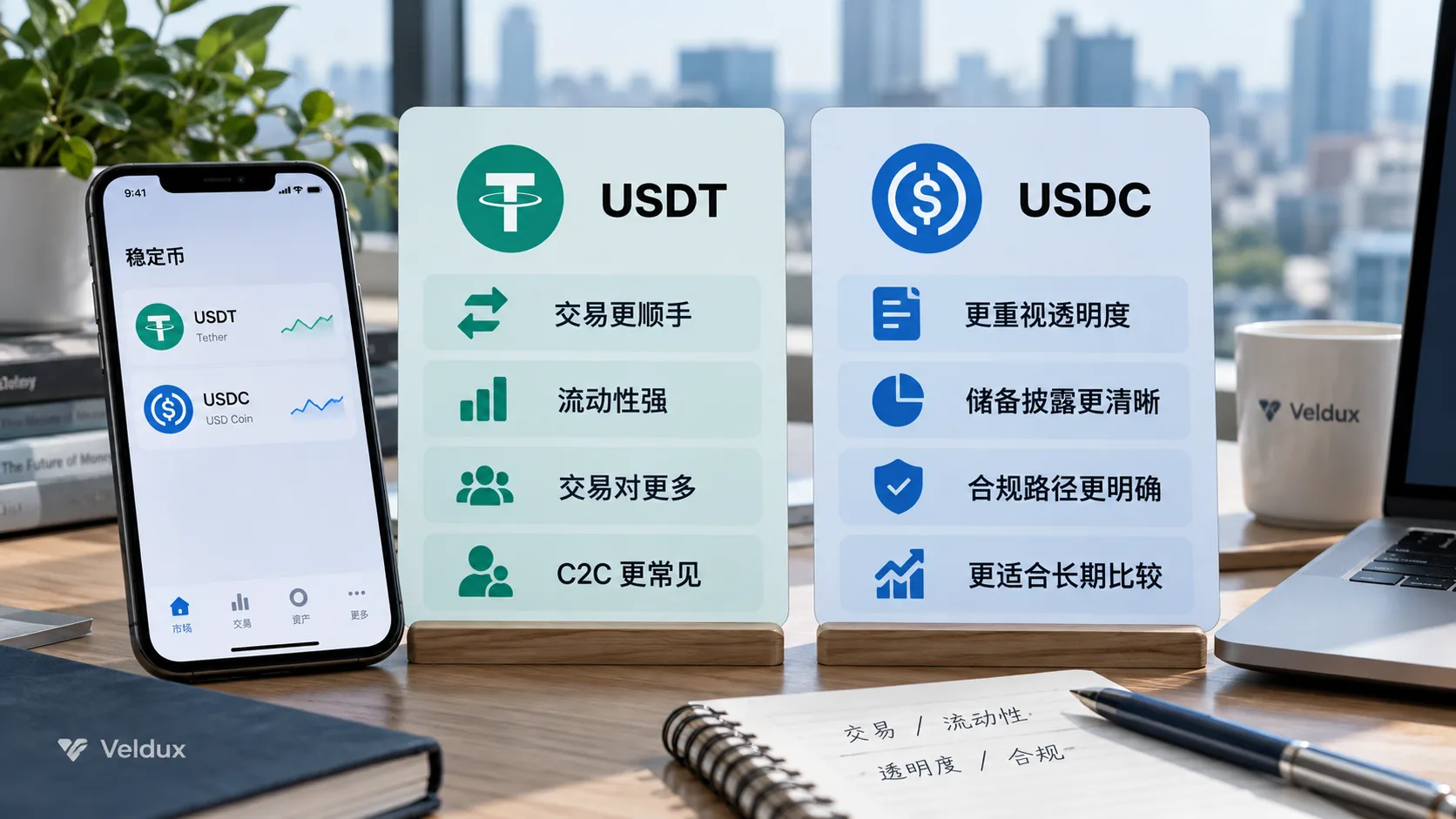
A simple way to think about it:
USDT is more like a "dollar tool for trading", USDC more like an "on-chain dollar tool that emphasizes transparency and a regulatory framework".
But this is only a mental model. It doesn't mean USDT can't be held long term, nor that USDC is necessarily safer than USDT.
What actually determines the risk is the following.
1. Reserves: what sits behind USDT and USDC?
Whether a stablecoin can hold $1 depends first on its reserves.
What are USDT's reserves?
Tether's reserves are no longer "all cash in a bank" as many people assumed early on.
USDT reserves are now centered on highly liquid assets, with US Treasuries making up a large share, alongside other asset classes.
| USDT reserve component | Main situation |
|---|---|
| US Treasuries and cash equivalents | A core component of the reserves |
| Gold | Part of the reserve assets |
| Bitcoin | Part of the investment assets |
| Other assets | May also include secured loans and similar items |
So saying "USDT is 100% cash" isn't accurate.
A more accurate description:
Tether backs USDT with a set of reserve assets, in which highly liquid US Treasuries and cash equivalents are prominent, but the asset structure is more complex than USDC's.
What are USDC's reserves?
USDC's structure is relatively simple.
The USDC reserves Circle discloses consist mainly of:
- the Circle Reserve Fund;
- bank deposits.
The Circle Reserve Fund is managed by BlackRock and holds mostly highly liquid assets such as short-term US Treasuries, overnight Treasury repo and cash.
| USDC reserve component | Main situation |
|---|---|
| Circle Reserve Fund | Holds mainly short-term US Treasuries, overnight Treasury repo and cash |
| Bank deposits | Used to support redemptions and day-to-day liquidity |
So "USDC is all bank cash" is also inaccurate.
USDC's advantage isn't that all reserves are cash, but that the reserve assets are relatively simple, highly liquid and disclosed more frequently.
2. Whose reserves are more transparent, USDT's or USDC's?
This is where the two get compared most often.
But after 2026, you can no longer simply write:
USDC has an audit, USDT doesn't.
That claim is out of date.
In August 2026, Tether announced that KPMG U.S. had completed its first full independent financial statement audit with an unqualified opinion[1]; Tether also still publishes quarterly reserve attestations. Circle's disclosure is more frequent — USDC reserve holdings are published weekly, plus a monthly third-party attestation from a Big Four firm.[2]
Two concepts need separating here:
| Report | What it means |
|---|---|
| Financial statement audit | Audits the company's financial statements as a whole |
| Reserve attestation | Verifies the reserves and related data for a specific reporting period |
After 2026, using "USDT has no full audit, USDC does" to tell them apart is no longer accurate. Tether has completed its first full financial statement audit and continues to disclose reserves through quarterly attestations; Circle's advantage remains more frequent reserve disclosure.
3. Is USDT or USDC safer?
This question can't be answered with a coin name alone.
Because "safe" includes at least 5 completely different risks:
| Risk | What actually matters |
|---|---|
| Reserve risk | Whether the issuer has enough assets to meet redemptions |
| Depeg risk | Whether it can hold close to $1 during market panic |
| Freeze risk | Whether the issuer can restrict addresses |
| Platform risk | Which exchange or provider holds the asset |
| Operational risk | Wrong network, wrong address or a scam |
From that angle:
USDC is clearer on reserve disclosure and regulatory framework; USDT is stronger on global trading liquidity and market acceptance.
That's what "different risk structures" means. It does not justify the simple conclusion:
USDC is definitely safe, USDT is definitely dangerous.
4. What really decides the choice is trading and cashing out
This is the point most USDT vs USDC comparisons miss.
You don't buy a stablecoin to read its whitepaper; you eventually use it.
If your flow is:
fiat → stablecoin → BTC/ETH and other assets → stablecoin → fiat
then what determines the experience isn't only the issuer's reserves, but also:
- which trading pairs the platform supports;
- which coins the P2P market supports;
- whether there are enough merchants in your local market;
- how wide the buy/sell spread is;
- whether you can convert back to fiat easily at the end.
On many platforms and markets where USDT is the main trading and P2P quotation asset, USDT usually has deeper trading liquidity.
That's why even someone who prefers USDC's reserve disclosure may still use USDT in practice.
If you ultimately need to cash out through P2P, what comes first?
The cash-out path is the series of conversion and payment steps a stablecoin goes through when it's changed back into local currency.
For people who need to exit through P2P, whether a stablecoin is "usable" depends not only on the issuer's transparency, but on whether there are enough merchants and enough depth at the exit.
Don't start by asking:
Which one is theoretically safer, USDT or USDC?
Instead, open the platform you actually use and that is permitted where you live, and check:
- which stablecoins it supports;
- how many active merchants there are;
- how wide the buy/sell spread is;
- which payment methods it supports;
- how deep the actual fills are.
If your local P2P market is mainly supplied by USDT, then holding USDC and needing to exit may require:
USDC → USDT → fiat
which is one more conversion than:
USDT → fiat
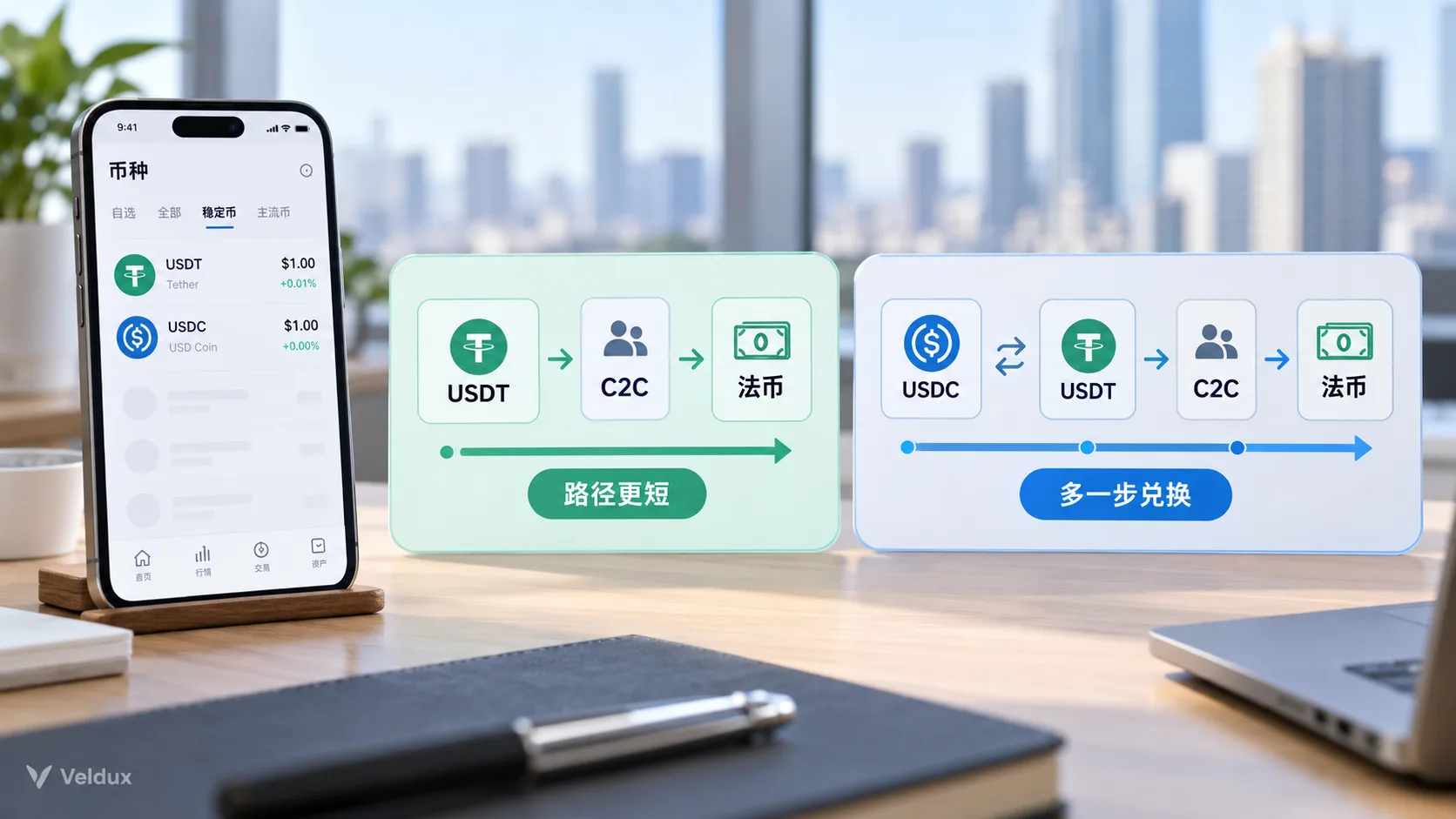
What that adds isn't only a fee, but also spread, extra steps and counterparty risk.
When you need to cash out to fiat, prioritize the stablecoin that actually has depth in your local market, not the one that ranks highest on reserves.
5. A frozen bank card from P2P and frozen USDT are not the same thing
This is easy to confuse.
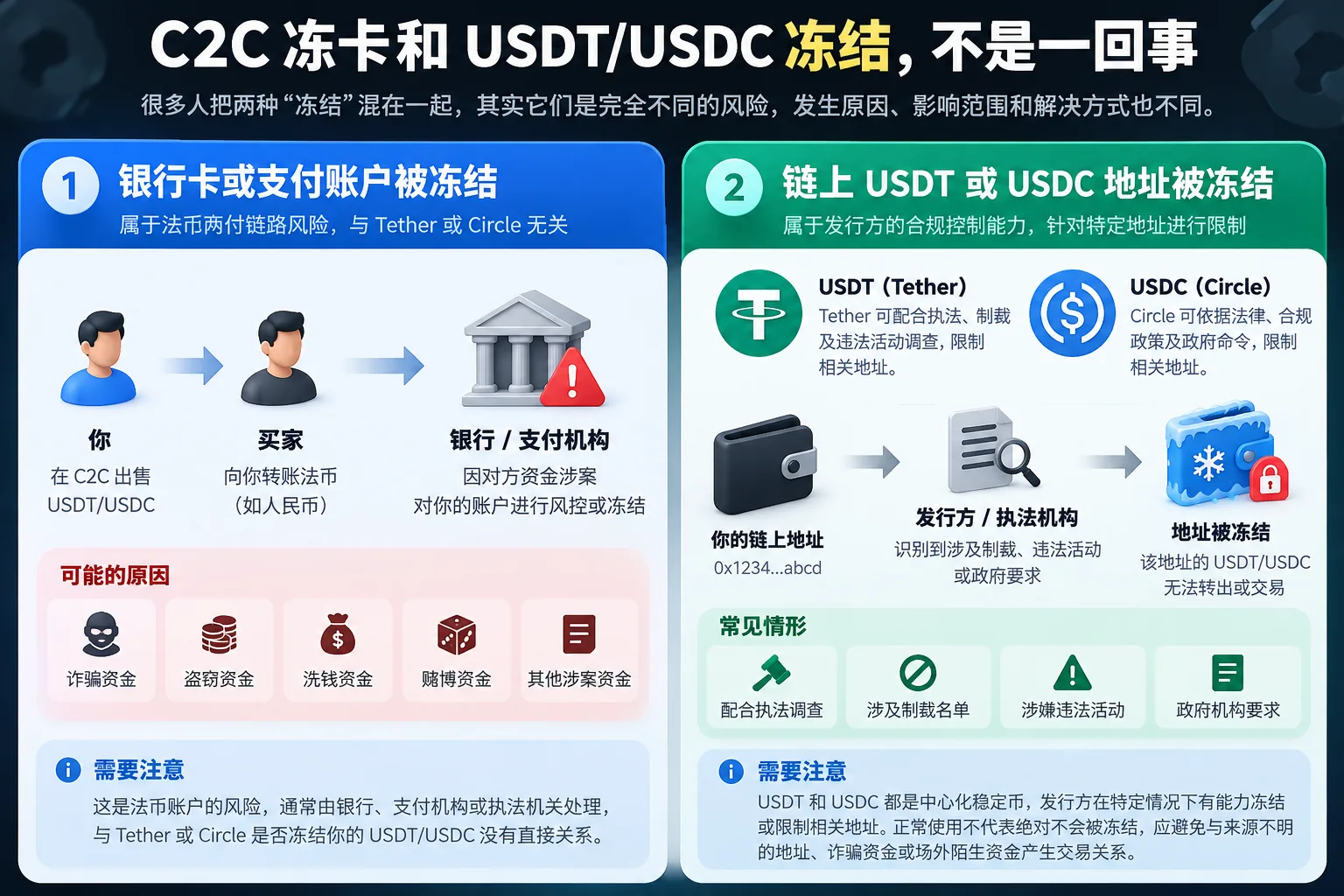
There are at least two completely different "freezes".
The first: your bank card or payment account is frozen
For example, you sell stablecoins through P2P and the counterparty sends you fiat.
If that money is later found to involve:
- fraud;
- theft;
- money laundering;
- gambling;
- or funds from another case;
the bank, payment institution or law enforcement may apply risk controls or a freeze to the related fiat account.
This is fiat payment-rail risk.
It does not mean Tether froze your USDT.
The second: an on-chain USDT or USDC address is frozen
USDT and USDC are both centralized stablecoins.
Both issuers retain the ability to restrict on-chain addresses in certain circumstances.
| Stablecoin | Issuer control capability |
|---|---|
| USDT | Tether can restrict related addresses in cooperation with law enforcement, sanctions and illegal-activity investigations |
| USDC | Circle can restrict related addresses under law, compliance policy and government orders |
In April 2026, Tether publicly disclosed that it had coordinated with US law enforcement to freeze more than $344 million in USDT across two addresses.[3]
Circle's USDC terms likewise explicitly include Blocked Addresses and a freeze mechanism.
So:
"Only USDT gets frozen, USDC can't be" is wrong.
And the reverse:
"Normal use means you definitely won't be frozen" can't be guaranteed either.
The more practical approach is to avoid trading with addresses of unknown origin, fraud proceeds or unfamiliar off-platform money.
6. Both USDT and USDC have depegged
A stablecoin's "stability" is a target, not a guarantee.
A depeg is when a stablecoin's market price clearly deviates from its $1 target.
Both USDT and USDC have experienced this.
USDC's most memorable episode: the 2023 Silicon Valley Bank event
In March 2023, during the failure of Silicon Valley Bank (SVB), Circle disclosed that about $3.3 billion of USDC's reserve cash was held at SVB.
That amount was then about 8% of USDC's reserves.
The market feared that portion couldn't be recovered, and USDC fell to roughly $0.87 in the secondary market.
US regulators later announced protection for SVB depositors, and USDC recovered to close to $1.
This proves:
Transparent reserves don't mean no risk.
The benefit of transparency is that the market knows where the money is; but if the reserve custodian bank runs into trouble, that risk gets priced in quickly too.
USDT has also had clear depegs
USDT has likewise been through several episodes of market stress and price deviation.
During panic phases such as 2018, USDT fell clearly below $1; during the violent crypto market swings of 2022, it also briefly traded below its peg.
But the price later returned to close to $1.
So it's not advisable to use:
USDT depegged 3 times, USDC only once.
that kind of simple counting to judge which is safer.
Because:
- the size of the depegs differed;
- the duration differed;
- the causes differed;
- and quotes differed across exchanges.
More valuable than counting times is:
Why it depegged, and whether the issuer had enough liquidity to handle redemptions.
7. The regulatory difference between USDT and USDC
If you're in the EU, this point matters especially.
Circle already issues USDC under the EU's MiCA framework.
In the European Economic Area, Circle France acts as the relevant issuing entity, holding the corresponding e-money and crypto asset service authorizations.
USDT's European situation is different.
As MiCA requirements for stablecoins and crypto service providers took effect, some European platforms have adjusted or restricted stablecoin services that don't meet their MiCA compliance requirements.
| Regional scenario | What to check when choosing |
|---|---|
| EU / European Economic Area | Check MiCA compliance status and platform support first |
| Other regions | Check local law and the specific trading platform's support |
So when using stablecoins in Europe, USDC's compliance path is a substantive advantage.
But "can USDT be used in Europe" can't be answered in one sentence, because the actual support may differ between platforms, services and countries.
8. Which has cheaper transfer fees, USDT or USDC?
You can't look at the coin alone.
Stablecoin transfer costs depend mainly on:
the blockchain network + the trading platform's withdrawal fee rules.
It's not "USDT is inherently cheap" or "USDC is inherently cheap".
For example, USDT can exist on:
- TRON;
- Ethereum;
- Solana;
- BNB Smart Chain;
- TON;
- other networks.
USDC also supports multiple chains.
So when comparing costs, check:
| What to check | Why |
|---|---|
| Coin | You must confirm whether it's USDT or USDC |
| Network | Determines which chain the asset is actually on |
| Receiving platform | Must support the same network |
| Withdrawal fee | Different exchanges may charge an additional withdrawal fee |
When transferring, match the network the receiving side supports first, then compare fees; don't force a network the other side doesn't support just to save a few dollars.
For a first transfer, test with a small amount.
9. USDT or USDC? Choose by these 6 scenarios
If the reserves, regulation and history above felt too complicated, judge directly by scenario.
| Scenario | Prioritize |
|---|---|
| Trading BTC, ETH, altcoins frequently | USDT |
| Needing deeper liquidity in P2P | USDT |
| Short-term fund rotation | USDT |
| Valuing reserve disclosure | USDC |
| EU compliance environment | USDC |
| Holding larger amounts long term | Consider diversifying |
Behind this table, remember one sentence:
USDT is strong on liquidity, USDC on transparency and the regulatory framework; the larger the amount, the less you should reduce the question to "which one is absolutely safe".
10. Before choosing USDT or USDC, check these 4 things
1. Don't treat a stablecoin as a bank deposit
Although USDT and USDC both target $1, they are not ordinary bank deposits.
Stablecoins still carry:
- depeg risk;
- issuer risk;
- reserve risk;
- regulatory risk;
- smart contract risk;
- platform risk.
A price that shows $1 for a long time doesn't mean the risk equals cash dollars.
2. Don't mix issuer risk with exchange risk
If you hold 10,000 USDC on an exchange:
you carry at least two layers of risk:
Circle/USDC risk + exchange risk.
The same goes for USDT.
Even if the stablecoin issuer is fine, the trading platform suspending withdrawals, going bankrupt or restricting accounts can still affect your use of the assets.
3. Check the network before transferring
Something labeled USDT isn't necessarily on the same chain.
Same for USDC.
Before transferring, check at least:
coin → network → address → receiving platform support.
On a first transfer, test with a small amount; it's much cheaper than chasing support afterwards.
4. In P2P, don't just pick the merchant with the highest price
When selling stablecoins, a slightly better rate isn't necessarily worth the extra risk.
You should check at the same time:
- the merchant's order volume;
- completion rate;
- account history;
- payment method;
- platform verification;
- transaction requirements.
The biggest P2P risk usually isn't giving up a little spread — it's where the counterparty's fiat money came from.
FAQ
What's the actual difference between USDT and USDC?
USDT and USDC are both centralized stablecoins pegged to the dollar, but their issuer, reserve structure, information disclosure, regulatory environment and market liquidity differ.
USDT is issued by Tether, with the advantage of market size, trading depth and reach; USDC is issued by entities affiliated with Circle, with more frequent reserve disclosure and issuance under the EU MiCA framework.
Which is safer, USDT or USDC?
Neither can simply be defined as absolutely safer.
If you compare reserve disclosure frequency and regulatory framework, USDC is clearer; if you compare trading liquidity and global market acceptance, USDT is stronger.
Both carry issuer, depeg, freeze, regulatory and platform risk.
For long-term holding, USDT or USDC?
If you must compare only the two, people who care more about reserve disclosure and the regulatory framework usually lean toward USDC.
But when holding larger amounts long term, the more important thing isn't picking a "forever safe" stablecoin, but controlling concentration risk across issuer, exchange, wallet and chain.
For trading, USDT or USDC?
In most scenarios that need high trading depth, look at USDT first.
USDT's global trading pairs and market liquidity are usually deeper.
But the specifics should still follow the platform you actually use and its pair depth.
Can USDC be cashed out to local currency?
Technically USDC can first be converted into other assets or fiat on platforms that support it, but whether you can exit directly through a particular P2P market depends on the platform, the region and merchant liquidity at the time.
If the actual market mainly supports USDT, the common path may become:
USDC → USDT → fiat.
So before cashing out, check the real local trading depth instead of judging only when you need to sell.
Can USDT be frozen?
Yes.
USDT is a centralized stablecoin, and Tether has the ability to freeze or restrict related addresses in specific law-enforcement, sanctions and illegal-activity situations.
This is not the same concept as a bank card being frozen because of a P2P trade.
Can USDC be frozen?
Yes.
Circle's terms explicitly reserve a Blocked Addresses mechanism and can restrict or freeze specific USDC addresses in accordance with the law.
So "USDC is decentralized, therefore it can't be frozen" is wrong.
Which one depegs less, USDT or USDC?
No guarantee is possible.
Both USDT and USDC have a history of clear deviations from $1.
USDC fell to about $0.87 during the 2023 Silicon Valley Bank event; USDT has also seen clear price deviations historically.
Judging depeg risk isn't about counting historical episodes; it's more about reserve assets, liquidity and redemption capacity.
Which has lower transfer fees, USDT or USDC?
Fees depend mainly on the network and the trading platform, not on USDT vs USDC alone.
The same stablecoin can cost different amounts on Ethereum, TRON, Solana and other networks.
Before withdrawing, check the network and fee shown live by the exchange.
Can USDT and USDC be swapped for each other?
Yes.
Platforms that support the relevant pair or a conversion feature can usually complete a USDT ↔ USDC conversion.
But watch out for:
- trading fees;
- bid-ask spread;
- the platform's supported regions;
- network selection.
If you'll eventually convert back to fiat, it's best to consider the exit path from the start.
Related articles
- Can USDT collapse? Reserves, audits and freeze risk explained — a closer look at Tether's reserves, audit, depeg and issuer risk
- How to cash out USDT to your bank: withdrawal and frozen-account risk — understand P2P cash-out, merchant selection and bank-card risk
- How to transfer USDT: choosing between TRC20, ERC20 and BEP20 — get clear on networks, fees and wrong-chain mistakes
- Where to keep your coins after buying: exchange vs wallet — where USDT and USDC should sit after you buy them
- How to buy USDT on Binance: P2P tutorial — the practical flow from fiat deposit to buying USDT
Data verification note
The key facts in this article were checked on 2026-10-16, one by one:
- Tether's first full financial audit: in August 2026 Tether announced that KPMG U.S. completed its first full independent financial statement audit with an unqualified opinion, while it still publishes quarterly reserve attestations. Source: Tether official announcement — first full financial audit.
- USDC reserve disclosure: Circle's USDC reserve holdings are disclosed weekly, with a monthly third-party attestation from a Big Four firm. Source: Circle transparency and reserve disclosure.
- Tether address freeze case: in April 2026 Tether coordinated with US law enforcement to freeze more than $344 million in USDT across two addresses. Source: Tether announcement on freezing $344 million in USDT with OFAC.
Disclaimer
This article explains stablecoin mechanics, risks and use cases only. It is not investment, trading, legal or financial advice, and it is not a guarantee of the safety of USDT, USDC or any other digital asset.
Stablecoins carry depeg, issuer, reserve, regulatory, freeze, trading-platform, smart contract and operational risk.
For larger amounts, judge independently according to your own risk tolerance and the laws of your jurisdiction.
Exchange operations · USDT · Wallet security
Responsible for researching and organizing content on Binance, OKX, USDT transfers, withdrawals and wallet security. The steps and key data in this article are verified according to the content type, using real operation records, official platform documentation and public sources. Interfaces, fees and regional rules may change, so the article is reviewed and updated continuously.
Status: manual review · Last verified 2026-10-16
Reviewed by: Veldux editorial team
- Tether official announcement — first full financial auditIn August 2026 Tether announced that KPMG U.S. completed its first full independent financial statement audit with an unqualified opinion, while it still publishes quarterly reserve attestations
- Circle — transparency and reserve disclosureUSDC reserve holdings are disclosed weekly, with a monthly third-party attestation from a Big Four accounting firm
- Tether announcement on freezing $344 million in USDT with OFACIn April 2026 Tether coordinated with US law enforcement to freeze more than $344 million in USDT across two addresses
- 2026-10-16UpdateAdded the evidence-chain superscripts and the "Data verification note", and updated the key-fact verification date.
Editorial principles ineditorial policy,corrections policy。