
How to buy Bitcoin: a complete first-purchase tutorial (2026)
Table of contents

Binance new-user benefit
20% fee rebate
Official Binance sign-up · You must complete identity verification (KYC) to trade and withdraw
How to buy Bitcoin
If it's your first time buying Bitcoin, you can think of the whole process as four steps:
Register on an exchange → complete KYC → prepare USDT → buy BTC in the BTC/USDT spot market.
If you already have USDT, you don't need to deposit again; go straight to the BTC/USDT spot page and buy BTC.
The thing people get wrong most often here is "spot" versus "futures".
If your goal is simply to buy some real Bitcoin and hold it, once you're on the trading page look for:
Spot / BTC/USDT
If you see:
- Perpetual
- Futures
- Long / Short
- 10×, 20×, 50×
then you're usually in futures or a leveraged product, not an ordinary BTC spot purchase page.
You also don't need to buy a whole coin at once. 1 BTC can be divided into 100,000,000 satoshis, so even if a full BTC is expensive, you can buy a very small fraction.
The actual minimum purchase amount doesn't depend on "the price of one BTC" but on the minimum order size the exchange has set at that moment.
For your first BTC purchase, learning to find the BTC/USDT spot market and complete a small trade matters far more than studying futures, leverage and complex order types.
What are the main ways to buy Bitcoin in 2026?
There are three common ones:
| Method | How it works | Best for |
|---|---|---|
| Fiat → USDT → BTC | Prepare USDT first, then go to BTC/USDT and buy BTC | Beginners buying for the first time |
| Existing USDT → BTC | Go straight to BTC/USDT and place an order | People who already hold USDT |
| Buy BTC directly on the platform | Use the exchange's supported bank card, bank transfer or Buy Crypto | People in regions where those channels are supported |
If you already hold USDT, the second is the most direct.
If you only hold fiat, first check what deposit methods the exchange offers in your region. The bank cards, bank transfers, P2P or other payment channels available differ from region to region.
You don't need to study dozens of features on your first purchase; getting this one route to work is enough:
Prepare the funds → find BTC/USDT spot → buy BTC.
Table of contents
- 3 things to understand before buying Bitcoin
- The complete flow for your first BTC purchase
- First, register on a platform and complete KYC
- How to prepare USDT
- How to buy on BTC/USDT spot
- How to choose between market and limit orders
- How to choose between Binance and OKX
- What is the minimum amount to buy BTC?
- Where to store BTC after buying
- What to watch for on your first BTC purchase
- What fees does buying BTC involve?
- FAQ
1. 3 things to understand before buying Bitcoin
1. You don't need to buy a whole BTC
Many people new to Bitcoin see the price of one BTC and assume ordinary investors can no longer afford it.
That's not the case.
Bitcoin can be bought in fractions:
1 BTC = 100,000,000 satoshis
You can buy:
- 0.01 BTC
- 0.001 BTC
- 0.0001 BTC
- or even smaller amounts
What actually limits the minimum purchase is the minimum order amount and minimum trade quantity the exchange sets for BTC/USDT.
So on your first BTC purchase, you don't need to worry about "when will I be able to afford a whole coin".
The more practical question is:
What is the smallest order the platform currently lets me place?
You can see it directly on the BTC/USDT order page.
2. Spot BTC and BTC futures are not the same thing
If you just want to actually buy some Bitcoin, the most important thing on your first visit to the trading page is to make sure you're in "spot".
| Type | What you actually get | Can you withdraw it to your own BTC wallet? | Is there leveraged liquidation risk? |
|---|---|---|---|
| BTC spot | BTC itself | Yes | No leveraged liquidation |
| BTC perpetual futures | A BTC price derivative | No, you can't withdraw it as BTC | Yes |
| Margin trading | A position built on borrowed assets | Depends on the product | Higher |
The simplest way to tell is to look at the page.
If it says:
Spot / BTC-USDT
it's usually ordinary spot trading.
If it says:
Perpetual / Futures / Long / Short / 10× / 20×
don't treat it as a normal BTC purchase.
If all you want on your first purchase is to hold BTC, spot is enough.
3. Why do so many people prepare USDT first?
Because BTC/USDT is a very common Bitcoin spot pair on exchanges.
For example:
BTC/USDT = 100,000
means:
1 BTC is currently worth about 100,000 USDT.
But that doesn't mean you need to prepare 100,000 USDT.
If you only put in 100 USDT, the platform automatically calculates how much BTC you get based on the execution price.
So many beginners follow:
Fiat → USDT → BTC
If you already hold USDT, it's even simpler:
USDT → BTC
Of course, USDT isn't the only way to buy BTC.
Depending on the platform and your region, you may also see:
- BTC/USDC
- BTC/fiat pairs
- Buy BTC with a bank card
- Bank transfer
- Buy Crypto
This article mainly uses BTC/USDT because that path is the easiest to understand.
2. The complete flow for your first BTC purchase
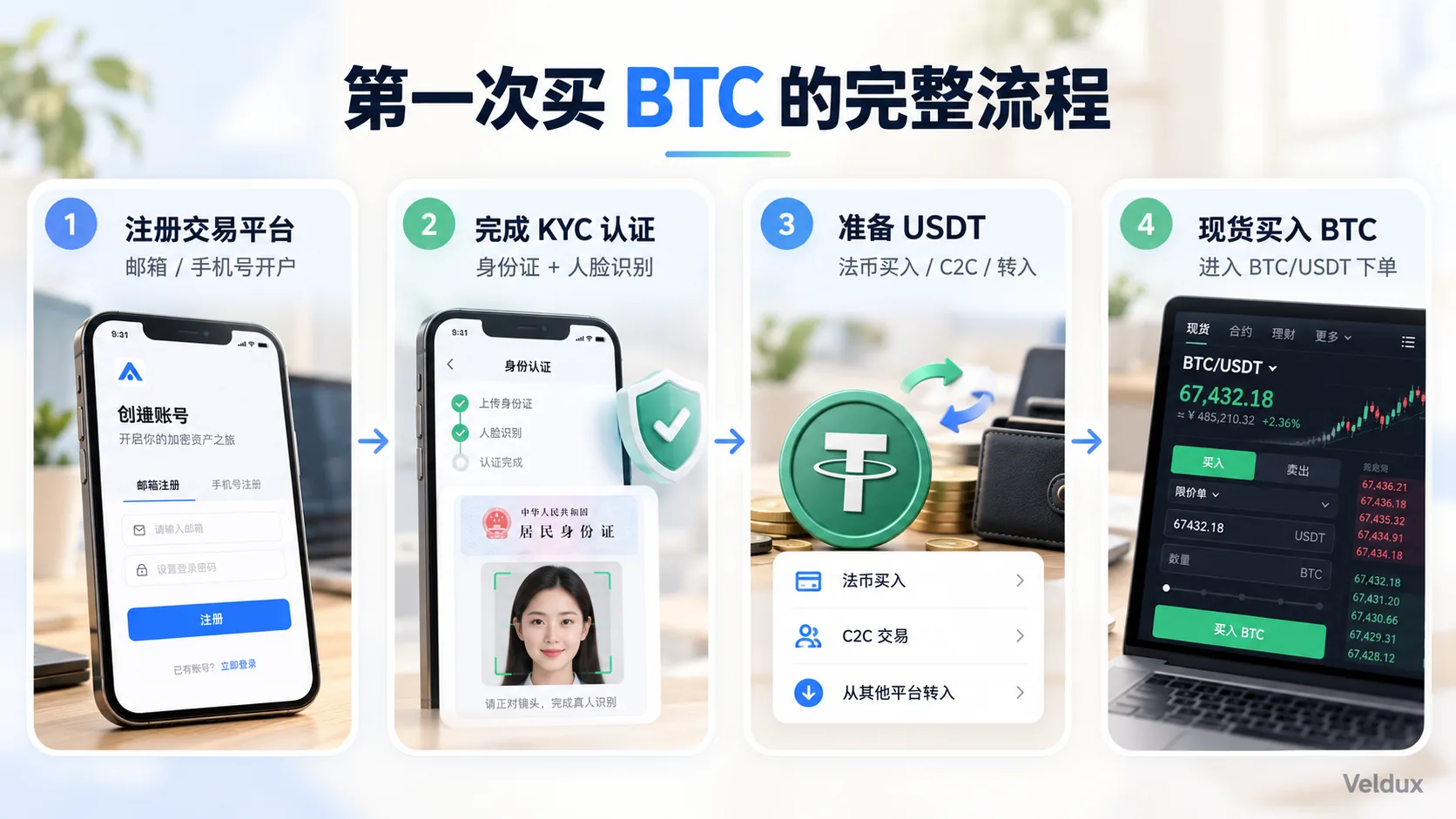
Broken down, it's really only four steps:
- Register on an exchange
- Complete KYC (identity verification)
- Prepare USDT
- Place a buy order in the BTC/USDT spot market
The actual "buying BTC" happens in step 4. Registration, KYC and funding are just preparation for the order.
| Step | What to do | Result |
|---|---|---|
| Step 1 | Register on an exchange | You have a trading account |
| Step 2 | Complete KYC | The applicable account features are enabled |
| Step 3 | Prepare USDT | The account has funds you can use to buy BTC |
| Step 4 | Place a BTC/USDT spot order | You receive BTC |
3. First, register on a platform and complete KYC
If you don't have a trading account yet, pick one of the platforms that support BTC spot trading, such as Binance or OKX.
Registration usually involves:
- Opening an account with an email or phone number
- Setting a password
- Enabling two-factor authentication
- Completing identity verification
For the full process, see the Binance registration tutorial or the OKX registration tutorial.
There's no need to register on many platforms at once for your first BTC purchase.
If you already have Binance, just use Binance.
If you already have OKX, there's no need to switch platforms just for your first BTC purchase.
What is KYC?
KYC means identity verification.
The platform will usually ask you to upload a government-issued ID and complete a face scan or other identity check.
If it keeps failing, common causes include:
- Glare on the ID photo
- Blurry images
- An expired ID
- A face-scan environment that's too dark
- Details that don't match the ID
Trading and fiat features differ by region, so which features are actually enabled after KYC still depends on what your account page shows.
4. How to prepare USDT
If you plan to buy Bitcoin through BTC/USDT, you need USDT in your account first.
USDT can come from:
- A deposit from another wallet
- A transfer from another exchange
- Buying crypto with fiat through the platform
- P2P trading supported by the platform
- Converting other assets
For your first USDT purchase, see how to buy USDT on Binance or how to buy USDT on OKX.
What to look at when using P2P
P2P can be understood simply as:
users trading fiat and crypto with each other through the platform's order system.
If the platform offers P2P in your location, don't just chase the lowest price.
Look at all of these:
| Item | What to check |
|---|---|
| Order volume | Is there a steady trade history |
| Completion rate | Are past orders consistent |
| Average release time | How fast the counterparty releases the crypto |
| Payment method | Does it match your own account |
| Platform verification badge | Helps judge the counterparty |
| Order terms | Are there unusual requirements |
Above all, don't move off the platform's order system to save a little money.
If the counterparty asks you to:
- Cancel the platform order
- Move to Telegram or WhatsApp
- Re-quote privately
- Send money to an account outside the order
be on your guard.
Normally, keeping the order, payment confirmation and communication inside the platform makes it much easier to keep records.
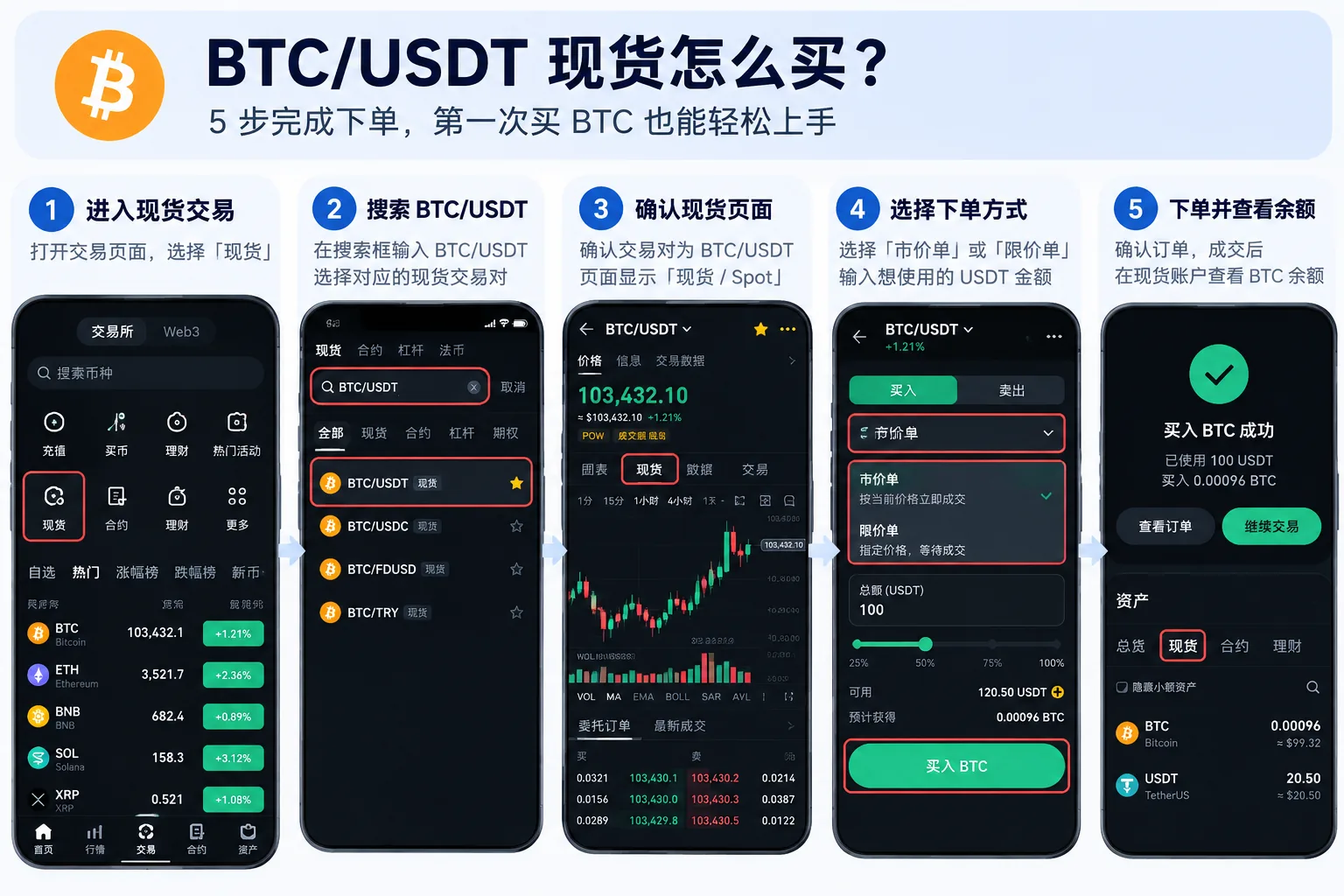
5. How to buy on BTC/USDT spot
Once you have USDT in your account, you can move on to actually buying BTC.
Interfaces differ slightly between platforms, but the logic is basically the same:
- Open "Trade" or "Spot"
- Search for BTC/USDT
- Confirm the page says Spot
- Tap "Buy BTC"
- Choose a market or limit order
- Enter the amount of USDT you want to use
- Review the order
- Submit
- Check your BTC balance after it fills
What does BTC/USDT mean?
BTC/USDT can be understood directly as:
the market where you buy and sell BTC with USDT.
Here:
- BTC is the asset you want to buy
- USDT is the asset used for pricing and settlement
For example:
BTC/USDT = 100,000
and you plan to put in:
100 USDT
The platform will convert that into however much BTC the actual execution price buys.
So on your first purchase, you don't need to calculate how much BTC to enter.
Just decide how much USDT you want to use.
6. How to choose between market and limit orders
Once you open the BTC/USDT page for the first time, the two most common options are the market order and the limit order.
| Comparison | Market order | Limit order |
|---|---|---|
| How it fills | Executes as soon as possible at available prices | You set the price and wait |
| Do you set the price | No | Yes |
| Execution speed | Usually fast | Not guaranteed |
| Best for | A first small purchase | When you have a specific buy price |
Market order
A market order prioritizes "filling quickly".
For example, you want to use:
100 USDT
to buy BTC.
Choose:
Market → Buy BTC → enter 100 USDT
The platform completes the trade at the prices available in the order book at that moment.
For a first purchase where you just want to learn the flow, a market order is usually more intuitive.
Limit order
A limit order means you enter the price you're willing to pay.
For example, BTC is currently:
100,000 USDT
but you're only willing to buy around:
95,000 USDT
so you place a limit order.
If the market never reaches that price, the order may never fill.
In simple terms:
Want to buy now: look at a market order. Want to wait for a price: use a limit order.
7. How to choose between Binance and OKX for buying BTC
Both support BTC spot trading. For a full comparison, see Binance vs OKX: which is better.
For someone buying BTC for the first time, there's no need to overthink the platform choice.
| Comparison | Binance | OKX |
|---|---|---|
| BTC/USDT spot | Supported | Supported |
| Market order | Supported | Supported |
| Limit order | Supported | Supported |
| Common base fee for regular spot | 0.10% / 0.10%[1] | Maker 0.08% / taker 0.10%[2] |
| BNB fee discount | Supported | Not applicable |
| Web3 wallet | Binance Wallet | OKX Wallet |
| Actual availability | Depends on region | Depends on region |
If you already have Binance, keep using Binance.
If you already have OKX, there's no need to switch platforms for your first BTC purchase.
If you have neither, compare:
- Whether the platform is available in your region
- Whether deposits are convenient
- Spot trading fees
- BTC/USDT liquidity
- Withdrawal fees
- Which interface you're more comfortable with
For a first small BTC purchase, being able to register, deposit and place an order normally is usually more important than a 0.01%–0.02% fee difference.
Once your trading frequency rises, it's not too late to compare fees carefully.
8. What is the minimum amount to buy Bitcoin?
BTC itself can be divided down to:
0.00000001 BTC
which is:
1 satoshi.
But that doesn't mean the exchange lets you place an order for just 1 satoshi.
The platform also sets:
- A minimum order amount
- A minimum BTC quantity
- A minimum order value
So:
"The smallest unit of BTC" and "the smallest amount you can buy on a platform" are not the same thing.
The most accurate way is to open the BTC/USDT order page.
Enter an amount; if it's below the platform's requirement, the page will usually show the current minimum order amount.
So it's not a good idea to treat:
"$5 definitely works"
or:
"you can start with $10"
as a permanent fixed rule.
9. Where to store BTC after buying
Once you've bought BTC, there are two main choices:
leave it on the exchange, or withdraw it to your own wallet.
For how to decide, see where is the safest place to store crypto after buying.
| Your situation | Common approach |
|---|---|
| Small amount, trade often | Leave it on the exchange |
| Long-term holding, rarely trade | Look into a self-custody wallet |
| Larger amount, long-term holding | Look further into a hardware wallet |
| Both trading and long-term holding | Keep them separate |
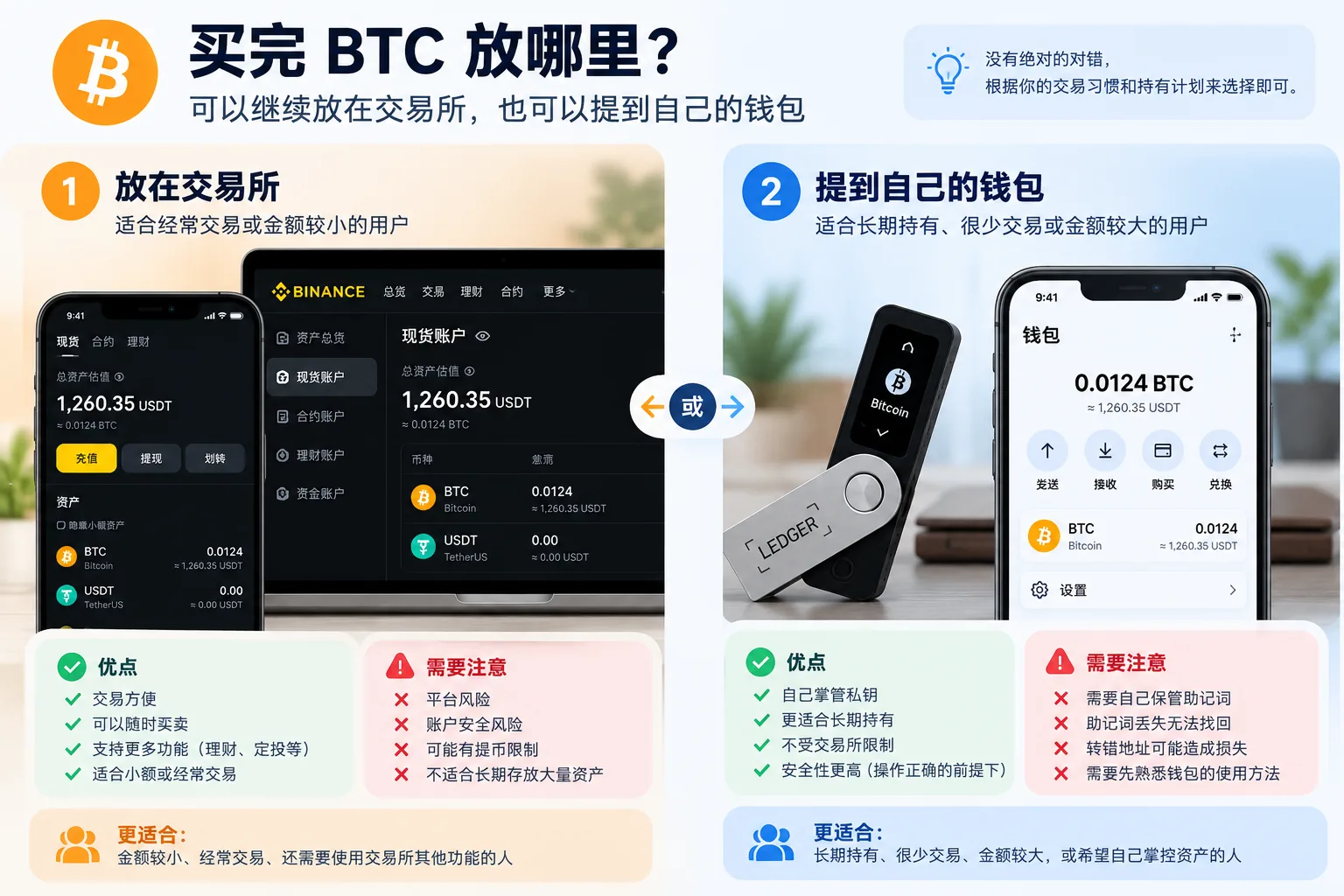
The biggest difference between a self-custody wallet and an exchange account is who manages the private keys.
On an exchange, assets are held through the platform's account system.
With a self-custody wallet, you manage them yourself:
- The private key
- The recovery phrase
- The wallet address
Both approaches carry risk.
On an exchange, the main things to watch are:
- Account security
- Platform risk
- Withdrawal restrictions
With self-custody, you need to watch out for:
- Losing the recovery phrase
- Leaking the recovery phrase
- Sending to the wrong address
- Operational mistakes
- Malicious approvals
If you haven't yet figured out recovery phrases, BTC addresses and the withdrawal flow, don't move all your BTC out just because "everyone says you need a cold wallet".
First learn how to use a wallet safely, then decide whether to transfer.
10. What to watch for on your first BTC purchase
First confirm you're on the spot page
On your first BTC purchase, the most common mistake isn't failing to place an order — it's ending up in the wrong trading product.
If you see:
Spot
then continue.
If you see:
Futures / Perpetual / 10× / 20×
first check whether you opened the wrong page.
You don't need a whole coin to "buy BTC"
BTC is designed to be bought in fractions.
How much you use the first time should depend on your own situation, not on "how much one BTC costs".
Check the address and network before withdrawing
If you plan to withdraw your BTC to a wallet after buying, at least confirm:
- The receiving BTC address
- The withdrawal network
- Whether your wallet supports it
- The current withdrawal fee
For your first self-custody withdrawal, test with a smaller amount first.
Don't leave the platform when using P2P
If you use P2P, try to keep:
- The order
- The communication
- The payment confirmation
- Any dispute
inside the platform's system.
Don't cancel a platform order just because the counterparty offers a cheaper private quote.
Never give verification codes, private keys or recovery phrases to anyone
Don't share any of the following with so-called "support agents" or strangers:
- SMS verification codes
- Google Authenticator codes
- Login verification codes
- Private keys
- Recovery phrases
Once a private key or recovery phrase leaks, the assets in that wallet can be taken out of your control.
11. What fees does buying BTC involve?
The real cost of buying BTC isn't just the spot fee you see on the trading page.
| Cost | When it occurs |
|---|---|
| Spot trading fee | When a BTC/USDT order fills |
| Bid-ask spread | On the market execution |
| P2P spread | When preparing USDT |
| Fiat payment fees | On some deposit channels |
| BTC withdrawal fee | When moving BTC to a wallet |
For example, you use:
1,000 USDT
to buy BTC.
Assume the spot fee is:
0.10%
Just looking at the trading fee, that's about:
1 USDT equivalent.
But if you paid a premium when buying USDT, or withdraw the BTC to a wallet afterwards, the total cost rises further.
So when comparing platforms, look at the whole chain:
Deposit → buy BTC → withdraw
rather than staring at a single fee number.
12. FAQ
Q1: How do I buy Bitcoin?
For your first BTC purchase, register on a platform that supports BTC spot trading, complete the required identity verification and prepare USDT, then buy in the BTC/USDT spot market.
If you already have USDT, just open spot, search BTC/USDT, enter an amount and place the order.
Q2: Do I always need to buy USDT first?
Not necessarily.
If you buy BTC through BTC/USDT, you need USDT.
But some platforms and regions also support BTC/USDC, fiat pairs, bank cards, bank transfers or other direct ways to buy crypto.
Q3: What is the minimum amount to buy Bitcoin?
There is no permanently fixed minimum in any currency.
Although BTC can be divided down to:
0.00000001 BTC
the actual minimum order amount is set by the platform's trading rules.
The most accurate answer is on the BTC/USDT order page.
Q4: For my first BTC purchase, should I use a market or a limit order?
If it's a first small purchase and the main goal is to complete the trade quickly, a market order is easier to understand.
If you already have a specific target price and want to wait for it, use a limit order.
Q5: Binance or OKX for buying BTC?
Both support BTC spot trading.
If you already have an account on one of them, using your existing platform is usually enough.
If you have neither, compare regional availability, deposit methods, spot fees and user experience.
Q6: Do I have to withdraw BTC to a wallet after buying?
Not necessarily.
For smaller amounts that you still trade often, leaving it on the exchange for now is fine.
If you plan to hold long term and already understand private keys, recovery phrases, BTC addresses and the withdrawal flow, then consider self-custody.
One-sentence summary
For your first Bitcoin purchase, remember this route:
Register on an exchange → complete KYC → prepare USDT → buy in BTC/USDT spot.
If you already have USDT, start directly from BTC/USDT.
You don't need to study many complex features on your first trade.
First make sure you're buying spot, run through the full flow with a small amount, and learn about wallets and asset custody afterwards — that's easier than studying futures, leverage and advanced order types all at once.
What to read next
- How to buy USDT on Binance: a complete P2P tutorial (2026) — the full walkthrough for the "prepare USDT" step in this article
- Can Bitcoin replace gold? BTC, gold or PAXG: how to choose (2026) — after buying, if you want to know what role BTC should play in your portfolio, read this
- Where is the safest place to store crypto after buying? Exchange, hot wallet or cold wallet (2026) — the decision framework for this article's "where to store BTC" section
- How to choose a cold wallet: Ledger, Trezor, OneKey or Tangem (2026) — once you've decided to hold long term, pick a hardware wallet
- How to withdraw from Binance to a wallet: steps, fees and network choice (2026) — before moving BTC to your own wallet, understand the withdrawal steps, networks and fees
Data verification note
The key facts in this article were checked on 2026-10-16, one by one:
- Binance spot base fee: for a regular user, the common base fee on spot pairs such as BTC/USDT is maker 0.10% / taker 0.10%, and holding BNB can offset part of the fee under the platform's rules. Source: Binance official spot fee page.
- OKX spot base fee: for a regular OKX user the spot fee is maker 0.08% / taker 0.10%, with no "OKB fee discount" mechanism. Source: OKX official announcement on spot and futures fee adjustments.
Exchange operations · USDT · Wallet security
Responsible for researching and organizing content on Binance, OKX, USDT transfers, withdrawals and wallet security. The steps and key data in this article are verified according to the content type, using real operation records, official platform documentation and public sources. Interfaces, fees and regional rules may change, so the article is reviewed and updated continuously.
Status: manual review · Last verified 2026-10-16
Reviewed by: Veldux editorial team
- Binance official spot fee pageVerifies the Binance column in the fee comparison table — for a regular user the common base fee on the BTC/USDT spot pair is maker 0.10% / taker 0.10%, with BNB discounts described on the same page
- OKX official announcement on spot and futures fee adjustmentsVerifies the OKX column in the fee comparison table — the spot fee for a regular user is maker 0.08% / taker 0.10%, with no platform-token fee-discount mechanism
- 2026-10-16UpdateAdded the evidence-chain superscripts and the "Data verification note", and updated the fact-check date.
Editorial principles ineditorial policy,corrections policy。