
Can Bitcoin replace gold? BTC, gold or PAXG: how to choose (2026)

Table of contents

Binance new-user benefit
20% fee rebate
Official Binance sign-up · You must complete identity verification (KYC) to trade and withdraw
Bitcoin cannot replace gold yet.
In September 2026 the short-term correlation between BTC and gold did rise to a multi-year high, and both were pushed at the same time by the "currency debasement / hard assets" trade. But rising together over a short window does not mean their risk profiles are now the same.
For an ordinary investor, the useful question isn't "does BTC count as digital gold?" but: if I want part of my portfolio to hedge currency debasement while keeping some growth upside, should I hold gold, BTC, or PAXG/XAUT?
My view is simple: gold is the shield, Bitcoin is the spear, and a gold token is the bridge that carries gold onto the blockchain. They can coexist; there is no need to force one to "replace" the other two.
Note: this article shares experience and general knowledge about asset allocation and is not investment advice. Crypto and gold prices both fluctuate; judge carefully based on your own situation.
The essentials: which one to choose, in one table
| Your goal | Better suited | Core reason |
|---|---|---|
| Prioritize defense and lower portfolio volatility | Gold / gold ETFs | Longer history, usually less volatile than BTC |
| Want more long-term upside and can stomach deep drawdowns | BTC | High upside, but clearly higher volatility and drawdowns |
| Already hold USDT and want gold exposure | PAXG / XAUT | 24/7 on-chain trading, no need to open a traditional brokerage account |
| Specifically want gold you can custody yourself | Physical gold | No token issuer or exchange custody layer |
| Want gold price exposure without touching on-chain assets | Gold ETFs | More convenient through a traditional brokerage account |
| Want both defense and upside | Gold + a small BTC allocation | The two are not stably highly correlated long term and can play different roles |
Who needs it / who doesn't
| Your situation | Recommendation |
|---|---|
| You just want to know "should I buy gold or Bitcoin?" | You need it; focus on the "four-dimension score" and "my decision logic" below |
| You've decided to allocate to gold but can't choose physical vs. gold tokens | You need it; skip straight to the "gold tokens" section |
| You don't touch crypto at all and only buy precious metals at a bank | Partly; you can skip the Bitcoin parts, but glance at "why they rise together" |
| You want to use Bitcoin to replace gold as a safe haven | Probably not — this is where the recent correlation misleads people most; read the "safe haven" row first |
Why "digital gold" is being hyped again in 2026
First, let's be clear about "correlation", because it is the master switch behind this narrative.
In September 2026, the 90-day correlation between Bitcoin and gold rose to its highest level since 2020. Different data sources and calculation methods don't produce exactly the same figure — it sits around 0.5 — but the direction is clear: BTC and gold have recently been moving together much more than in the past. At the same time, Bitcoin's correlation with the S&P 500 fell noticeably.
It looks like "Bitcoin left tech stocks and moved closer to gold". But what really matters is the driver behind it:
This round of Bitcoin and gold rising together looks more like a "currency debasement / hard assets" trade than a traditional "safe haven" move.
The backdrop: US inflation is still sticky (July PCE was 3.7% year over year), the 30-year Treasury yield climbed as high as 5.37% (the highest since 2007), Brent crude sat around $109, and before the September Fed meeting the market priced the odds of "further rate hikes" at roughly 80%–85% (CME, after the September 11 CPI release). The market was no longer debating "when will rates be cut" but "will the Fed hike again". In that environment, some capital stopped treating Bitcoin as "leveraged tech" and put it, alongside gold, into a hedge bet "against the dollar's purchasing power and against sovereign debt".

So the rise in correlation says this: some capital is putting Bitcoin and gold into the same trading logic — "anti-debasement / hard assets" — not that "Bitcoin has acquired gold's safe-haven property". Those two things are very different, and we'll unpack that below.
One more honest point: historically, the Bitcoin-gold correlation has not stayed stably high; it has often fallen back quickly within weeks. Treating it as proof that "Bitcoin has become digital gold" is the most dangerous part of this narrative.
Bitcoin vs gold: a four-dimension score
Let's strip off the "is it digital gold?" label and look at the four dimensions that actually drive the decision:
| Dimension | Gold | Bitcoin | Gold tokens (PAXG/XAUT) |
|---|---|---|---|
| Inflation / debasement hedge | Strong, long history | Medium, right direction but very volatile | Mostly tracks the gold price |
| Safe haven / downside resistance | Strong, often holds up or rises in crises | Weak, often falls with risk assets under stress | Tracks gold, plus an extra issuer risk layer |
| Long-term upside | Steady but moderate | High historical annualized return, deep drawdowns | Tracks gold only, no excess return |
| Liquidity / transferability | Medium, physical delivery is slow | Strong, on-chain in seconds, divisible | Medium, transferable on-chain but thin liquidity |

Reading those four rows, the conclusion is clear:
- On "resisting declines" and "seeking stability", gold is the clear winner — 2025 is a ready-made example: according to Julius Baer, gold rose about 66% over the year while Bitcoin fell about 6%.
- On volatility and drawdowns, Bitcoin is clearly more aggressive than gold. BTC has gone through multiple 40%–70% drawdowns, and in its early full bear markets fell more than 80%; gold has also had very large long bear markets — for example, a long-term drawdown of more than 60% after 1980 — but over most shorter periods its day-to-day volatility is still clearly lower than Bitcoin's. So "gold is steadier" holds, but it would be wrong to simplify that into "gold's worst historical drawdown was only in the low teens".
- Gold tokens have the most specific role: they don't create excess return; they exist to "put the gold price on-chain", so you can allocate to gold without going through a traditional brokerage account.
So the word "replace" is itself the wrong frame. Gold and Bitcoin are not two competitors in the same race; they are two sets of tools for different macro scenarios.
Gold tokens: the third option many people miss
At this point a more practical option is hard to avoid: if you agree that "a little gold makes sense", but everything you hold is USDT and you don't want to open a bank or brokerage account just to buy gold, then gold tokens (PAXG, XAUT) are the third option — one token corresponds to one troy ounce of physical gold, and the price tracks spot gold.
Gold tokens need to be described accurately here, because many introductions oversimplify them:
A gold token is not merely a "digital certificate that tracks the gold price". With PAXG and XAUT, the official structure links the token to physical gold in custody, and holders have rights over the corresponding gold — Paxos's terms state clearly that PAXG holders have beneficial ownership of the corresponding allocated gold, and can even look up the serial number, purity and weight of the associated bar; XAUT officially states that one token corresponds to one troy ounce of physical gold. But "having rights over gold" and "being able to walk away with a bar at any time" are two different things: physical redemption usually involves identity verification, full-bar quantities, location and delivery conditions, and what a small holder actually uses is still mainly on-chain trading and gold price exposure.
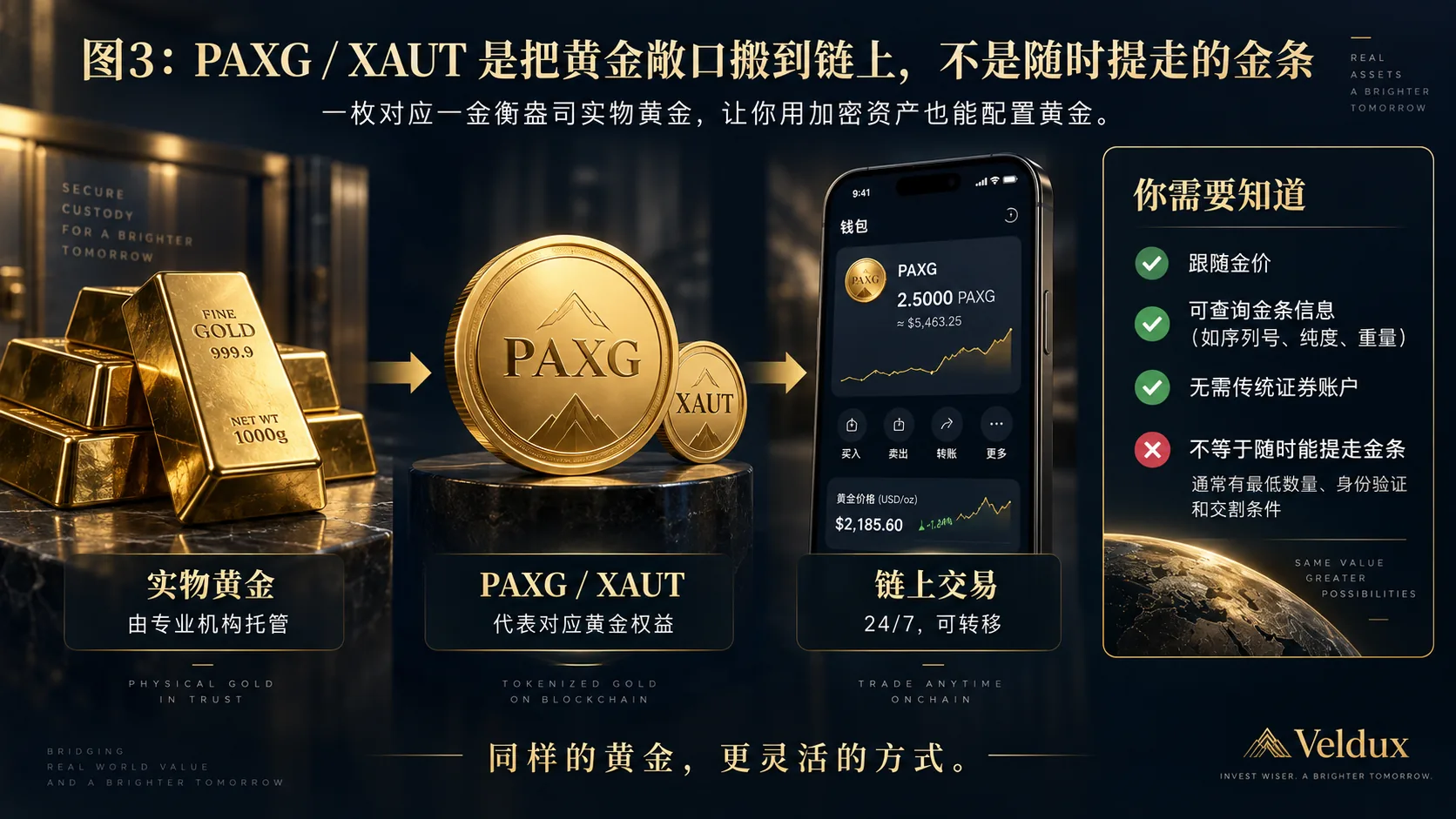
How to choose between PAXG and XAUT, and what their fees and redemption thresholds are, is covered in a separate article: How to buy gold tokens: PAXG vs XAUT differences, fees and which to choose. Here you only need to remember one thing: gold tokens suit people who "want gold exposure without touching a traditional account"; if you want to actually hold and custody your own physical bars, they are not the right tool.
My decision logic: how to choose for different needs
Compressing my own judgment into a few lines, applied to concrete scenarios:
| Your situation | Better suited | Reason |
|---|---|---|
| Prioritize defense and fear big drawdowns | Mainly gold (or gold tokens) | Clearly lower volatility and drawdowns |
| Can tolerate deep drawdowns and want long-term upside | Mainly BTC | High upside, but you must ride out the volatility |
| Hold USDT and want to add gold conveniently | Buy gold tokens directly | No extra steps, all on-chain |
| Want to custody physical gold yourself | Physical gold | You actually hold the bars or coins |
| Want to track the gold price without on-chain assets | Gold ETFs | Easier to buy and sell in a traditional brokerage account |
| Haven't figured out your goal | Don't buy yet | No goal = no allocation logic |

My own principle: first decide whether this money is meant to be "stable" or "growth-oriented", then decide whether it leans toward gold or Bitcoin; if you need both, give each a role instead of forcing a binary choice.
And I won't change this framework just because of the September correlation spike — short-term correlation changes, and your decision logic shouldn't follow it.
Common pitfalls
Pitfall 1: seeing a record correlation and assuming Bitcoin became a safe-haven asset
In September the correlation hit a multi-year high and the internet filled up again with "digital gold is back". The easiest mistake here is moving money that should be stable into Bitcoin, hoping it is "both a safe haven and fast-growing" — but it cannot give you both at once.
The two rising together this time is a phase-level result of the "anti-dollar" trade, not "Bitcoin holds up when things fall". Once risk appetite turns, Bitcoin will most likely go back to being a high-volatility risk asset. So money that needs a safe haven belongs in gold, and only money seeking growth should look at Bitcoin; don't let one short-term correlation curve make two decisions with different purposes for you.
Pitfall 2: treating a "gold token" as "exchangeable for a gold bar"
Some people buy PAXG thinking "I can swap it for a bar whenever I want", then discover at redemption time that they need a full bar, with minimum quantities and fees. A gold token gives you gold rights and gold price exposure, not "physical metal you can withdraw at any time". If you want to custody bars, buy physical gold; if you only want some gold exposure without touching a traditional account, that's when gold tokens fit.
Pitfall 3: forcing a binary choice between "gold vs Bitcoin"
"Should I buy gold or Bitcoin?" is the wrong question to begin with. They are not substitutes; forcing a choice usually ends with either betting everything on one or buying neither. Reframe it: is this money for stability or for upside? If you need both, give each a role. Fidelity Digital Assets' 2026 portfolio research also found that, in historical backtests, adding a small BTC allocation improved the risk-adjusted return of some traditional portfolios (the 1%–3% range is especially worth noting), while BTC and gold still keep a low long-term correlation — they are not necessarily substitutes.
Security risks
- Correlation changes: the Bitcoin-gold correlation does not stay stably high; don't treat short-term synchronization as a permanent state, and certainly don't size a position around it.
- Bitcoin is extremely volatile: it has gone through multiple 40%–70% drawdowns, and in its early full bear markets fell more than 80%, with no repayment guarantee of any kind. Only consider it if you can accept that.
- Gold tokens carry counterparty risk: their value depends on the issuer's vault actually holding the corresponding gold — one extra risk layer compared with physical gold.
- Don't use leverage: with gold or Bitcoin, adding leverage turns "seeking stability" into "gambling for your life".
- Regional compliance: some countries and regions place extra restrictions on crypto assets; check your local law before allocating. People under 18 should not participate.
FAQ
Q1: Can Bitcoin really replace gold?
Not at present. Bitcoin's volatility and drawdowns are clearly higher than gold's; in crises gold often holds up while Bitcoin often falls with risk assets. They are more complementary: gold handles defense, Bitcoin handles upside.
Q2: Bitcoin and gold correlation rose recently — does that mean Bitcoin became a safe-haven asset?
No. This rise reflects "both are being treated as a bet against dollar debasement" and therefore rise together, not "Bitcoin holds up when prices fall". And this kind of synchronization has reversed quickly many times in the past.
Q3: Should I buy gold or Bitcoin?
Ask about the goal first: if you want stability and fear drawdowns, gold (or gold tokens) fits better; if you can withstand big declines and want long-term upside, then consider a small Bitcoin allocation. If you want both, let each play a role instead of choosing one.
Q4: How do gold tokens like PAXG relate to Bitcoin and physical gold?
A gold token is a certificate that puts gold rights on-chain; one token corresponds to one ounce of physical gold, and it suits people who hold USDT and want to add gold conveniently. It carries more issuer risk than physical gold and less upside than Bitcoin. More in PAXG vs XAUT.
Q5: Gold rose in 2025 while Bitcoin fell — why?
In 2025 gold rose about 66% and Bitcoin fell about 6%, which shows precisely that they are not the same thing: gold strengthens in safe-haven and anti-inflation environments, while Bitcoin suffers when rates are high and risk appetite contracts. Don't infer a long-term relationship from one year of moving together or apart.
Q6: Is now a good time to chase gold or Bitcoin at highs?
I wouldn't chase highs. Gold has already risen a lot in a short period, Bitcoin is oscillating around $80,000, and macro risks (rate-hike expectations, Treasury yields, oil) are still present. Whether to buy and how much depends on your own horizon and the drawdown you can tolerate, not on "whether this is a high right now".
One-sentence summary
Bitcoin cannot replace gold yet — this correlation spike is a phase-level phenomenon of "hedging against the dollar together", not a transfer of "safe-haven" properties. What you should actually do isn't pick one, but first decide "stability or upside": stability fits gold (or the gold tokens PAXG/XAUT), upside justifies a small Bitcoin allocation, and if you want gold exposure through crypto, use gold tokens — each does its own job, and none replaces the others.
What to read next
- How to buy gold tokens: PAXG vs XAUT differences, fees and which to choose — once you've decided to add gold tokens, use this to pick PAXG or XAUT
- How to convert USDT to local currency: selling on Binance / OKX P2P and the frozen-bank-account risk — money in your portfolio eventually has to come out; this covers cash-out
- How to buy USDT on Binance: a complete P2P tutorial — before buying Bitcoin or gold tokens, you first need USDT
- How to transfer USDT: TRC20 vs ERC20 vs BEP20, which chain to use — if on-chain transfers and fees come up, this explains them in more detail
- How to buy Bitcoin: a complete tutorial for your first BTC purchase in 2026 — after deciding on a small BTC allocation, the full flow from opening an account and buying USDT to placing a BTC/USDT spot order
- What is RWA and how do you buy it? Tokenized gold, US stocks and Treasuries explained (2026) — if you want to see gold tokens inside the bigger "real-world assets on-chain" picture, start here
- How to choose a cold wallet: Ledger, Trezor, OneKey or Tangem (2026) — whether to self-custody long-term BTC or gold tokens, and how to pick a device
- Where is the safest place to store crypto after buying? Exchange, hot wallet or cold wallet (2026) — if you're still wondering "should I move it off the exchange?", start with this framework
Data sources and content notes
The Bitcoin-gold correlation, volatility, drawdown and 2025 performance figures in this article are cross-compiled from public material as of September 2026:
- Correlation: The Block's coverage of the BTC-gold correlation hitting its highest level since 2020 in September 2026, and asset correlation data from Traders' Hub and others
- Gold drawdown history: GoldObserve
- Gold token structure: Paxos PAX Gold terms, Tether Gold official FAQ
- Portfolio research: Fidelity Digital Assets
- 2025 gold vs Bitcoin performance: Julius Baer
- Macro data: US Bureau of Economic Analysis (BEA) July PCE, CME FedWatch pricing of rate-hike odds, FT coverage of long-term Treasury yields, Reuters coverage of Brent crude
One important caveat: correlation, the gold price and the Bitcoin price are all snapshot data that change in real time; this article cites September 2026 levels. The macro backdrop (rate expectations, Treasury yields, oil) also keeps changing — rely on the latest official data and market prices.
This article was compiled by Queenie from public material and common allocation questions. If you spot updated data or errors, please tell us via contact.
Last updated: 2026-10-16
Disclaimer
This article is for general education and experience-sharing about Bitcoin, gold and gold token allocation. It is not investment advice, financial advice or a trading recommendation.
Crypto assets and gold prices are highly volatile, and crypto in particular carries extremely high volatility, regulatory change, cybersecurity and operational risks. Users should judge carefully based on their own risk tolerance and local law, and consult a professional financial adviser where needed. People under 18 should not trade crypto.
Exchange operations · USDT · Wallet security
Responsible for researching and organizing content on Binance, OKX, USDT transfers, withdrawals and wallet security. The steps and key data in this article are verified according to the content type, using real operation records, official platform documentation and public sources. Interfaces, fees and regional rules may change, so the article is reviewed and updated continuously.
Status: manual review · Last verified 2026-10-16
Reviewed by: Veldux editorial team
- Paxos PAX Gold (PAXG) official pageVerifies the "gold tokens" section — PAXG is issued by Paxos, each token corresponds to one troy ounce of physical gold held in custody, holders have beneficial ownership of the corresponding allocated gold, and can look up the serial number, purity and weight of the associated bar
- Tether Gold (XAUT) official pageVerifies the "gold tokens" section — XAUT is an on-chain token backed by physical gold, officially one token per troy ounce of gold, and redeeming a full bar involves identity verification and minimum-quantity conditions
- Julius Baer, "Revisiting the hypothesis of digital gold"Verifies the 2025 performance comparison — gold rose about 66% over the year while Bitcoin fell about 6% — and the judgment that the two are driven by different investor bases and that the short-term correlation can reverse
- Fidelity Digital Assets, "Getting Off Zero: Evaluating Bitcoin in 2026"Verifies the portfolio research cited in "Pitfall 3" — in historical backtests, adding a small BTC allocation (1%–3% range) improved the risk-adjusted return of some traditional portfolios, and BTC and gold still keep a low long-term correlation
- 2026-10-16UpdateAdded sources for the key facts and completed the fact check.
Editorial principles ineditorial policy,corrections policy。