
Cash out USDT on Binance/OKX P2P: process and frozen accounts (2026)
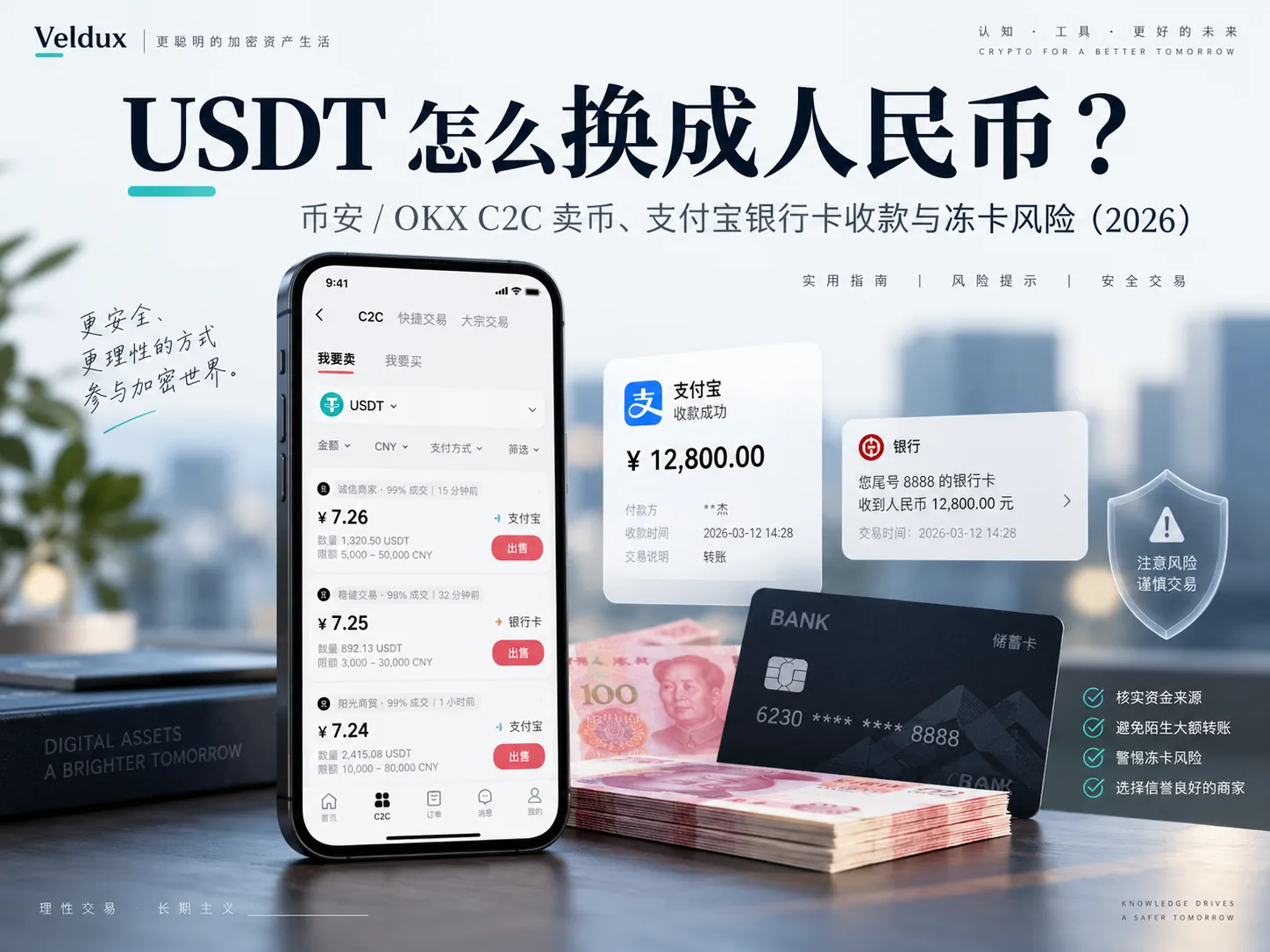
Table of contents

Binance new-user benefit
20% fee rebate
Official Binance sign-up · You must complete identity verification (KYC) to trade and withdraw
Cashing out USDT into your local currency: what really worries most beginners isn't "where the button is", but two questions:
How does the money actually get into my bank account or payment app? And once it's there, could it trigger a risk control check or even a frozen account?
The usual approach is to sell USDT in an exchange's P2P market: you put the USDT into the platform's escrow, the buyer pays your verified receiving account in local currency according to the order, and once you've confirmed your own account actually received the money, you release the USDT on the platform.
Both Binance and OKX call this feature P2P (or P2P trading) in their English interface, and this article uses P2P throughout.
But first, the most important point:
Platform escrow reduces the risk of "released the coins and never got paid", but it cannot guarantee that the money the other side pays you has a clean origin, and it cannot stop your bank, your payment app or a court from applying a risk control hold, a payment block or a freeze under the law.
So the real work in a P2P cash-out isn't only "confirm receipt before releasing" — it's also the counterparty's history, the payer's verified identity, order anomalies, and keeping the transaction records.
A single P2P order usually settles in minutes once the buyer pays; what takes real work is choosing the counterparty and verifying who actually paid. The two things that most often go wrong are releasing the coins before the money has really landed and accepting a payment from someone other than the buyer.
The facts in this article were last checked in October 2026.
Important: crypto rules differ by country and region. In several jurisdictions, converting between crypto and fiat, or running a business that matches crypto trades, is restricted or treated as regulated activity, and stablecoins are generally covered by the same rules. This article explains how P2P works, how the platforms behave and where the money risk sits; it is not an encouragement or compliance advice to convert crypto to fiat anywhere. Judge by the rules of your registration region and of where you live.
Quick overview: how do you turn USDT into local currency?
The whole process can be understood simply as:
USDT → P2P order → the buyer pays in local currency → you confirm the money really reached your account → the platform releases the USDT
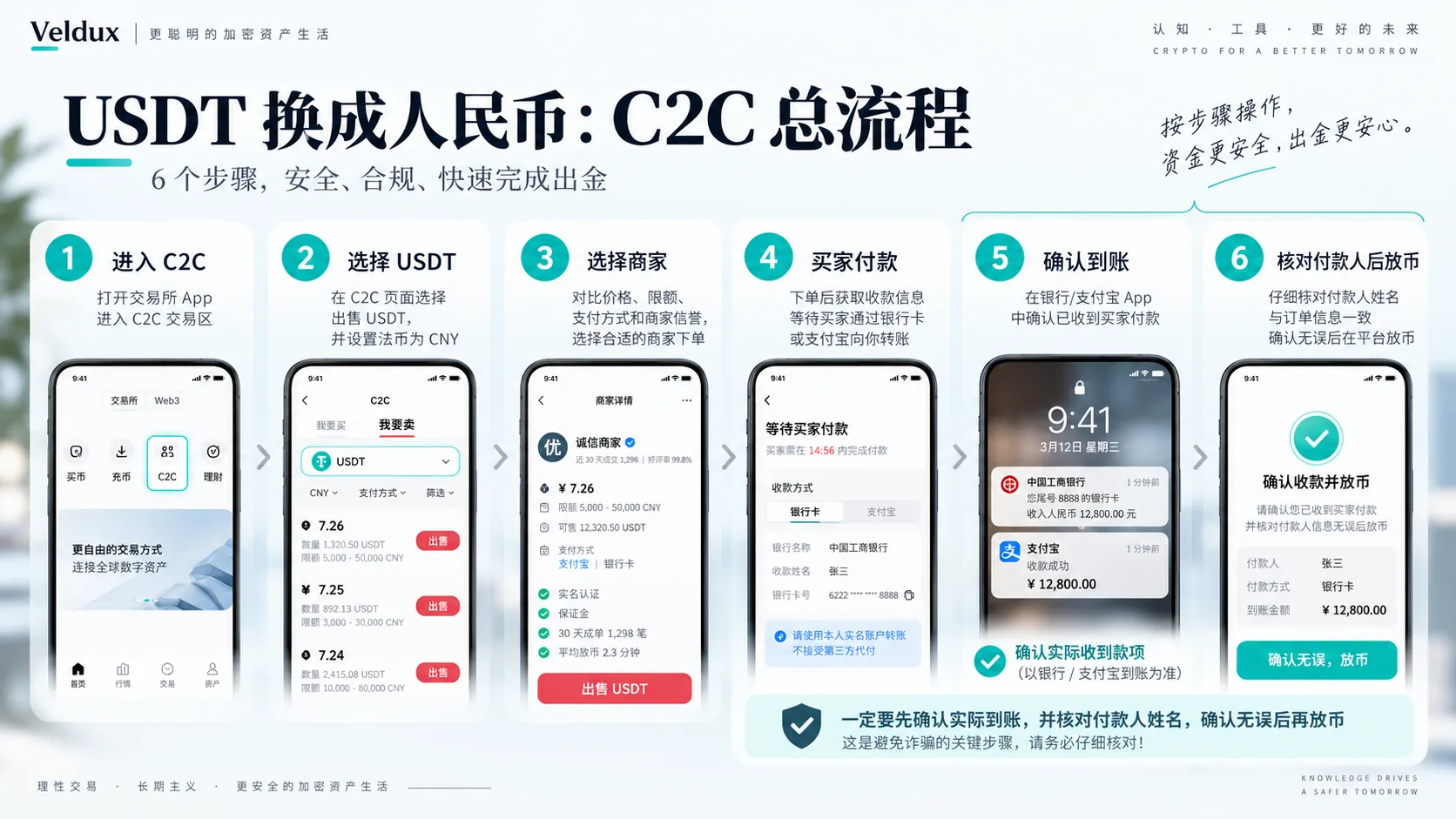
It is not:
USDT → Binance / OKX withdraws local currency straight to your bank account
Don't confuse these two concepts.
The exchange is mainly responsible for holding the USDT in the order; the fiat payment usually happens between the two parties' banks, payment apps or another payment method the platform supports.
| Situation | What to focus on |
|---|---|
| First time selling USDT | Start with a small amount to learn the P2P flow; don't chase the best quote right away |
| You already have a merchant you trade with regularly | Keep checking the merchant's status, the order and each payment's verified identity; don't skip checks because it went well before |
| Receiving into a payment app | Use an account in your own name, confirm the money actually arrived and check who paid |
| Receiving into a bank account | Don't just look at the arrival; keep the order and the bank statement |
| A clearly large amount | Don't treat "splitting the order" as a way to dodge risk controls; focus on proof of source of funds, transaction records and local rules |
| A clearly abnormal quote | Don't pick someone just because the price is high; check the merchant's history and the order terms first |
My own principle has always been simple:
I'd rather take a slightly worse rate than switch to a stranger for a few cents.
If you're still deciding whether to cash out with USDT or USDC (their P2P exit routes differ quite a bit), start with: USDT vs USDC: what's different when cashing out.
1. Before you cash out, understand these 4 things
1. A P2P cash-out is, in essence, selling USDT
When you sell USDT in a P2P market, the exchange is not paying you local currency.
What actually happens is:
- You create or accept an order to sell USDT;
- The platform temporarily holds the USDT in escrow;
- The buyer pays your receiving account according to the order;
- You confirm that you really received the money;
- You tap confirm receipt on the platform;
- The platform releases the USDT to the buyer.
So the digital asset and the fiat money travel through two separate systems:
- USDT sits inside the exchange's P2P escrow system;
- The money sits inside the bank, the payment app or another payment system.
That's why an exchange can protect the coins in an order, but cannot guarantee that every payment has an absolutely clean origin.
2. "Platform-verified merchant" doesn't mean "this payment is definitely safe"
A verified merchant, a high completion rate and a large order history are all worth considering.
But don't read it as:
verified merchant = nothing will ever go wrong.
A merchant's history only helps you judge whether the counterparty is relatively stable; it cannot prove that every payment they make you in future is free of fund risk.
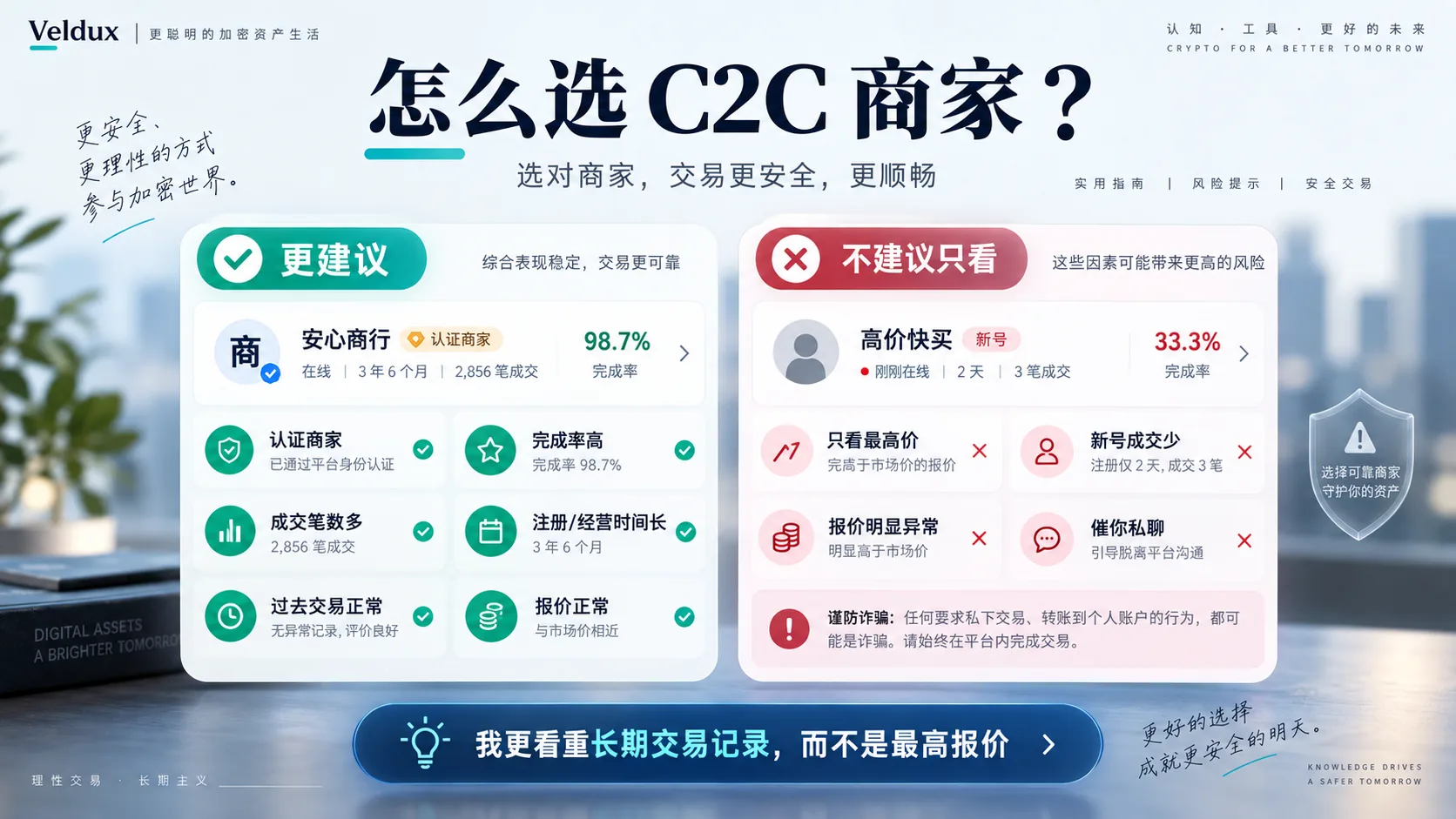
That's why, when choosing a P2P merchant, I don't look at a single metric.
I mainly look at:
- Whether it's a platform-verified merchant;
- How long it has been registered or operating;
- The number of completed trades;
- The completion rate;
- Whether it has had normal trades recently;
- Whether I've completed normal orders with it before;
- Whether the quote clearly deviates from the normal market;
- Whether it asks to move to a private chat or trade off the exchange.
The longer it has traded, the steadier its history, and the more I've traded with it normally before, the more I lean towards it.
3. More important than "is the merchant an old one" is who pays
Many guides don't explain this clearly.
Suppose the buyer on the order is "John Smith", but the person who actually sends the money to your bank account or payment app is "Jane Doe". That calls for extra caution.
OKX's current P2P rules clearly require that payment, in principle, come from an account whose verified identity matches the buyer's; if a payment arrives from an account that isn't the buyer's, the platform advises the seller to hold off releasing and handle it through the order appeal.[1]
One reason is to prevent so-called third-party payment or triangular fraud.
So:
Receiving the money doesn't mean you should release right away.
The correct order is:
Confirm the money actually arrived → check who paid → check the amount → check the order → then decide whether to release.
If the payer clearly doesn't match the order information, don't tap release just because "the money is already here".
4. A restricted P2P account doesn't have just one cause
People online often call every case a "frozen account", which isn't accurate.
What you may be facing is:
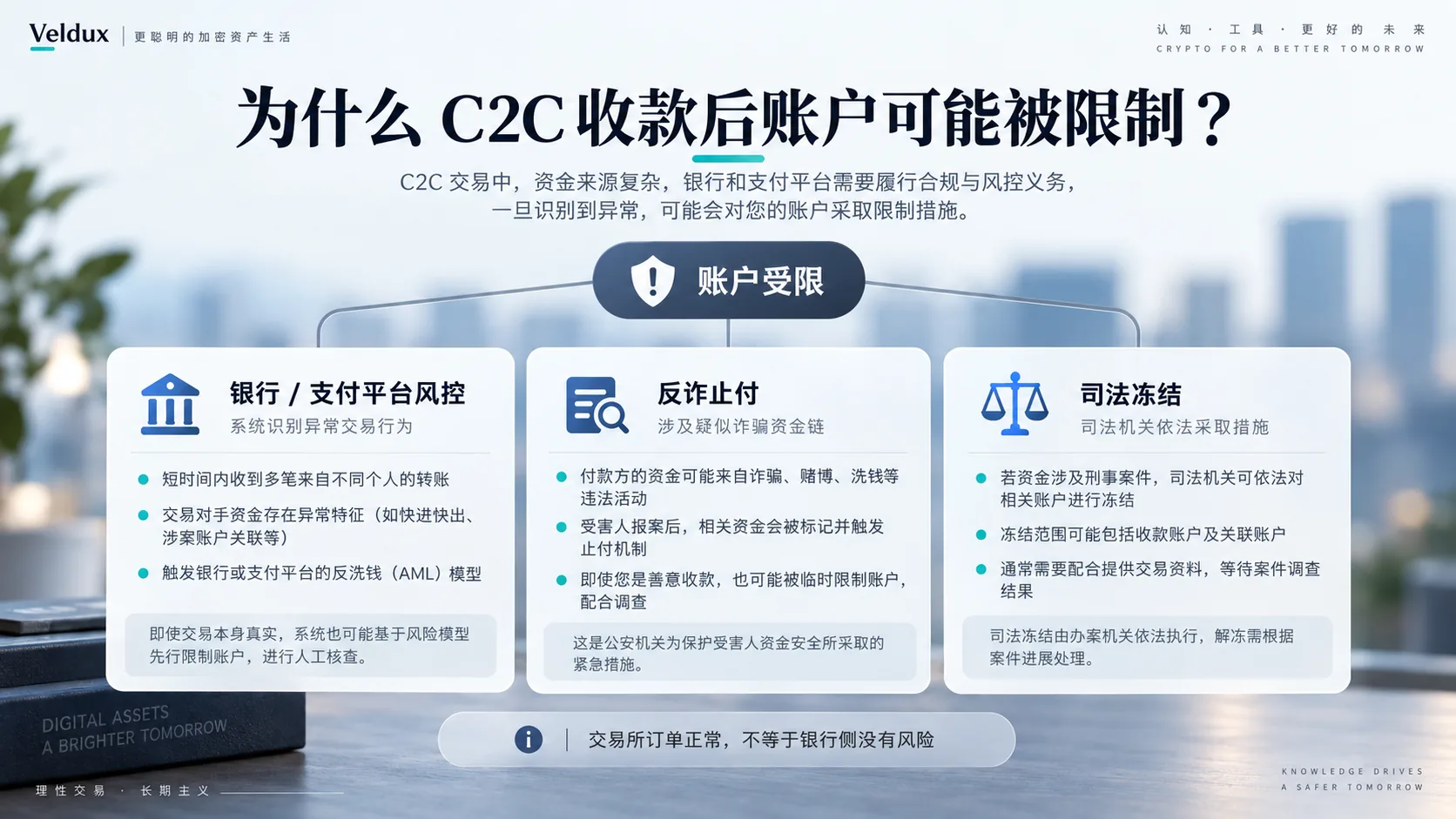
The bank's or payment platform's own risk controls
For example, the account suddenly shows a receiving pattern, amount or frequency different from usual, and the bank or payment app asks for further verification.
An anti-fraud payment block or risk hold
If a payment is linked to a reported account, a fraud case or an abnormal chain of funds, the account may be temporarily restricted.
A court or law-enforcement freeze
If the funds come within the scope of an investigation, the competent authority may freeze the bank account under the law.
These three kinds of problem can differ in how they're handled and how long they last.
So don't reduce it to:
"Sell USDT and your account gets frozen."
Nor to:
"Stick to old merchants and you definitely won't get frozen."
The actual risk depends on the funds, the counterparty, the state of the account, the payment channel and the regulatory environment, among other factors.
2. How I usually choose P2P merchants
This part is my actual experience in use; it is not an official guarantee from any platform, nor a "100% freeze-proof method".
When I do a P2P cash-out, I don't always go for the highest quote.
If I already have an established merchant I trade with normally, I'd rather keep trading with the same one.
My habit these days is mainly:
Prioritise merchants registered or operating for more than 1 year, with a stable trade history, whom I've already completed normal orders with.
For receiving, I mostly use a payment app in my own verified name.
Up to the last update of this article, using that method I haven't run into anti-fraud calls or account restrictions.
But this has to be stressed:
This is only my personal history; it doesn't prove that "old merchant + payment app" avoids risk controls.
The real purpose is to reduce the uncertainty of facing a completely new counterparty every time, not to try to get around the bank's or the payment app's risk controls.
A simple example:
if merchant A, whom I've traded with many times and who has a long operating history and stable volume, quotes 1.001 today, and a new merchant I've never traded with quotes 1.003, I usually won't switch to a complete stranger for a 0.2% difference.
Because for me:
A merchant's history and stability matter more than a tiny price difference.
Even so, after trading with the same merchant many times, every single order still needs re-checking:
- Whether the money really arrived;
- Whether the amount is right;
- Whether the payer looks normal;
- Whether there was a third-party payment;
- Whether anyone asked to process things off the platform;
- Whether the order shows any anomaly warning.
Normal before doesn't mean this one can skip the checks.
3. The full process for selling USDT on Binance / OKX P2P
The mechanics of P2P selling on Binance and OKX are basically the same; only the entry points and interface wording differ slightly.
Entry points can change with the app version, the country and the registration region, and certain features may not be available in your region.
4. How to sell USDT on Binance
To sell USDT on Binance you need an account that is already registered and identity-verified (KYC). If you haven't registered yet, see the Binance registration tutorial first and come back after.
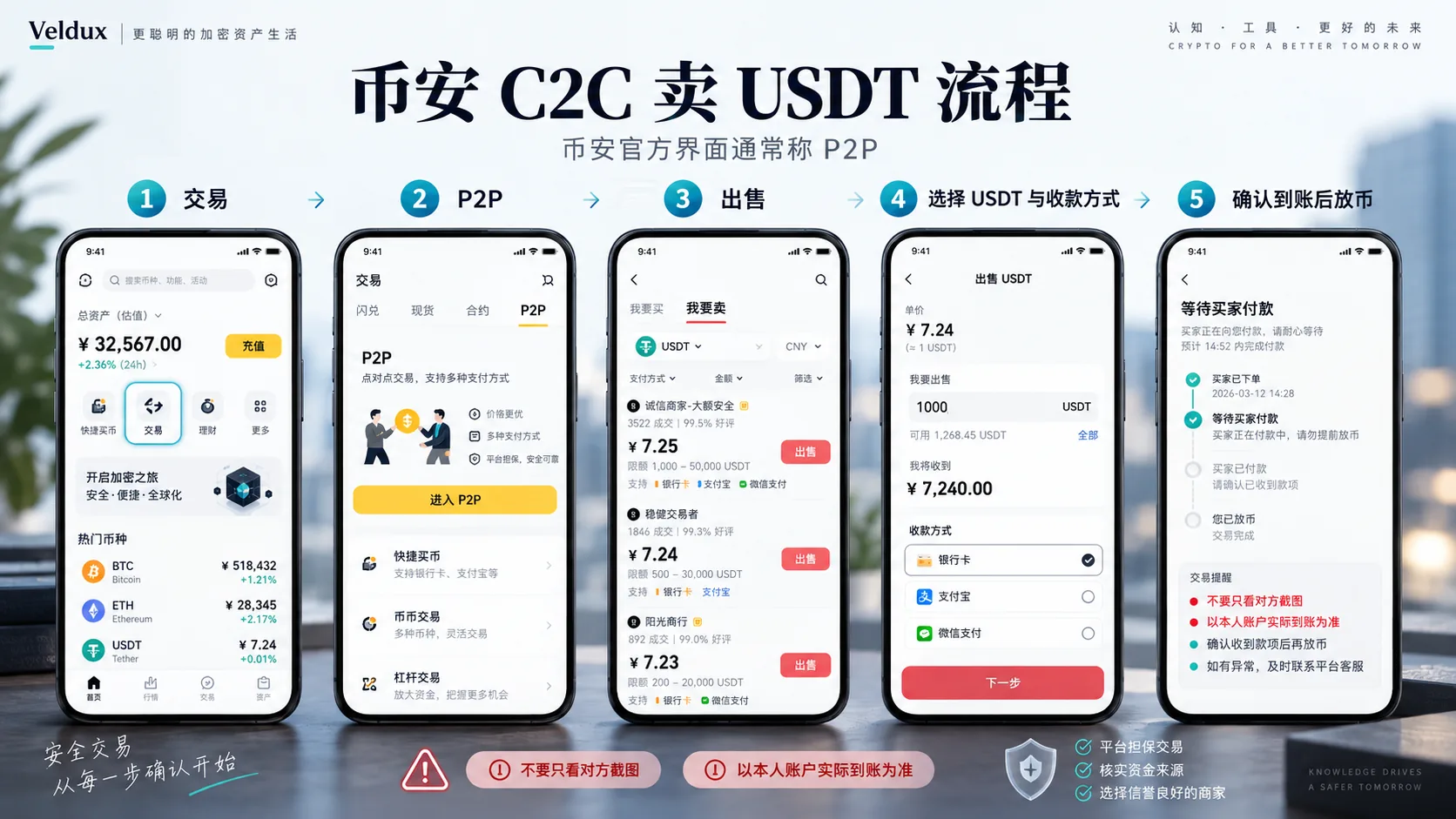
Step 1: open the P2P page
In the Binance app, find:
Trade → P2P
Then switch to:
Sell
Some versions also offer a quick-trade area.
If your account or region doesn't show the matching fiat currency, payment method or P2P feature, don't try to get around the restriction by changing your details or using someone else's account.
Step 2: choose USDT and the payment method
Choose the digital asset you want to sell, for example:
USDT
Then look at the fiat currencies and payment methods your account actually offers.
When adding a payment method, use an account in your own verified name and make sure the details are correct.
Step 3: choose the counterparty
Don't pick purely by "price, highest to lowest".
It's worth checking at the same time:
- Merchant verification;
- Number of orders;
- Completion rate;
- Merchant history;
- Trading limits;
- Payment window;
- Order terms.
If you already have an established merchant you've traded with successfully, you can treat that history as an extra reference point.
Step 4: submit the sell order
Enter the amount of USDT you want to sell.
Once the order is placed, the USDT goes into escrow according to the platform's mechanics.
Then you wait for the buyer to pay.
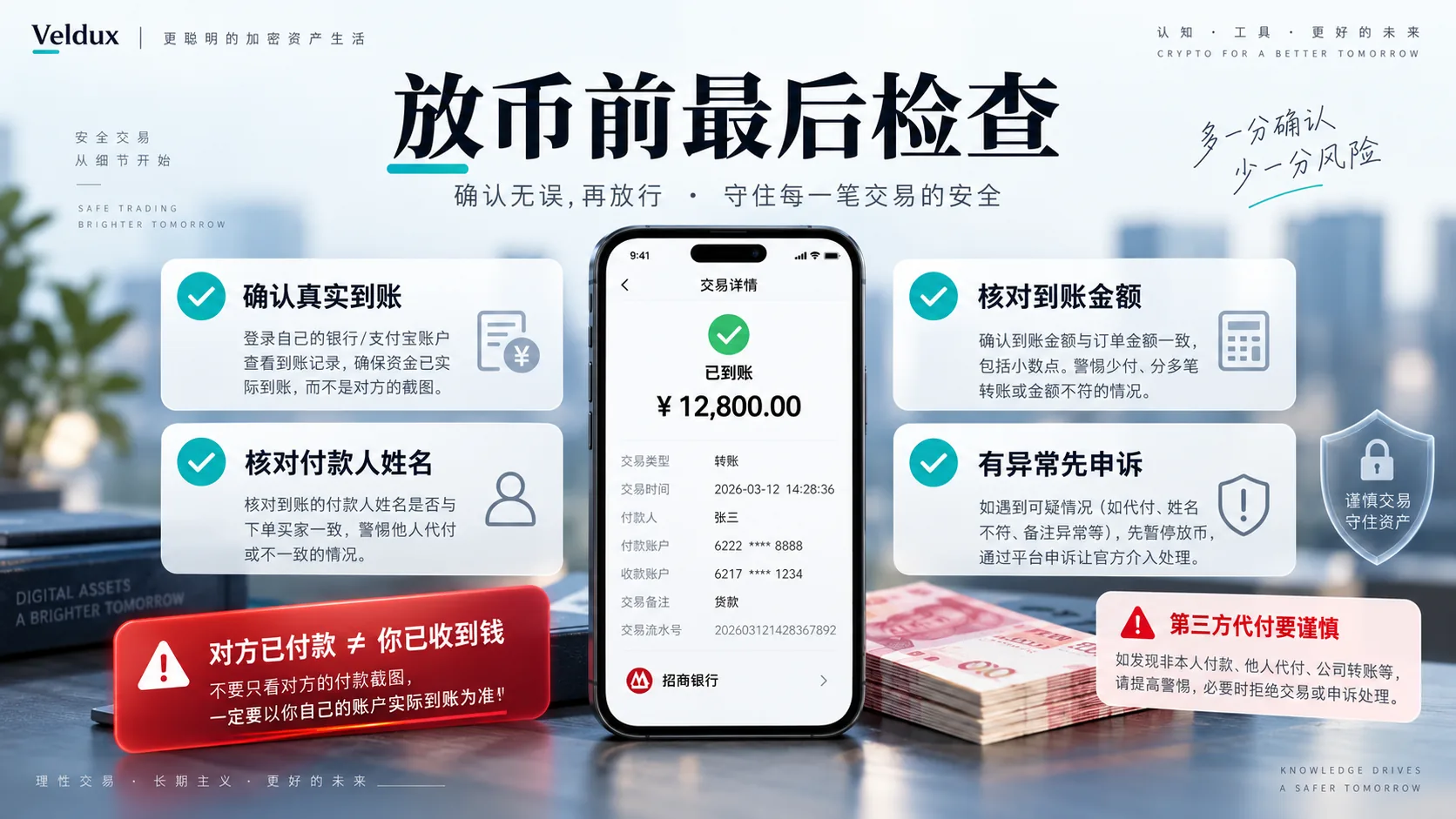
Step 5: don't release just because it says "the buyer has paid"
This is the most important step in the whole P2P cash-out flow.
When the counterparty taps:
Paid
it only means:
they told the exchange "I paid".
It does not mean the money has reached your bank account or payment app.
So you have to open:
- Your payment app;
- Your bank app;
- The relevant receiving account;
and check whether the money really came in.
Binance also explicitly reminds sellers to confirm for themselves that the money has actually reached their bank account or payment account before tapping confirm receipt and releasing the digital asset, rather than relying only on SMS, email or the other side's screenshot.[2]
Step 6: check the payer and the amount
Once you see the money, check:
- Whether the amount received is correct;
- Whether the payer looks normal;
- Whether a third party paid;
- Whether the order shows any anomaly warning.
If the information looks wrong, don't rush to release; use the platform's order appeal.
Step 7: confirm receipt and release the USDT
Only after confirming everything is fine, tap:
Confirm receipt / Payment Received
Then complete the additional verification the platform requires.
Once the USDT is released, the P2P order is really finished.
5. How to sell USDT on OKX
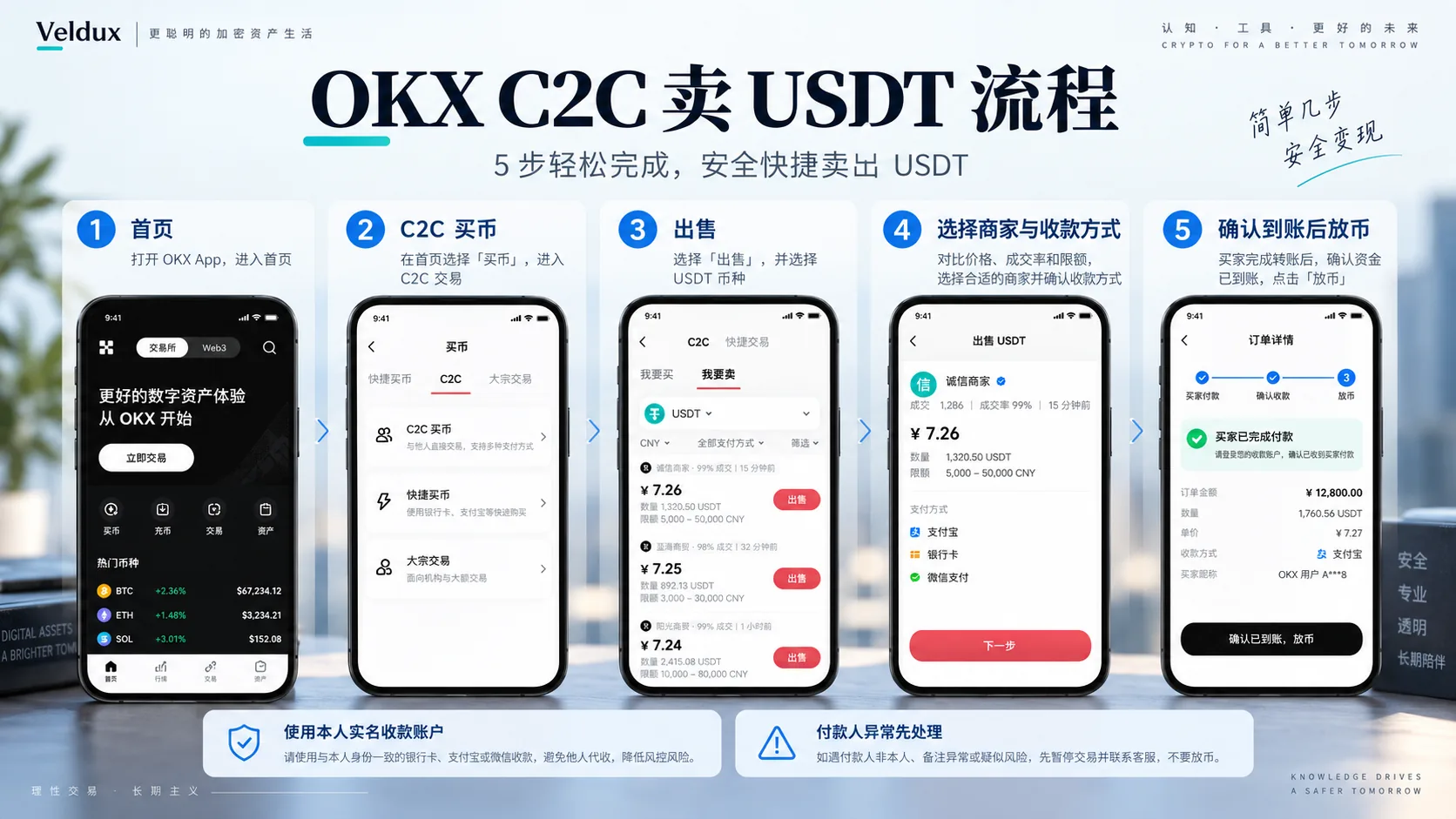
OKX's current English interface calls this P2P.
Step 1: open P2P
From the app's home screen, go to:
P2P
Then find:
Sell
Step 2: choose USDT and your local currency
Choose:
USDT
and look at the fiat markets your account actually offers.
OKX's P2P page still shows quick-sell markets, but whether a given function applies to your account depends on the page after you sign in and on your registration region.
Step 3: link a receiving account in your own name
OKX's current Help Center shows that eligible users can link, depending on what the page supports:
- A bank account;
- A payment app;
- Another supported payment method.
Regular users should use a receiving account in their own verified name.
I personally prefer a payment app, mainly because it's convenient to check arrivals and history.
But a payment app isn't automatically free of risk controls just because it is one.
Step 4: choose the merchant
My method here is the same as before.
Rather than chasing only the best quote, I value:
verification + trade history + completion rate + time registered/operating + past experience.
If a merchant has already traded normally several times and stays stable over the long term, I usually won't switch to a stranger for a tiny price difference.
Step 5: wait for payment
When the buyer pays, you'll see the order status change.
Don't release right away.
Go into your payment app or bank account yourself and confirm.
Step 6: check especially for third-party payment
OKX is fairly clear on this:
if the name on the account that actually paid doesn't match the identity of the buyer on the order, pause the release and handle it through the platform.
The reason is that such a trade may involve third-party payment or triangular fraud.
So even if:
the money has already arrived
you still have to look at:
who paid.
Step 7: confirm the money arrived, then release
Confirm:
- The money really arrived;
- The amount is correct;
- The payer shows nothing abnormal;
- The order has no dispute;
then tap confirm receipt and release the USDT.
6. Bank account or payment app: which is better for receiving P2P payments?
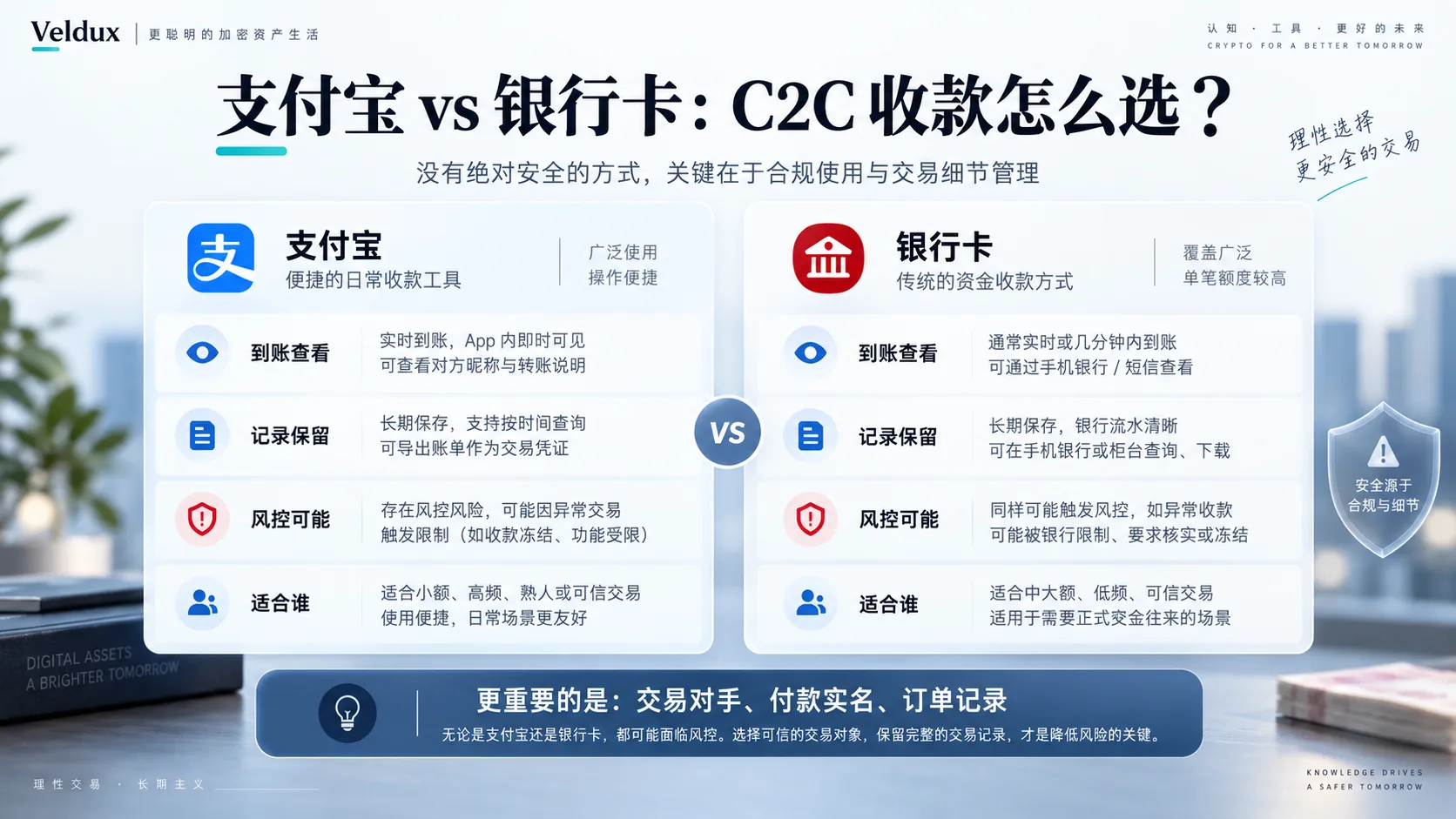
There's no method you can simply call:
"absolutely safer".
Payment app
Advantages:
- The arrival is shown fairly clearly;
- Convenient to check day to day;
- OKX currently lets eligible accounts link a payment app;
- It keeps a fairly complete transaction record.
Risks:
- The payment app has its own anti-money-laundering and risk-control systems;
- Abnormal funds or abnormal trades can still trigger restrictions;
- A third-party payment still has to be dealt with.
Bank account
Advantages:
- The bank statement is formal;
- The fund trail is clear;
- Most counterparties are familiar with bank transfers.
Risks:
- Abnormal funds can trigger the bank's risk controls;
- Funds tied to a case can lead to a payment block or a court freeze;
- If your main account is restricted, daily life can be affected.
So what really matters isn't:
Payment app or bank account?
but:
Who the counterparty is, who actually paid, whether the records can prove it, and whether the order is complete.
7. Why can receiving P2P payments get your account restricted?
Many people simply say:
"Because you received dirty money."
That isn't completely wrong, but it's too crude.
An account restriction after receiving a P2P payment can come from several links in the chain.
Case 1: the payment is tied to a case
If the money the buyer pays you is linked to a chain of funds from fraud, gambling, money laundering or another case, once the tracing reaches your account, it may come within the scope of an investigation.
Even if you had no idea where the money came from, you may still have to explain why it entered your account.
Case 2: account behaviour triggers the payment platform's risk controls
For example:
- Many payments from strangers in a short period;
- A sudden change in amounts or frequency;
- Account behaviour clearly different from the past.
The bank or payment app may require verification.
Case 3: third-party payment
This is the kind of situation that deserves particular attention in P2P.
The order is A buying coins, but B sends you the money.
That means:
the order relationship and the actual money relationship don't fully match.
If B's funds are disputed, you have to explain why someone unrelated to your order paid you.
That's why the platforms keep stressing verified-name matching.
8. Why I prefer to keep trading with the same established merchant
Because part of the risk in P2P comes from information asymmetry.
The first time you face an unfamiliar merchant, all you can look at is:
- The profile on the page;
- The completion rate;
- The order history;
- The merchant verification;
- The platform labels.
But after trading normally with the same merchant several times, you have at least one more piece of information:
your own transaction history.
That's why I don't switch to unfamiliar merchants often for a very small price difference.
But again:
Sticking to an established merchant only reduces counterparty uncertainty; it doesn't remove the risk in the source of funds.
Even after dozens of trades:
the 31st one still needs the arrival checked;
the payer still needs checking;
an obviously abnormal third-party payment still can't be accepted.
9. These "freeze-proof" tricks — don't trust them blindly
Online you often see so-called:
"P2P freeze-proof tutorials".
Many of them have no reliable basis.
Myth 1: splitting into many small orders avoids a freeze
Not necessarily.
Frequent small payments from strangers can also form an abnormal trading pattern.
If the amount is clearly large, what matters more is:
- Whether the source of funds can be explained;
- Whether the transaction records are complete;
- Whether it complies with local rules;
- Whether the bank account is being used normally.
Don't treat "splitting orders" as a way to dodge risk controls.
Myth 2: using several bank accounts is safer
There's no such guarantee either.
If the funds themselves are problematic, spreading them across more accounts doesn't change their nature.
It only makes your own fund trail more complicated.
Myth 3: a merchant registered more than 1 year ago is absolutely safe
I do prioritise established merchants with a longer registration or operating history.
But:
that's a screening criterion, not a safety proof.
An established merchant still needs each trade checked.
Myth 4: a payment app can never be frozen
That isn't right either.
A payment app has its own risk-control, anti-money-laundering and account-security mechanisms.
The fact that I haven't run into anti-fraud calls or account restrictions using a payment app is only my personal history; it can't be generalised into a conclusion.
10. The 5 easiest traps to fall into in P2P
Trap 1: releasing on a screenshot
The other side sends:
"I've already transferred it."
and then a screenshot of a successful payment.
Don't treat a screenshot as evidence.
Screenshots can be forged, and transfers can be reversed or delayed.
Look only at the actual record of arrival in your own account.
Trap 2: only looking at the highest price
If a merchant's quote is clearly higher than everyone around them, don't immediately assume you've found a bargain.
An abnormal quote can have several causes.
At the very least, check:
- The merchant's history;
- The limits;
- The number of trades;
- The terms;
- The payment method.
Taking on the uncertainty of a complete stranger for a tiny price difference usually isn't worth it.
Trap 3: accepting third-party payment
When the buyer on the order isn't the person who actually paid, be more careful.
Especially if they say:
"It's a friend's account."
"Our company's finance team is paying you."
"It's my family member's account."
Don't ignore the problem just because the money has arrived.
Follow the platform's rules and, if needed, open an appeal.
Trap 4: moving to a private chat
Someone may say:
"Add me on WhatsApp, we'll trade directly next time at a better price."
That immediately gives up the platform order and its escrow protection.
Later, if there is:
- No payment;
- Underpayment;
- A funds dispute;
- An identity dispute;
the platform will struggle to help you the way it would with a normal P2P order.
So my principle is:
the trade happens inside the exchange order.
Trap 5: keeping no records after the money arrives
When an account problem actually appears:
"I remember it was money from selling USDT"
isn't much of a proof.
You should be able to produce:
- The exchange order number;
- The USDT amount;
- The trade time;
- The counterparty's details;
- The platform chat log;
- The payment app or bank statement;
- The record of where the digital asset came from.
That is a complete evidence chain.
11. What if your bank account or payment app really is restricted?
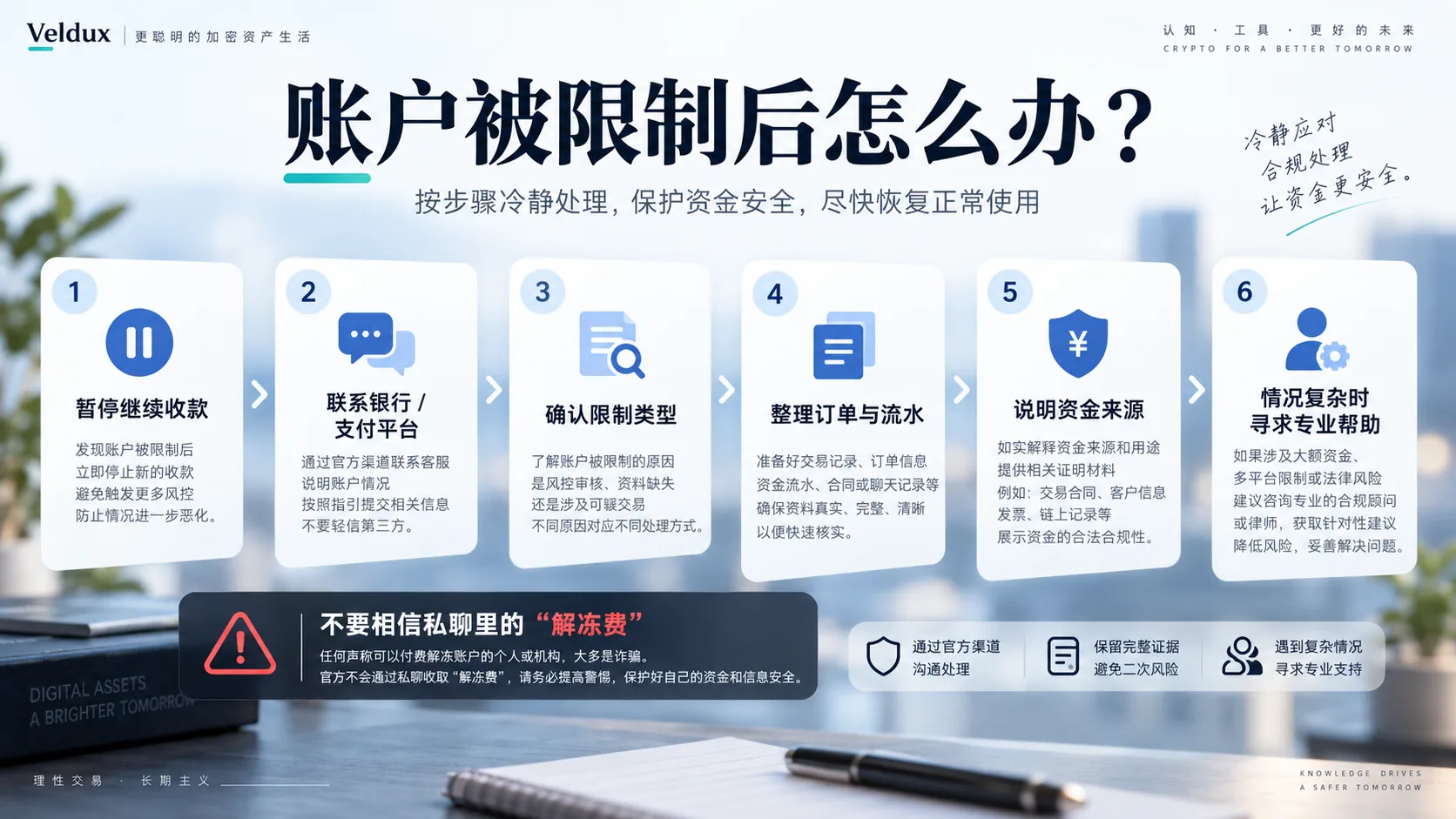
First, don't search the internet for a so-called "unfreeze trick" and follow it blindly.
The first thing is to confirm:
what kind of restriction it actually is.
Step 1: stop receiving and sending related payments
If the account suddenly shows an abnormal restriction, don't keep receiving new P2P payments while you're sorting the problem out.
Get the current situation clear first.
Step 2: contact the payment app or the bank
Confirm:
- Whether it's the platform's internal risk control;
- An anti-fraud payment block;
- Or a court or law-enforcement freeze.
These three are not the same thing.
Step 3: if it's a judicial freeze, confirm the authority
If the bank tells you clearly that it's a freeze ordered by an authority, you can ask:
- Which authority ordered it;
- Their contact details;
- The scope of the freeze;
- What documents you need to prepare.
Don't judge by what the internet says:
"It's lifted in three days, guaranteed."
"It lifts itself after a month."
The duration of a judicial freeze depends on the jurisdiction and the case; it can last months, longer in complex cases, and there is usually a mechanism to extend it while the law allows. If the funds are confirmed to be unrelated to the case, the freeze should be lifted in accordance with the law.
Step 4: organise the complete transaction records
At the very least prepare:
- The P2P order;
- The order number;
- The trade time;
- The USDT amount;
- The trade price;
- The counterparty's details;
- The chat log;
- The payment app or bank statement;
- The record of where the USDT came from.
Don't delete the chats, and don't clean up records just because a few months have passed.
Step 5: explain the source of funds as required
The point isn't to explain:
"Someone told me cashing out this way wouldn't freeze."
but to be able to explain:
why this money entered your account.
A complete, continuous, verifiable order record is worth more than a verbal explanation.
Step 6: get professional help if the amount is large or the case is complex
If it involves:
- A large amount;
- An authority in another jurisdiction;
- Several payments tied to a case;
- A long freeze;
- A demand for compensation;
- Preparing legal documents;
don't rely only on experience posts online.
If needed, consult a lawyer familiar with this kind of case.
12. What if someone demands an "unfreeze fee" or "security deposit"?
If someone contacts you through:
- WhatsApp;
- Telegram;
- Signal or another messenger;
- A phone call;
- A private message;
and tells you:
"Pay the unfreeze fee and it will be lifted."
"Send the deposit and it's released immediately."
"Transfer it to a safe account first."
be extremely wary.
Don't transfer money directly to a private account they give you.
The right move is:
verify directly through the official channels of the bank, the payment app, the authority or the exchange.
No real account problem should ever be solved only through a stranger's private chat window.
13. Does P2P selling on Binance or OKX charge a fee?
Don't reduce it to:
"All P2P is free forever."
Some OKX P2P markets show zero trading fees, but the order page is what counts.
Binance states that different P2P markets and order types may carry maker or taker fees, and that fees vary with the market.
Also, even when the platform fee is 0:
you still have another cost:
the quote spread.
For example, the market reference price and the price at which a merchant will buy your USDT can differ.
That spread moves in real time with:
- The market;
- The time;
- The fiat currency;
- The amount;
- The payment method;
- The merchant.
So it isn't advisable to judge the cost with a long-term fixed "0.5%–2%" figure.
When placing the order, compare directly:
how much local currency you will actually receive in the end.
14. How long does a P2P cash-out take?
There's no fixed answer here either.
The speed depends on:
- The merchant;
- The payment method;
- The bank's processing speed;
- Whether an order appeal appears;
- The market conditions at the time.
Many orders set a clear payment deadline.
But always remember:
An order showing "paid" doesn't mean your account has received anything.
Go only by the actual record in your payment app or bank account.
15. My P2P decision logic
If I had to compress my approach into a few lines, it would be:
1. Don't switch to strangers for a few cents
If I've already traded normally several times with a merchant that has operated for more than 1 year and has stable volume, I prioritise that actual history.
2. I mainly receive into a payment app in my own name
That's my personal habit.
So far, using that method I haven't run into anti-fraud calls or account restrictions.
But this isn't a "risk-control-proof method", and it doesn't mean a payment app is inherently safer than a bank.
3. Every single trade gets re-confirmed
Even after many trades:
no arrival, no release.
Abnormal payer, no direct release.
Abnormal order, appeal first.
4. I don't accept off-platform trades
However familiar the merchant, I prefer to keep the exchange order record.
Because with an order:
you at least have a complete record of the time, amount, quantity and chat.
5. I keep the records
The core of P2P risk management isn't the so-called:
"how to make risk controls not see it".
It's:
if someone later asks where this money came from, whether you can explain it completely.
FAQ
Q1: How do I turn USDT into my local currency?
The common mechanism is to sell USDT in the P2P market of an exchange that supports your registration region: the buyer pays your verified receiving account in local currency according to the order, and you release the USDT only after confirming the money really arrived.
Whether a specific feature is available depends on your registration region, local rules and what the exchange page shows.
Q2: Can Binance and OKX withdraw USDT straight to my local bank account?
In P2P it isn't "the exchange converts USDT automatically and wires it to your bank".
What actually happens is:
you sell USDT and the counterparty pays you.
The digital asset is held by the exchange in escrow; the fiat payment is made through the payment method both sides chose.
Q3: Which is safer, a payment app or a bank account?
Neither can guarantee that no risk control will ever trigger.
A payment app and a bank each have their own anti-money-laundering, anti-fraud and account risk-control mechanisms.
Rather than agonising over the receiving tool, the counterparty, the payer's verified identity, the completeness of the order and the fund records matter more.
Q4: Is it safer to use a merchant registered more than a year ago?
Operating time and trade history can serve as one screening criterion.
I personally also lean towards established merchants with a longer operating history, stable volume and previous normal trades.
But it can't guarantee that every future payment is risk-free.
So every trade still needs re-checking.
Q5: Is there an advantage to always using the same merchant?
The main advantage is reducing the information uncertainty of facing a new counterparty each time, and the fact that you already have your own transaction history.
But a "fixed merchant" can't replace checking the payer's verified identity, nor guarantee that the payment platform's or bank's risk controls won't trigger.
Q6: Why check the payer after the money has arrived?
Because P2P carries the risk of third-party payment and triangular fraud.
If the buyer on the order and the person who actually paid clearly don't match, releasing the digital asset directly isn't advisable; appeal or verify according to the platform's rules.
Q7: If I received the money, is my bank account guaranteed not to be frozen?
It can't be guaranteed.
An account can be restricted by the payment platform's internal risk controls, an anti-fraud payment block, a link to funds from a case or a judicial freeze.
A trade completing normally doesn't mean there's no other risk on the bank's side.
Q8: For a large amount, is it safer to split it into many small trades?
That's not the right way to look at it.
Deliberately splitting trades doesn't change the source of funds, and shouldn't be used as a way to dodge bank risk controls.
With a large amount, focus instead on proof of the source of funds, order records, local law and the rules for using the bank account.
Q9: Does selling USDT through P2P charge a fee?
It varies by platform and market.
Some OKX P2P markets currently show zero trading fees; Binance states that different markets may charge maker/taker fees.
The fee shown when you create the order is what counts.
There is also the spread between the merchant's quote and the market reference price.
Q10: The other side already tapped "paid" — why can't I release right away?
Because that's only their statement inside the exchange.
You have to go into your payment app or bank account yourself and confirm that the money actually arrived.
If it hasn't actually arrived, don't release the USDT.
In one sentence
Cashing out USDT through P2P isn't about managing a "sell button"; it's about the whole chain:
choose the counterparty → create the order → verify the real arrival → check who paid → keep the records → then release.
I personally prefer merchants with more than 1 year of operation, stable trade history and previous normal trades, and I mainly receive into a payment app in my own name, without switching to unfamiliar counterparties for a tiny price difference.
But I wouldn't call this a "freeze-proof method".
What it really reduces is:
the uncertainty of facing a completely unfamiliar counterparty.
It can't guarantee that every future payment is free of problems, and it can't get around the normal anti-money-laundering and risk controls of a bank, a payment app or the authorities.
So the most important principle remains:
don't accept abnormal third-party payments, don't leave the platform for private trades, don't release without seeing the real money, and keep the order and fund records for the long term.
Next steps
- How to buy USDT on Binance: a complete P2P tutorial
- How to buy USDT on OKX: a complete P2P tutorial
- USDT transfer tutorial: how to choose between TRC20 and ERC20
- Binance vs OKX: which exchange is better?
Data verification note
The key facts in this article were checked on 2026-10-16, one by one:
- Verified-name requirement for P2P payments: OKX's rules require the paying account to match, in principle, the buyer's verified identity; when a payment comes from an account that isn't the buyer's, the platform advises the seller not to release and to handle it through the order appeal. Source: OKX official Help Center.
- Confirm the arrival before releasing: Binance reminds sellers to confirm for themselves that the money has actually reached their bank account or payment account before tapping confirm receipt and releasing the digital asset, rather than relying only on SMS, email or the other side's screenshot. Source: Binance official Help Center.
Disclaimer
This article only explains USDT, the mechanics of P2P trading, the platform operations and the related risks, and does not constitute investment, trading, legal, tax or compliance advice.
Activities involving crypto are subject to different laws and regulatory requirements in different countries and regions. Readers should judge according to where they live, the region where their account is registered and the applicable law, and should not read this article as a way to get around a financial institution's risk controls, anti-money-laundering checks or regulatory requirements.
If a large amount, a judicial freeze, funds tied to a case or a legal dispute is involved, consult the relevant financial institution, authority or a lawyer.
Exchange operations · USDT · Wallet security
Responsible for researching and organizing content on Binance, OKX, USDT transfers, withdrawals and wallet security. The steps and key data in this article are verified according to the content type, using real operation records, official platform documentation and public sources. Interfaces, fees and regional rules may change, so the article is reviewed and updated continuously.
Status: manual review · Last verified 2026-10-16
Reviewed by: Veldux editorial team
- OKX official Help Center: binding a P2P payment method and verified-name checksVerifies "who pays matters more than whether the merchant is established": a P2P payment should in principle come from an account whose verified identity matches the buyer's; a payment from an account that is not the buyer's should pause the release and go through the order appeal
- Binance official Help Center (P2P)Verifies steps 5 and 6 of selling on Binance: the platform reminds sellers to confirm for themselves that the money actually reached their bank account or payment account before confirming receipt and releasing the digital asset, rather than relying on SMS, email or the buyer's screenshot
- 2026-10-16UpdateAdded the evidence-chain superscripts and the "Data verification note"; moved the official links from the old "sources and notes" section into sources, and refreshed the fact-check date.
Editorial principles ineditorial policy,corrections policy。