
Binance vs OKX in 2026: which exchange is better for beginners?
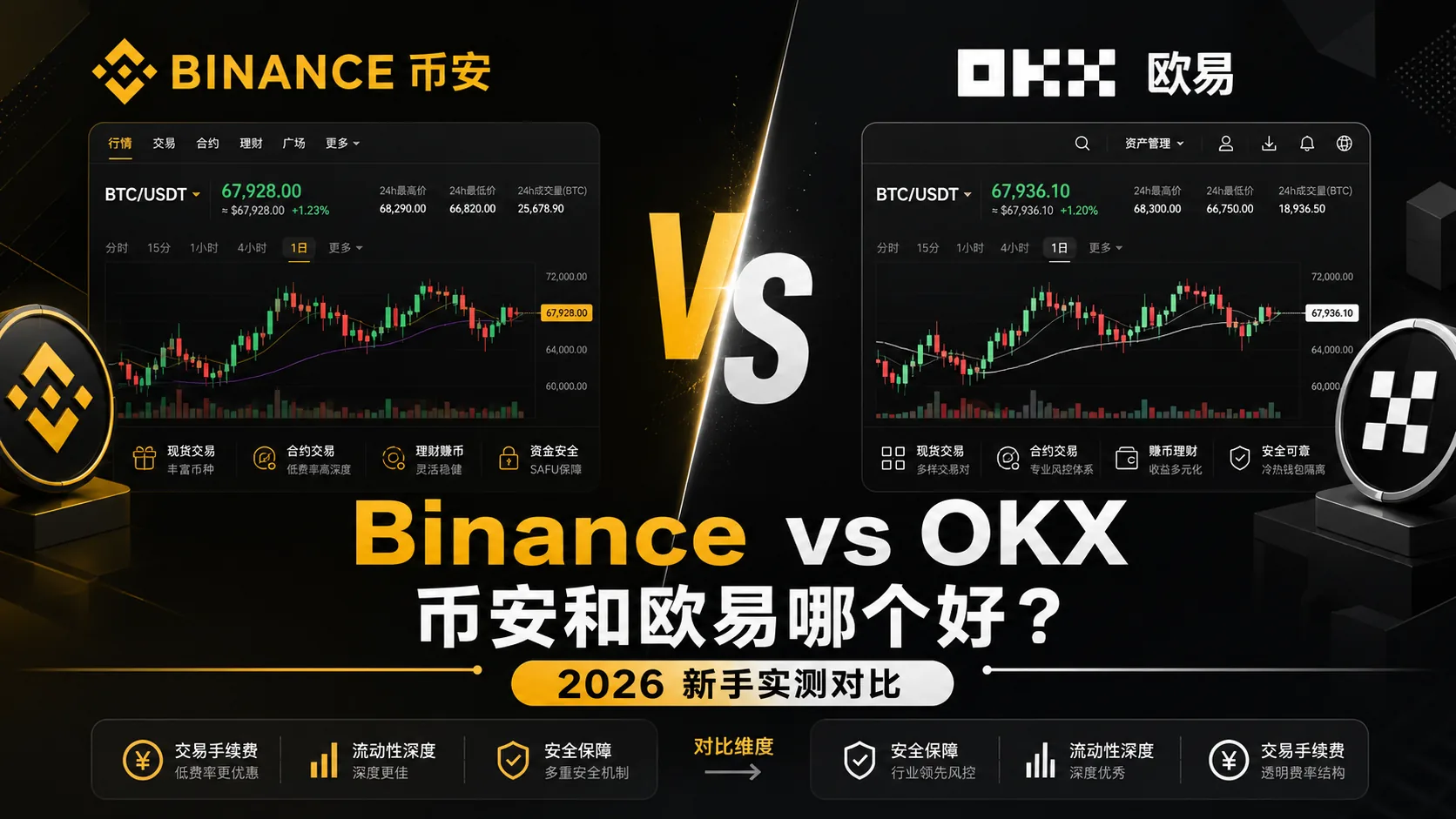
Table of contents

Binance new-user benefit
20% fee rebate
Official Binance sign-up · You must complete identity verification (KYC) to trade and withdraw
OKX new-user benefit
20% fee rebate
Official OKX sign-up · You must complete identity verification (KYC) to trade and withdraw
Binance and OKX are two of the exchanges people hesitate between the most. Most comparisons pile up specs and leave you more confused. This one does the opposite: it covers nine dimensions that actually affect your decision and focuses on the practical differences you notice when you trade: the account structure has different names, the buying entry point isn't the same and the criteria for filtering merchants are called something else. By the end you should be able to decide.
Note: this is a comparison based on personal experience and does not constitute investment advice. Trading crypto has risks; act with caution.
The short version
There's no objectively better exchange, only one that fits you better.
| Your situation | Choice |
|---|---|
| Complete beginner, first purchase, want more tutorials and deeper spot liquidity | Binance |
| You value localized support, stable access from your country and want to use the Web3 wallet | OKX |
| You trade futures and want the fullest product line (Earn/Launchpad/mining) | Binance |
| You're fee-sensitive and mostly place limit orders | OKX (slightly lower maker) |
| You've been undecided for a while | Open both: one as main, one as backup |
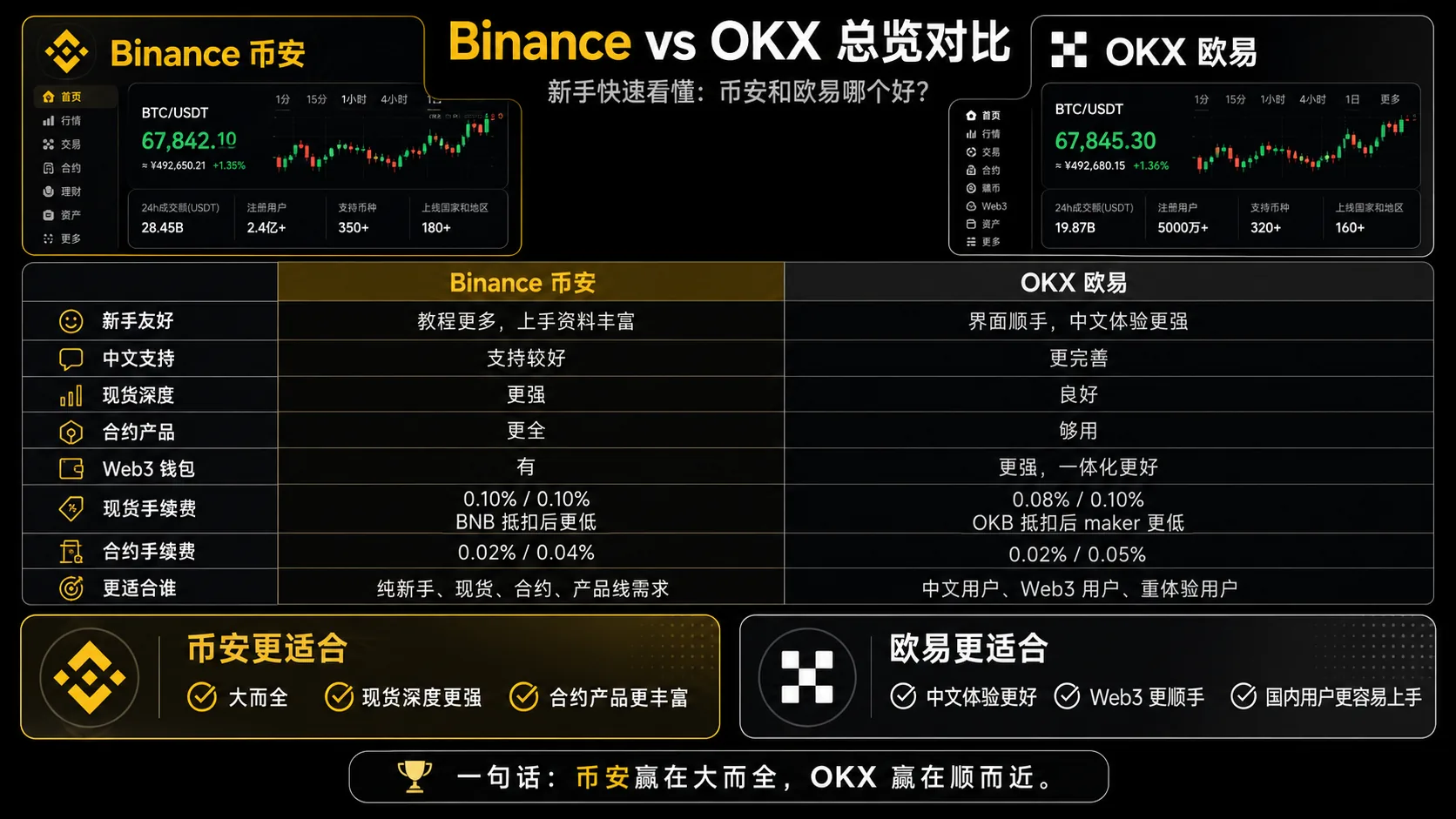
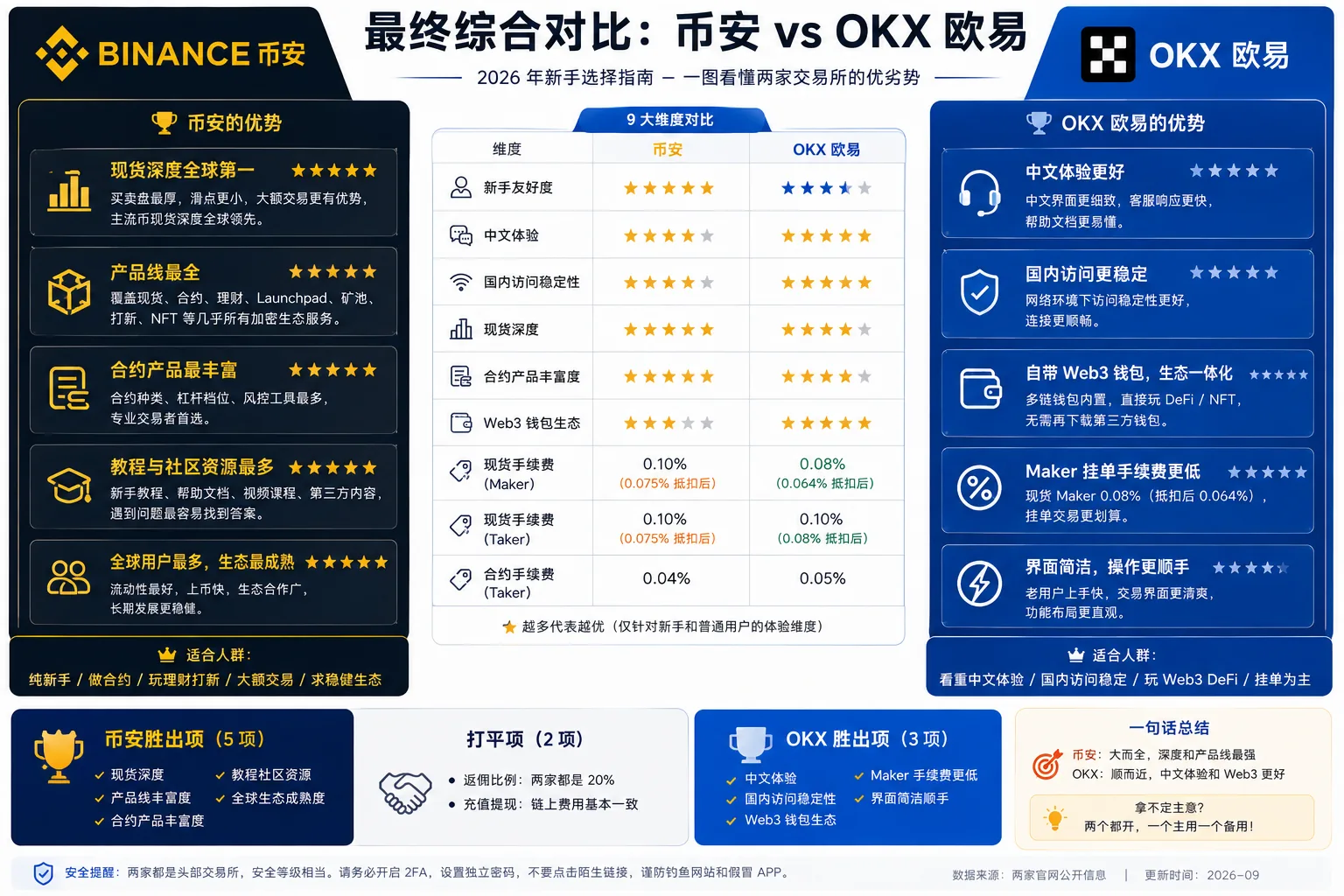
In one sentence: Binance wins on breadth and variety; OKX wins on smoothness and local fit. The fee difference is so small you can ignore it; don't obsess over 0.01%. What really defines your experience is product depth and localized support.
Who this is for / not for
| Your situation | Recommendation |
|---|---|
| You don't have an account yet and are torn between the two | Yes; read "Nine dimensions, one by one" first, then decide |
| You already have one and it works well | No need to switch; the differences don't justify the effort |
| You want to open both to compare | You can, but don't reuse the same password |
| You just want to buy USDT or BTC | Yes; first decide which exchange, then follow registration and the purchase |
Table of contents
- My comparison criteria: why these 9 dimensions
- Nine dimensions, one by one
- Q1 2026 market data: who's bigger and more transparent
- Already using one? Is it worth switching?
- Overall comparison table
- Common mistakes on both exchanges
- Security risks
- FAQ
My comparison criteria: why these 9 dimensions
For a beginner, it's not about comparing more specs, but only what actually affects your day-to-day experience. I picked these 9 dimensions: the first two (registration/KYC and buying USDT) are what you'll do immediately; the middle four (fees, withdrawals, language, wallet) define the long-term experience; the last two (security and who each is for) close the decision.
What's left out, like "number of listed coins" or "order-book depth curves", barely affects a beginner's decision and mostly distracts. Below I go dimension by dimension, with real usage impressions rather than official-site specs.
Nine dimensions, one by one
Dimension 1: registration and KYC
On both, registration is three steps: open account → activate → KYC, and it takes 10-15 minutes in total. The real difference is in the KYC levels:
| Exchange | KYC levels | How far you can trade |
|---|---|---|
| Binance | Two: basic (Lv1) + standard (Lv2) | In most regions you need Lv2 |
| OKX | Three: Lv1 / Lv2 / Lv3 | With Lv2 you can already buy, use P2P and withdraw |
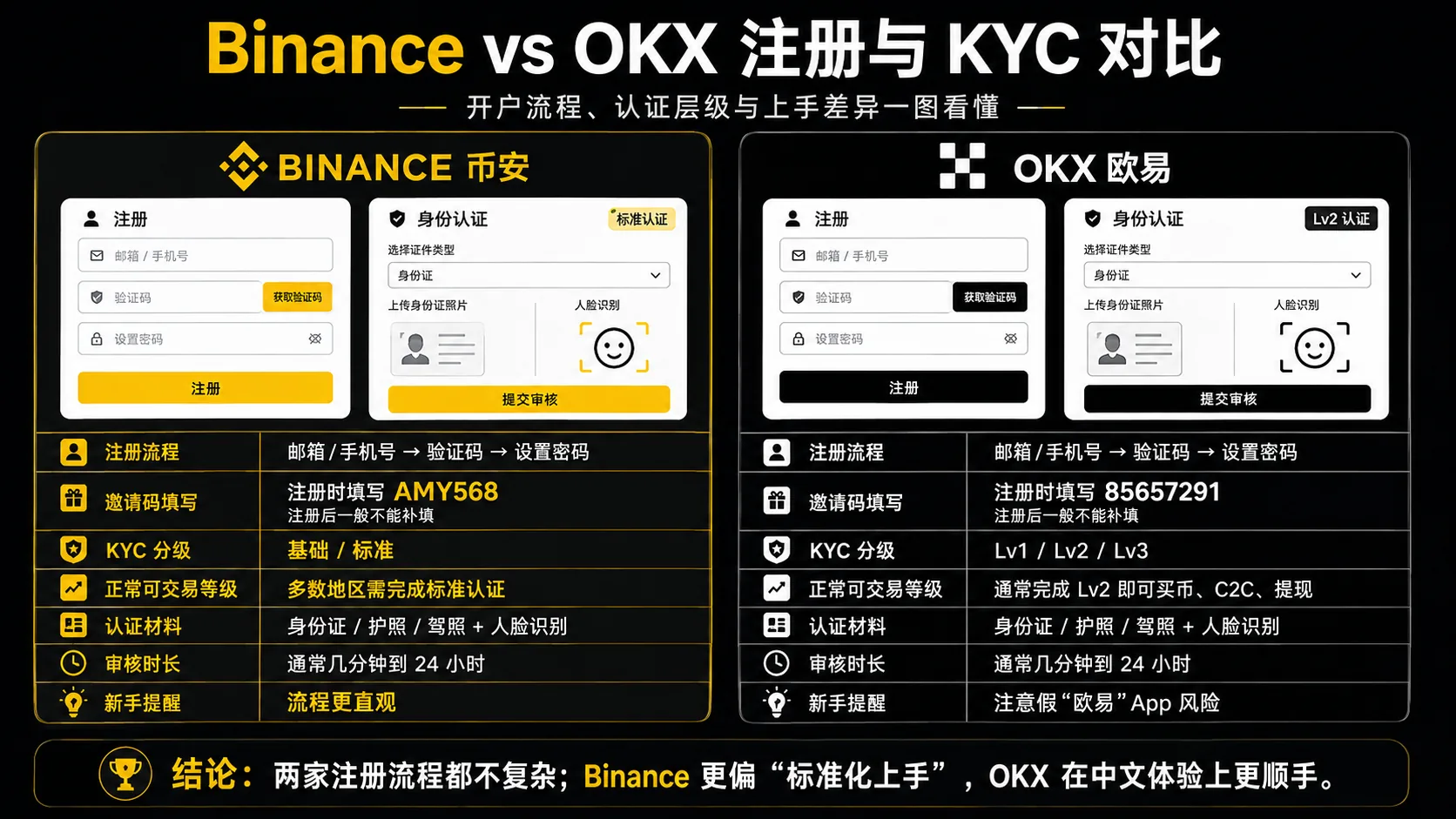
OKX splits KYC into more levels, but for a beginner the rule is the same on both: "you have to reach Lv2 to trade normally." The referral code is also entered at the registration step: AMY568 on Binance and AMY568 on OKX, both with a 20% rebate; if you skip it, you can't add it later.
One extra warning: in many regions, phishing apps that imitate OKX are a known trap. This is a pitfall that doesn't appear in the Binance article; the detail is in "Security risks."
Dimension 2: buying USDT / P2P (where the practical difference is biggest)
On both, the first option for buying USDT is P2P with your local currency, and the mechanism is identical: the platform escrows the merchant's USDT and releases it when you pay. But in practice there are three differences:
Difference 1: the account structure works differently. Since 2026-09-29, Binance uses the spot account by default and USDT bought via P2P usually lands directly, without an internal transfer. On OKX, money enters the "funding account" and has to be moved to the trading account before you can trade. When switching from Binance to OKX, beginners get confused because they look for a "spot account" and OKX has no account by that name. Remember: on Binance the spot account is the default and needs no transfer; on OKX you must transfer to the trading account.
Difference 2: the buying entry point isn't the same. OKX's "Buy" page has an express buy tab that lets you buy with a card or a third-party service without picking a merchant, but with a high spread (3-5% and up). Binance's entry point is P2P directly, without such a visible "skip the steps" shortcut. On OKX it's easy to tap "express buy" by accident and overpay.
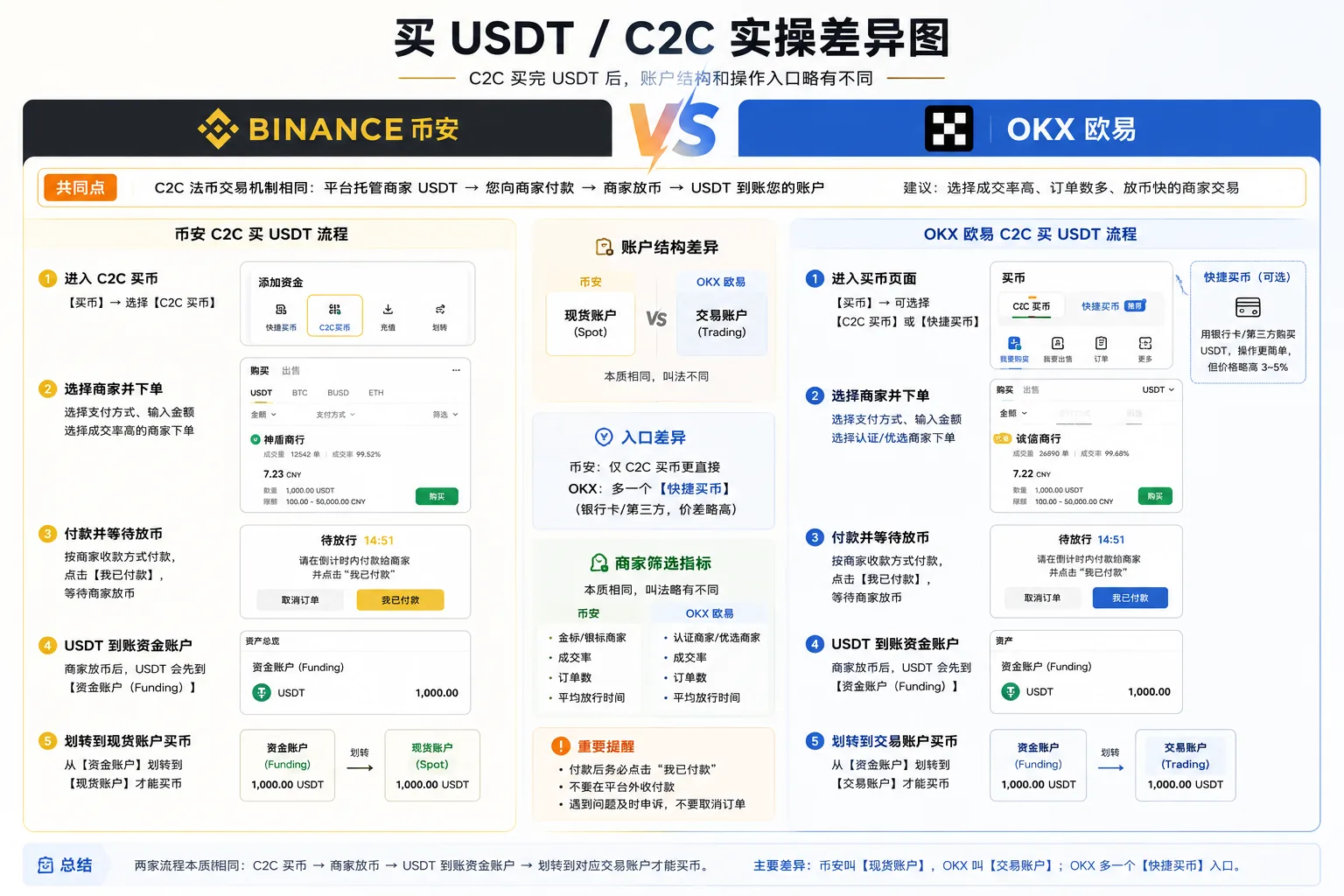
Difference 3: the criteria for filtering merchants are called something different. They're essentially the same: completion rate, number of orders, average release time and verification level. Binance talks about gold/silver badges; OKX talks about verified/preferred merchants. The logic for choosing is completely transferable: learn one and it works on both.
Conclusion: the underlying process is the same, but OKX's "trading account" naming and "express buy" entry are two of its own traps. Pay attention when switching platforms. The full Binance flow is in how to buy USDT on Binance; OKX's flow is the same idea, with the funding-account → trading-account transfer as the extra step.
Dimension 3: spot fees
Spot fees (maker / taker):[1]
| Exchange | Maker | Taker | With platform-token discount |
|---|---|---|---|
| Binance | 0.10% | 0.10% | BNB gives 25% off; taker drops to 0.075% |
| OKX | 0.08% | 0.10% | No OKB discount[2] |
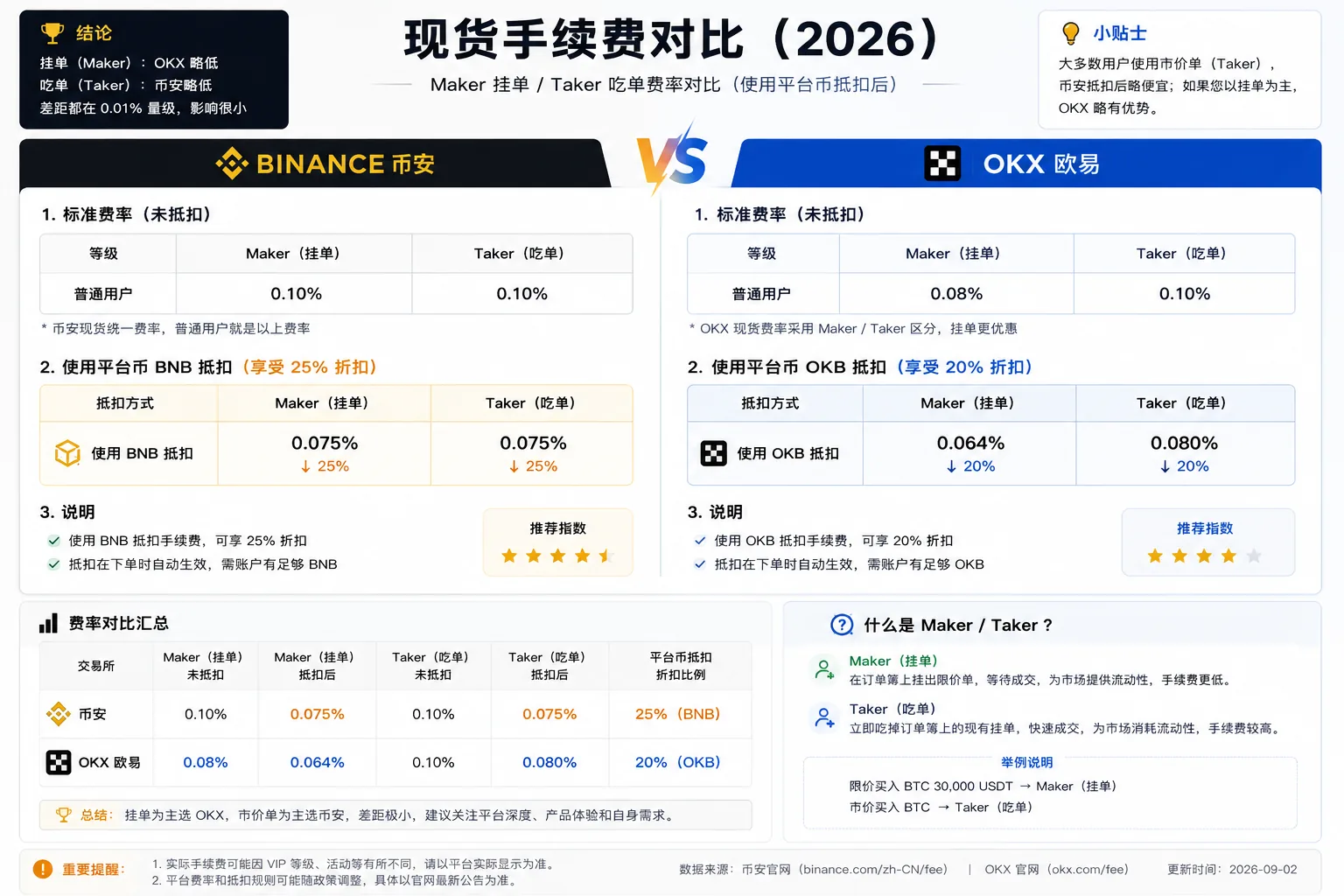
On maker, OKX is a bit lower; on taker, Binance ends up a bit lower after the BNB discount. The difference is in the 0.01% range. Most beginners use market orders (taker), where Binance is slightly cheaper, but that difference doesn't justify choosing an exchange. Worth noting: Binance tends to have the deepest spot liquidity in the market, with deeper order books and less slippage; that affects your real execution price far more than a 0.01% fee difference.
Dimension 4: futures fees
Futures fees:
| Exchange | Maker | Taker |
|---|---|---|
| Binance | 0.02% | 0.05% |
| OKX | 0.02% | 0.05% |
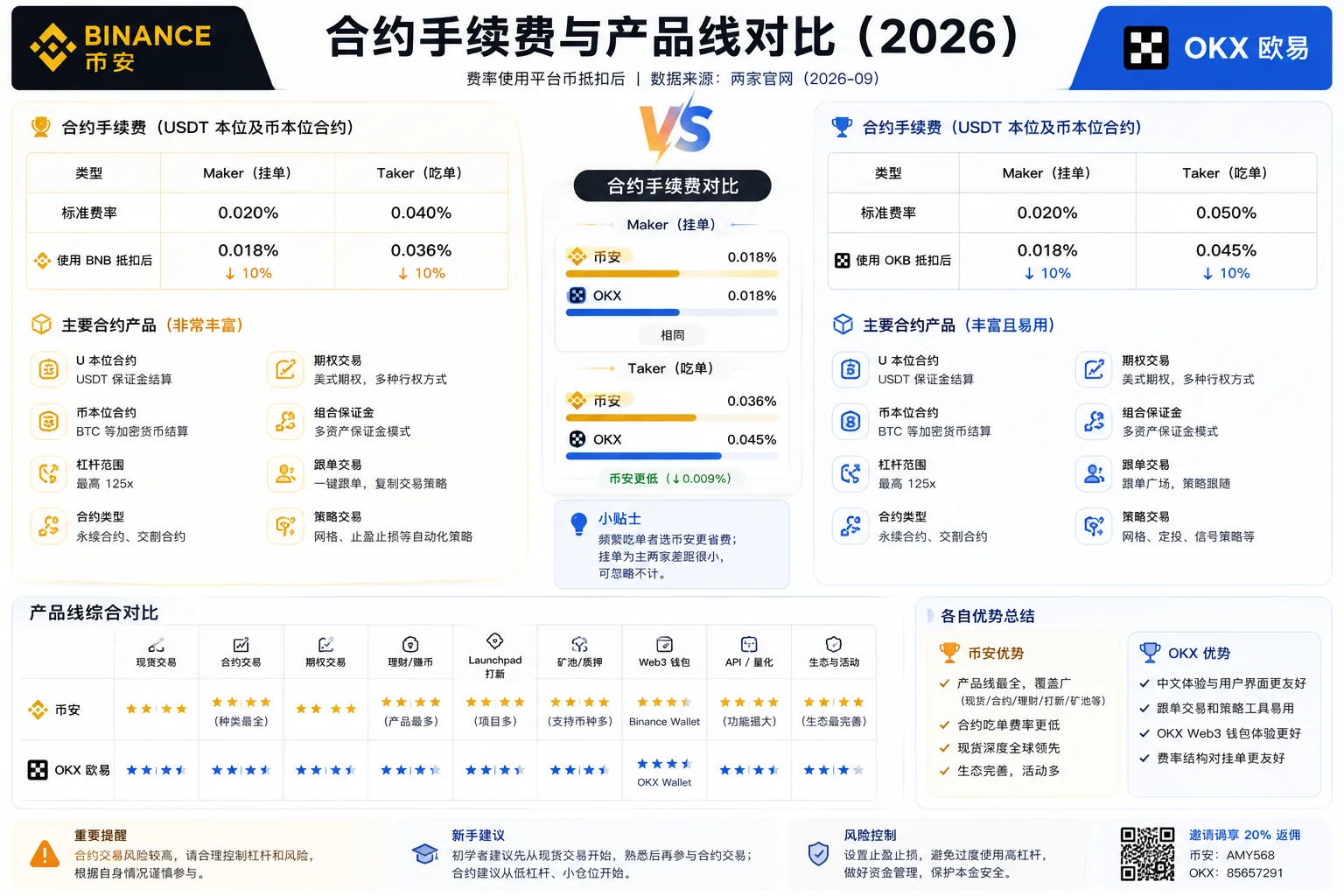
On futures, maker and taker cost the same on both: a tie. If you mostly trade futures, Binance has a fuller product line (contract types, leverage tiers, risk-control tools), which matters more than the fee difference.
Dimension 5: deposits and withdrawals
Both support the main networks: TRC20 (first choice for small amounts, seconds, 1 USDT), ERC20 (large amounts, maximum compatibility, dynamic gas), BEP20 (cheap in the Binance ecosystem) and Solana/Polygon (very low fees). Deposits are free and withdrawals charge the network gas; the platform adds almost no fee of its own.
On this dimension they're essentially tied. Speed depends on the network, not the platform: TRC20 in seconds, ERC20 in minutes. What actually matters is choosing the right network; don't use a TRC20 address to receive ERC20 coins.
Dimension 6: localized support and regional access
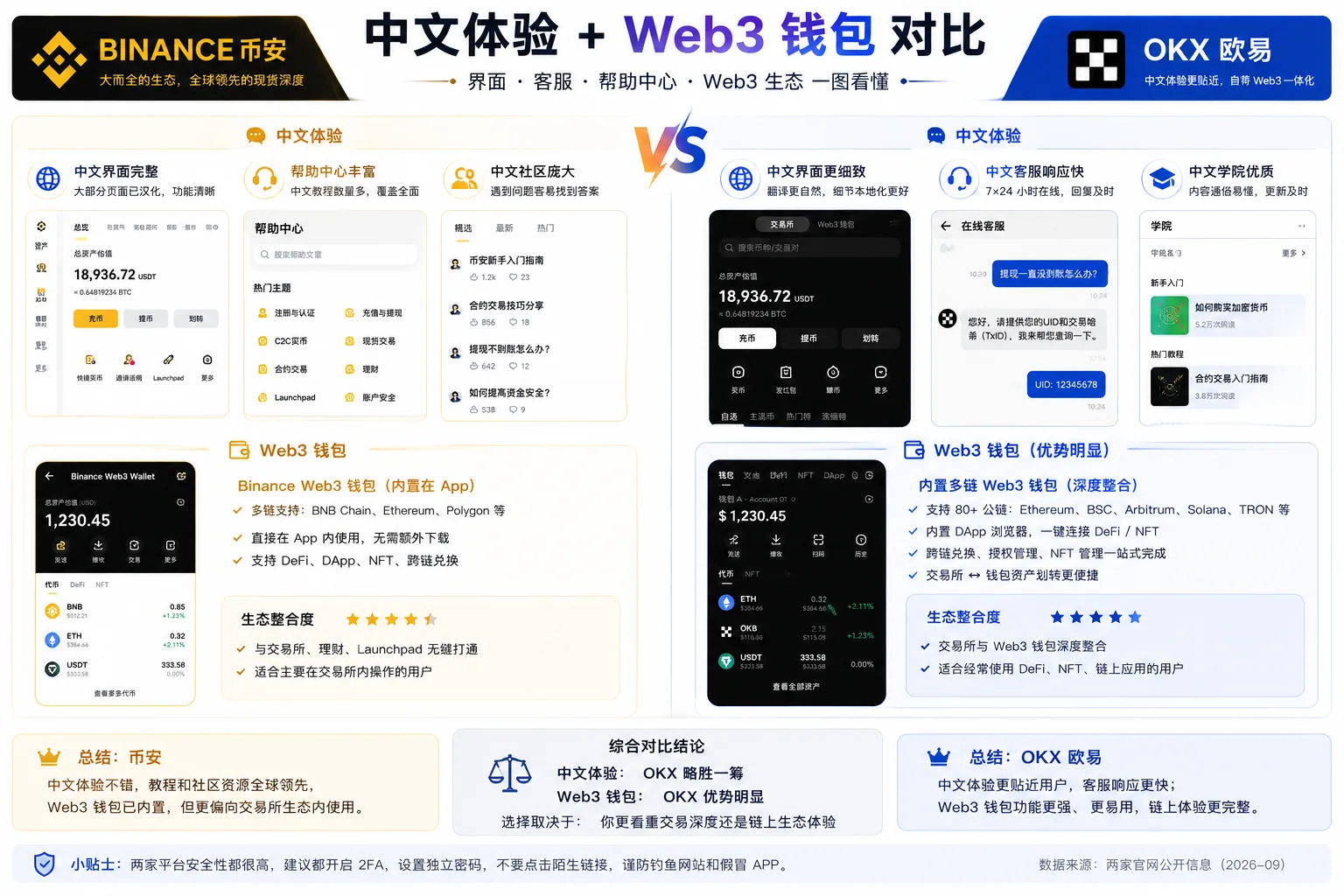
OKX tends to invest more in localized interfaces, support and help content across many languages, and it's often easier to find someone when a problem comes up. Binance's English support is also solid, but OKX's localized coverage and regional teams are broader in several markets.
On regional access, the gap can be concrete for English speakers. As of late 2026, OKX holds a full MiCA license in the EU (Malta, granted January 2025) and can serve all EEA states, and it also serves UK residents.[5] Binance, by contrast, did not secure a MiCA license and is reported to have stopped new EU sign-ups, spot orders and deposits from July 1, 2026 (withdrawals remain open), and it paused new UK sign-ups back in October 2023. In the US both operate through separate entities (Binance.US and OKX US), and in Canada both are restricted. Availability varies by country and can change — confirm your own situation before deciding.
Dimension 7: Web3 wallet
OKX includes a multi-chain Web3 wallet; after buying you can go straight to DeFi or NFTs on-chain without installing another app, and the integrated experience is smoother. Binance also has a Web3 wallet, but its ecosystem integration is less complete than OKX's.
If you want to do everything in one place, choose OKX. If you only buy and sell inside the exchange, this dimension doesn't affect you.
Dimension 8: security
Both are top-tier global exchanges with a comparable security level; both have had incidents and both have compensation records. The key to security isn't the platform, it's your habits: enable 2FA, use different passwords, don't open phishing links and don't share verification codes.
Phishing apps that imitate Binance and OKX are a frequent trap for users in many regions; with both you have to prevent it. Don't let your guard down just because the interface feels comfortable in your language.
Dimension 9: which type of user
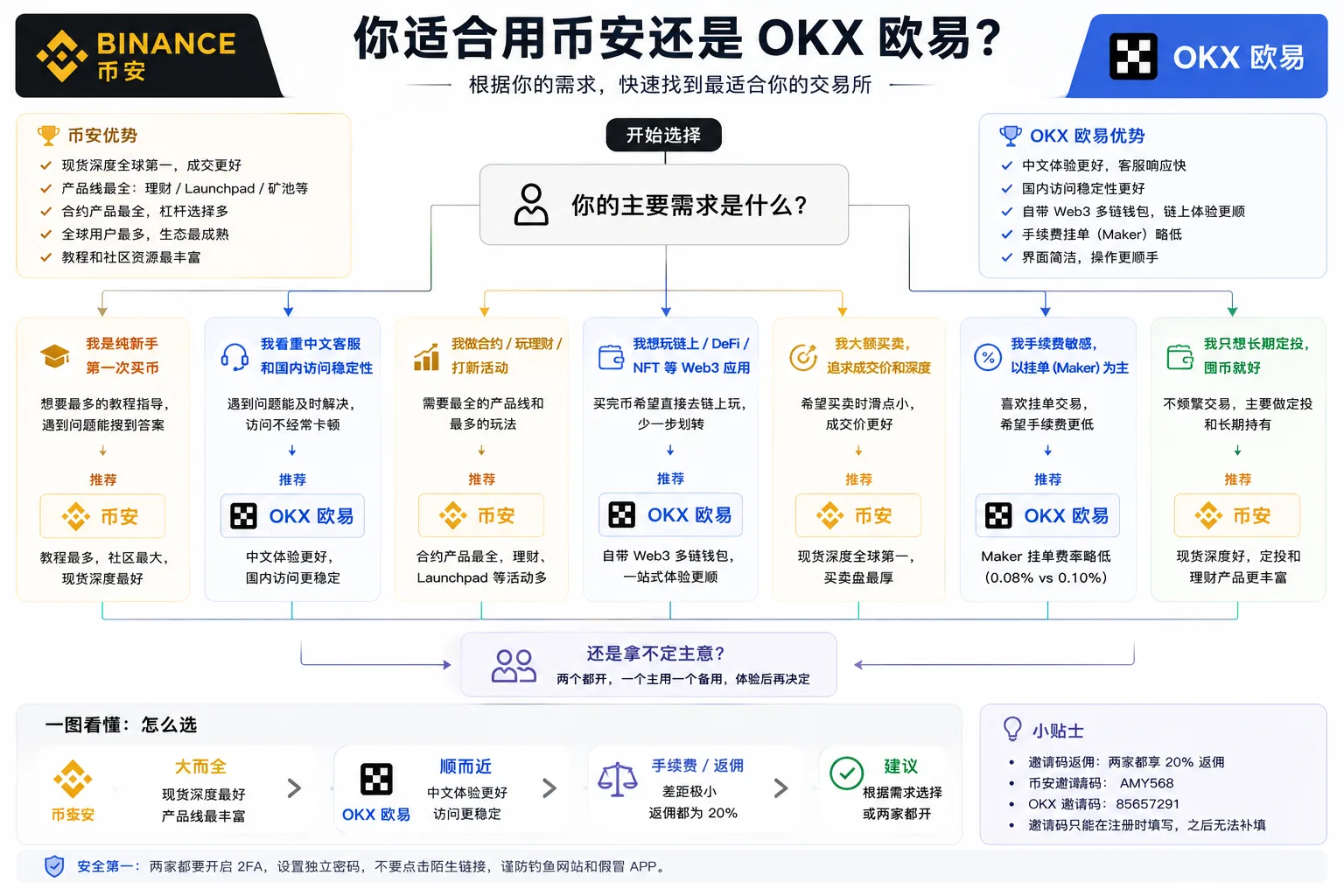
After the 8 dimensions above, it comes down to this table:
| Your situation | Recommendation | Why |
|---|---|---|
| Complete beginner, first purchase | Binance | More tutorials, deeper spot liquidity and the biggest community |
| You value localized support and stable access | OKX | Better localized support and regional availability |
| You trade futures, Earn or Launchpad | Binance | Fuller product line |
| You want to use Web3 / DeFi | OKX | Integrated multi-chain Web3 wallet, all in one |
| You buy and sell large amounts and want a good price | Binance | Deeper spot liquidity and less slippage |
| Fee-sensitive, mostly limit orders | OKX | Maker at 0.08%, slightly lower |
| You only accumulate BTC or do periodic buys | Binance | Good spot liquidity and full savings/DCA products |
| Short-term high frequency, mostly futures | Binance | Fuller futures products and slightly lower taker |
| You buy USDT just to move to DeFi on-chain | OKX | Integrated Web3 wallet, one less step |
| You can't decide | Open both | One main and one backup; decide after trying |
Q1 2026 market data: who's bigger and more transparent
The nine dimensions above focus on the user experience. If you also want an objective "size" reference, here's a set of third-party data — from CoinGlass's 2026 Q1 crypto market share report and RootData's exchange transparency ranking. They're approximate third-party figures that vary each quarter; just look at the order of magnitude, don't obsess over the exact digit.
| Indicator | Binance | OKX | Difference |
|---|---|---|---|
| Quarterly derivatives volume | ~$4.90T (~34.9%)[3] | ~$2.19T | Binance ~2.2× larger |
| Quarterly spot volume | ~$639.9B (~34.3%)[3] | ~$162.7B (last of the Top 5) | Binance ~4× larger |
| Average daily open interest | ~$23.9B (~29.9%)[3] | ~8.5% | Binance ~3.5× larger |
| Assets under custody | ~$152.9B (~73.5% of the top)[3] | ~$15.9B | Binance ~9.6× larger |
| ±1% depth on BTC futures | ~$284M[3] | ~$160M | Binance ~1.8× larger |
| Licenses | 23+[4] | 9+[4] | Binance more |
| Weekly visits | ~8.5M[4] | ~4.8M[4] | Binance ~1.8× larger |
| Transparency score (RootData) | #1 (90.8)[4] | #2 (87.7)[4] | Small difference |
This data confirms several of the conclusions above: Binance is an order of magnitude bigger — derivatives volume is more than double OKX's, spot is about 4×, and assets under custody are nearly 10×; that's the basis of its "deeper spot liquidity and less slippage." But being bigger doesn't mean leading everywhere: the transparency scores are only 3 points apart (90.8 vs 87.7) and both top the ranking, so on security and compliance they're on par; OKX also invested earlier in AI tools and on-chain products (OnchainOS). "Binance is bigger" and "OKX is smoother" don't contradict each other: it depends on what you value more.
Already using one? Is it worth switching?
Many people's real question isn't "which to choose from scratch", it's "I already use Binance (or OKX), is it worth switching?". My answer: unless the exchange you use today has a clear problem that stops you from trading, I don't recommend switching over a fee difference.
The real cost of switching is higher than you think:
| Cost | What it involves |
|---|---|
| Redo KYC | Upload the document again and do another facial check |
| Reconfigure security | Re-enable 2FA, the anti-phishing code and the withdrawal whitelist |
| Relearn the accounts | "Spot account" on Binance and "trading account" on OKX; memorize them again |
| Migrate funds | Withdraw → transfer between platforms, pay gas and possibly trigger risk controls |
When it's worth switching: when access cuts out often, you can't find support, or you start using Web3 daily and the exchange wallet doesn't serve you. That kind of real problem justifies the effort. Over a 0.01% fee, no.
When it's worth opening another account: if you want to try both, open a second one and be done; you don't need to "switch" — both can coexist.
Overall comparison table
If you want a quick glance, this is enough:
| Dimension | Binance | OKX | Who wins |
|---|---|---|---|
| Beginner friendliness | 5 | 4 | Binance |
| Localized support | 4 | 5 | OKX |
| Regional access | 4 | 5 | OKX |
| Spot liquidity | 5 | 4 | Binance |
| Futures products | 5 | 4 | Binance |
| Rebate | 5 | 5 | Tie |
| Spot maker | 0.10% | 0.08% | OKX |
| Spot taker (with discount) | 0.075% | 0.08% | Binance |
In one sentence: Binance wins on depth and product variety; OKX wins on localization and access; rebates and fees are essentially tied.
Common mistakes on both exchanges
Mistake 1: agonizing for half an hour over a 0.01% fee
Scenario: I compared fees between the two for half an hour and in the end the difference was under 0.01%; meanwhile, I missed my entry point.
Lesson: the fees are nearly identical; don't waste time there. Opening the account and trying it matters more.
Mistake 2: looking for accounts using the other exchange's names
Scenario: someone moved from Binance to OKX, bought USDT and searched everywhere for the "spot account"; OKX has no account by that name and they thought the purchase had failed.
Lesson: remember the account rules are different: on Binance the "spot account" is the default and there's no transfer when buying USDT; on OKX you have to transfer to the "trading account."
Mistake 3: using the same password on both
Scenario: for convenience, someone set the same password on Binance and OKX; if one leaks, the other is exposed too.
Lesson: passwords must be different and both should have 2FA. That's the minimum.
Mistake 4: assuming a comfortable interface means it's safer
Scenario: the localized interface felt comfortable and they let their guard down; they fell for a phishing app that imitated OKX or Binance.
Lesson: interface comfort and security are different things. Users in many regions are frequent phishing targets: download only from the official site and don't open links from private chats.
Security risks
- Download apps only from the official site: Binance at binance.com and OKX at okx.com. Don't open "installer" links that arrive via private chat, SMS or unknown sites.
- Different passwords and 2FA on both: if one account leaks, the other stays safe.
- The referral code is only used at registration: AMY568 on Binance and AMY568 on OKX, both with a 20% rebate; if you skip it, you can't add it later.
- Local compliance: some countries or regions restrict crypto trading. Before registering, confirm your jurisdiction's law and don't use proxies of unknown origin to access the platforms.
- Under 18: don't participate: both exchanges require you to be of legal age.
FAQ
Q1: Which is safer, Binance or OKX?
Both are top-tier global exchanges with a comparable security level; both have had incidents and both have compensation records. The key isn't the platform, it's your habits: 2FA, unique passwords, don't open phishing links and don't share codes.
Q2: Which has lower fees?
On spot maker, OKX is a bit lower (0.08% vs 0.10%); on taker, Binance ends up a bit lower with the BNB discount (0.075% vs 0.08%). On futures, Binance's taker is slightly lower. The difference is in the 0.01% range; don't overthink it.
Q3: For a first purchase, Binance or OKX?
For a complete beginner, Binance: more tutorials, deeper spot liquidity and a bigger community, so you find more answers when a problem comes up. If you value localized support and stable regional access more, choose OKX.
Q4: Can I use both?
Yes. Many people open both: one main and one backup. Just use different passwords and enable 2FA on both.
Q5: How is the account structure different?
Since 2026-09-29, Binance uses the "spot account" by default and USDT bought via P2P usually needs no transfer. On OKX, buying uses the "trading account" and USDT received in the "funding account" has to be moved there before you trade.
Q6: Is the referral code rebate the same on both?
Yes, 20% on both. AMY568 on Binance and AMY568 on OKX, and they can only be entered at registration.
Summary
Binance wins on breadth (deeper spot liquidity and the fullest product line); OKX wins on smoothness and local fit (better localized support, stable regional access and an integrated Web3 wallet). For tutorials, Binance; if you value language and access, OKX. Fees and rebates are essentially tied; if you can't decide, open both.
If you're going to register
| Your choice | What to do |
|---|---|
| Register on Binance from this site (20% rebate) | Register on Binance; the code AMY568 is filled in automatically |
| Register on OKX from this site (20% rebate) | Register on OKX; the code AMY568 is filled in automatically |
| Don't use a code | Go directly to binance.com / okx.com and register |
The first two rows are affiliate links: registering through them may generate revenue for us, but it doesn't affect the objective conclusions of this article. More in Advertising and affiliate disclosure.
Related articles
- How to register on Binance in 2026: account setup and KYC step by step (code AMY568) — if you decide on Binance, start here
- How to buy USDT on Binance: a complete P2P tutorial (2026) — the full buying flow referenced in Dimension 2
- How to use the Binance referral code: the 20% rebate and what to check (2026) — if you want to understand the code and rebate rules
Data verification note
The key facts in this article were checked on 2026-10-18, one by one:
- Binance spot fees: for a regular user, the base spot maker and taker fee is 0.10%; enabling BNB fee payment gives up to 25% off, about 0.075%. Source: Binance spot trading fees.
- OKX spot fees: for a regular user, OKX charges 0.08% spot maker and 0.10% taker, with no OKB discount. Source: OKX fee rules.
- Q1 2026 market share data: the derivatives/spot volume, open interest, assets under custody and BTC futures depth are approximate figures from CoinGlass's 2026 Q1 crypto market share report, and vary each quarter; they serve only as an order-of-magnitude reference. Source: CoinGlass 2026 Q1 market share report.
- Transparency and license data: the number of licenses, weekly visits and transparency score come from RootData's exchange transparency ranking (late April to early May 2026 weekly rankings), a third-party rating. Source: RootData exchange transparency report.
- OKX MiCA license and EU availability: OKX received full MiCA authorization in Malta (January 2025) and can passport its services across the EEA; this is the reference for the EU/regional availability claim. Binance's EU/UK restrictions are as reported in market coverage as of late 2026. Source: OKX MiCA authorization announcement.
Disclaimer
This article only offers information and experience for choosing an exchange. It does not constitute investment advice, financial advice or a trading recommendation.
Crypto asset prices are highly volatile, and trading carries platform, market, cybersecurity and human-error risks. Each person should assess their own risk tolerance and comply with the laws of their jurisdiction. People under 18 should not trade crypto.
Exchange operations · USDT · Wallet security
Responsible for researching and organizing content on Binance, OKX, USDT transfers, withdrawals and wallet security. The steps and key data in this article are verified according to the content type, using real operation records, official platform documentation and public sources. Interfaces, fees and regional rules may change, so the article is reviewed and updated continuously.
Status: manual review · Last verified 2026-10-18
Reviewed by: Veldux editorial team
- Binance spot trading feesFor a regular user, the base spot maker and taker fee is 0.10%; paying fees with BNB gives up to 25% off (≈0.075%)
- OKX fee rulesFor a regular user, OKX charges 0.08% spot maker and 0.10% taker; the effective rate with a platform-token discount follows what the official site currently shows
- CoinGlass 2026 Q1 crypto market share reportDerivatives volume (Binance ~$4.90T / 34.9% vs OKX ~$2.19T), spot volume, open interest, assets under custody and BTC futures depth (approximate figures)
- RootData exchange transparency reportTransparency score (Binance 90.8 / OKX 87.7), number of licenses and weekly visits (third-party statistics)
- OKX MiCA authorization announcementOKX received full MiCA authorization in Malta (January 2025) and can passport its services across the EEA; reference for the EU/regional availability claim
- 2026-10-16UpdateAdded the evidence-chain superscripts and the "Data verification note", and updated the fact-check date.
- 2026-10-18UpdateAdded 2026 Q1 third-party market-share and transparency data (CoinGlass/RootData) as an objective size reference; added the MiCA/regional-availability source for the English edition.
Editorial principles ineditorial policy,corrections policy。