
How to use the Binance referral code: the 20% rebate and key points (2026)
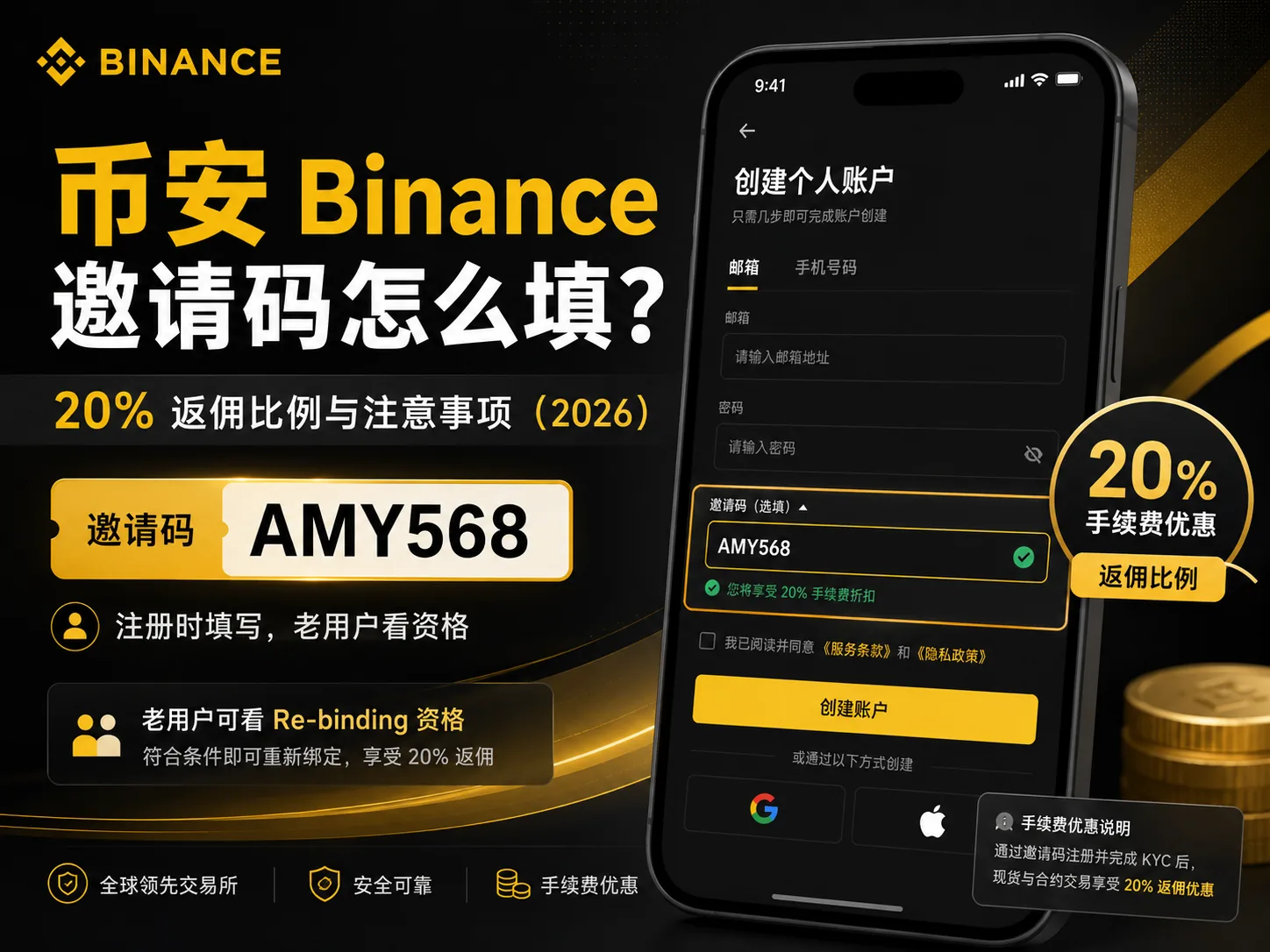
Table of contents

Binance new-user benefit
20% fee rebate
Official Binance sign-up · You must complete identity verification (KYC) to trade and withdraw
In 2026, the safest way to use a Binance referral code is still to enter it during the sign-up step. If you skip it, in the normal case you can't add it later from the account settings; however, Binance now opens re-binding (Referral Re-binding) to some existing users who meet conditions, and whether you can do it depends on your account status and the platform's current eligibility.[1]
With AMY568, the invitee gets a fee benefit (not free crypto): a 20% rebate on spot and 20% on futures. This article explains what actually gets rebated, how to confirm AMY568's current benefit, how to enter it on the web and app, and whether an existing user can bind it.
Note: this article shares experience about referral codes and the rebate mechanism, and is not investment advice. Trading crypto carries risk; act with caution.
The essentials
| Question | Answer |
|---|---|
| When do you enter the code? | Safest during the sign-up step; if skipped, you normally can't add it, though some existing users can use re-binding |
| What do you get? | A 20% fee rebate on spot and 20% on futures |
| Can you skip it? | Yes, just without the fee benefit |
| Can an existing user add it? | Some can, depending on eligibility on the official Referral Re-binding page |
In one sentence: the referral code is "a fee benefit you confirm while signing up", not a sign-up bonus; new users shouldn't skip it and existing users should check their re-binding eligibility.
Who needs it / who doesn't
| Your situation | Recommendation |
|---|---|
| You're about to sign up for Binance | Use it: enter AMY568 while registering; there's no extra cost |
| You already trade on Binance and want the rebate | Check your re-binding eligibility; see "Can an existing user bind it?" below |
| You only register to watch prices and rarely trade | Doesn't matter; the difference is minimal |
| You trade frequently | The fee benefit matters more; it adds up over time |
Table of contents
- First, what actually gets rebated
- How much is the AMY568 fee benefit
- How to tell if a referral code is legit: four questions
- How to confirm the 20% before registering
- How to enter it: web and app
- Can an existing user bind it?
- How to check whether you already have a referrer
- What to do in your situation
- Mistakes I made
- Promises you can dismiss right away
- Security risks
- FAQ
First, what actually gets rebated
This is where beginners get confused most. Many people think that after using a referral code, a sum of crypto or cash will appear in the account out of nowhere. It won't.
What a Binance code gives the invitee is, in essence, a part of your future trading fees, returned or discounted. When you trade you generate fees, and the code's rule makes you pay a little less; if you don't trade, there are no fees, so there's nothing to return.
Note: this "fee benefit" is 20% on spot and 20% on futures. It is a return or discount on part of the trading fee, not a lump of money gifted at sign-up.
How much is the AMY568 fee benefit
AMY568 is a code for the invitee: it corresponds to the invitee's fee benefit — that is, the return or discount you get on your own fees when you use the code.
As for exactly how much: the rebate linked to AMY568 is 20% on spot and 20% on futures. It's a fixed rebate percentage, with no distinction between spot and futures trading. Figures advertised on third-party sites are only references; don't draw conclusions from the number alone.
How to tell if a referral code is legit: four questions
Not all "Binance codes" are equal. When someone recommends one, ask four questions:
| Question | How to evaluate it |
|---|---|
| Can the source be verified through official channels? | A legitimate code comes from Binance's official site or app during sign-up, not a link dropped in a private chat or group |
| Is the percentage above 20%? | The maximum Binance gives the invitee is 20%; anything above 20% (40%, 50%...) usually counts the referrer's commission and presents it as your discount |
| Is it entered at sign-up or added later? | Legitimate codes are used in the sign-up step; whoever says "register first, then add the code" usually points to an unofficial process |
| Are there extra clauses or requirements? | A normal code doesn't ask you to transfer, provide passwords or codes, or deposit first; if it does, it's a scam |
Remember: faced with a promise above 20%, your first reaction should be "whose money are they counting?", not "what a bargain".
How to confirm the 20% before registering
Instead of trusting my "20%", confirm it yourself in three steps; it's visible right on the sign-up page:
- Enter the sign-up page through an official Binance invitation link.
- Expand the Referral ID / referral-code area.
- Confirm the code and the fee-benefit percentage the page shows, then complete registration.
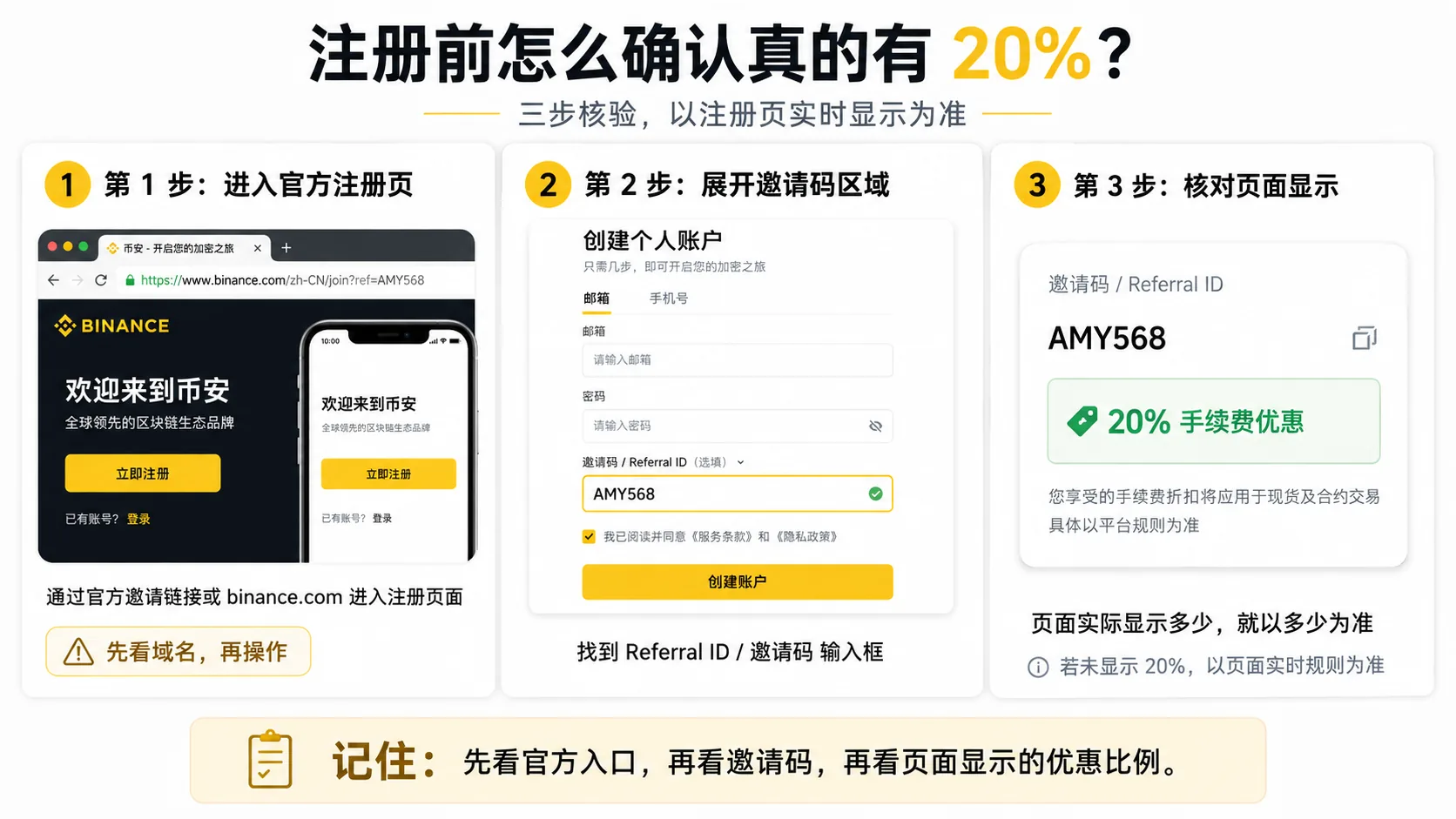
The sign-up page shows the 20% fee rebate corresponding to AMY568. Just check that the code is entered correctly; don't obsess over third-party promotional images.
How to enter it: web and app
The process is tied to registration; just follow the steps.
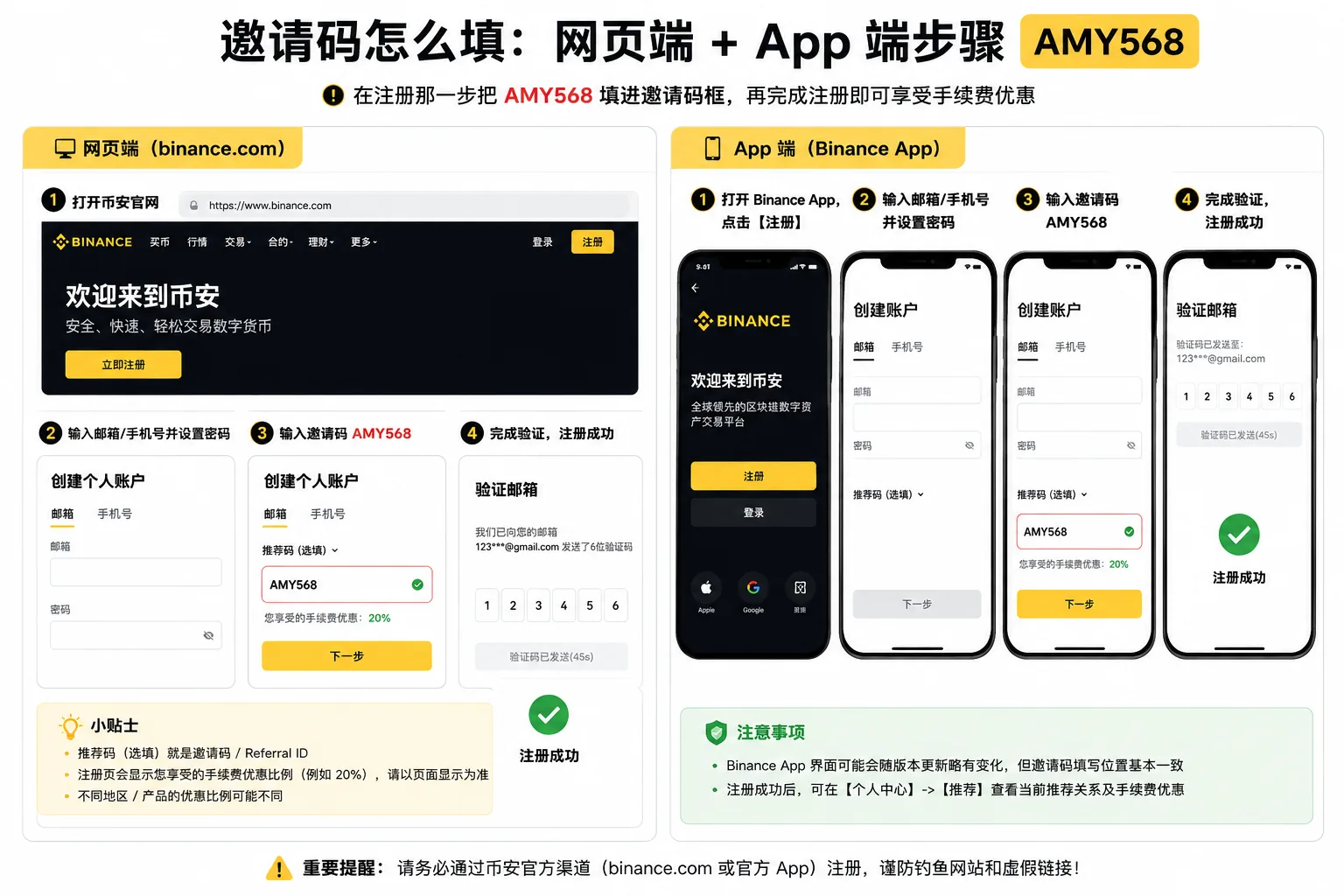
On the web
- Open the official site binance.com and tap "Register" in the top right.
- Enter your email or phone number and set a password.
- Find the "Referral ID" field and enter AMY568.
- Complete the email or SMS verification and finish registering.
On the app
- Open the Binance app and tap "Register".
- Fill in your email or phone number and password.
- Enter AMY568 in the "Referral ID" field.
- Complete verification and your registration is done.
The key action is one: enter AMY568 in the referral-code field during the sign-up step, then finish the process. That's the safest way.
Can an existing user bind it?
It's possible, but with clear conditions — and it's not "re-binding": it's the first binding for an existing user who never had a referrer.
Binance's "Affiliate Recall program" lets registered users who meet conditions bind a rebate relationship. According to Binance's official FAQ, the invitee must meet all of these at once:
- Be registered on Binance and never have been bound to any referrer;
- Have been registered more than 90 days;
- Have not traded or used any Binance product line in the last 90 days (this was 180 days; it changed to 90 days on 2026-03-24).[2]
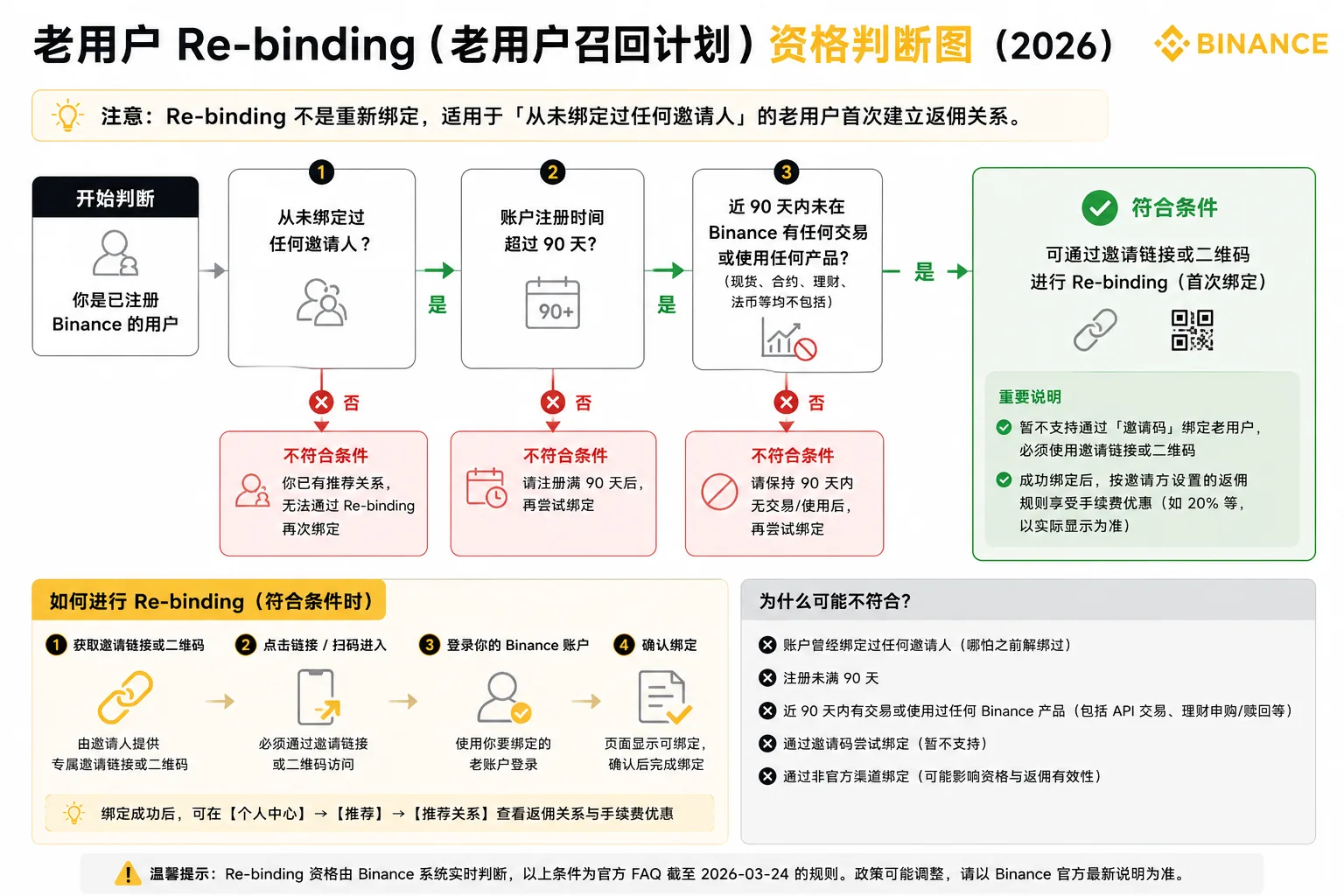
Two cautions: this program lets an existing user who never had a referrer bind for the first time, not change an existing relationship; and you can't bind an existing user with a code — you must use an invitation link or QR code.
There's also a newer, separate path Binance published in late 2026: the Affiliates Rebind feature, initiated by an affiliate. Its reported conditions are stricter on activity but lower on account age — the user must have KYC done, no existing referrer, a master account, under $5,000 in trading volume in the last 90 days, and the binding only completes once the user reaches $150,000 in volume within 30 days.[3] Treat these as reported conditions and confirm on Binance's official page.
If you don't meet the conditions, you can't force the binding, and it's not worth reworking your account just for the rebate. The exact rules are in the official FAQ: Affiliate Recall program.
How to check whether you already have a referrer
If you want to bind, first confirm whether you already have a referral relationship:
- New user: if you didn't enter a code at sign-up, you're normally in a "no referral relationship" state;
- Existing user: you can check on Binance's Referral pages whether you already have a referrer or a referral relationship.
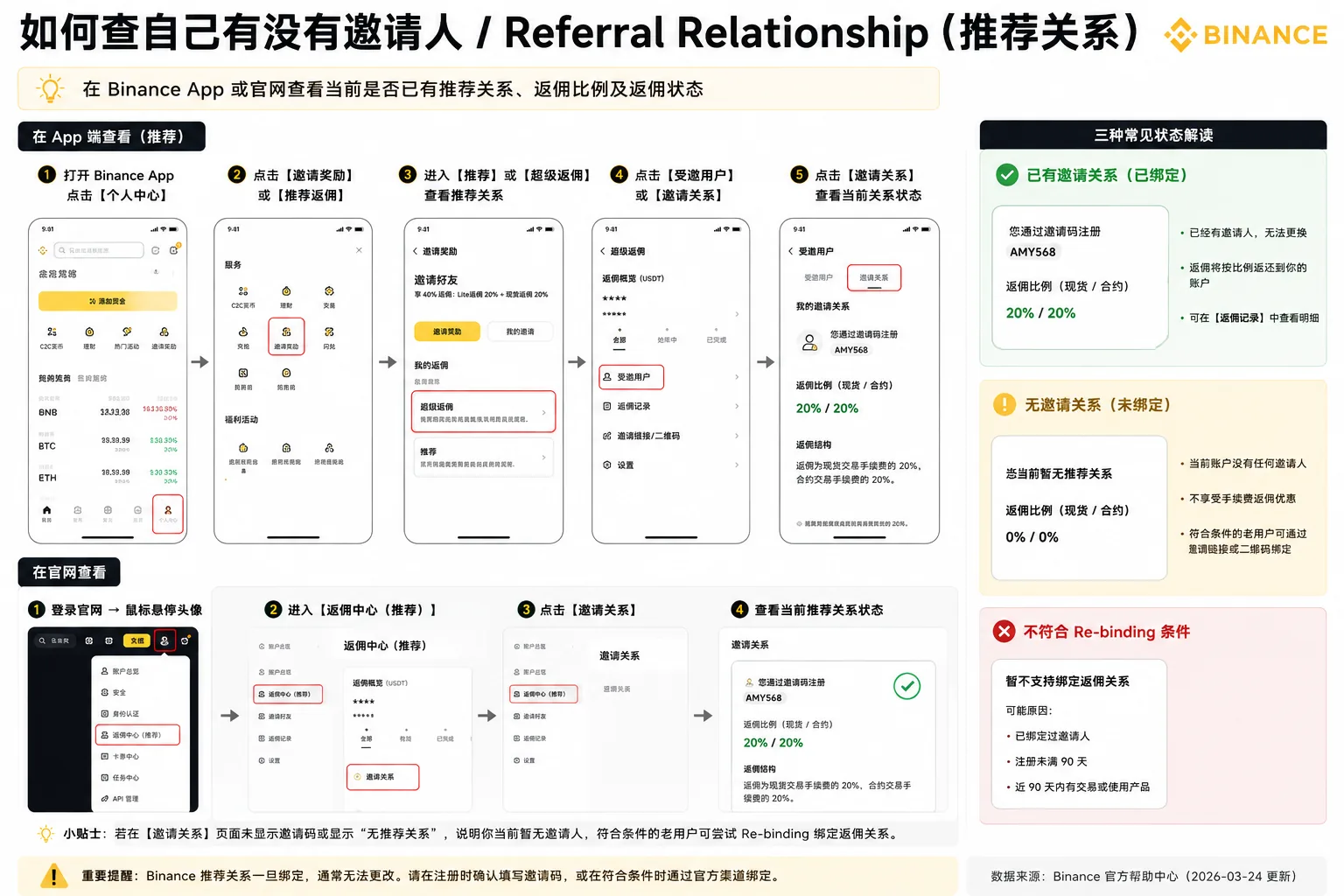
The exact path depends on the current version of the Binance app or site. Rather than memorizing buttons, check the official FAQ: Affiliate Recall program, which lists the entries and conditions.
What to do in your situation
| Your situation | What to do |
|---|---|
| You haven't registered yet | Enter AMY568 while registering; it costs nothing extra |
| You registered but have no referral relationship | Check your re-binding eligibility under the Recall program first |
| You registered and already have a referral relationship | Normally can't be re-bound; don't overthink it |
| You barely trade | The fee benefit matters little; using it or not is fine |
| You're choosing between Binance and OKX | Compare products, fees and experience first; don't decide by the code alone |
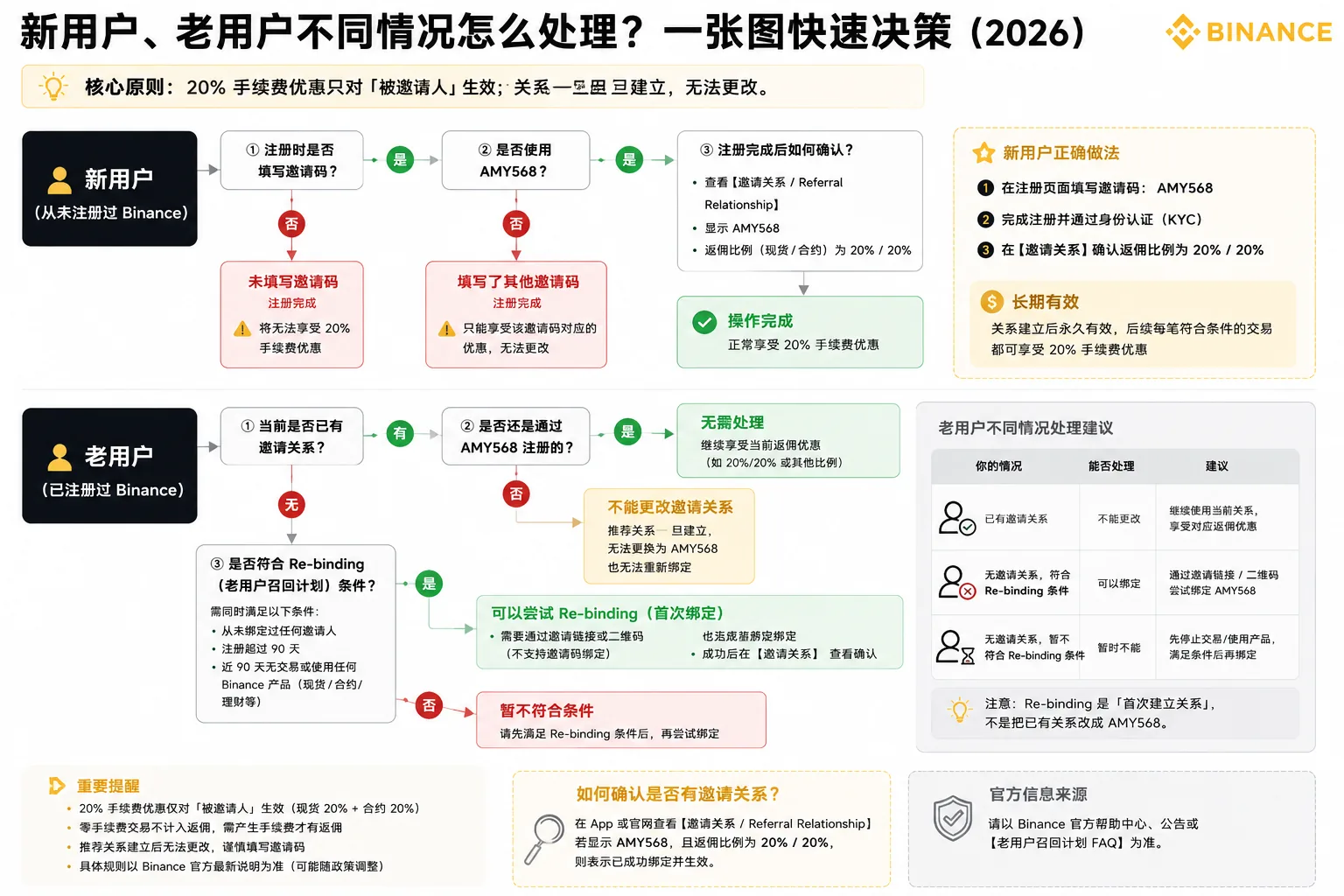
In one sentence: the referral code is "a benefit you confirm after deciding", not "the reason to decide".
Mistakes I made
Mistake 1: thinking the rebate was "free crypto at sign-up"
Scenario: many people enter the code, register, then stare at the account waiting for money to arrive. Nothing arrives and they think they've been scammed.
Cause: taking the "fee benefit" as a "sign-up bonus". In reality it's a return or discount on part of the trading fee; if you don't trade, there's nothing.
Lesson: before using the code, understand it's a "fee discount", not a "sign-up bonus", so you don't set wrong expectations.
Mistake 2: skipping the code field to register faster
Scenario: to finish quickly, I left the code field empty thinking "I'll add it later".
Cause: I didn't know adding it later is a hassle (only some existing users can re-bind).
Lesson: registration is only a few steps; don't save those seconds. Enter AMY568 before moving on.
Promises you can dismiss right away
Among the promotion around Binance codes, some claims can be ignored the moment you see them:
| Claim | Why it's false |
|---|---|
| "40% or 50% rebate" | The maximum Binance gives the invitee is 20%; the excess comes from the referrer's commission, presented as your discount |
| "Free crypto / USDT on sign-up" | The code gives a fee rebate or discount, not a sign-up bonus; without trading there's nothing |
| "Cash back on deposit" or "rebate with a deposit" | A normal code involves no deposits, transfers or collateral; if it asks for these, it's scam language |
| "Permanent and platform-guaranteed" | Rebate rules can change with platform policy; no "locked forever" promise is credible |
None of this has anything to do with a real referral code. A real code is one thing: enter it correctly at sign-up, then your trading fees are rebated or discounted according to the rule.
Security risks
- Verify the official site and app: download and sign in only through binance.com. Any private message, SMS or unknown site asking you to download a "Binance installer" or an "exclusive version" may be phishing.
- Don't use unknown codes for a "high rebate": codes promising percentages far outside the norm usually carry hidden clauses or are simply scams. The rebate doesn't put your money at risk, but account security matters more.
- The rebate has nothing to do with account security: using a code or not doesn't change security; what actually protects you are 2FA, the anti-phishing code and the withdrawal whitelist (see the registration tutorial).
FAQ
Q1: Is a Binance referral code mandatory? What if I skip it? No, it isn't mandatory; you can register without one. If you skip it, you normally can't add it later, but some existing users can check their eligibility through official re-binding (entry above). If you want the fee benefit, enter AMY568 when you sign up.
Q2: Who receives the rebate? How does it arrive? The invitee receives a benefit or return on the fees they pay later, according to the corresponding rule; it's not a one-time payout. The exact path and scope follow Binance's official rules.
Q3: Is using someone else's code the same as using AMY568 from this site? No. Different codes can give different benefits. AMY568 from this site gives a 20% rebate on spot and 20% on futures.
Q4: Can an existing user bind a referral code? Some can, but they must meet the Affiliate Recall program conditions: never had a referrer, registered over 90 days and no trades in the last 90 days; also, it can't be done with a code — only with an invitation link or QR code. See the official FAQ.
Q5: Is the AMY568 code legit? It's the code this site offers and it auto-fills when you register through our promotional link. A normal code never asks you for transfers, passwords or verification codes; the real risk usually comes from fake registration links, fake support agents and phishing pages.
Q6: If I use a code, does Binance charge me higher fees? No. The benefit makes you pay a little less in fees; using a code never charges you more.
Summary
The safest way is to enter the referral code during registration; if you skip it, you normally can't add it, though some existing users can use the official re-binding. AMY568 gives the invitee a fee benefit (not free crypto): 20% on spot and 20% on futures. Don't let the code decide which exchange you trade on.
If you're about to register
| Your choice | What to do |
|---|---|
| Register through this site's promotional link | Sign up for Binance; the code AMY568 auto-fills and the page shows the fee-benefit percentage |
| No referral code | Go directly to binance.com and register; the features are the same, just without the fee benefit |
The first row of the table is an affiliate link: registering through it may generate income for us, but it doesn't affect this article's objective conclusions. More in affiliate disclosure.
Related articles
- How to buy USDT on Binance: a complete P2P tutorial (2026) — the first step after your registration is approved is buying USDT
- Binance vs OKX: which is better for you (2026) — don't let the rebate decide the exchange; read this comparison
- Buy USDT on Binance or OKX? (2026) — if you only want to buy USDT, this comparison is more focused
- How to register on OKX: account setup and identity verification (2026) — if you want to sign up for OKX, start here
Data verification note
The key facts in this article were checked on 2026-10-18, one by one:
- Referral Re-binding mechanism: Binance's Affiliate Referral Pro system includes Referral Re-binding (a re-binding request) that lets eligible existing users with no current referrer re-establish a referral relationship. Source: Binance official FAQ — Affiliate Referral Pro usage.
- Recall program conditions: the invitee must be registered and never have had a referrer, have been registered over 90 days and not have traded or used any Binance product line in the last 90 days; the 90-day threshold changed from the earlier 180 days on 2026-03-24. Source: Binance official FAQ — Affiliate Recall program.
- Affiliates Rebind feature conditions: a newer re-binding path initiated by an affiliate — the user must have KYC done, no existing referrer, a master account and under $5,000 in trading volume in the last 90 days, and the binding completes only after reaching $150,000 in volume within 30 days. Source: Binance official FAQ — Affiliates Rebind feature.
Additional note: rebate rules and the maximum percentage can change with platform policy; the 20% spot and 20% futures figures reflect the current rule and should be confirmed against what the account and the sign-up page actually show.
Disclaimer
This article only shares experience and explains the Binance referral-code and rebate mechanism. It is not investment advice, financial advice or a trading recommendation.
Crypto asset prices are highly volatile, and trading carries platform, market, cybersecurity and human-error risks. Rebate rules can change with platform policy; always consult Binance's latest official rules. Each person should assess their own risk tolerance and comply with the laws of their jurisdiction. People under 18 should not trade crypto.
Exchange operations · USDT · Wallet security
Responsible for researching and organizing content on Binance, OKX, USDT transfers, withdrawals and wallet security. The steps and key data in this article are verified according to the content type, using real operation records, official platform documentation and public sources. Interfaces, fees and regional rules may change, so the article is reviewed and updated continuously.
Status: manual review · Last verified 2026-10-18
Reviewed by: Veldux editorial team
- Binance official FAQ — Affiliate Referral Pro usageThe Affiliate Referral Pro dashboard includes the Referral Re-binding mechanism, aimed at eligible existing users
- Binance official FAQ — Affiliate Recall programTo bind a rebate relationship, an existing user must never have had a referrer, have been registered more than 90 days and not traded in the last 90 days; the 90-day threshold was changed from 180 days on 2026-03-24
- Binance official FAQ — Affiliates Rebind featureA newer re-binding path initiated by an affiliate — the user must have KYC done, no existing referrer, a master account and under $5,000 in trading volume in the last 90 days; binding completes only after reaching $150,000 in volume within 30 days
- 2026-10-18UpdateAdded the newer Affiliates Rebind feature (volume-based) alongside the existing Recall program, and re-verified the 90-day rule and the 20% spot/futures rebate against official Binance sources.
- 2026-10-16UpdateAdded the evidence-chain superscripts and the "Data verification note", and updated the fact-check date.
Editorial principles ineditorial policy,corrections policy。