
How to buy gold tokens: PAXG vs XAUT, fees and which to choose (2026)
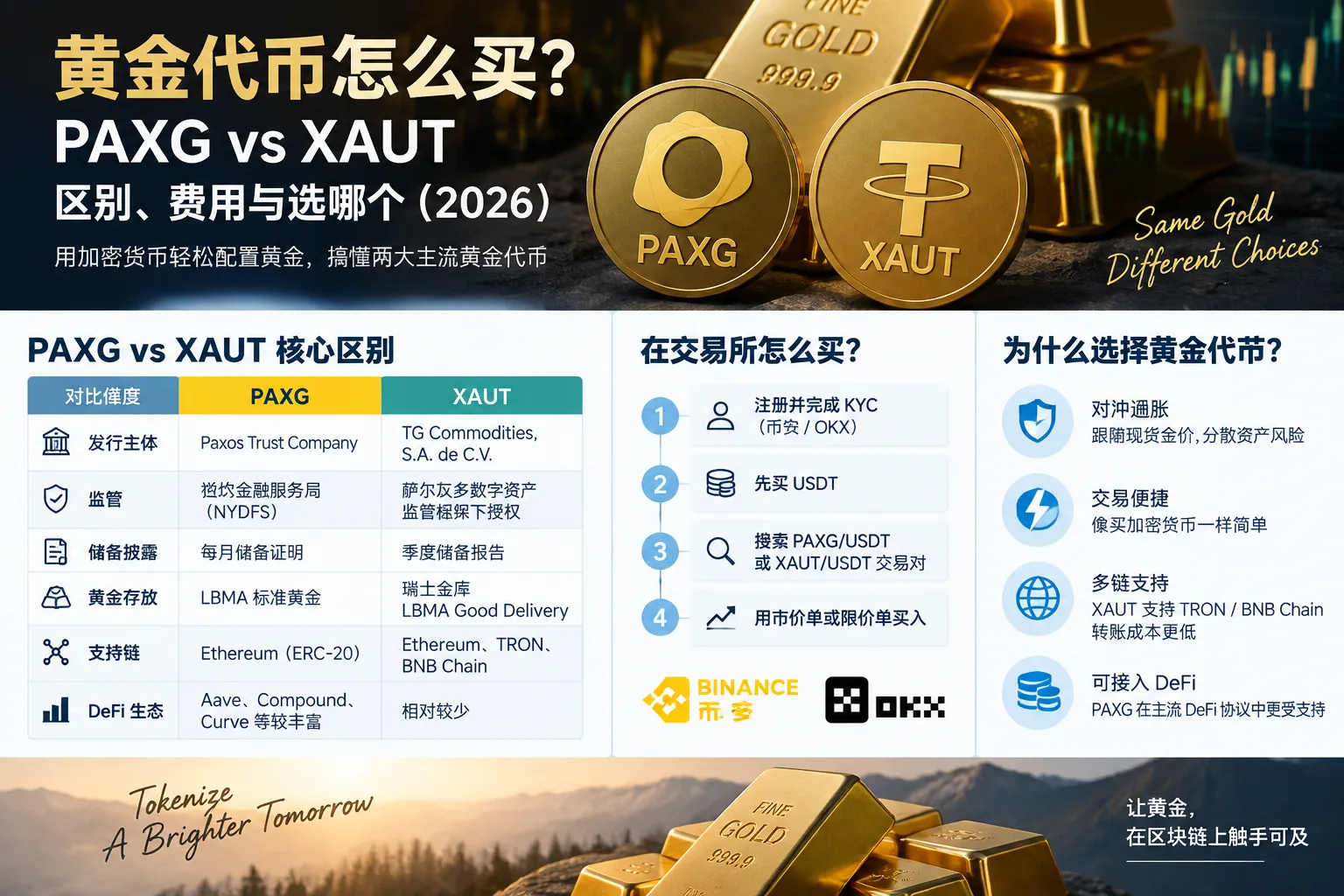
Table of contents

Binance new-user benefit
20% fee rebate
Official Binance sign-up · You must complete identity verification (KYC) to trade and withdraw
If you want to buy gold with crypto, the two most common choices are PAXG (Paxos Gold) and XAUT (Tether Gold).
Each token represents one troy ounce of physical gold, and the price tracks spot gold. So what really decides which one you pick is not the gold price, but the issuer, the disclosure, the redemption path and the supported networks.
My conclusion first: choose PAXG if you value the US regulatory framework, the disclosure system and a mature DeFi ecosystem; choose XAUT if you trust the Tether ecosystem and want to save transfer costs on TRON or BNB Chain; if you actually want to swap tokens back for a gold bar, both thresholds are high, so don't buy for that reason.
This is a 9-minute read that saves you from two common mistakes: expecting to redeem a gold bar anytime, and ignoring the spread and network fees.
Note: this article compares gold tokens and shares operational experience. It is not investment advice. Gold tokens carry issuer counterparty risk, and their price can deviate from spot gold, so judge carefully.
The essentials
| Your situation | Which to choose |
|---|---|
| Small gold-price hedge, you value US regulation and disclosure | PAXG |
| You trust the Tether ecosystem and want cheaper on-chain transfers on TRON / BNB Chain | XAUT |
| You want DeFi yield (Aave / Curve, etc.) | PAXG |
| You actually want to redeem tokens for physical gold bars | Both thresholds are high; read "Redemption thresholds" below first |
| You just want to buy a little gold on an exchange | Whichever has a spot pair and a tight spread on the platform you use |
In one sentence: PAXG is strong on regulation, disclosure and ecosystem; XAUT is strong on issuer background and multi-chain support. The gold-price peg works essentially the same way on both; all the difference is in "who issues it, how it is disclosed and how you get the real gold back".
Who needs it / who doesn't
| Your situation | Recommendation |
|---|---|
| You want to add some gold with crypto assets to hedge volatility | It fits; read the differences and fees below before choosing |
| You only trust physical bars you can hold | Probably not for you — redeeming tokens for metal has high thresholds; buying physical gold or a gold ETF is simpler |
| You hold USDT and don't want to go through a bank to buy gold | It fits; this is the most practical use case for gold tokens |
| You know nothing about tokenized assets | It fits, but think first: you are buying "a claim on the gold price", not "gold bars registered in your name" |
What PAXG and XAUT actually are
Tokenized gold is essentially a way to turn physical gold into a transferable claim.
The issuer stores gold in a regulated vault and issues a corresponding number of tokens on-chain. Each token you hold represents one troy ounce of gold.
PAXG is issued by Paxos Trust Company, regulated by the New York Department of Financial Services (NYDFS); the gold is held in LBMA vaults in London and elsewhere, and a reserve attestation is published monthly.[1]
XAUT is issued by TG Commodities, S.A. de C.V., registered in El Salvador (part of the Tether group); the gold is held in Swiss vaults, a reserve report and independent assurance are published quarterly, and the issuer holds the relevant local authorization for digital asset issuance.[2]
One thing deserves a separate note, because the legal structure of the two tokens is not exactly the same:
Both use physical gold as the underlying asset, but the allocation mechanism differs. XAUT's official terms describe the token as "indivisible ownership" of the gold in a designated bar, and holders can look up the serial number, purity and weight of the associated bar; PAXG is expressed more as a "claim on the gold held in the vault". Either way, that does not mean an ordinary user can take 0.1 token to a vault and collect 0.1 ounce of gold — physical redemption is still subject to whole bars, KYC, fees and delivery conditions.
Understanding that much is enough; the table below is what you will actually use.
The core differences
| Dimension | PAXG | XAUT |
|---|---|---|
| Issuer | Paxos Trust Company | TG Commodities, S.A. de C.V. (El Salvador) |
| Regulation | New York Department of Financial Services (NYDFS) | Authorized under El Salvador's digital asset framework |
| Reserve disclosure | Monthly reserve attestation | Quarterly reserve report + independent assurance |
| Gold storage | LBMA-standard gold | Swiss vaults, LBMA Good Delivery gold |
| Officially supported chains | Ethereum (ERC-20) | Ethereum (ERC-20) + TRON (TRC-20) + BNB Chain (since 2026-03) |
| DeFi integration | Aave, Compound, Curve and others, relatively rich | Comparatively limited |
| Liquidity / platforms | Binance, OKX, Kraken and others; relatively high liquidity | OKX, Bitfinex, Binance (since 2026-03) and others |
Two things deserve separate attention, because they are the easiest to overlook and they affect your real cost the most.
First, the choice of chain matters more than it looks. PAXG is mainly on Ethereum, so transfers require ETH gas, which can run from a few dollars to more than ten when the network is congested. XAUT is available not only as ERC-20 but also on TRC-20 (TRON) and, since March 2026, BNB Chain (BEP-20); transfers on TRON or BNB Chain usually cost one or two dollars or less. For someone moving small amounts frequently, that difference is real — but it is not the decisive reason to choose one, as explained below.
Second, the threshold for redeeming physical gold is high on both sides. That is the focus of the next section; many people buy without ever checking it.
Official facts verified as of September 2026
| Item | PAXG | XAUT |
|---|---|---|
| Each token represents | 1 troy ounce of gold | 1 troy ounce of gold |
| Issuer | Paxos Trust Company | TG Commodities, S.A. de C.V. |
| Gold standard | LBMA | LBMA Good Delivery |
| Reserve disclosure | Monthly | Quarterly |
| Officially supported chains | Ethereum | Ethereum, TRON, BNB Chain |
| XAUT minimum direct purchase | — | 50 XAUT |
| XAUT physical redemption | — | Whole bars, usually about 430 XAUT |
| XAUT redemption fee | — | 0.25% |
| PAXG base redemption tier | 0.125%* | — |
*Since September 1, 2026, the PAXG redemption fee is tiered by the account's net redemption amount over the previous 30 days; converting it into allocated / unallocated gold adds a 0.05% in-kind conversion fee. Trading, deposits and withdrawals on exchanges follow different rules from direct subscription and redemption with the issuer.
How to buy on Binance / OKX
Buying gold tokens works much like buying USDT or BTC: find the right pair.
Buying PAXG / XAUT on Binance
- Register and complete KYC (see the Binance registration guide)
- Buy USDT first (see the Binance USDT buying guide)
- Search for the PAXG/USDT or XAUT/USDT pair on the spot page
- Buy with a market or limit order
Since March 2026, Binance has also listed XAUT spot trading, supporting the Ethereum / BNB Chain networks. Spot fees follow Binance's standard rates: maker 0.10% / taker 0.10%, and the taker fee can drop to 0.075% with the BNB discount.[3]
Buying PAXG / XAUT on OKX
- Register and complete KYC (see the OKX registration guide)
- Buy USDT (see the OKX USDT buying guide)
- Search for PAXG/USDT or XAUT/USDT on the spot page
- Buy
OKX spot fees are maker 0.08% / taker 0.10%.[4]
One practical tip: check the bid-ask spread before the fee. Gold tokens are less liquid than mainstream coins such as USDT and BTC, the order book is thinner, and slippage on a market order can hurt more than the fee. Market orders are fine for small orders; for larger ones, use a limit order or look at the order book first.
The real threshold for redeeming physical gold
This is the part most comparison articles skip, yet it is exactly what matters to anyone who wants the metal back.
Remember one premise first: the gold tokens you buy on an exchange represent gold in the issuer's vault, not bars registered in your name.
Converting tokens into physical gold is restricted on both sides, and PAXG changed its fee schedule in September 2026.
On the PAXG side, the redemption fee was just adjusted in September 2026. Since September 1, 2026, Paxos charges PAXG redemptions in tiers based on the account's net redemption amount over the previous 30 days: the base tier is 0.125%, then 0.25% for $2M–$10M, 0.35% for $10M–$20M and 0.50% above $20M; converting PAXG into allocated / unallocated gold adds a 0.05% in-kind conversion fee. The specific physical delivery conditions still follow Paxos's rules at the time.[5]
On the XAUT side, redemption must be in whole bars. Because the actual weight of LBMA Good Delivery bars is not fixed, Tether Gold officially suggests preparing about 430 XAUT; the final amount is deducted according to the actual fine troy ounce content of the allocated bar. The redemption fee is 0.25%, physical delivery is in Switzerland, and delivery costs may apply.[6]
| Redemption route | PAXG | XAUT |
|---|---|---|
| Physical bars | Whole LBMA bars, tiered fee (from 0.125%) | Whole bars, usually about 430 XAUT, delivered in Switzerland |
| Fees | From 0.125% + 0.05% in-kind (if applicable) | 0.25% + delivery and other costs |
See the point? The "whole bar" redemption threshold is in the hundreds of tokens on both sides, which is unrealistic for most retail investors. You can sell a small amount back into USDT on an exchange, but that is not the same as "getting the real gold back".
So my judgment is direct:
If your goal is to hold gold as a hedge, gold tokens are enough, because what you are buying is gold-price exposure.
If your goal is to get a real gold bar, gold tokens are probably not for you; buying physical bars, coins or a gold ETF is simpler.
Don't take on the token's counterparty risk and premium just for the psychological comfort of "maybe redeeming a bar someday".
My selection logic: how to choose by situation
In concrete terms, I split it three ways:
| Your situation | Recommendation | Why |
|---|---|---|
| You hold USDT and want a 5% gold hedge | Either PAXG or XAUT | Pick whichever is convenient and has a tight spread on your platform |
| You move small positions often and care about transfer costs | XAUT | TRON / BNB Chain transfers are cheap |
| You value US regulation and disclosure, and want DeFi yield | PAXG | NYDFS regulation + monthly reserve attestation + a broad ecosystem |
| Long-term, large holding with infrequent moves | Compare disclosure on both | Long holding puts more weight on issuer credit and custody structure |
| You want physical gold bars | Neither; buy physical gold or an ETF | Redemption thresholds are high and the fees don't work in your favor |
The core sentence: a gold token gives you "gold-price exposure" and "on-chain transferability", not physical gold itself. Once that is clear, choosing becomes simple.
Mistakes I've made
Mistake 1: treating a gold token as "redeemable for a bar anytime"
Scenario: I assumed buying PAXG meant buying gold, and that I could swap it for a bar whenever I wanted. Then I found out redemption requires whole bars, a minimum quantity and fees.
Lesson: a gold token is gold-price exposure, not a physical bar. Before buying, decide whether you want "the gold price" or "the metal".
Mistake 2: watching the price but not the spread and liquidity
Scenario: I saw the gold token trading "cheap" versus spot and bought with a market order. The order book was thin, and the fill was noticeably worse than expected.
Lesson: gold tokens are less liquid than mainstream coins. Use limit orders for larger sizes and check the bid-ask spread before ordering.
Mistake 3: ignoring which chain to transfer on
Scenario: I moved PAXG on Ethereum and the gas fee was higher than expected, making a small transfer a net loss.
Lesson: if transfer cost matters, XAUT on TRON (TRC-20) or BNB Chain is cheaper; PAXG is mainly on Ethereum and you pay ETH gas.
Security risks
- Counterparty risk: the value of a gold token depends on the issuer actually holding the corresponding gold in its vault. PAXG is regulated by NYDFS and publishes a monthly reserve attestation, which is more transparent; XAUT belongs to the Tether ecosystem and publishes a quarterly reserve report. This is the main structural difference between the two on issuance and disclosure.
- Premium / discount risk: a gold token's price does not always equal spot gold 1:1; it can trade at a premium or discount, especially when liquidity is poor.
- Don't buy for "redeeming a bar": the physical redemption threshold is high; do not use "I can get the real gold later" as your reason to buy.
- Wallet security: if you withdraw gold tokens to an on-chain wallet, the seed phrase and private key matter just as much as with USDT or BTC — never expose them.
- Regional compliance: some countries and regions impose extra restrictions on tokenized assets. Confirm the law where you live before buying. Do not participate if you are under 18.
FAQ
Q1: Which is safer, PAXG or XAUT?
Looking at issuance and disclosure structure, PAXG is more solid: Paxos is regulated by the New York Department of Financial Services and publishes a monthly reserve attestation. XAUT belongs to the Tether ecosystem, publishes a quarterly reserve report and is regulated in El Salvador. But both are established tokenized-gold products and far more credible than small gold tokens.
Q2: Is a gold token really equal to 1 ounce of gold?
Mechanically, one token corresponds to one troy ounce of physical gold, but the actual trading price can deviate from spot gold because of premiums or discounts; it is not strictly 1:1. And what you hold is a claim on vaulted gold, not a bar registered in your name that you can collect anytime.
Q3: Can I buy XAUT on Binance?
Yes. Since March 2026, XAUT has been available on BNB Chain, and Binance has also opened XAUT spot trading, supporting the Ethereum / BNB Chain networks. The exact pairs and networks depend on what Binance's spot page currently shows.
Q4: Can gold tokens be used for DeFi yield?
PAXG has richer DeFi integration and can be used for lending and liquidity provision in protocols such as Aave and Curve. XAUT has a smaller on-chain ecosystem. But DeFi yield carries extra risks (smart-contract risk, liquidation risk) and is not guaranteed profit.
Q5: Gold tokens or a gold ETF?
It depends on your situation. If you already hold crypto and want to add gold, gold tokens are convenient; if you don't touch crypto and want standardization and low fees, a gold ETF is simpler. Both give you gold-price exposure; the advantage of gold tokens is on-chain transferability and 24/7 trading.
Q6: Are gold tokens suitable for long-term holding?
Yes, but you need to understand the issuer's counterparty risk and disclosure quality. For large, long-term holdings, PAXG's regulation and reserve attestations are more reassuring; if you withdraw to an on-chain wallet during that time, pay attention to wallet security.
In one sentence
PAXG is strong on US regulation, monthly reserve attestation and a more mature DeFi ecosystem; XAUT is issued by Tether Gold, keeps its gold in Switzerland and supports Ethereum / TRON / BNB Chain, making multi-chain transfers more flexible. If you want the real metal back, both thresholds are high. What you buy with a gold token is "gold-price exposure" and "on-chain transferability", not a physical bar — once that is clear, the choice becomes easy.
If you're planning to sign up
Buying gold tokens requires an account on Binance or OKX and some USDT.
| Your choice | What to do |
|---|---|
| Register on Binance through this site (20% rebate) | Register on Binance; the code AMY568 is filled in automatically |
| Register on OKX through this site (20% rebate) | Register on OKX; the code AMY568 is filled in automatically |
| No referral code | Go directly to binance.com / okx.com and register |
The first two rows are affiliate links. Registering through them may generate revenue for us, but it does not affect this article's objective conclusions. See the affiliate disclosure.
Related articles
- Buying US stocks with USDT (2026) — another "buy traditional assets with crypto" topic; this one explains how to tell real stocks from tokenized products
- Where should you keep crypto after buying? Exchange, hot wallet or cold wallet — decide whether to withdraw your gold tokens to a wallet
- How to transfer USDT: TRC20, ERC20 or BEP20? — a closer look at the TRC20 vs ERC20 difference
- Binance vs OKX: which is better for beginners (2026) — if you haven't chosen an exchange yet, start here
Data verification note
The key facts in this article were checked on 2026-10-16, one by one:
- PAXG issuance and regulation: PAXG is issued by Paxos Trust Company and regulated by the New York Department of Financial Services (NYDFS); the gold is held in LBMA vaults and a reserve attestation is published monthly. Source: Paxos PAX Gold official page.
- XAUT issuance and reserve disclosure: XAUT is issued by El Salvador-registered TG Commodities, S.A. de C.V. (part of the Tether group); the gold is held in Swiss vaults, with a quarterly reserve report and independent assurance. Source: Tether Gold official page.
- Binance spot fees: Binance spot maker 0.10% / taker 0.10%; with the BNB discount the taker fee can drop to about 0.075%. Source: Binance spot fee schedule.
- OKX spot fees: OKX spot maker 0.08% / taker 0.10%; there is no official OKB fee-discount mechanism. Source: OKX announcement on spot and futures fee rates.
- PAXG redemption fee: since 2026-09-01, tiered by the account's net redemption amount over the previous 30 days, with a base tier of 0.125% and higher rates at larger amounts (up to 0.50%); converting to allocated / unallocated gold adds a 0.05% in-kind conversion fee. Source: Paxos PAX Gold fee information.
- XAUT physical redemption: must be in whole bars, with official guidance usually suggesting about 430 XAUT; the redemption fee is 0.25%, delivery is in Switzerland and delivery costs are extra. Source: Tether Gold fee schedule.
Disclaimer
This article is for educational comparison and operational information about gold tokens. It does not constitute investment, financial or trading advice.
Gold tokens carry issuer counterparty risk, market risk, premium/discount risk, cybersecurity risk and operational risk. Redemption, tax and compliance treatment for tokenized assets varies by region. Users should judge carefully according to their own risk tolerance and comply with local laws and regulations. Do not trade crypto or tokenized assets if you are under 18.
Exchange operations · USDT · Wallet security
Responsible for researching and organizing content on Binance, OKX, USDT transfers, withdrawals and wallet security. The steps and key data in this article are verified according to the content type, using real operation records, official platform documentation and public sources. Interfaces, fees and regional rules may change, so the article is reviewed and updated continuously.
Status: manual review · Last verified 2026-10-16
Reviewed by: Veldux editorial team
- Paxos PAX Gold official pagePAXG is issued by Paxos Trust Company and regulated by the New York Department of Financial Services (NYDFS); the gold is held in LBMA vaults and a reserve attestation is published monthly
- Tether Gold official pageXAUT is issued by TG Commodities, S.A. de C.V., with gold held in Swiss vaults and a reserve report published quarterly
- Binance spot fee scheduleBinance spot maker 0.10% / taker 0.10%; with the BNB discount the taker fee is about 0.075%
- OKX announcement on spot and futures fee ratesOKX spot maker 0.08% / taker 0.10%; no OKB discount
- Paxos PAX Gold fee informationSince 2026-09-01 the PAXG redemption fee is tiered by 30-day net redemption amount; the base tier is 0.125%, and in-kind conversion adds 0.05%
- Tether Gold fee scheduleXAUT physical redemption costs 0.25% and must be done in whole bars (the official guidance usually suggests about 430 XAUT); delivery is in Switzerland
- 2026-10-16UpdateAdded the evidence-chain superscripts and the "Data verification note", and updated the fact-check date.
Editorial principles ineditorial policy,corrections policy。