
How to buy Treasury RWA: BUIDL, USDY and ONDO — differences and thresholds (2026)
Table of contents
Binance new-user benefit
20% fee rebate
Official Binance sign-up · You must complete identity verification (KYC) to trade and withdraw
If you hold USDT or idle crypto assets and want to earn interest from US Treasuries, many people get stuck at the first step:
You search for "Treasury RWA" or "tokenized Treasuries" and a pile of names appears — BUIDL, USDY, ONDO, BENJI, OUSG. Which one is actually a Treasury, which one can retail investors buy, and which one is not the same thing at all?
The short answer first:
The products actually tied to US Treasury and government money-market yield are RWA products such as USDY, BUIDL, BENJI and OUSG; the ONDO you can easily buy on Binance / OKX is the Ondo ecosystem's governance token.
ONDO does not represent US Treasuries, does not represent fund shares in USDY, and is not Ondo Finance stock. Holding ONDO does not automatically earn Treasury interest just because Ondo runs a Treasury RWA business.
Also, although BlackRock's BUIDL has the highest profile, direct subscription is usually an institutional route with an initial investment threshold of about $5 million; for eligible non-US users, USDY is currently one of the easier on-chain Treasury yield products to understand and access.
This is a 13-minute read that saves you from two common mistakes: buying ONDO thinking it is a Treasury, and assuming BUIDL is open to retail investors.
Note: this article is for education about the structure, thresholds and risks of tokenized Treasury products and is not investment advice. Treasury RWA carries issuer, custody, smart-contract, redemption and regional compliance risks. Some products are only for institutions, Qualified Purchasers or eligible non-US investors; rely on the issuer's latest official page.
The essentials
| Your situation | What to look at first |
|---|---|
| You want short-term Treasury yield exposure with crypto assets and qualify as non-US | USDY |
| Your capital is institutional-scale and you meet Qualified Purchaser-type requirements | BUIDL |
| You want on-chain shares of a US-registered money-market fund and your region supports it | BENJI |
| You want to trade the Ondo / RWA governance token | ONDO |
| You want to understand Ondo's institutional Treasury product | OUSG |
In one sentence:
BUIDL, USDY, BENJI and OUSG earn yield tied to underlying assets such as US Treasuries and government money-market instruments; ONDO is the Ondo ecosystem governance token, its price is set by market supply and demand and other factors, and holding ONDO does not give you the Treasury yield from USDY or BUIDL.
Who should read this
| Your situation | What to read first |
|---|---|
| You have idle stablecoins and want short-term Treasury exposure | Focus on USDY's eligibility, redemption and underlying assets |
| You want on-chain shares of a US-registered money-market fund | Understand BENJI's account eligibility and supported networks |
| Your capital is institutional-scale and you meet the relevant investor requirements | Then study institutional products such as BUIDL and OUSG |
| You are simply bullish on the Ondo / RWA sector price | Study ONDO, but do not treat it as a Treasury |
| You only want low-risk exposure to traditional Treasuries | Also compare T-bills or Treasury ETFs through a bank or broker |
The last row matters:
if your goal is simply to hold traditional Treasuries, tokenized Treasuries are not necessarily easier than a bank or broker.
RWA adds on-chain transfer, wallets and composability, but it also adds issuer, smart-contract, KYC, redemption and jurisdictional constraints.
What exactly is Treasury RWA?
"Treasury RWA" is one category of real-world asset tokenization (RWA).
In simple terms, it maps yield-bearing assets such as short-term US Treasuries, government money-market funds, cash or repo onto a blockchain through fund shares, notes or other securities structures.
But one point must be clear first:
do not understand every Treasury token as "a US Treasury security sitting directly in your wallet".
Different products represent completely different legal rights.
For example:
- BENJI: represents shares in the Franklin OnChain U.S. Government Money Fund (FOBXX);
- BUIDL: represents an interest in BlackRock's tokenized fund;
- USDY: a yield-bearing RWA product backed by short-term US Treasuries, bank deposits and similar assets;
- OUSG: Ondo's short-term US Treasury yield product for institutional investors;
- ONDO: only the Ondo ecosystem governance token, not tied to any specific Treasury principal.
So even when the media groups them all under "RWA" or the "Ondo ecosystem", their asset nature can be completely different.
How are BUIDL, USDY, ONDO and BENJI different?
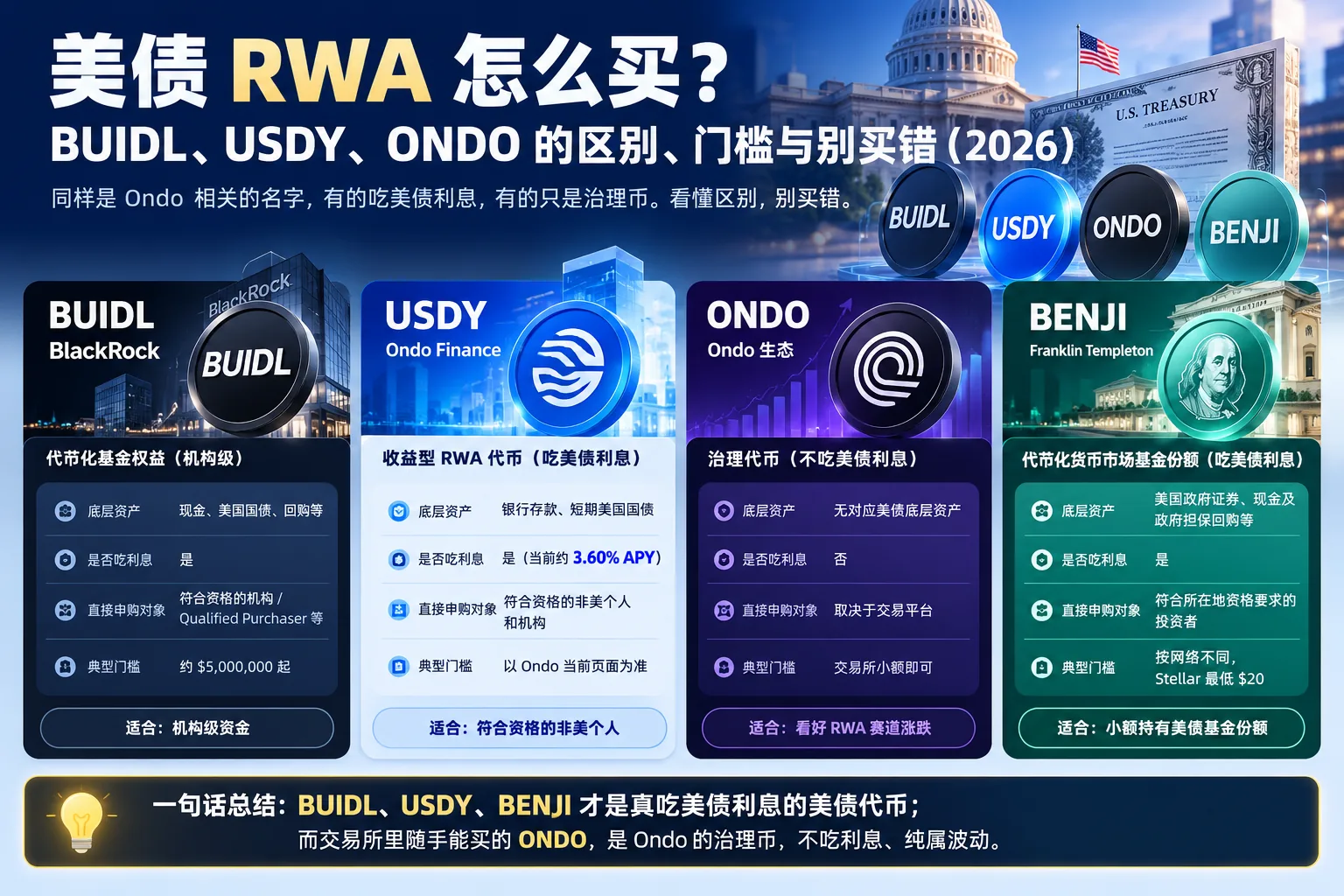
These four names often appear together, but their asset nature is completely different: BUIDL, USDY and BENJI are all related to US Treasury or government money-market yield, while ONDO is the Ondo ecosystem governance token, does not represent Treasuries and generates no corresponding Treasury interest.
| Product | BUIDL | USDY | ONDO | BENJI |
|---|---|---|---|---|
| What it is | Tokenized fund interest | Yield-bearing RWA product | Governance token | Tokenized money-market fund shares |
| Underlying assets | Cash, US Treasuries, repo, etc. | Bank deposits, short-term US Treasuries | No corresponding Treasury underlying | US government securities, cash, government-guaranteed repo, etc. |
| Generates underlying yield? | Yes | Yes | No | Yes |
| Who can subscribe directly | Qualified Purchasers and other eligible investors | Eligible non-US individuals and institutions | Depends on the trading platform | Investors who meet local eligibility requirements |
| Typical threshold | Direct subscription from about $5 million | Per Ondo's current page | Small amounts on an exchange | Varies by network; Stellar minimum $20 |
| Main use | Institutional on-chain cash management | On-chain dollar yield exposure | Ondo ecosystem governance and market trading | On-chain money-market fund investment |
The columns worth reading most are who can subscribe directly and underlying assets.
BUIDL has the highest profile, but ordinary retail investors generally cannot access its direct subscription channel.
By comparison, some access routes for USDY and BENJI have visibly lower thresholds, but whether you can actually subscribe still depends on:
- your identity;
- your jurisdiction;
- whether you pass KYC / AML;
- which chain you use;
- the issuer's current rules.
What is BENJI, and why isn't the minimum a uniform $20?
BENJI is the on-chain fund share of Franklin Templeton's Franklin OnChain U.S. Government Money Fund (FOBXX).
Simply:
1 fund share corresponds to 1 BENJI.
US retail investors can also participate through official channels such as the Benji Investments App, but it is not automatically open in every country and region.
And BENJI's minimum initial investment is not uniform.
| Network | Minimum initial investment |
|---|---|
| Stellar | $20 |
| Aptos | $100 |
| Base | $100 |
| Solana | $100 |
| Polygon | $1,000 |
| Arbitrum | $1,000 |
| Avalanche | $100,000 |
| Ethereum | $5,000,000 |
So when someone says:
You can buy BENJI with a $20 minimum
that is only half right.
The more accurate statement is:
the minimum initial investment on Stellar can be as low as $20, the minimum differs by network, and the issuer can adjust or waive the relevant thresholds.
ONDO ≠ Ondo Finance stock ≠ USDY ≠ a Treasury
This is the layer where the most buying mistakes happen.
Remember first:
ONDO ≠ USDY ≠ OUSG ≠ Ondo Finance equity
What each one is:
- ONDO: a governance token;
- USDY: a yield-bearing RWA product;
- OUSG: a short-term US Treasury yield product for institutional investors;
- Ondo Finance: one of the companies / protocol development and product ecosystem entities.
ONDO does not represent US Treasuries, does not represent shares in USDY or OUSG, and is certainly not Ondo Finance stock.[1]
Holding ONDO also does not automatically give you the underlying Treasury yield generated by USDY, OUSG or other Ondo RWA products.
So if you see this in Binance or OKX spot:
ONDO/USDT
you are buying the ONDO governance token, not a Treasury.
What is OUSG?
Many people also come across OUSG when searching for Ondo.
OUSG and ONDO are completely different.
OUSG is Ondo's short-term US Treasury yield product for institutional investors, mainly aimed at giving institutional capital on-chain exposure to US Treasury yield.[2]
So a simple way to remember:
- USDY: more for eligible non-US individuals and institutions;
- OUSG: more for institutional investors;
- ONDO: a governance token.
Three product names in the same Ondo ecosystem often appear together, but their asset nature is completely different.
Information verified as of September 2026
| Product | Issuer / product provider | Main direct subscribers | Direct subscription threshold |
|---|---|---|---|
| BUIDL | BlackRock / Securitize | Qualified Purchasers and other eligible investors | Usually from $5 million |
| USDY | Ondo | Eligible non-US individuals and institutions | Per Ondo's current subscription page |
| ONDO | Ondo ecosystem / Ondo DAO | Crypto traders | Depends on the trading platform |
| BENJI | Franklin Templeton | Investors who meet local eligibility requirements | Varies by network; Stellar minimum $20 |
USDY's official site currently shows about 3.60% APY.[3]
That is not a fixed rate; it changes with:
- short-term US interest rates;
- underlying asset yields;
- product fees;
- issuer rules.
In addition, direct subscription and redemption of USDY require KYC / AML, non-US person status and jurisdictional requirements.
So do not read:
USDY is for non-US users
as:
Anyone who is not American can definitely buy it.
Those are not the same thing.
How big is the tokenized Treasury market now?
In terms of industry size, Treasuries are already one of the most mature RWA categories.
As of mid-September 2026, RWA.xyz measured the distributed value of tokenized US Treasuries and related money-market products at about $15.4–15.7 billion.[4]
At minimum, this shows one thing:
tokenized Treasuries are no longer an experimental niche product.
But for ordinary users, the more important questions are still:
Can I buy it in my region? What legal structure am I actually buying? How do I subscribe and redeem?
How to buy: earning interest and betting on price are two different routes
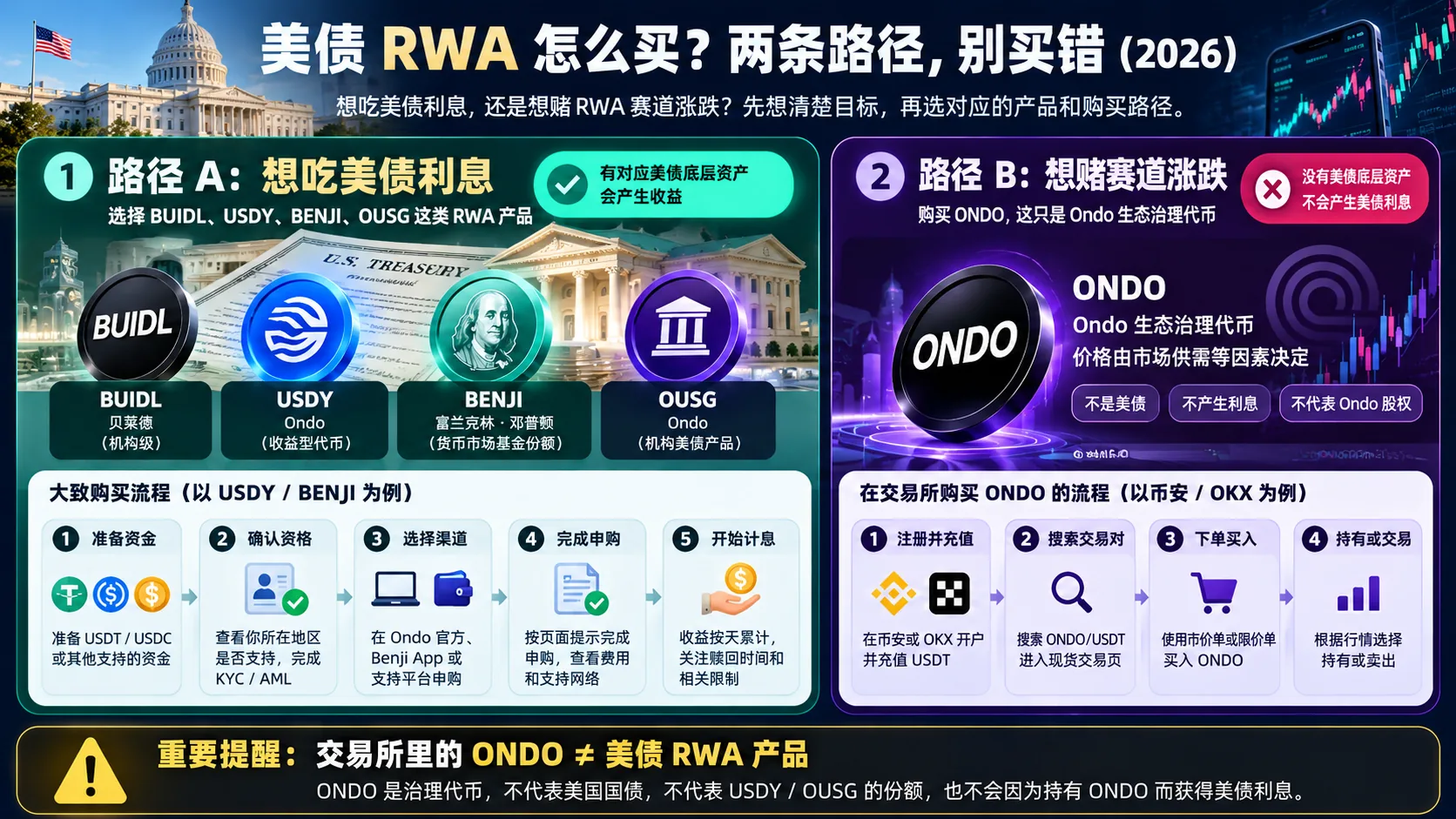
Before buying Treasury RWA, separate your goals: if you want Treasury-related yield, you are studying products such as USDY, BENJI, BUIDL and OUSG; if you only want to trade RWA sector price moves, the ONDO you buy is just a governance token, does not represent Treasuries and generates no corresponding Treasury interest.
Want Treasury yield exposure: study USDY or BENJI
If your goal is:
to earn short-term Treasury-related yield with on-chain assets
start with USDY.
The general process is:
- Prepare usable funds such as USD / USDC / USDT;
- Confirm whether USDY is open to your region and profile;
- Complete KYC / eligibility review on Ondo's official site or a supported channel;
- Check the current subscription assets, supported networks and fees;
- After subscribing, understand how yield accrues, subscription / redemption timing, fees and whether holding or transfer restrictions apply.
If you would rather hold on-chain shares of a US-registered money-market fund, look into BENJI.
BENJI's key question is not "whose yield is higher", but first:
- whether your region is supported;
- whether you can open a Benji account;
- which chain you use;
- what the corresponding minimum investment is.
Want to trade the RWA sector: ONDO is a different matter
If you search ONDO/USDT directly on Binance, OKX or another trading platform:
you are buying the ONDO governance token.
You can trade it with ordinary market and limit orders, but understand:
ONDO is a market-traded crypto asset; holding it does not automatically give you the underlying asset yield generated by USDY, OUSG or other Ondo RWA products.
So:
being bullish on Ondo's Treasury RWA business
and:
buying ONDO means buying Ondo's Treasuries
are completely different things.
A practical way to judge
Before buying, ask yourself three questions:
1. Does this token have a corresponding underlying asset?
For example:
- BUIDL: yes;
- USDY: yes;
- BENJI: yes;
- ONDO: no corresponding basket of Treasury principal.
2. Where does the yield come from?
If the yield comes from:
- Treasuries;
- government money-market instruments;
- bank deposits;
- repo;
then it may be a yield-bearing RWA.
If it mainly comes from:
- secondary-market price increases;
- market sentiment;
- governance expectations;
then you are not "earning Treasury interest".
3. Am I buying a subscription product or exchange spot?
Products such as BUIDL, USDY and BENJI usually involve:
- the official platform;
- KYC;
- eligibility review;
- subscription and redemption.
Whereas what appears directly on an exchange:
ONDO/USDT
is ordinary spot trading.
The entry points are different too.
Which product for which goal?
| Your goal | Look further into | Key difference |
|---|---|---|
| Short-term Treasury yield exposure, eligible as non-US | USDY | Underlying is bank deposits and short-term US Treasuries; eligibility and regions are limited |
| Larger capital and you meet the relevant investor requirements | BUIDL | Institutional product; direct initial investment threshold about $5 million |
| On-chain money-market fund shares | BENJI | 1 BENJI corresponds to 1 FOBXX share; minimum investment varies by network |
| Ondo's institutional Treasury product | OUSG | Short-term US Treasury yield product for institutional investors |
| Trading the Ondo ecosystem governance token | ONDO | No Treasury principal or interest; a price-volatility crypto asset |
Core sentence:
for Treasury yield exposure, study BUIDL, USDY, BENJI and OUSG; for trading Ondo ecosystem price expectations, study ONDO.
Do not mix the two.
The 3 most common mistakes
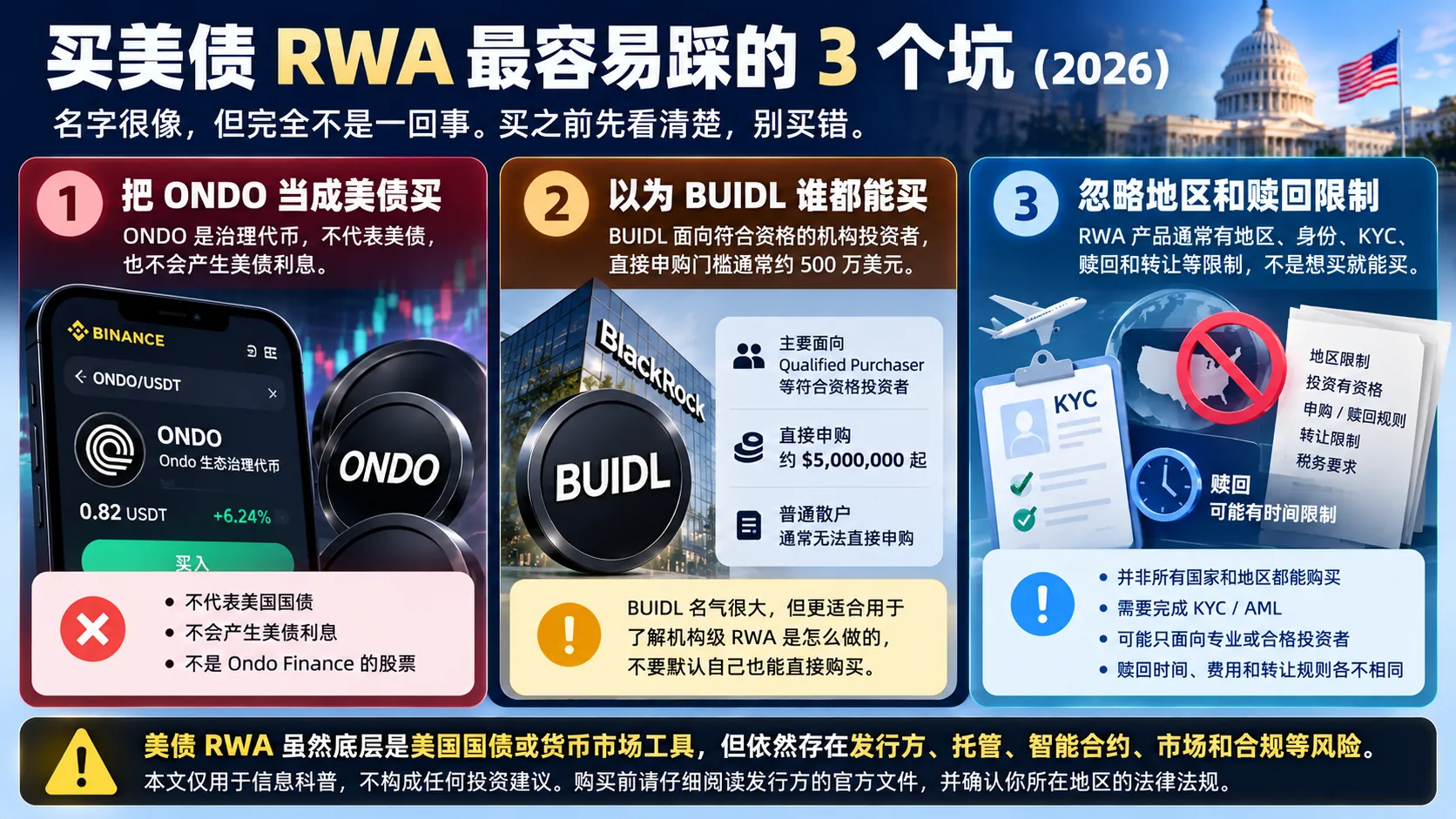
When buying Treasury RWA, the most common error is not the yield but confusing product nature, investor eligibility and regional restrictions. In particular: ONDO is not a Treasury, BUIDL is not something ordinary retail investors can subscribe to by default, and RWA products such as USDY and BENJI may also be subject to KYC, regional and redemption rules.
Mistake 1: buying ONDO thinking it is a Treasury
Common scenario:
You see "Ondo is an RWA leader" and "Ondo tokenizes Treasuries", so you buy ONDO on an exchange, believing you have allocated to Treasuries.
That is exactly the problem:
the Ondo ecosystem includes both RWA products such as USDY and OUSG, and the ONDO governance token.
Sharing a name within one ecosystem does not mean the assets are the same.
Before buying, ask:
Does the token I am buying have corresponding bond / fund assets behind it? Where does the yield come from?
If there is no underlying Treasury yield, do not treat it as a Treasury.
Mistake 2: assuming anyone can buy BUIDL
BUIDL is backed by BlackRock, so it gets a lot of exposure.
Many people see:
BlackRock has put Treasuries on-chain
and assume they can subscribe directly too.
But BUIDL's direct subscription path is mainly for investors who meet Qualified Purchaser-type requirements, with an initial investment threshold usually around $5 million.
Therefore:
check whether you meet the investor eligibility first, then look at the issuer's reputation.
For ordinary individuals, BUIDL is more useful for understanding how institutional RWA works than as a default purchase entry point.
Mistake 3: ignoring regional and redemption limits
One of the biggest differences between RWA and ordinary crypto tokens is:
it often carries identity restrictions at the securities and fund level.
You may find:
- your region cannot subscribe;
- KYC does not pass;
- only professional / qualified investors are allowed;
- redemption timing is restricted;
- some networks are not open;
- some transfer recipients are restricted.
So before buying, at least confirm:
- Can I buy it in my region?
- How do I redeem?
- How long does redemption take?
- What are the fees?
- Can the token be transferred freely?
These questions are usually more important than a 0.1% difference in yield.
Security risks
Issuer and custody risk
Although products such as BUIDL, USDY and BENJI disclose their issuer, legal structure and underlying assets, issuer, custodian and operational risks remain.
The underlying asset being US Treasuries does not make the entire on-chain product "zero risk".
Smart contract and network risk
Once an asset is tokenized, new technical risks are added:
- smart contracts;
- blockchain networks;
- wallets;
- cross-chain infrastructure.
Redemption risk
On-chain liquidity does not mean you can always redeem immediately at the theoretical net asset value.
In special market conditions, some products may experience:
- redemption delays;
- redemption limits;
- secondary-market discounts;
- reduced liquidity.
No direct government guarantee
Take BENJI: even if the fund mainly invests in US government securities, the fund investment itself is not guaranteed by the US government or the FDIC.
The fund can still lose money.
Regional compliance risk
RWA products often have securities characteristics.
So different countries and regions may have completely different rules on:
- subscription;
- transfer;
- holding;
- tax.
Confirm local law and product terms before buying.
Don't treat a governance coin as a Treasury asset
Protocol or governance tokens such as ONDO, CFG and SYRUP may be related to the RWA sector, but they are not Treasuries themselves.
Their price volatility can be far greater than that of the underlying US Treasuries.
Wallet security
If you withdraw the relevant tokens to an on-chain wallet:
seed phrases, private keys, approvals, phishing sites and wrong networks carry the same risks as with any other on-chain asset.
FAQ
Q1: How exactly are ONDO and USDY related?
They belong to the same Ondo ecosystem, but their asset nature is completely different.
USDY is a yield-bearing RWA product whose underlying assets include bank deposits and short-term US Treasuries.
ONDO is a governance token, does not represent USDY shares and does not automatically earn USDY yield just because you hold it.
Q2: Is ONDO stock in the Ondo company?
No.
ONDO is the Ondo ecosystem governance token; it does not represent equity in Ondo Finance and does not represent US Treasuries.
Therefore:
ONDO ≠ Ondo Finance stock.
Q3: Can retail investors buy BlackRock BUIDL directly?
Ordinary retail investors usually cannot access the direct subscription path.
BUIDL's direct subscription is for Qualified Purchasers and other eligible investors, with an initial investment threshold usually around $5 million.
So for ordinary individuals, it is more useful to check first whether lower-threshold products such as USDY and BENJI are open in their region.
Q4: Is BENJI really available from $20?
In some cases, yes.
The minimum initial investment on Stellar is $20.
But other networks may be:
- $100;
- $1,000;
- $100,000;
- or even $5 million.
So you cannot simply summarize it as:
BENJI minimum $20.
More accurately:
BENJI's minimum investment depends on the blockchain used.
Q5: What is USDY's current yield?
As verified in September 2026, Ondo's official page showed USDY APY at about 3.60%.
But that number changes and is not a fixed-yield promise.
It is affected by short-term Treasury rates, bank deposit yields, product costs and rule changes.
Q6: Can I buy Treasuries directly on Binance / OKX?
You need to separate the two.
Binance / OKX let you trade crypto assets such as ONDO, but:
buying ONDO does not mean buying Treasuries.
Formal subscriptions to products such as USDY, BUIDL and BENJI usually go through the issuer's official site or a designated channel, with KYC and investor eligibility review.
So do not see ONDO on an exchange and conclude that the exchange offers direct subscription to BUIDL or USDY.
Q7: I already have USDT. How do I buy Treasury RWA?
Work through this order:
- Confirm whether your region allows participation;
- Confirm the product type — USDY, BENJI, BUIDL or OUSG;
- Check the minimum subscription;
- Complete the issuer's KYC / eligibility review;
- Check whether it accepts USDC, USD, USDT or another funding source;
- Then complete the subscription.
Do not just search "ONDO" on an exchange and assume you have bought a Treasury.
Q8: What is the difference between a Treasury token and buying Treasuries through a broker?
The yield source may be related to US Treasuries in both cases, but the holding structure differs.
Traditional broker channels usually involve:
- Treasury Bills;
- Treasury Notes;
- Treasury ETFs;
- money-market funds.
RWA adds a layer:
- token issuance;
- blockchain networks;
- smart contracts;
- wallets;
- on-chain transfer.
So RWA has the advantage of on-chain composability, but also adds technical and issuance-structure risk.
In one sentence
To earn Treasury yield with on-chain assets, the first step is not to see which name is most popular, but to distinguish:
are you buying an RWA product with Treasuries / government money-market instruments underneath, or just a governance coin for the RWA sector?
Simple version:
- BUIDL: BlackRock's institutional tokenized fund, direct initial investment usually about $5 million;
- USDY: Ondo's yield-bearing RWA, worth studying for eligible non-US users, currently about 3.60% APY on the official site;
- BENJI: on-chain fund shares of Franklin Templeton's FOBXX, with minimum investment varying by network;
- OUSG: Ondo's short-term US Treasury yield product for institutional investors;
- ONDO: Ondo ecosystem governance token, not a Treasury, not USDY, and not Ondo Finance stock.
The easiest mistake is treating ONDO as a Treasury.
Related articles
- What is RWA and how do you buy it? Tokenized gold, US stocks and Treasuries explained (2026) — start here if you want to understand the whole RWA market
- Buying US stocks with USDT (2026): exchange or traditional broker? Don't buy the wrong product — the same lesson: similar names, completely different rights
- Binance Direct Stocks vs bStocks: real stocks and tokenized stocks (2026) — understand the difference between real securities, on-chain certificates and tokens
- How to buy gold tokens: PAXG vs XAUT, fees and which to choose (2026) — compare another relatively mature RWA category
- Where should you keep crypto after buying? Exchange, hot wallet or cold wallet — read this if you end up withdrawing RWA tokens to an on-chain wallet
Data verification note
The key facts in this article were checked on 2026-10-16, one by one:
- Nature of ONDO: ONDO is the Ondo ecosystem governance token; it does not represent US Treasuries or USDY shares, and it is not Ondo Finance stock. Source: Ondo Foundation official docs, "The ONDO Token".
- OUSG positioning: OUSG is aimed at institutional investors and offers on-chain exposure to short-term US Treasury yield. Source: Ondo Finance official OUSG product page.
- USDY yield and eligibility: the official site shows about 3.60% APY, a floating rather than fixed yield; direct subscription and redemption require KYC / AML, non-US person status and jurisdictional requirements. Source: Ondo Finance official USDY product page.
- Tokenized Treasury market size: in mid-September 2026, RWA.xyz measured the distributed value of tokenized US Treasuries and related money-market products at about $15.4–15.7 billion; this is dynamic data. Source: RWA.xyz data platform.
Disclaimer
This article is for education about the product structure, subscription thresholds and risks of tokenized Treasuries (Treasury RWA). It does not constitute investment, financial or trading advice.
Treasury RWA carries issuer counterparty risk, custody risk, market risk, redemption risk, smart-contract risk, cybersecurity risk and regulatory compliance risk.
Even if the underlying assets are mainly US government securities, that does not mean the token, fund or related investment product is guaranteed by the US government or the FDIC.
Subscription, redemption, tax and compliance requirements for tokenized assets vary by region; some products are only for institutions, Qualified Purchasers, professional investors or eligible non-US investors.
Check the official product documents and local laws and regulations before making a decision.
Exchange operations · USDT · Wallet security
Responsible for researching and organizing content on Binance, OKX, USDT transfers, withdrawals and wallet security. The steps and key data in this article are verified according to the content type, using real operation records, official platform documentation and public sources. Interfaces, fees and regional rules may change, so the article is reviewed and updated continuously.
Status: manual review · Last verified 2026-10-16
Reviewed by: Veldux editorial team
- Ondo Foundation official docs, "The ONDO Token"ONDO is a governance token with an initial total supply of 10 billion, and does not correspond to any Treasury principal or interest
- Ondo Finance official OUSG product pageOUSG is a product for institutional investors offering exposure to short-term US Treasury yield
- Ondo Finance official USDY product pageUSDY's official site shows about 3.60% APY; direct subscriptions and redemptions are for eligible non-US individuals and institutions
- RWA.xyz data platformIn mid-September 2026, the distributed value of tokenized US Treasuries and related money-market products was about $15.4–15.7 billion
- 2026-10-16UpdateAdded the evidence-chain superscripts and the "Data verification note", and updated the fact-check date.
Editorial principles ineditorial policy,corrections policy。