
How to buy US stocks on Binance: Direct Stocks steps, fees and settlement (2026)
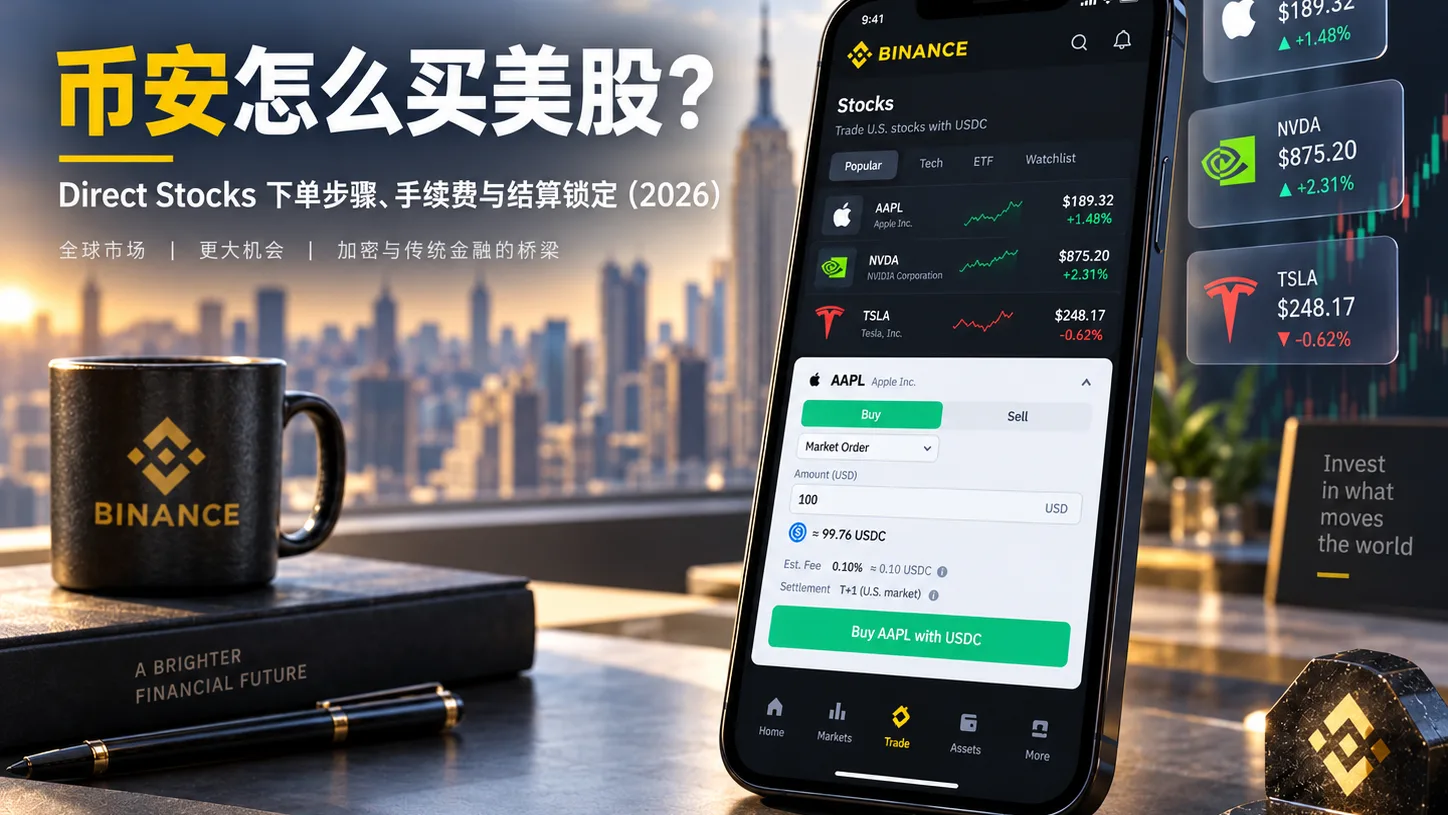
Table of contents

Binance new-user benefit
20% fee rebate
Official Binance sign-up · You must complete identity verification (KYC) to trade and withdraw
To buy Apple, Nvidia, Tesla or other US stocks on Binance, you no longer need to move USDT to a traditional broker first.
Eligible Binance users can buy US-listed stocks and ETFs directly from the stock-trading entry in the app.
The short answer: Binance currently calls this service Binance Stock Trading, and in practice you reach it through "Trade → Stocks". The minimum investment depends on the instrument; some stocks can be bought in fractions from about $5. The main settlement asset is USDC, and you can also pay with supported assets such as USDT, BNB, U and USD1, which the system converts to USDC automatically when you place the order.[1]
Once your account is funded, the first order usually takes about five minutes. But before you start, two rules matter more than the buttons:
- Zero commission does not mean zero trading cost. For orders of $350 or less, the minimum platform fee is $0.35; above $350 the minimum fee is waived and a spread of about 0.1% applies.[2]
- After you sell a stock, the money is not always available to withdraw immediately. Until securities settlement completes, the sale proceeds stay in a pending state, usually settled on a T+1 US trading day.
Risk note: This article only explains how Binance Stock Trading works, along with its fees and settlement rules, and is not investment advice. Stocks, ETFs and crypto assets can all lose value. Whether the service is available, which stocks are supported, the fees and the trading sessions vary by region, account eligibility and product rules; rely on what the order page actually shows.
What to know before buying US stocks on Binance
| Item | Current rule |
|---|---|
| Entry | Binance App "Trade → Stocks" |
| Product | US-listed stocks and ETFs |
| Number of instruments | The company says more than 7,000 stocks and ETFs |
| Minimum amount | Some instruments from about $5, with fractional shares |
| Main settlement asset | USDC |
| Other payment assets | USDT, BNB, U, USD1 and other supported assets |
| Stock commission | 0 |
| Orders ≤ $350 | Minimum platform fee of $0.35 |
| Orders > $350 | Spread of about 0.1% |
| Settlement after a sale | Usually T+1 US trading day |
| Custody structure | Nest Trading → Alpaca Securities |
| Trading hours | Regular and extended sessions; some stocks up to 24/5 |
Data checked as of 2026-10-16. Fees, supported assets and trading hours can all change; check the order preview before you place an order.
If you don't have a Binance account yet, start with the Binance registration tutorial.
If you don't have USDT in the account yet, see how to buy USDT on Binance.
Table of contents
- Before you buy: Binance Stock Trading and bStocks are not the same
- Full steps to buy US stocks on Binance
- How Binance calculates stock trading fees
- Market order vs limit order
- Binance US stock trading hours
- Why you can't withdraw after selling a stock
- Where the shares you bought are actually held
- Dividends and W-8BEN
- Common mistakes
- FAQ
Before you buy: Binance Stock Trading and bStocks are not the same
Binance now offers both traditional stock trading and tokenized stock products, so the first time you see "stocks" in the app it's easy to mix them up.
This article is about Binance Stock Trading, which many users still call Direct Stocks from its earlier name.
This type of stock trading uses a traditional brokerage and custody structure: Nest Trading Limited acts as introducing broker and sends securities orders to the clearing broker Alpaca Securities LLC, which handles execution, clearing, settlement and custody.[3]
After buying, you are the beneficial owner of the shares you hold and, where applicable, can receive dividends and take part in corporate actions.
bStocks is a different product altogether.
In simple terms:
| Binance Stock Trading | bStocks |
|---|---|
| Share ownership in a securities account | Tokenized securities linked to shares |
| Custodied by a securities broker | Can exist as an on-chain asset |
| Settled under US securities rules | Focused on on-chain circulation |
| Selling involves securities settlement | Different product structure |
| The subject of this article | Covered in a separate comparison |
If what you care about is "24/7, can I withdraw it to a wallet, how do I use it on-chain", start with Direct Stocks vs bStocks.
Full steps to buy US stocks on Binance
The example below uses the Binance app.
The layout can vary slightly between app versions, but the main path Binance currently gives is:
Trade → Stocks
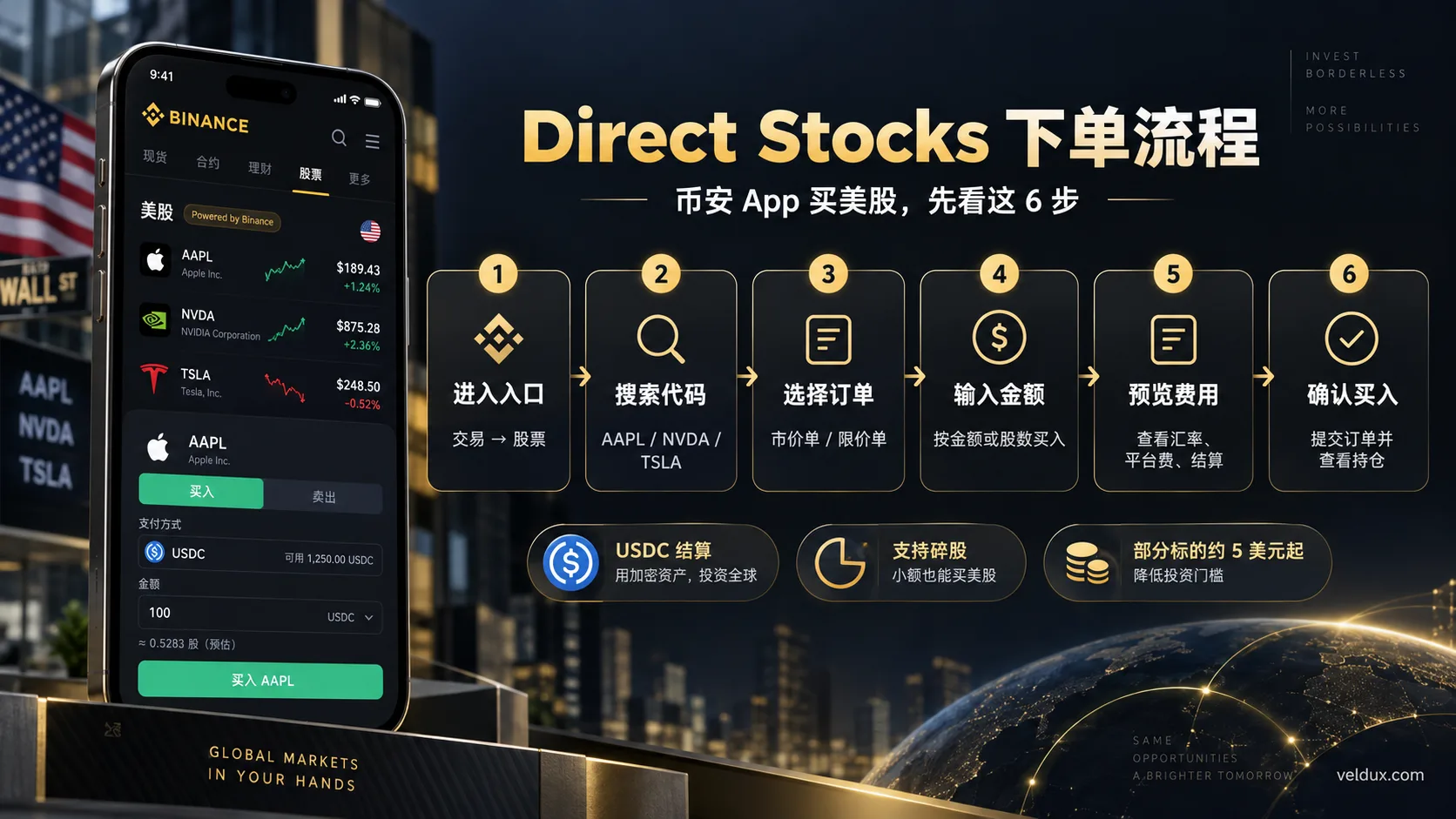
The six-step flow for buying US stocks on Binance: Trade → Stocks → search the ticker → choose the order → enter the amount → preview the fees → confirm the purchase.
Step 1: open the stock trading page
Open the Binance app and tap at the bottom:
Trade → Stocks
You then land on the stock market page.
Some versions may also offer entry points from Markets or from TradFi-related sections. If your account shows no "Stocks" entry at all, don't go hunting for someone else's screen.
Whether Binance Stock Trading is available depends on:
- Your region of residence
- Account eligibility
- KYC status
- Local availability of the product
No entry doesn't mean you followed the wrong steps; it more likely means this account currently isn't eligible for the product.
Step 2: search for the ticker
Once you're on the stock page, search for the stock you want to look at.
For example:
- Apple:
AAPL - NVIDIA:
NVDA - Tesla:
TSLA - Microsoft:
MSFT - Amazon:
AMZN
It's better to check ticker + company name rather than picking by a name in another language.
Binance currently offers more than 7,000 US-listed stocks and ETFs, but not every instrument has exactly the same:
- Minimum order amount
- Fractional-share rules
- Trading sessions
- 24-hour trading eligibility
The specific parameters on the stock trading page are what count.
Step 3: tap buy and choose the order type
On the stock detail page, tap "Buy".
You will mainly see:
- Market order
- Limit order
Some interfaces may also offer Stop Limit and other order types.
If this is your first order, the most important thing is to understand the difference between a market order and a limit order; that's explained separately below.
Step 4: enter an amount or a number of shares
Some stocks support two ways of buying:
Buy by amount
For example, enter:
50 USDC
The system calculates how many fractional shares you can buy at the execution price.
Buy by number of shares
For example, enter:
0.1 AAPL
The system calculates how much cash you need to pay.
Fractional-share support isn't identical across every stock, so don't read "from $5" as "every stock always starts at exactly $5".
The current official wording is: the minimum investment for eligible stocks can be as low as about $5.
Step 5: choose the paying account and asset
Binance stocks settle mainly in USDC.
You can currently use funds from:
- Funding Account
- Spot Account
Besides paying directly with USDC, you can use some other supported assets, for example:
- USDT
- BNB
- U
- USD1
If you buy stocks with a non-USDC asset such as USDT, the system does not take the USDT straight to the securities market.
The actual flow is:
USDT → automatic conversion to USDC → stock order submitted
So always check the live conversion rate at this step.
Step 6: preview the order
Before submitting, tap "Preview".
This page matters more than the "Buy" button itself.
Check at least:
- Ticker
- Purchase amount
- Order type
- Trading session
- Time-in-Force
- Platform fee / spread
- USDC conversion rate
- Estimated number of shares
If you're not using USDC, the rate can refresh with the market price.
Don't just look at "I want to buy $100 of stock"; look at the final cost and the number of shares you'll actually get.
Step 7: confirm the purchase
Once the details look right, tap:
Convert & Buy
If you're using USDT, BNB or another asset, the system first completes the USDC conversion and then submits the stock order.
Any USDC left over that wasn't used for the fill returns to your Funding Account.
Step 8: check the position
After the order fills, open the stock positions page to see:
- Number of shares held
- Cost
- Current price
- Market value
- Profit / loss
- Order history
If you sell the stock later, the proceeds usually return to the Funding Account in USDC.
But there is an important distinction here:
Seeing the USDC on screen does not mean the money has completed securities settlement.
This is covered in detail below.
How Binance calculates stock trading fees
Binance currently advertises Stock Trading as:
0 stock trading commission.
But "0 commission" and "0 cost" are not the same thing.
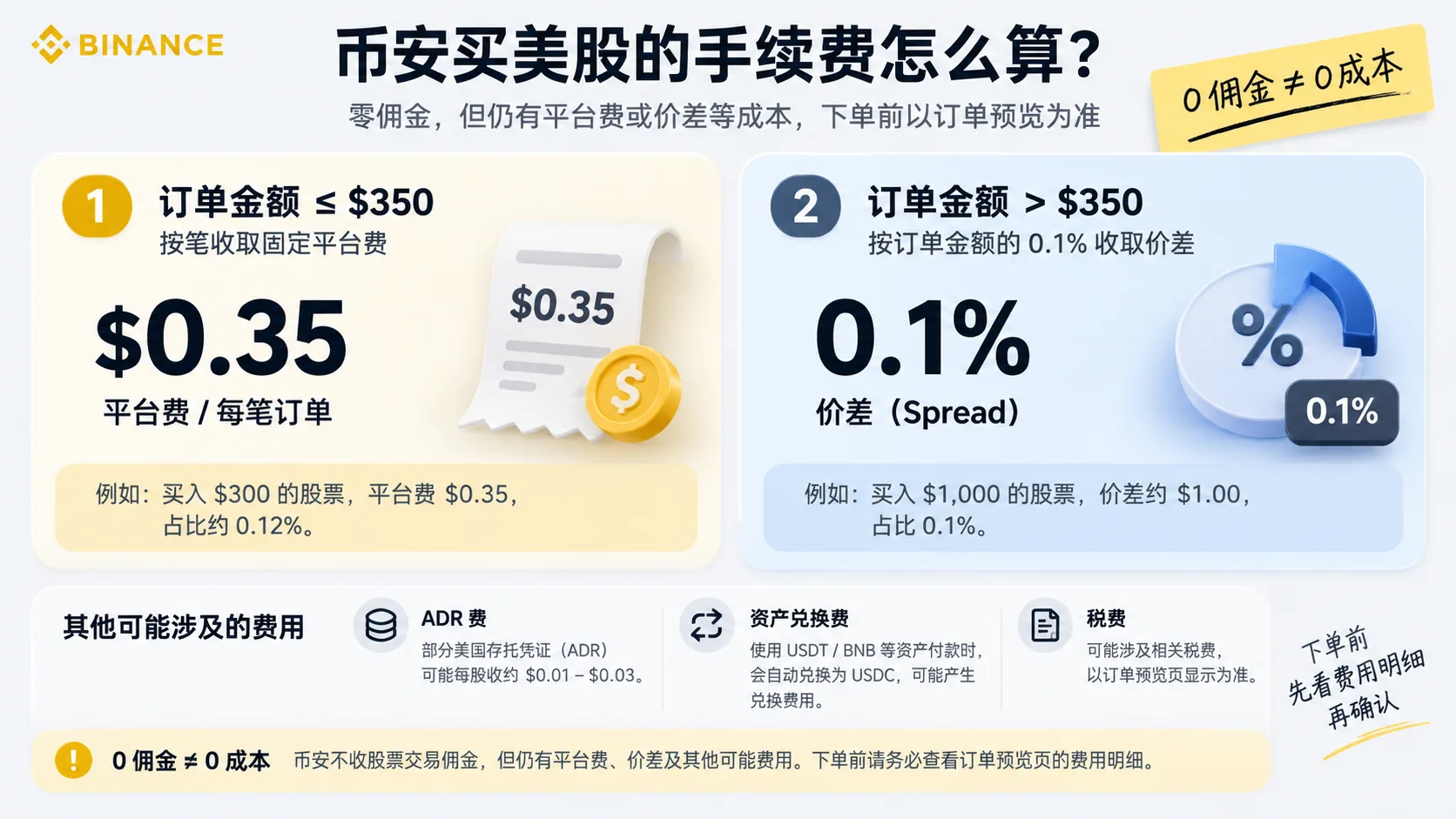
Binance stock trading has 0 commission, but platform fees, spreads, asset-conversion costs, ADR fees and taxes can still apply. Rely on the order preview before you place an order.
The main fee structure currently looks like this.
| Order value | Platform fee | Spread |
|---|---|---|
| ≤ $350 | Minimum $0.35 | — |
| > $350 | Minimum fee waived | About 0.1% |
Example 1: buying $100 of stock
If the order value is 100 USDC:
the platform fee is about:
0.35 USDC
Assuming the share price is $50, and ignoring other market moves for simplicity, the amount actually used to buy stock is roughly:
100 - 0.35 = 99.65 USDC
Example 2: buying $300 of stock
The platform fee is still:
$0.35
That is about:
0.117%
of the order value.
So a fixed fee weighs proportionally more on very small orders.
Example 3: buying $1,000 of stock
The order is now above $350.
The $0.35 minimum platform fee is waived and the charge becomes roughly:
1,000 × 0.1% = $1
The order page still shows the final figure.
Besides the platform fee, what other costs are there?
Don't memorize only $0.35 and 0.1%.
Other costs can arise while you hold the stock.
ADR fees
If you buy an ADR (American Depositary Receipt), the depositary bank may charge an ADR administration fee.
Binance currently states that ADR fees are usually around:
$0.01–0.05 per share
They are normally charged once or twice a year, depending on the specific ADR program.
Even if you have already sold the ADR, as long as you held it on the relevant record date, the fee may still be charged later.
The deduction order is usually:
- USDC in the Funding Account
- Spot Account
- If the balance is insufficient, an equivalent asset may be temporarily frozen until the fee is collected
So if you hold ADRs long term, don't look only at the buy/sell fee.
Asset-conversion cost
If you buy stocks with a non-USDC asset such as USDT or BNB, the system converts it to USDC first.
The actual conversion rate is set by the order preview.
So:
A different payment asset can also change your final cost.
Taxes and regulatory fees
Different stocks, transactions and tax statuses may also generate:
- Taxes
- Regulatory fees
- Dividend-related taxes
- Other third-party fees
These costs don't appear on every trade.
Market order vs limit order
This is where beginners get confused most.
Market order
The goal of a market order is:
To fill as quickly as possible at the price currently available in the market.
But note that a market order does not necessarily fill at the last price you saw.
When the market moves fast, slippage can occur.
Also, Binance lets you submit a market order outside normal trading hours, but a market order only becomes truly executable once Regular Trading Hours begin.
Regular US stock market hours are:
9:30–16:00 Eastern Time
excluding US holidays.
Limit order
A limit order means:
You set the execution price you're willing to accept.
For example, if NVDA is at $150 and you set:
a limit buy at $145
the order can only fill if the market reaches a price that meets your condition.
A limit order can be set as:
- DAY
- GTC
GTC can stay open for up to about 90 days, until it is:
- filled
- canceled
- expired
Note that fractional-share orders and other cases may carry additional restrictions.
Which order suits which situation?
Don't read this as "market orders are always better" or "limit orders are always better".
A more accurate way to think about it:
| What you want | Which to use |
|---|---|
| Fill quickly at the market price during regular hours | Market order |
| Control the maximum buy price or minimum sell price | Limit order |
| US stocks are outside regular hours | Check whether ETH / 24-hour is supported, then use a supported limit order |
| Leave a price in the market for a long time waiting to fill | GTC limit order |
Which order to use depends on your own trading objective.
Binance US stock trading hours
Binance stocks are not limited to the traditional 9:30–16:00.
The product can currently cover up to:
24 hours × 5 days a week
But note this carefully:
Not every stock supports full 24-hour trading.
Today the sessions roughly break down as:
Regular Trading Hours
Eastern Time:
9:30–16:00
Both market and limit orders can participate.
Pre-Market
Eastern Time:
4:00–9:30
Market orders generally wait for the regular open.
Limit orders that support the relevant session can participate.
Post-Market
Eastern Time:
16:00–20:00
Here too, eligible limit orders do most of the work.
Overnight
Some stocks that support 24-hour trading may also open an overnight session.
Whether a stock does depends on its individual page.
So don't see Binance advertise "24/5" and read it as:
Any stock, any order, fills instantly 24 hours a day.
Those are not the same thing.
Why can't you withdraw after selling a stock?
This is where Binance Stock Trading differs sharply from ordinary USDT spot trading.
Stock trades must complete securities settlement.
The standard settlement cycle for US stocks is currently:
T+1
meaning settlement completes on the next securities trading day after execution.[4]
A simple example.
Suppose you sell a stock on a normal Monday trading day.
Generally:
Monday: trade executes
Tuesday: enters the next securities settlement cycle
But if you run into:
- A weekend
- A US securities market holiday
- Special market arrangements
the timing rolls forward.
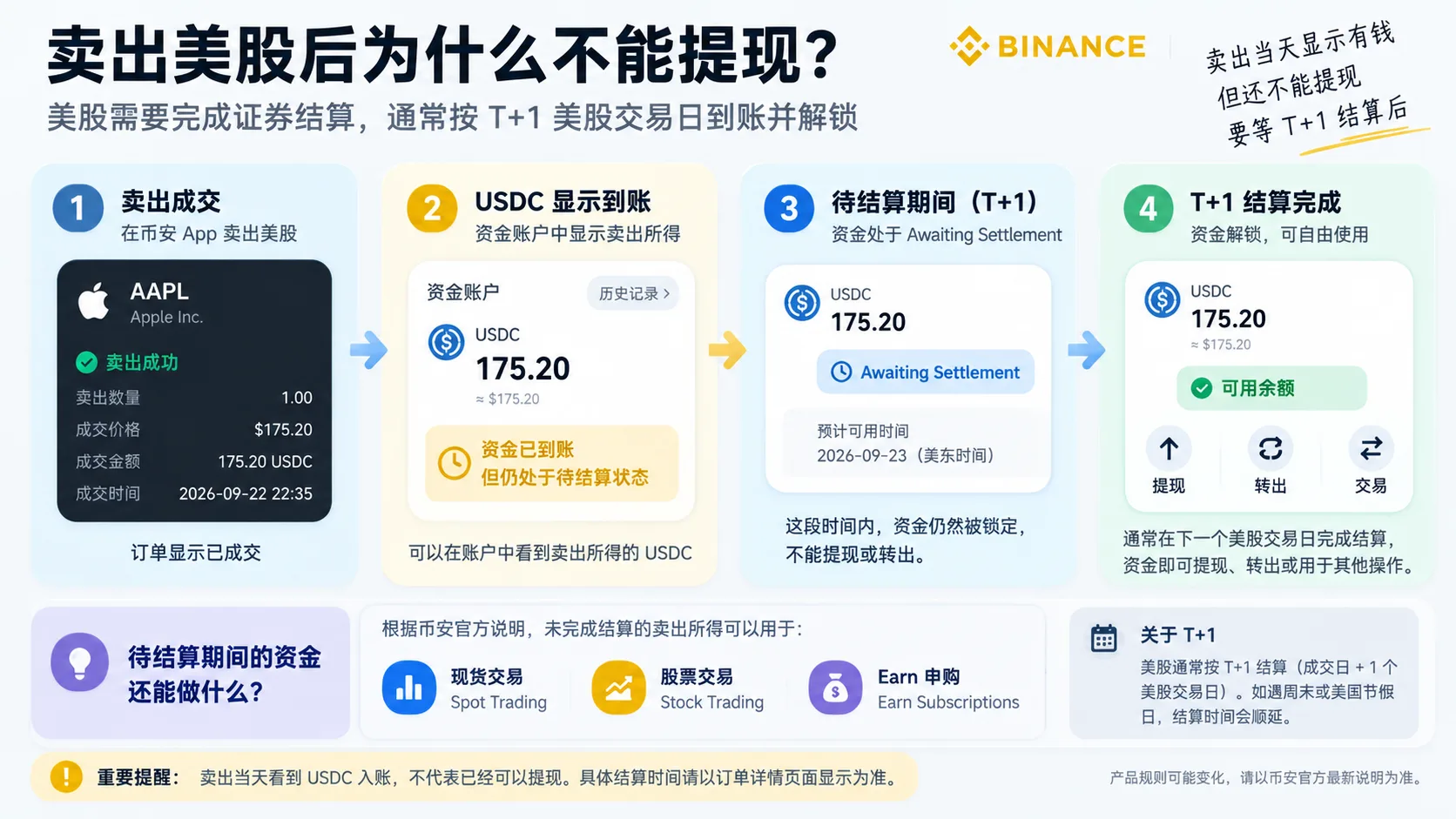
After selling a stock, the USDC may already appear credited but can still be in Awaiting Settlement. Withdrawal and transfer restrictions are usually lifted only after the T+1 settlement on a US trading day.
What can you do with money awaiting settlement?
After selling a stock, the USDC may already show on the assets page.
But before settlement formally completes, it remains:
Awaiting Settlement
Binance currently states clearly that unsettled sale proceeds can be used for:
- Spot Trading
- Stock Trading
- Earn subscriptions
but before full settlement it is not the same as settled cash you can freely transfer or withdraw.
The estimated settlement date can be seen on the order detail page.
So if you sold the stock in order to move the money out, don't stop at "sale successful".
Also confirm:
Whether Settlement has completed.
Where are the shares you bought actually held?
Many people buying US stocks on Binance for the first time assume:
The shares sit in the Binance wallet, just like BTC and USDT.
That's not how it works.
Binance Stock Trading uses a securities brokerage structure.
According to Binance's official disclosure:
Nest Trading Limited acts as introducing broker and sends securities orders to:
Alpaca Securities LLC
Alpaca Securities handles:
- Order execution
- Clearing
- Settlement
- Custody
Binance itself does not directly custody these securities.
The user is the beneficial owner of the shares purchased.
So Direct Stocks and "buying an ordinary crypto token that tracks the TSLA price" are not the same legal or product structure.
Do the stocks pay dividends?
Where applicable, yes.
Binance states clearly that the beneficial owner of the shares can:
- Receive dividends
- Participate in applicable corporate actions
For example:
- Stock splits
- Reverse splits
- Certain corporate actions
- Cash dividends
The exact treatment depends on the security and the corporate-action rules.
Dividends and W-8BEN
For non-US tax residents, US-source dividends usually involve US withholding tax.
The general IRS rule is:
US-source dividends paid to nonresident individuals are generally withheld at 30%; if the conditions of an applicable tax treaty are met, a lower treaty rate can be claimed with a valid W-8BEN.[5]
But don't read this as:
Filling in a W-8BEN always means 10%.
The actual rate depends on:
- Your tax residence status
- Your country or region
- Whether the US has an applicable tax treaty with that jurisdiction
- Whether you meet the treaty-benefit conditions
- Whether your tax form is valid
So the more accurate wording is:
A W-8BEN documents your non-US status and, where eligible, claims the applicable treaty treatment; the exact withholding rate is whatever the broker and the tax documents actually process.
If you plan to hold US stocks long term for dividends, this is worth sorting out before you buy, more so than the trading commission.
There is also a special rule for small positions
Binance Stock Trading currently has no standard:
- Account maintenance fee
- Inactivity fee
- Stock custody fee
But there is a small-position rule.
If a stock:
has a market value below $5
and:
has had no stock trading activity for 120 consecutive days
Binance may send an advance notice.
After the notice, if the rule is met, that small position may be sold to USDC after about 30 days, and a processing fee of about:
$0.01
may be charged.
So if the account holds only a tiny fractional position, it's not wise to ignore account notifications for long periods.
Common mistakes
1. Reading "zero commission" as "zero fees"
The stock trading commission is 0.
But there are also:
- A $0.35 minimum platform fee
- A 0.1% spread
- Asset-conversion costs
- ADR fees
- Taxes
- Other possible regulatory fees
To judge the real cost, look at the order preview, not just the "0 Commission" in the ad.
2. Paying with USDT and assuming the stock settles in USDT
USDT can be used as a payment asset.
But the core settlement asset of Binance Stock Trading is USDC.
When you use assets such as USDT, they are converted automatically first.
So always check the conversion rate.
3. Selling a stock and assuming the USDC can be withdrawn right away
A completed sale and completed securities settlement are not the same thing.
After selling, you may already see the USDC, but it can still be:
Awaiting Settlement
Only after settlement completes can it be treated under the settled-funds rules.
4. Mixing up Binance Stock Trading and bStocks
This is the easiest confusion right now.
Binance Stock Trading is a securities brokerage structure.
bStocks is a tokenized securities product.
The two differ clearly in:
- Custody
- On-chain transfer
- Settlement
- Dividend treatment
- Legal product structure
Don't assume they're the same product just because both show TSLA or AAPL.
5. Reading "24/5" as "market orders fill instantly 24 hours a day"
No.
Only some stocks support 24-hour trading.
And a market order submitted outside Regular Trading Hours generally waits for the regular session before it can execute.
Whether pre-market, post-market or overnight trading is available depends on:
- The stock itself
- The Trading Session
- The Order Type
Look at all three together.
6. Ignoring regional eligibility
Binance Stock Trading is not available to every Binance user worldwide.
Binance keeps stressing:
The product and some features vary by jurisdiction.
If your account shows no entry, check the regional eligibility the platform actually displays rather than trying to work around the restriction.
Is Binance Stock Trading safe?
This question needs to be split into two layers.
Layer one: who custodies the securities?
Binance discloses that its stock securities are executed, cleared, settled and custodied by the partner clearing broker Alpaca Securities LLC, with Nest Trading Limited as introducing broker.
Alpaca Securities is a US-registered securities broker and an SIPC member.[6]
But SIPC is not investment insurance.
It does not compensate you because:
- A stock falls
- You bought the wrong stock
- The market crashes
- You lose money on an investment
So "there is a securities custody system" and "the investment cannot lose money" are two different things.
Layer two: does the investment itself carry risk?
Of course.
Pay particular attention to:
- Individual stock price volatility
- Lower liquidity in pre-market and post-market
- Potentially wider spreads in extended hours
- Specific rules for fractional shares
- Exchange rates and conversion costs
- Tax treatment
- Changes in regional product policy
Don't treat stock trading as simple as a stablecoin transfer just because the entry sits inside the Binance app.
Do I need to open another account to buy US stocks on Binance?
Operationally, an eligible user can go straight into Stock Trading from an existing Binance account, without downloading another app and completing a completely separate front-end account-opening process as with a traditional broker.
But behind the stock trading there is still a securities brokerage account and broker service structure, subject to the relevant securities product terms, account eligibility and identity-verification requirements.
So the more accurate understanding is:
Not having to leave the Binance app to register with a traditional broker does not mean the stock has no brokerage account or securities legal relationship.
FAQ
How do I buy US stocks on Binance?
Open the Binance app and go to:
Trade → Stocks
Search for tickers such as AAPL, NVDA or TSLA, choose the order type and purchase amount, then choose the payment asset in the Funding Account or Spot Account.
Preview the fees and conversion rate and confirm the order.
What is the minimum to buy US stocks on Binance?
Binance currently says the minimum investment for some stocks can be as low as about $5, with fractional shares.
But different stocks have different trading parameters; rely on what the order page shows.
Can I buy US stocks directly with USDT?
Yes, USDT can be used as a payment asset.
But stock trading settles mainly in USDC.
When you use USDT, the system first converts it to USDC at the rate shown on the page, then submits the stock order.
Does buying US stocks on Binance cost a fee?
The stock trading commission is currently 0.
But that doesn't make it completely free.
The main current rules are:
- Orders ≤ $350: minimum platform fee of $0.35
- Orders > $350: minimum fee waived, spread of about 0.1%
Asset conversion, ADR, tax or regulatory costs may also apply.
Why can't I withdraw the money after selling a stock?
Because securities trading requires settlement.
After a sale, the USDC may already appear in the Funding Account, but funds that have not settled are still pending.
Stocks usually use a T+1 settlement cycle; the estimated settlement date is shown on the order detail page.
Can I still use money that is awaiting settlement?
Binance currently states that unsettled stock sale proceeds can be used for:
- Spot trading
- Stock trading
- Earn subscriptions
but not being settled yet is not the same as being free to withdraw or transfer.
Do the stocks I buy on Binance pay dividends?
Eligible stocks do.
Binance Stock Trading users are the beneficial owners of the shares they buy and, where applicable, can receive dividends and participate in corporate actions.
Does Binance support 24-hour stock trading?
Some stocks support up to 24/5.
But not all of them.
And market orders mainly execute within Regular Trading Hours.
Whether pre-market, post-market or overnight trading is supported depends on the specific stock's Trading Session.
Am I buying real shares or a token?
The Binance Stock Trading covered in this article is a securities trading service.
Binance states that the user is the beneficial owner of the shares purchased, custodied through a partner broker structure.
That is not the same product as bStocks tokenized securities.
Is Binance Stock Trading available in my region?
Availability depends on the account's region, identity verification and the platform's real-time eligibility determination.
This article does not provide any way to evade or bypass regional restrictions.
The most reliable check is whether the Binance app shows a Stocks entry after you complete KYC, and whether the securities product terms allow your current account to use it.
Summary in one sentence
You can buy US stocks on Binance today by going directly to "Trade → Stocks" for Binance Stock Trading and placing an order after searching the ticker.
Some stocks can be bought in fractions from about $5, settle mainly in USDC, and can be paid for with supported assets such as USDT, BNB, U and USD1 with automatic conversion.
But remember three key points:
First, 0 commission is not 0 cost: orders up to $350 currently pay a minimum platform fee of $0.35, and orders above $350 pay a spread of about 0.1%.
Second, some stocks support up to 24/5 trading, but market orders still mostly execute during regular US stock market hours.
Third, after a sale the trade still goes through securities settlement, usually T+1 trading day; seeing USDC credited does not mean you can withdraw immediately.
Understanding these three points before placing your first stock order matters more than simply seeing "Binance now offers US stocks".
If you're going to register
| Option | What to do |
|---|---|
| Register through this site's link | Register on Binance; the referral code AMY568 is filled in automatically |
| No referral code | Go directly to binance.com and register |
The registration link above is an affiliate link. If you complete an eligible registration or trade through it, this site may earn a commission, but that does not increase the investment safety of the products described in this article.
Campaign rewards, rebate rates and eligibility can vary by region and campaign rules; rely on what the registration page actually shows.
See Advertising and affiliate disclosure for details.
Next steps
- Buying US stocks with USDT: don't mix up these three products
- How to withdraw from Binance to a wallet: steps, fees and choosing a network
- How to use the Binance referral code: rebate rate and what to check
Data verification note
The key facts in this article were checked on 2026-10-16, one by one:
- Minimum amount and settlement asset: the minimum investment for eligible stocks can be as low as about $5, with fractional shares; stocks settle mainly in USDC, and when you use supported assets such as USDT, BNB, U and USD1, the system converts them to USDC automatically when you place the order. Source: Binance official announcement on the Direct Stocks product.
- Fee rules: stock trading commission is 0; orders of $350 or less pay a minimum platform fee of $0.35, while orders above $350 have the minimum waived and pay a spread of about 0.1%; the order preview is what counts. Source: Binance official fee explanation.
- Brokerage and custody structure: Nest Trading Limited acts as introducing broker and sends securities orders to Alpaca Securities LLC, which handles execution, clearing, settlement and custody; Binance does not directly custody these securities. Source: Binance Academy "What Is Binance Stocks Trading?".
- Settlement cycle after a sale: the standard US stock settlement cycle is usually T+1; proceeds from an unsettled sale sit in Awaiting Settlement and can be used for spot, stock trading and Earn during that period, but cannot be withdrawn or transferred out. Source: Binance official stock trading FAQ.
- Dividend withholding tax: US-source dividends paid to nonresident individuals are generally withheld at 30%; a lower treaty rate may apply only if treaty conditions are met and a valid W-8BEN is filed; the broker and the tax documents process the actual rate. Source: US Internal Revenue Service.
- Custodian broker status: Alpaca Securities is a US-registered securities broker and an SIPC member; SIPC returns eligible securities and cash if the broker fails and does not protect against a stock decline or investment losses. Source: Alpaca official site.
Fees, supported stocks, trading hours, settlement, regional eligibility and tax treatment can all change; this article does not treat any dynamic figure as a permanent rule. Before you actually place an order, rely on the stock page in the Binance app, the order preview and the securities product terms in real time.
Disclaimer
This article only explains the product structure, operating flow, trading fees and settlement mechanism of Binance Stock Trading, and does not constitute investment advice, securities advice, tax advice or legal advice.
Stock and ETF prices can rise or fall and may cause a loss of principal. Pre-market, post-market and overnight trading may also involve lower liquidity, higher volatility and wider bid-ask spreads.
Tax rules depend on each person's tax residence status and applicable law. For W-8BEN, dividend withholding or cross-border tax questions, check the official rules or consult a professional for your situation.
Users should also comply with the laws and regulations of their location and with the product eligibility restrictions Binance applies to their region.
Exchange operations · USDT · Wallet security
Responsible for researching and organizing content on Binance, OKX, USDT transfers, withdrawals and wallet security. The steps and key data in this article are verified according to the content type, using real operation records, official platform documentation and public sources. Interfaces, fees and regional rules may change, so the article is reviewed and updated continuously.
Status: manual review · Last verified 2026-10-16
Reviewed by: Veldux editorial team
- Binance official announcement (launch of the Direct Stocks product)The minimum investment for eligible stocks can be as low as about $5, with fractional shares; stocks settle mainly in USDC, and supported assets such as USDT and BNB are converted to USDC automatically when you place an order
- Binance official fee explanation (stock trading costs)Stock trading commission is 0; orders ≤$350 pay a minimum platform fee of $0.35, while orders >$350 have the minimum waived and pay a spread of about 0.1%
- Binance Academy "What Is Binance Stocks Trading?"Nest Trading Limited acts as introducing broker and sends securities orders to Alpaca Securities LLC, which executes, clears, settles and custodies them; the user is the beneficial owner of the shares purchased
- Binance official FAQ on stock tradingThe standard settlement cycle for US stocks is usually T+1; proceeds from an unsettled sale sit in "Awaiting Settlement" and can be used for spot, stock trading and Earn subscriptions, but cannot be withdrawn or transferred out early
- US Internal Revenue Service (withholding on US-source dividends paid to nonresident aliens)US-source dividends paid to nonresident individuals are generally withheld at 30%; a lower treaty rate applies only if the conditions are met and a valid W-8BEN is on file
- Alpaca official siteAlpaca Securities is a US-registered securities broker and an SIPC member; SIPC only returns eligible securities and cash if the broker fails, and does not protect investment losses
- 2026-10-16UpdateAdded the evidence-chain superscripts and the "Data verification note", and updated the fact-check date.
Editorial principles ineditorial policy,corrections policy。