
IBKR vs Binance: crypto exchange or broker for US stocks? (2026)
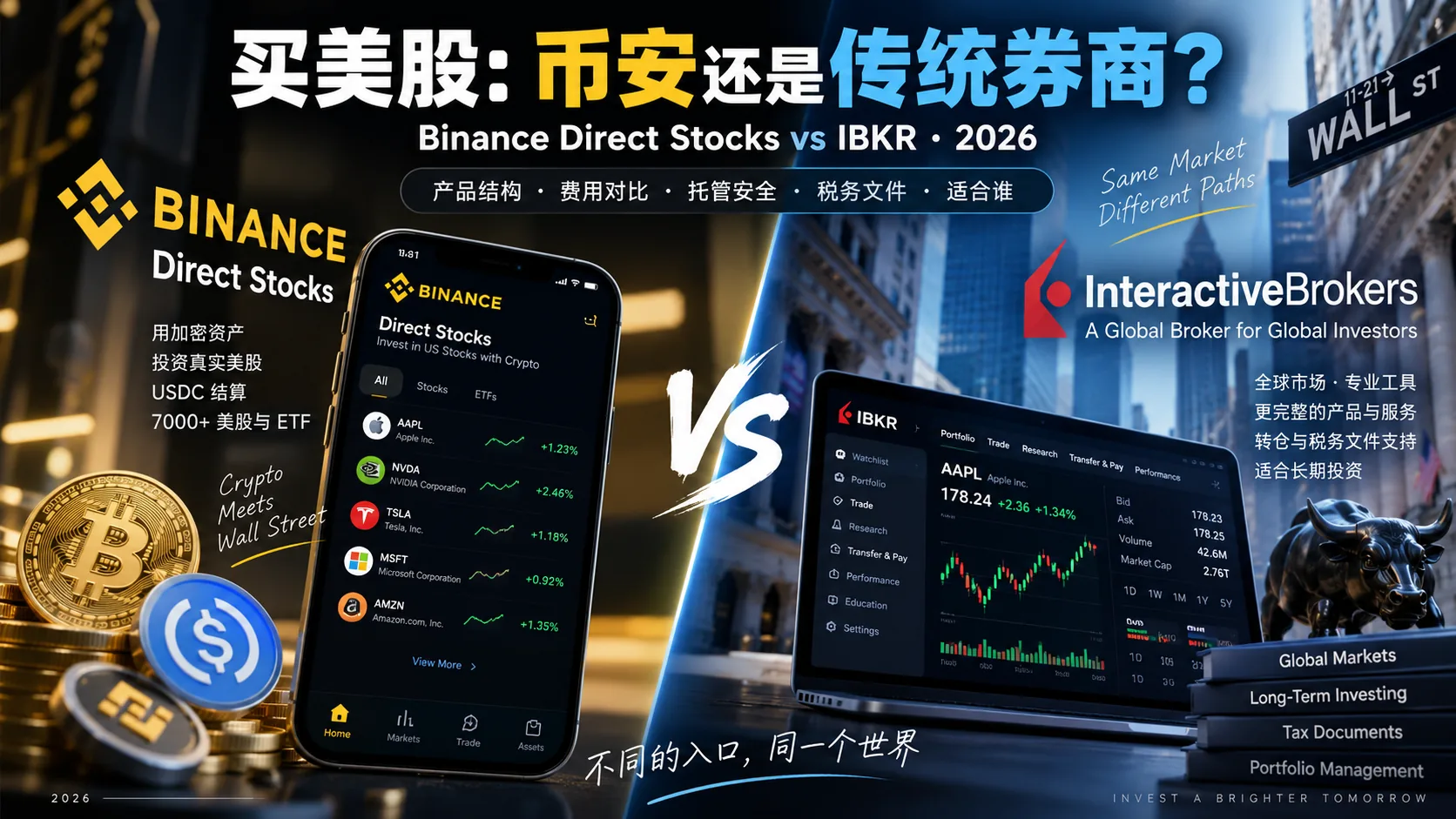
Table of contents

Binance new-user benefit
20% fee rebate
Official Binance sign-up · You must complete identity verification (KYC) to trade and withdraw
Buying US stocks, with a crypto exchange or a traditional broker?
In 2024 this was mainly a comparison of fees and user experience. By 2026, you first have to look at where you are resident, what US dividend tax applies to you, and which account you can actually open.
For international investors, the most important dividing line depends on whether your country has a tax treaty with the US, and on which broker genuinely accepts residents of your country:
- Mexico has a treaty, so US stock dividends can drop from 30% to 10% with a valid W-8BEN.[2]
- Argentina has no treaty, so dividends stay withheld at 30% and a W-8BEN only documents your status, it does not reduce the rate.[3]
- The US default is 30% withholding on US-source dividends for nonresidents; only with a treaty in force and a valid W-8BEN does the lower rate apply.[1]
So what really needs comparing isn't a bare "exchange or broker", it's:
First confirm which accounts you can legally open from your country, then compare fees, custody, tax documents and transferability.
This is a long comparison — budget about 11 minutes to read it end to end; if you only have two, read the table right after the contents. The two traps most readers fall into: assuming "both are SIPC protected" means the same protection, and assuming US dividends are always withheld at 10%.
This article only explains product structure and the current regulatory picture. It is not investment or tax advice, and it does not discuss any way to bypass regional restrictions. Stocks and crypto assets both carry risk.
Table of contents
- Which "traditional broker" you can actually open
- What exactly Binance Direct Stocks is
- Custody and SIPC
- Dividend tax and the W-8BEN
- Binance vs IBKR fees
- Transfers and tax documents
- How to choose according to your situation
- FAQ
First, the conclusion: match your situation
| Your situation | Realistic options | My recommendation |
|---|---|---|
| Resident of a country with a US tax treaty (e.g. Mexico) | Local brokers, international brokers such as IBKR, and the crypto exchange entry; dividends can fall to 10% with a W-8BEN | Compare custody, fees, transfers and tax documents |
| Resident of a country without a US tax treaty (e.g. Argentina) | Local instruments such as CEDEARs, or US/international brokers; dividends stay at 30% | Treat dividend tax as a deciding factor before choosing |
| You already hold USDT and only want a small position | The crypto exchange (Binance Direct Stocks) is faster, but separate real shares from tokenized stocks and perpetuals | Use the real-share section, not the tokenized or futures sections |
| Long-term holding, dividends and a possible future transfer | A traditional broker (IBKR or a local one) usually provides better tax documentation | Check the W-8BEN and your country's tax rules |
The core point: the denominator in this question isn't "which platform has the lowest fee", it's "where are you resident and which account can you legally open".
Why this question changed in 2026
It isn't that brokers became stricter overnight; the map changed on two fronts.
First, crypto exchanges moved directly into stock trading. Binance launched real stock trading (Direct Stocks) in 2026, giving people who already hold crypto a direct door into US stocks without opening a traditional brokerage account. That made the "exchange vs broker" comparison relevant to a new audience.
Second, in most markets the variable that weighs most on real cost has always been the US tax-treaty map, and that did not change in 2026: Mexico has a treaty (dividends at 10%), Argentina does not (30%), and countries such as Chile and Venezuela do. What did change is that you now have a third route — the crypto exchange — sitting alongside local and international brokers.
The practical conclusion isn't "everyone can open everything", it's that the combination of your country of residence and the product you actually want (a real share, not a token) defines your options.
First, clarify: which "traditional broker" can you actually open?
| Broker | Who it is for | What to check in 2026 |
|---|---|---|
| IBKR | Residents of many countries, depending on country-specific requirements | Broad market access, low commissions, complete tax documents |
| Local regulated broker in your country | Residents of the country where it is licensed | Local-currency funding, but sometimes narrower US market access and higher fees |
| International fintech broker | Residents of supported countries only | Check the accepted-country list at registration; some restrict residency |
| Crypto exchange stock entry | Users who already hold crypto in a supported region | Distinguish real shares from tokenized stocks and perpetuals |
One warning is worth stating plainly:
The internet still carries both "tutorials" that promise you can open a US account from anywhere with no requirements and lists claiming "it's no longer possible from your region". Neither extreme is accurate. The way to know whether you can open an account is to see what documents the broker asks for during registration and KYC, and whether it ultimately approves you — not an old guide or a rumor.
What exactly is a crypto exchange's US-stock entry?
If the traditional broker route is complicated by country or documentation, it's worth understanding the crypto exchange's stock entry properly.
Take Binance: its direct stock business (Direct Stocks), launched in 2026, is not "a coin that tracks a stock price" — it is stock trading connected to a real brokerage account system.
Here's the point where many people get confused: inside the Binance app there are three stock-related products — real shares (Direct Stocks), tokenized securities (bStocks) and stock perpetual futures. These have completely different legal natures and must be separated before buying. I explain how to tell them apart in detail in another article; here I focus only on the "real share" line.
The structure behind Binance Direct Stocks is "introducing broker + clearing broker":
| Role | Entity | What it does |
|---|---|---|
| Introducing broker | Nest Trading (ADGM-licensed, Abu Dhabi) | Order referral and front-end compliance |
| Clearing / custody broker | Alpaca Securities | Execution, clearing, settlement, custody, dividends and corporate actions |
In other words:
Execution, clearing, settlement and custody for Binance Direct Stocks are provided by Alpaca Securities LLC, not by Binance's crypto wallet.[4]
This structure is key to understanding the safety section below, so keep it in mind.
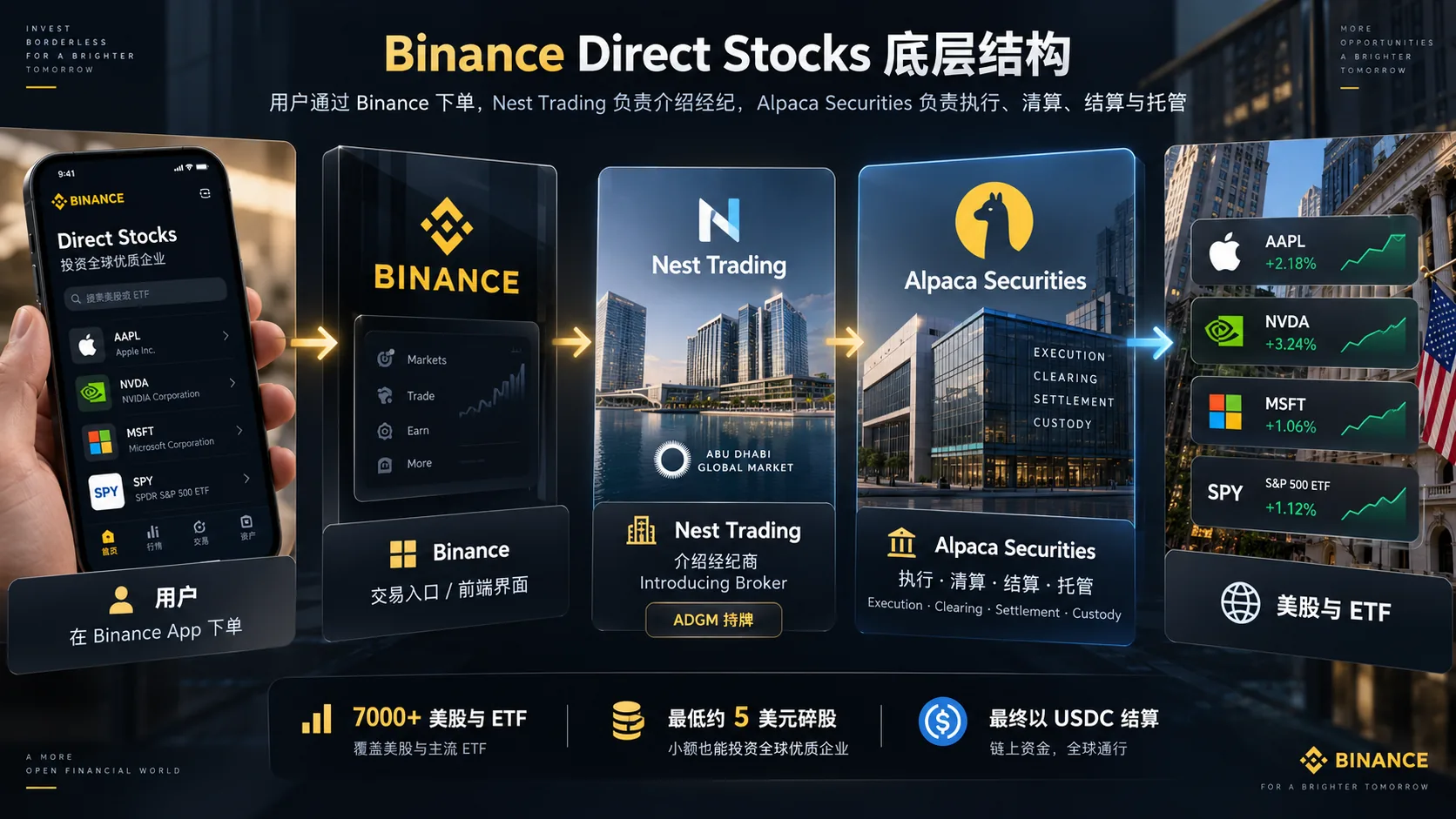
Figure: Binance Direct Stocks does not custody the shares itself; orders are referred through Nest Trading and Alpaca Securities handles execution, clearing, settlement and custody.
On instruments and how trading works, public information says: 7,000+ US stocks and ETFs are supported, with fractional shares from about $5, final settlement in USDC and automatic conversion of supported assets such as USDT or BNB into USDC. Settlement assets, available regions and fees change fast; rely on what your account actually shows.[5]
If you don't have USDT yet, sort out funding first: how to buy USDT on Binance.
Custody and safety: what does SIPC actually protect?
This is the part of the "crypto exchange vs traditional broker" comparison most often waved away with "both have SIPC".
Alpaca is an SEC-registered broker-dealer and a member of FINRA and SIPC (Securities Investor Protection Corporation). The standard SIPC protection limit is:
- Up to $500,000 for securities
- Of which up to $250,000 in cash[6]
On top of that, Alpaca has purchased excess SIPC coverage from Lloyd's of London: after the standard limit is exhausted, each client can receive up to $75 million in additional securities and cash, but there is a $250 million aggregate cap, and again it does not cover market price declines.[7]
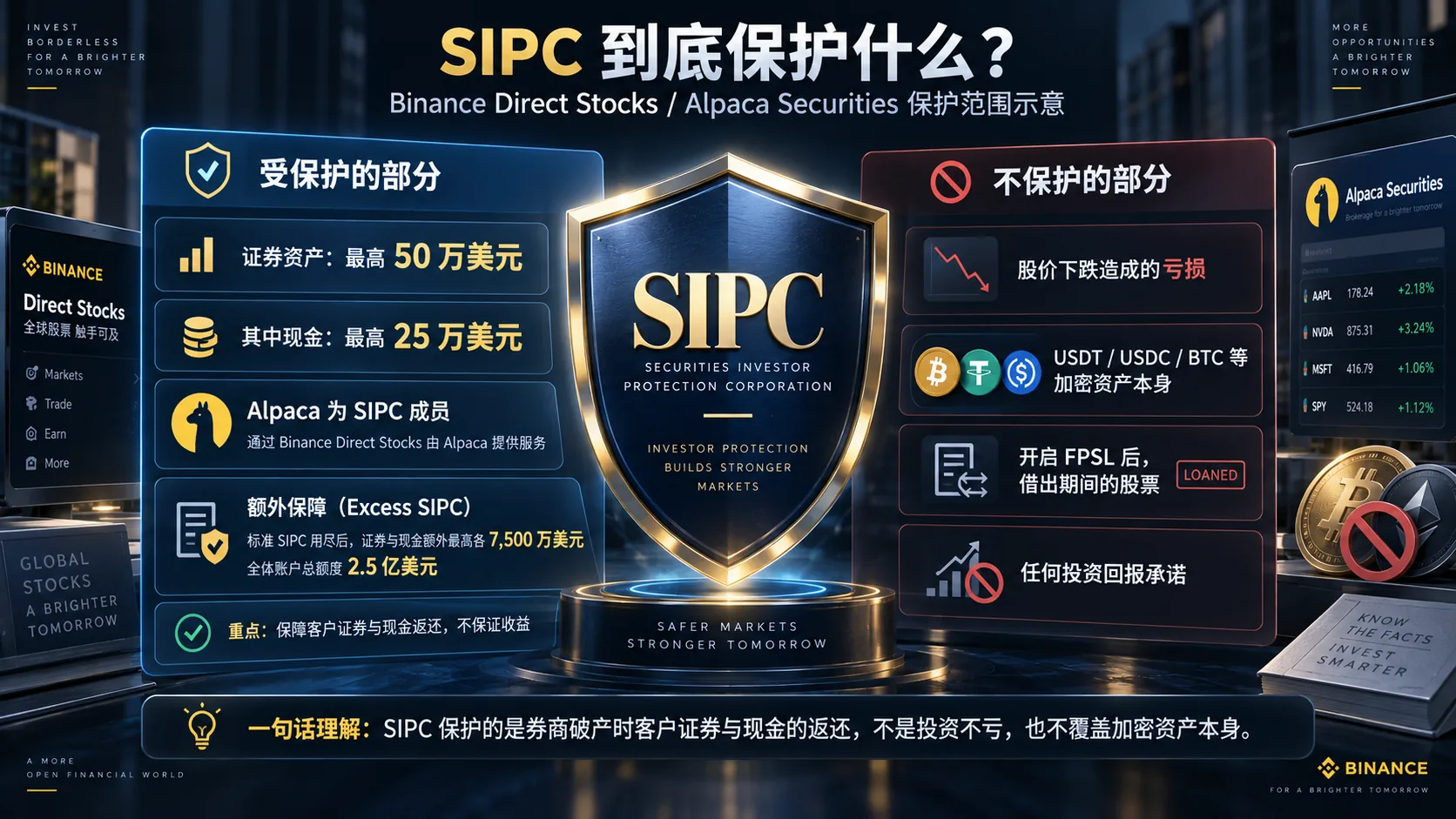
Figure: SIPC mainly returns eligible securities and cash when a broker fails; it does not cover market losses, crypto assets themselves, or shares lent out under FPSL.
But several SIPC boundaries have to be clear:
- It does not cover investment losses. If a stock falls from $100 to $50, SIPC does not pay.
- It covers the return of client securities and cash when the broker fails, not account gains.
- Crypto assets are not within SIPC. The USDT, USDC or BTC in your account are not "securities" protected by SIPC; only stock positions that have entered the securities account system may qualify.
- When you open an account indirectly through a third-party platform, how the protection applies to you depends on the specific securities account agreement — don't conclude from the words "SIPC Member" alone.
A traditional broker's client relationship is usually more direct; Binance Direct Stocks adds a service layer (Binance/Nest) on top of Alpaca. For large, long-term holders, review the securities account agreement, how assets are registered and the bankruptcy-segregation arrangement, rather than comparing only the SIPC logo.
How are dividends taxed: 30% or 10%?
If you buy US stocks for dividends, you can't avoid the withholding the US applies to nonresident aliens.
The default rule is: US-source dividends are withheld at 30% for nonresidents; with a treaty in force and a valid W-8BEN, the lower treaty rate applies, withheld at source by the broker when the dividend is paid.[1]
How it breaks down by country:
- Mexico (treaty): with a valid W-8BEN, withholding drops from 30% to 10% for most individual investors (the 5% rate applies to companies with substantial holdings, not the ordinary investor).[2]
- Argentina (no treaty): dividends stay at 30%; a W-8BEN only documents that you are a nonresident, it does not reduce the rate.[3]
- Other countries: check whether your country has a treaty (Chile and Venezuela, for example, do) and what rate applies to your case.
Key points:
- No valid W-8BEN → 30% withheld; a valid form and an applicable treaty → the treaty rate, withheld by the broker.
- A W-8BEN is generally valid from signature until 31 December of the third following calendar year (for example, signed in September 2026, generally valid until 31 December 2029), unless something occurs that invalidates the information.
- REITs, MLPs and special structures should not automatically assume the reduced treaty rate. Different distribution types may carry additional US withholding and reporting rules; follow the broker's tax documentation and the relevant US tax law.
- Certain US Treasury bond interest may be exempt for nonresidents; distributions from a bond ETF are not the same as holding the bonds directly, and their withholding depends on the tax nature of the distribution.
- Capital gains (buy-sell difference): for nonresidents in the usual sense, capital gains on ordinary US stock trades generally carry no US federal income tax, with exceptions such as the 183-day rule or income effectively connected with a US trade or business.
And on your own side: most countries tax worldwide income and usually allow a foreign tax credit, within limits, for tax already paid — keep the 1042-S the broker issues so you can claim it.
This is where a hidden difference between a "crypto exchange" and a "traditional broker" shows up:
A traditional broker usually gives you more complete tax documents (such as the 1042-S), which you need in order to file and claim credits. Whether the stock account behind a crypto exchange provides equally complete documents depends on your account rules. If long-term dividends and tax treatment matter to you, check this before buying — not after you discover you can't get a tax form.
Fees side by side
"0 commission" is the loudest selling point of crypto exchange stock entries, but it does not mean the cost is zero.
| Item | Binance Direct Stocks | IBKR Pro |
|---|---|---|
| Stock commission | Standard rate: 0 commission; orders ≤ $350 pay a $0.35 platform fee; above $350, a spread of about 0.1% of order value | Tiered starts at about $0.0035/share with a $0.35/order minimum; Fixed is $0.005/share with a $1/order minimum |
| Fractional shares | Supported on some stocks, from about $5 | Supported on eligible stocks |
| Settlement asset | USDC as the main settlement asset | Cash in the brokerage account |
| Other costs | Possible asset conversion and spread | Tiered also carries exchange, regulatory and clearing fees |
Here you have to separate IBKR's two pricing models, because people mix up the parameters:
- Tiered: on the first 300,000 shares, about $0.0035/share with a $0.35/order minimum, plus exchange, regulatory and clearing fees.
- Fixed: $0.005/share with a $1/order minimum.[8]
- IBKR Lite's $0 US stock trades are aimed mainly at US residents.
The Binance numbers above are the "standard rate": the platform may run occasional promotions (lower platform fees or spreads); before executing, check the order preview.[9]
For small, recurring contributions, Binance's "0 commission + $0.35 platform fee" does save money; for larger single orders, or if execution price matters to you, the spread and hidden costs matter more.
It's also worth asking where the money comes from on a "0 commission" platform. Binance's official page discloses that it may receive payment for order flow (PFOF), and public disclosure also shows a PFOF and securities-lending revenue-sharing arrangement between Binance and Alpaca. The point to note: PFOF is an order-execution business model that exists in the US market and has a long-running regulatory discussion around best execution and conflicts of interest — explain the mechanism, but don't rule on whether it is "legal or illegal".[10]
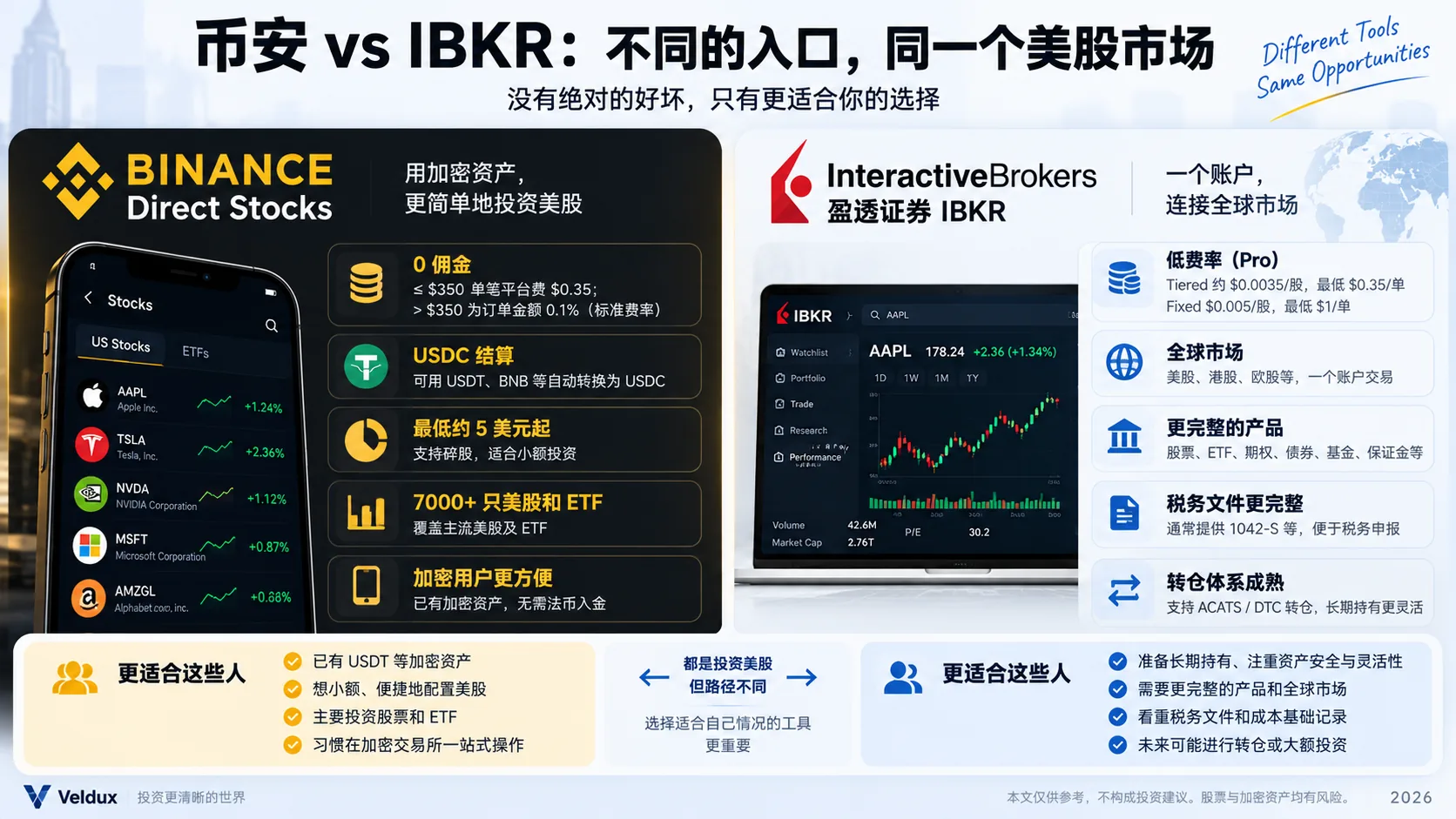
Figure: Binance Direct Stocks is more about giving crypto users easy access to the US market; IBKR offers broader global markets, tax documentation and a more complete transfer system. They fit different scenarios.
Transfers and tax documents: the real dividing line for long-term holding
If you only want to "put a few hundred dollars into some US stocks", the crypto exchange entry is convenient enough.
But if you intend to treat US stocks as a long-term core asset, these two things are decisive:
Transfers. Transfers between traditional brokers are mature; platforms such as Binance also support DTC transfers, but with clear limits — whole shares only, a maximum of 50 tickers per request, fractions cannot be transferred directly by DTC, transfers in take at least 14 business days, and transfers out are processed in batches. Before holding long term, it's worth reading the transfer rules once.[11]
Tax documents. Traditional brokers are usually more complete on dividend tax slips, cost basis and annual reports — the "long-term holding kit". Whether the stock account behind a crypto exchange can provide equally complete documents has to be verified case by case.
These two are the most practical boundary between "put a little in" and "hold seriously".
My decision logic: one table
Combining the dimensions above, you can decide like this:
| Your situation | My recommendation |
|---|---|
| Resident of a treaty country who wants recurring dividends | Use the treaty: a W-8BEN brings withholding down to 10%; compare a local broker (e.g. GBM+/Bursanet in Mexico) with IBKR |
| Resident of a non-treaty country who wants US stock exposure | Accept 30% dividend withholding or use local instruments such as CEDEARs; evaluate an international broker |
| You already hold USDT and only want a one-off position | The crypto exchange's real-share entry is faster; first separate real shares, tokenized stocks and perpetuals |
| Long-term holding, dividends and a possible future transfer | A traditional broker (IBKR or a local one) is usually the better main account |
| You want options, bonds, global markets or a margin account | The traditional broker (IBKR-type) clearly wins |

Figure: there is no single answer to buying US stocks; look first at residence, account type and account status, then compare custody, fees, tax documents, transferability and your objective.
The core principle is still the same:
First confirm which account you can legally open from your country, then talk about fees and experience.
The mistakes most people make
1. Seeing "SIPC" and assuming everything is covered. SIPC does not cover losses or crypto assets, and with an indirect account you have to read the agreement. Don't let "both have SIPC" end the discussion.
2. Confusing tokenized stocks with real shares. On Binance, bStocks and Direct Stocks are two different things: one is a certificate representing beneficial rights, the other is a real holding in a securities account. Both carry a stock name, but they are not the same.
3. Assuming dividends are always withheld at 10%. Without a W-8BEN it's 30%, and not every country has a treaty (Argentina stays at 30%). REITs/MLPs should not assume the reduced rate, and an expired W-8BEN puts you back at 30%.
4. Assuming "0 commission" means zero cost. Spread, asset conversion, regulatory fees and transfer fees are all costs; on small orders the fixed fee weighs more.
5. Enabling securities lending changes the protection structure. Binance's FPSL (Fully Paid Securities Lending) lets you lend positions to institutions for interest, but the official warning is explicit: while the shares are lent they are not SIPC protected, you lose the corresponding voting rights, and dividends may be paid as cash-in-lieu. Long-term holders should understand this before enabling it.[12]
6. Trusting "I can open a US account for you, no requirements" intermediaries. In 2026 that is at best a grey-market promise. To know whether a broker accepts you, look at what it asks for during registration and KYC, and whether it approves you.
FAQ
Can I open an IBKR account from my country?
Generally yes, depending on the country and the requirements, but not every international broker accepts residents of every country equally. The way to find out is to register a profile and see what documents it asks for and whether it approves you; don't rely on old tutorials.
How much is withheld from dividends?
It depends on your country. The US rule is 30% for nonresidents. With a treaty and a valid W-8BEN it drops: Mexico goes to 10%. Without a treaty (Argentina), it stays at 30% and the W-8BEN only documents your status.
Are the stocks on a crypto exchange real shares?
It depends on the product. Binance Direct Stocks is real shares inside the Alpaca broker system; bStocks are tokenized securities; stock perpetuals are derivatives. Don't mix them.
Are shares bought on Binance covered by SIPC?
Execution, clearing and custody are handled by Alpaca Securities LLC, which is an SIPC member and also provides excess SIPC. But crypto assets are not within SIPC, how it applies to an indirect account depends on the agreement, and shares lent under FPSL are not protected while lent.
Is the dividend always withheld at 10%?
No. The default is 30%. With a treaty and a valid W-8BEN it can fall (Mexico 10%), but REITs/MLPs and special structures should not assume the reduced rate, and an expired W-8BEN returns you to 30%.
Can I transfer shares out of a crypto exchange?
Some platforms support DTC transfers, but with limits: whole shares only, a maximum of 50 tickers per request, fractions are not transferred by DTC, and transfers in take at least 14 business days. Read the rules before holding long term.
Does the W-8BEN expire?
Yes. It is generally valid from signature until 31 December of the third following calendar year; if it expires or becomes invalid, withholding returns to 30%. Keep it current if you receive dividends.
The final decision
If you already hold USDT and only want a one-off position:
First separate real shares, tokenized stocks and perpetuals, then go into the real-share section.
If you plan to hold long term, collect dividends and possibly transfer later:
A traditional broker (IBKR or a local one) is usually the better main account.
If dividend tax weighs heavily on you (for example, Argentina with no treaty):
Check your country's treaty status and local alternatives (such as CEDEARs) before deciding.
The real answer is never "exchange or broker", it's:
First work out where you are resident and which account you can legally open, then talk about everything else.
If you're going to register
| Your choice | What to do |
|---|---|
| Register through this site's link (20% rebate) | Register on Binance; the referral code AMY568 is filled in automatically |
| No referral code | Go directly to binance.com and register; same features, just without the rebate |
The first row of the table is an affiliate link: registering through it may generate revenue for us, but it does not affect the objective conclusions of this article. See Advertising and affiliate disclosure.
Related reading
Still deciding between Binance and OKX? Start here:
Binance vs OKX: which is better in 2026? A beginner's comparison
Want to understand the difference between a real share and a tokenized bStock? See:
Binance Direct Stocks vs bStocks: real shares or tokenized stocks?
Already decided to buy and want the step-by-step? See:
How to buy US stocks on Binance: a complete guide (2026)
Data verification note
The key facts in this article were checked on 2026-10-16, one by one:
- Default withholding rule: US-source dividends are withheld at 30% for nonresidents; with a treaty in force and a valid W-8BEN the lower treaty rate applies. Source: IRS.
- Mexico (treaty): for residents of Mexico, a W-8BEN reduces dividend withholding from 30% to 10% under article 10 of the US–Mexico treaty. Source: GBM.
- Argentina (no treaty): Argentina has no income tax treaty in force with the US, so US-source dividends stay withheld at 30%. Source: IRS treaty tables.
- Direct Stocks structure: Nest Trading Limited (an ADGM-licensed introducing broker) refers the order, and Alpaca Securities LLC executes, clears, settles and custodies; Binance does not custody these securities. Source: Binance official announcement.
- Direct Stocks instruments and settlement: supports 7,000+ US stocks and ETFs, fractional shares from about $5, USDC settlement and automatic conversion of USDT/BNB to USDC. Source: Binance Academy.
- Standard SIPC limit: Alpaca is an SEC-registered broker-dealer and a FINRA and SIPC member; the standard limit is $500,000 for securities ($250,000 of it cash) and it does not cover price declines. Source: Alpaca.
- Excess SIPC coverage: once the standard limit is exhausted, each client can receive up to $75 million of additional securities and cash, subject to a $250 million aggregate cap. Source: Alpaca official blog.
- IBKR commissions: Tiered charges about $0.0035/share with a $0.35/order minimum on the first 300,000 shares; Fixed charges $0.005/share with a $1/order minimum; IBKR Lite's $0 stock trades are for US residents. Source: IBKR pricing page.
- Binance Direct Stocks fees: standard stock rate 0 commission; orders ≤ $350 pay a $0.35 platform fee; above $350 a spread of about 0.1% of order value applies. Source: Binance official fee explainer.
- PFOF disclosure: Binance discloses that it may receive payment for order flow (PFOF); it is an execution model with an ongoing regulatory discussion around best execution. Source: Binance official announcement.
- DTC transfer rules: whole shares only, a maximum of 50 tickers per request, fractions are not transferred by DTC, transfers in take at least 14 business days and transfers out are processed in batches. Source: Binance FAQ.
- FPSL lending risks: while shares are lent under FPSL they are not SIPC protected, voting rights are lost, and dividends may be paid as cash-in-lieu. Source: Binance FAQ.
Account eligibility, the number of instruments, regional policies, fees, transfers and tax treatment all change; this article does not treat these dynamic data points as permanent rules. Before deciding, rely on what the broker and platform show during registration, KYC and in the account agreement.
Disclaimer
This article only explains product structure and the current regulatory picture so that crypto users can understand buying US stocks; it is not investment, legal or tax advice.
Stocks, ETFs, crypto assets and derivatives all carry risk. Cross-border account opening and trading are subject to the regulations of your country of residence; comply with local laws and do not use any method to evade them.
The availability of different securities products and broker services depends on your country of residence and account eligibility; rely on the actual review and agreement.
Exchange operations · USDT · Wallet security
Responsible for researching and organizing content on Binance, OKX, USDT transfers, withdrawals and wallet security. The steps and key data in this article are verified according to the content type, using real operation records, official platform documentation and public sources. Interfaces, fees and regional rules may change, so the article is reviewed and updated continuously.
Status: manual review · Last verified 2026-10-16
Reviewed by: Veldux editorial team
- IRS (withholding on US-source income paid to nonresident aliens)US-source dividends are withheld at 30% by default for nonresident aliens; with a valid treaty and a valid W-8BEN the lower treaty rate applies
- GBM (Mexican broker) — dividend taxes in Trading USAFor residents of Mexico, a W-8BEN reduces dividend withholding from 30% to 10% under article 10 of the US–Mexico treaty
- IRS — United States income tax treaties A to ZArgentina has no income tax treaty in force with the US, so US-source dividends stay at 30% with no treaty reduction
- Binance official announcement (launch of Direct Stocks)Direct Stocks uses an "introducing broker Nest Trading Limited + clearing broker Alpaca Securities" structure; execution, clearing, settlement and custody are handled by Alpaca, not by the Binance wallet
- Binance Academy — What Is Binance Stocks Trading?Supports 7,000+ US stocks and ETFs, fractional shares from about $5, USDC settlement, and automatic conversion of supported assets such as USDT or BNB into USDC
- Alpaca — SIPC protection explainerAlpaca is an SEC-registered broker-dealer and a FINRA and SIPC member; the standard limit is $500,000 for securities (of which $250,000 is cash) and it does not cover market price declines
- Alpaca official blog (excess SIPC coverage expansion)Once the standard SIPC limit is exhausted, each client can receive up to $75 million of additional securities and cash coverage, subject to a $250 million aggregate cap
- IBKR pricing page (stock commissions)IBKR Pro Tiered charges about $0.0035/share with a $0.35/order minimum on the first 300,000 shares; Fixed charges $0.005/share with a $1/order minimum; IBKR Lite's $0 stock trades are aimed at US residents
- Binance official fee explainer (Direct Stocks costs)Standard stock trading fee is 0 commission; orders of $350 or less pay a $0.35 minimum platform fee; above $350 the minimum is removed and a spread of about 0.1% of the order value is charged
- Binance official announcement (payment for order flow disclosure)The official page discloses that Binance may receive payment for order flow (PFOF) compensation on stock orders
- Binance FAQ (stock DTC transfer rules)Transfers are limited to whole shares, a maximum of 50 tickers per request, fractions cannot be transferred directly by DTC, transfers in take at least 14 business days, and transfers out are processed in batches
- Binance FAQ (FPSL securities lending)While shares are lent under FPSL they are not SIPC protected, the corresponding voting rights are lost, and dividends may be paid as cash-in-lieu
- 2026-10-16UpdateAdded the inline evidence superscripts and the "Data verification note", and updated the fact-check date.
Editorial principles ineditorial policy,corrections policy。