
Binance vs OKX fees in 2026: spot, futures and the real cost

Table of contents

Binance new-user benefit
20% fee rebate
Official Binance sign-up · You must complete identity verification (KYC) to trade and withdraw
OKX new-user benefit
20% fee rebate
Official OKX sign-up · You must complete identity verification (KYC) to trade and withdraw
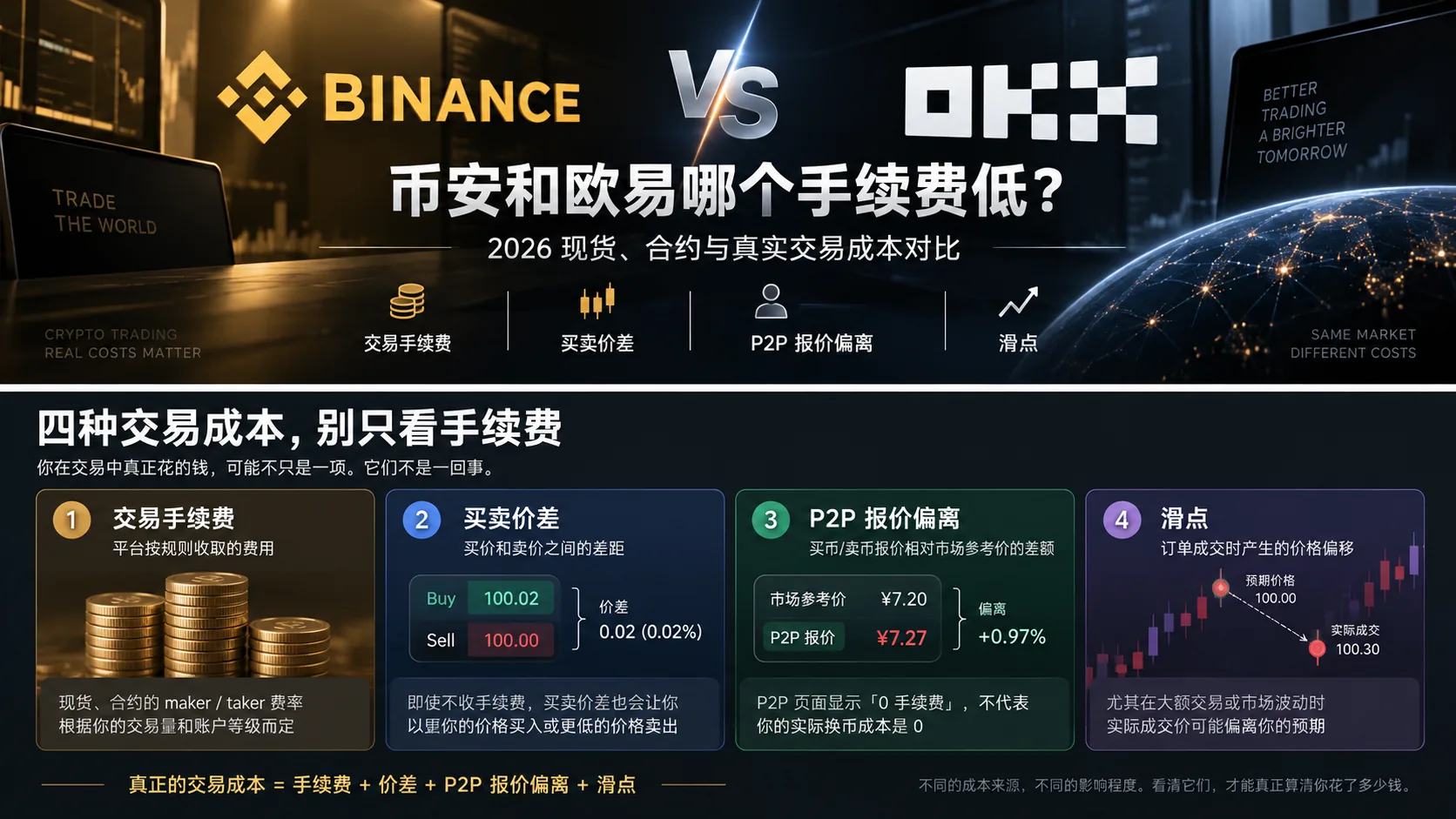
When comparing the fees of Binance and OKX, most people stare only at base-rate differences like 0.01%–0.02%. But what really decides how much extra you pay at the end is four kinds of money: the fee the platform explicitly charges, the bid-ask spread, the deviation of a P2P quote from the market reference price, and the slippage when an order fills. They are not the same thing. This article separates and calculates those four, and puts the two most easily overlooked ones (spread and slippage) on the table.
Note: this article shares experience about fees and fee mechanisms and is not investment advice. Crypto trading carries risk; act with caution.
Key information
Don't fixate on a base-rate difference of 0.01%–0.02%; that is often not where most of the cost is. The base spot/futures rates of the two leading exchanges differ only slightly, but for an ordinary user the easily ignored items that can widen real cost are P2P quote deviation, the bid-ask spread and slippage.
| Situation | Current base-rate comparison | What to watch more |
|---|---|---|
| No BNB, spot maker | OKX 0.08% vs Binance 0.10% | Actual execution price, spread |
| Binance with BNB, spot maker | Binance about 0.075% vs OKX 0.08% | The gap is only 0.005 percentage points |
| Binance with BNB, spot taker | Binance about 0.075% vs OKX 0.10% | Depth, slippage |
| Futures | The base taker rate differs slightly | Funding rate, depth, margin rules |
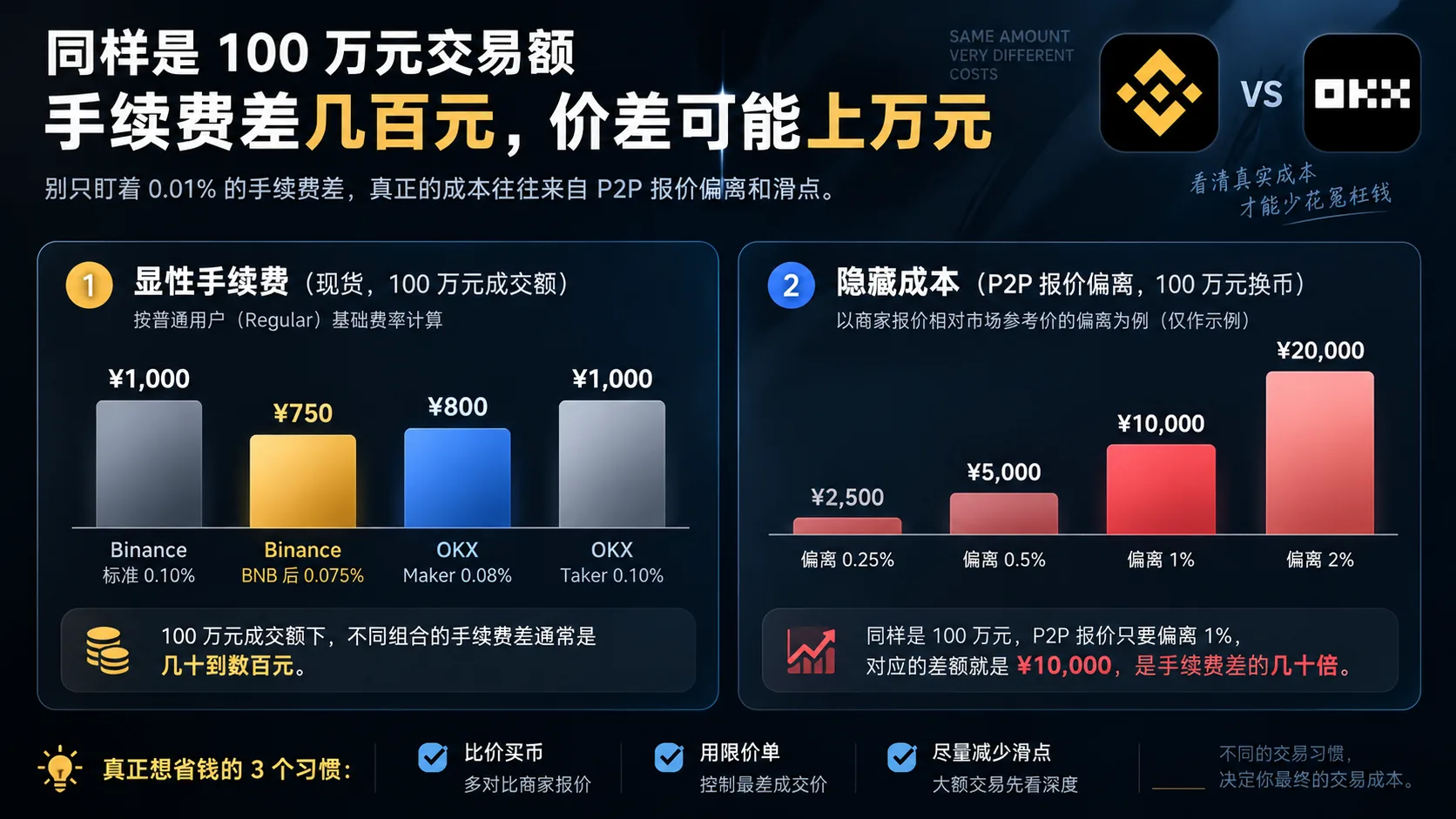
In one sentence: at the Regular spot rates listed here, the fee difference between combinations on $1,000,000 of volume is usually tens to a few hundred dollars, while hidden costs such as P2P quote deviation and slippage are often an order of magnitude larger. Below I work it out with two tables.
Who needs this / who doesn't
| Your situation | Recommendation |
|---|---|
| You trade frequently or in large size and fees are a real cost | Yes; focus on the two tables in "Putting a number on it" |
| You just registered and are buying for the first time | No need to overthink it; read the buying tutorial and get the first purchase right |
| You already use one and want to switch platforms over fees | Probably not; read "Three mistakes" before deciding |
| You trade futures and care about every basis point | Yes; focus on the "futures" section |
Table of contents
- First, lay out the rates: spot, futures, deposits and withdrawals in one table
- First, a clarification: these claims circulating online are out of date
- Fees vs hidden costs: putting a number on it
- Don't confuse the BNB payment discount with the referral benefit
- VIP tiers: only meaningful at high volume
- My decision logic: where to start saving
- Three places where it's easiest to miscalculate cost
- Security risks
- FAQ
First, lay out the rates: spot, futures, deposits and withdrawals in one table
Based on the base Regular-user rates both platforms published as of September 2026, merged into one table:[1]
| Stage | Binance | OKX | Current comparison |
|---|---|---|---|
| Spot maker (limit order) | 0.10% (about 0.075% with BNB) | 0.08% | Without BNB: OKX; with BNB: Binance slightly lower |
| Spot taker (market order) | 0.10% (about 0.075% with BNB) | 0.10% | With BNB, Binance slightly lower |
| Futures maker | 0.02% | 0.02% | Tie |
| Futures taker | 0.05% | 0.05% | Tie |
| Deposit | The platform usually charges no on-chain deposit fee | The platform usually charges no on-chain deposit fee | Watch the sender's network fee |
| Withdrawal | Shows a fee by asset and network | Shows a fee by asset and network | Compare the actual displayed amount before ordering |
Two clarifications: Binance's BNB payment discount is currently calculated at 25%, and both spot maker and taker can drop from 0.10% to about 0.075%, not just one side; internal transfers are usually free. A withdrawal fee is not a fixed "on-chain gas" cost — centralised exchanges usually set withdrawal fees per coin and network, and the amount can change with network conditions and platform policy. So to compare the two platforms' withdrawal fees, pick the same asset and the same network, and use the amount shown live on the order page. Fee numbers change with platform policy; the official fee page is authoritative.
First, a clarification: these claims circulating online are out of date
Claim 1: "holding OKB discounts your fees" — no longer applies
OKX's latest fee-rules FAQ states clearly: there is currently no "hold OKB to discount trading fees" feature; OKB is treated under the standard fee rules for an ordinary asset. The widely circulated "0.064% after the OKB discount" is old content; stop using it as a basis for choosing a platform.[2]
Claim 2: "the BNB discount mainly lowers taker fees" — not accurate
Binance's Regular spot base is maker/taker 0.10% each; once you qualify and enable BNB fee payment, both drop by 25% to about 0.075%, not just taker.
Claim 3: don't take advertised "high rebates" at face value
Two concepts need separating: the commission percentage the referrer earns and the fee benefit the invitee actually gets are not the same thing.
As the invitee, what you actually need to look at is the benefit percentage shown on the registration page and in your account. A "maximum rebate" in third-party advertising may correspond to a different campaign, channel or referrer rule, and cannot be read directly as the fee discount you will end up with.
Fees vs hidden costs: putting a number on it
First, the explicit fee. Using the current base spot rates for a regular user, here are three volume tiers converted into actual amounts:
| Spot volume | Binance standard 0.10% | Binance with BNB 0.075% | OKX maker 0.08% | OKX taker 0.10% |
|---|---|---|---|---|
| $10,000 | $10 | $7.50 | $8 | $10 |
| $100,000 | $100 | $75 | $80 | $100 |
| $1,000,000 | $1,000 | $750 | $800 | $1,000 |
Now the hidden cost. A P2P page showing "0 fees" does not mean your actual cost of exchanging currency is zero — what you really need to compare is the difference between the merchant's quote and the USDT/fiat reference price at that same moment. That difference is not a fixed platform charge, and there is no long-term fixed "1% standard"; it changes with the fiat currency, payment method, buy/sell direction, order size, region and time.[3] The table below is a mathematical illustration only, assuming a P2P quote deviates from the reference by several different levels:
| Amount exchanged | 0.25% deviation | 0.5% deviation | 1% deviation | 2% deviation |
|---|---|---|---|---|
| $10,000 | $25 | $50 | $100 | $200 |
| $100,000 | $250 | $500 | $1,000 | $2,000 |
| $1,000,000 | $2,500 | $5,000 | $10,000 | $20,000 |
Look at the two tables together and it's clear: at the Regular spot rates listed here, on $1,000,000 of volume the fee difference between combinations is usually tens to a few hundred dollars; but if the exchange quote deviates 1% from the reference, the difference is $10,000. That is why "who charges 0.01% less" is not the key to saving money.
Don't confuse the BNB payment discount with the referral benefit
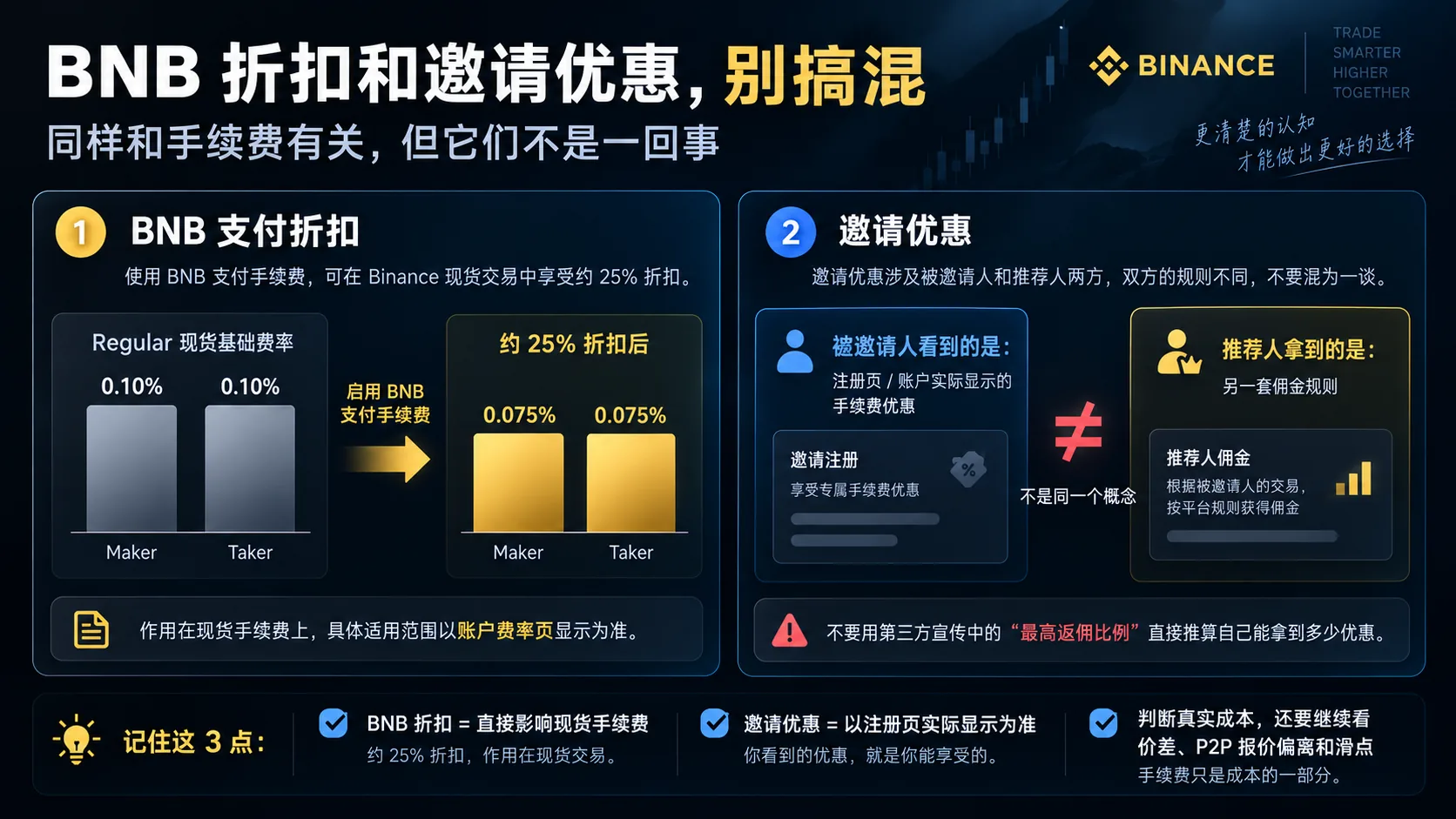
BNB payment discount: Binance's Regular spot base is maker/taker 0.10% each; once you qualify and enable "pay fees with BNB", both drop by 25% to about 0.075%. The scope and exact percentage of the discount follow what your account's fee page shows.
Referral benefit: when you register through an invitation link, the invitee gets a fee-related benefit, but that percentage ≠ the commission the referrer earns. How much you actually get follows what the registration page shows in real time.
These are two different mechanisms; whether you can enjoy both and what each percentage is should not be inferred from third-party advertising numbers. To estimate fees and rebates yourself, you can use the site's fee calculator and rebate calculator.
VIP tiers: only meaningful at high volume
Both platforms have VIP systems tiered by 30-day volume and holdings, unlocking lower rates at higher volume; at some of OKX's higher VIP tiers, some spot maker rates can even go negative. But beginners usually can't reach them, so I won't expand here. Until your volume gets there, the savings lever is in the "hidden costs" of the previous section, not in VIP. For the exact tiers, see the official fee pages of Binance and OKX.
My decision logic: where to start saving
| Your situation | Recommendation | Reason |
|---|---|---|
| Mostly limit orders, no BNB discount | OKX | Maker 0.08% is below Binance's standard 0.10% |
| You qualify for and enable BNB payment | Binance | Maker/taker both about 0.075%, slightly below OKX's 0.08%/0.10% |
| Mostly futures | Don't just look at the 0.01% taker gap | Also compare funding rates, order-book depth, contract types and margin rules |
| You genuinely want to save money | Separate the four kinds of money first | Hidden costs are usually larger than the fee gap |
| A small-amount beginner | Don't overthink it; open an account and make the first purchase | The difference is negligible |
The bottom line: the right way to save is not "pick the exchange with the lower rate", but to see first whether the extra money you pay is going to fees, spread or slippage. Either platform is fine; miscalculating the cost is what's expensive.
Three places where it's easiest to miscalculate cost
Mistake 1: comparing only the fee and not the actual execution price
Platform A charging 0.01% less does not mean the coins you buy there are definitely cheaper. The deposit quote, bid-ask spread and execution depth can all outweigh that fee advantage. Judge cost by the final execution price, not just the fee column.
Mistake 2: reading "0 fees" as "no cost"
A P2P or express-buy screen showing "0 fees" does not mean there is no spread in the quote. Judge the real cost by the final execution price, not just the "fee" column.
Mistake 3: assuming a limit order is always a maker
A limit order is only a maker when it enters the order book and waits for someone to take it; if you place a limit order that immediately matches an existing order, it is still a taker. For large trades, check order-book depth and the bid-ask spread first; a limit order lets you cap the worst price you'll accept, but it does not guarantee maker status or a fill.
Security risks
- Stick to the official sites: for fees, downloads and login, use only Binance's binance.com and OKX's okx.com. Don't click "installer" or "internal channel" links sent via private chat, SMS or unknown sites.
- Don't believe "high rebates" or "internal rates": percentages far outside the normal range often come bundled with other conditions or are simply scams. Fees don't affect the safety of your funds, but account security matters more.
- Rates follow what the official site displays in real time: third-party advertising numbers are only a reference; before ordering, use what the official fee page and registration page show.
FAQ
Q1: Which charges lower fees, Binance or OKX?
The difference is limited and depends on whether you use the BNB discount: without BNB, OKX is lower on spot limit orders (0.08% vs Binance's 0.10%); with BNB payment enabled, Binance's maker/taker both sit at about 0.075%, actually a bit below OKX's 0.08%/0.10%. On futures taker they tie (0.05% vs 0.05%). But what really decides how much extra you pay is P2P quote deviation and slippage, not that 0.01%.
Q2: How much is the fee on buying $10,000 of spot?
At base rates: Binance's standard taker 0.10% is $10, about $7.50 with BNB; OKX maker $8, taker $10. By comparison, on the same amount a P2P quote deviating just 1% is $100; the fee difference is negligible.
Q3: Does holding OKB discount fees?
According to OKX's latest fee rules, there is currently no "hold OKB to discount fees" feature; OKB is treated under ordinary asset standard rates. The "0.064% after the OKB discount" circulating online is an outdated claim.
Q4: Does the BNB discount only lower taker fees?
No. On Binance spot, once BNB fee payment is enabled, both maker and taker drop 25% from 0.10% to about 0.075%.
Q5: How much does a referral code actually rebate?
After registering through an invitation link, the fee-benefit percentage the invitee actually receives follows what the registration page and account show. The referrer's commission rules and the invitee's benefit are not the same concept; don't use a third-party "maximum rebate" figure to judge how much you'll get.
Q6: Is it worth switching platforms for fees?
Probably not. At the Regular spot rates listed here, on $1,000,000 of volume the fee difference between combinations is usually tens to a few hundred dollars, while switching means redoing KYC, reconfiguring security and relearning the account structure. Working out where your extra cost actually goes saves more than switching.
In one sentence
The base spot/futures rates of Binance and OKX differ only slightly; agonizing over that 0.01% is pointless. What really decides how much extra you pay is the deviation of P2P quotes from the reference price, and execution slippage. Saving starts with separating the four kinds of money — don't stare at the fee column; look at the final execution price.
If you're about to register
| Your choice | What to do |
|---|---|
| Register on Binance through this site (with a fee benefit) | Register on Binance; the code AMY568 fills in automatically |
| Register on OKX through this site (with a fee benefit) | Register on OKX; the code AMY568 fills in automatically |
The two rows above are affiliate links: registering through them may generate revenue for us, but it doesn't affect this article's objective conclusions. More in advertising and affiliate disclosure.
Next steps
- Binance vs OKX: which is better? A hands-on 2026 beginner comparison — fees are only one of nine dimensions; for the overall choice, read this
- Buy USDT on Binance or OKX? A hands-on 2026 P2P buying comparison — the "P2P quote deviation" discussed here happens at the buying step
- How to use the Binance referral code: rebate percentage and what to check — how referral benefits and rebates are calculated
- How to register on Binance: account opening and KYC step by step (2026) — if you've decided on Binance, start with this
- How to register on OKX: account opening and identity verification (2026) — if you've decided on OKX, start with this
Data verification note
The key facts in this article were checked on 2026-10-16, one by one:
- Binance spot rates and the BNB discount: for a regular user, spot maker/taker is 0.10% each; once you qualify and enable "pay fees with BNB", it drops by up to 25% to about 0.075%, applying to both maker and taker, not just one side. Source: Binance spot trading fees.
- OKX spot rates and the OKB discount: OKX mainstream spot Regular is maker 0.08% / taker 0.10%; according to OKX's latest fee-rules FAQ, there is currently no "hold OKB to discount trading fees" feature, and OKB is treated under ordinary asset standard rates. Source: OKX official fee rules FAQ.
- P2P quote deviation: a P2P buy page showing "0 fees" does not mean there is no cost; the real difference is between the merchant quote and the USDT/fiat reference price at that moment, and it is neither a fixed platform charge nor a long-term fixed standard. Source: Binance P2P fee information.
Disclaimer
This article only shares experience and explains exchange fee and rebate mechanisms. It does not constitute investment advice, financial advice or a trading recommendation.
Crypto asset prices are highly volatile, and trading carries platform, market, cybersecurity and operational risk. Fee and rebate rules can change with platform policy; always use the latest official rules. Users should judge carefully according to their own risk tolerance and comply with the laws of their jurisdiction. People under 18 should not trade crypto.
Exchange operations · USDT · Wallet security
Responsible for researching and organizing content on Binance, OKX, USDT transfers, withdrawals and wallet security. The steps and key data in this article are verified according to the content type, using real operation records, official platform documentation and public sources. Interfaces, fees and regional rules may change, so the article is reviewed and updated continuously.
Status: manual review · Last verified 2026-10-16
Reviewed by: Veldux editorial team
- Binance spot trading feesFor a regular user, spot maker/taker is 0.10% each; enabling BNB fee payment lowers it to about 0.075% with up to 25% off, applying to both maker and taker
- OKX official fee rules FAQOKX mainstream spot Regular is maker 0.08% / taker 0.10%, and there is currently no "hold OKB to discount trading fees" feature
- Binance P2P fee informationThe P2P buy page can show 0 fees; the real cost is the difference between the merchant quote and the USDT/fiat reference price, not a fixed platform charge
- 2026-10-16UpdateAdded the evidence-chain superscripts and the "Data verification note", and updated the fact-check date for key facts.
Editorial principles ineditorial policy,corrections policy。