Is OKX safe in 2026? Licenses, proof of reserves and real risks
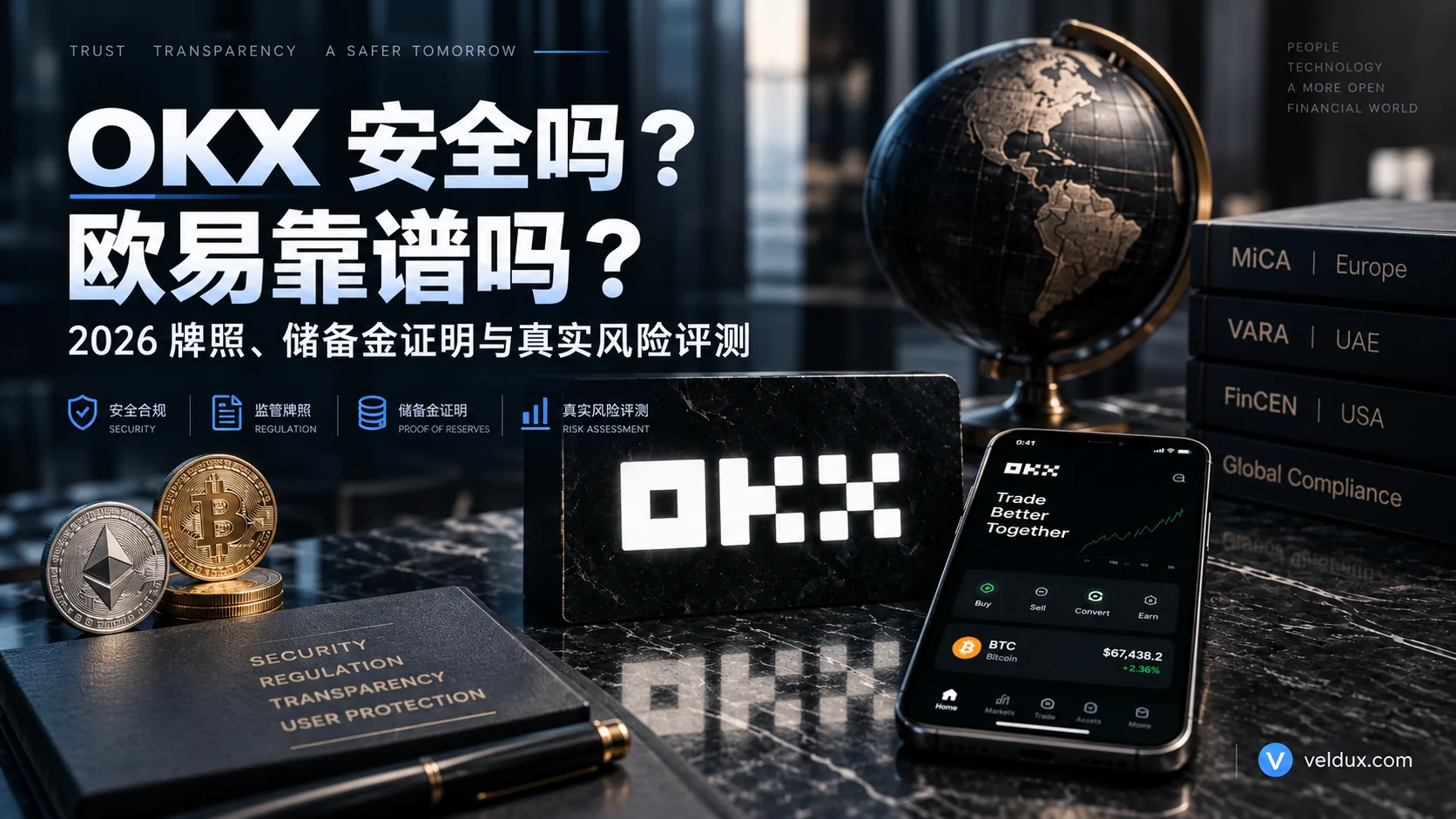
Table of contents
OKX new-user benefit
20% fee rebate
Official OKX sign-up · You must complete identity verification (KYC) to trade and withdraw
Is OKX reliable? Let's be clear first: it is a legitimate top-tier exchange, not a scam; its technical security is solid, but it carries compliance baggage, and the entity most users sign with has no government backstop. So the word "safe" has to be taken apart — here's the breakdown.
Note: this article is an objective review of exchange security. It is not investment advice, and it is not a promise that "your money is definitely fine if you leave it here". Crypto trading carries risk, and every centralised exchange carries custody risk.
First, the questions people ask most; details below:
| Question | Answer |
|---|---|
| Is OKX a scam? | No. A top-tier exchange, but with past compliance controversies (see below) |
| Is it safe to leave funds there? | Technically solid (no disclosed core-wallet breach + proof of reserves), but no deposit insurance backstop |
| Does it have licenses? | Yes, an EU MiCA license and a Dubai VARA license; but most international users are on the Seychelles entity |
| Can it be hacked? | No publicly disclosed major incident in custodied assets; the real danger is you getting phished |
| Who is it for? | Users willing to set up security and not keep all assets on an exchange (selection table at the end) |
How good is OKX's technical security?
First, the part that reassures most people — on "the exchange's own technical security", OKX is in the industry's first tier.
To date, there is no publicly disclosed core-wallet security incident at the exchange that caused large-scale losses of user custodied assets. That is the biggest difference between it and many small and mid-sized exchanges. OKX has long been among the world's leading crypto exchanges, with user numbers and trading volume near the top of the industry, and while it custodies a large amount of assets, it has never publicly disclosed a breach of its core wallet — which is rare in this industry.
It relies on these layers:
Combined cold and hot wallet storage: OKX manages assets with a mix of cold and hot wallets, keeping a large share in offline environments to reduce online attack risk.
Monthly Proof of Reserves: published every month since October 2022 using zk-STARK zero-knowledge proof technology, so users can verify for themselves that "the exchange's assets really do cover your balance" without exposing personal privacy. The latest edition (period 46, August 2026) covers 22 major coins, with all reserve ratios ≥100%, including BTC 111%, ETH 101%, USDT 106% and USDC 101%.[1] Note: proof of reserves ≠ bank deposit insurance. It proves that "the exchange's assets currently cover user balances", but it cannot eliminate operational risk or guarantee the exchange won't have problems in the future.
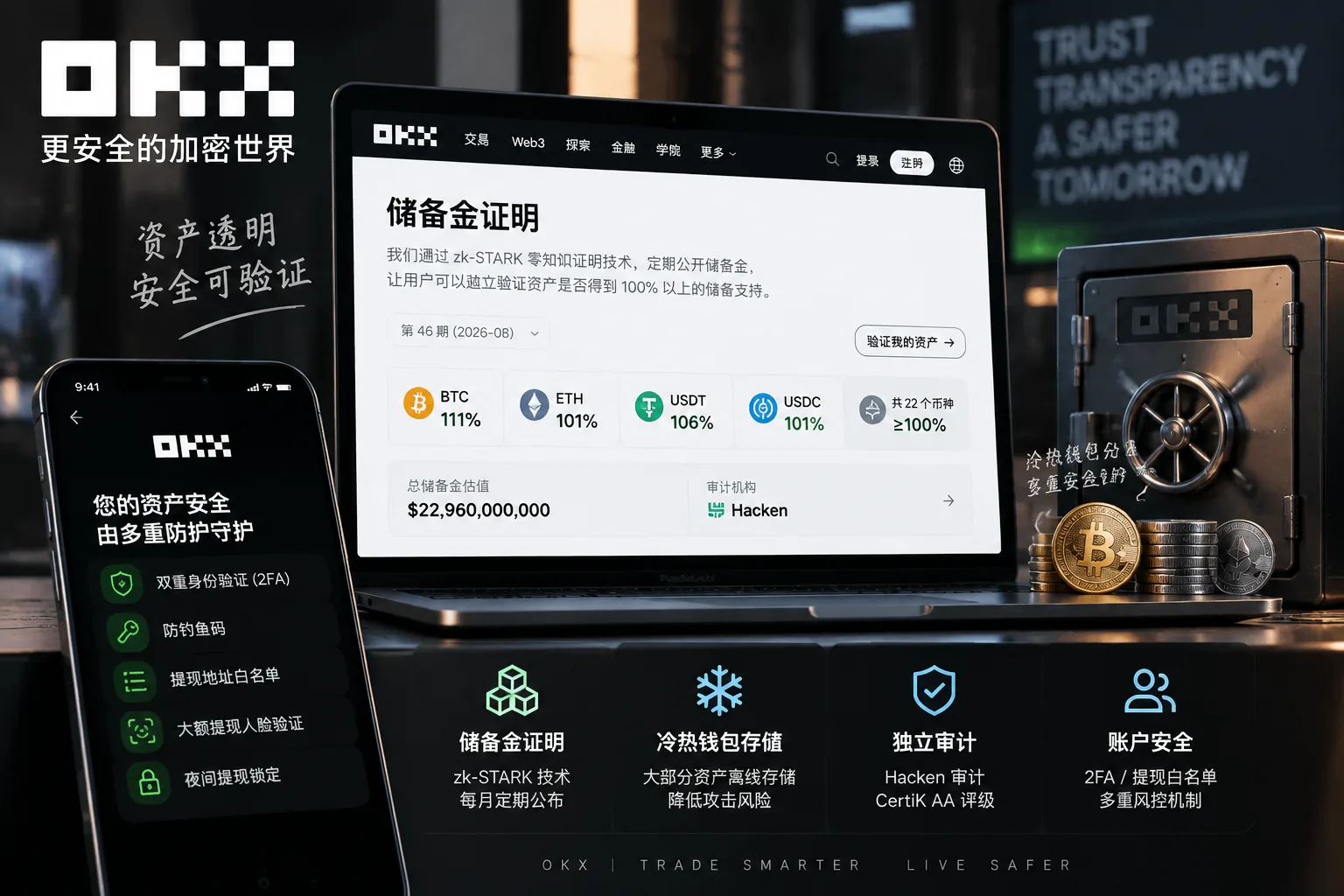
Independent audits and ratings: proof of reserves is independently audited by security firm Hacken; third-party security agency CertiK has assessed OKX and given it a high rating (AA), though such ratings are only a reference and cannot replace regulatory review.
Complete account security features: 2FA, anti-phishing code, withdrawal whitelist, facial verification for large withdrawals and overnight withdrawal lock — the essentials are all there.
In one sentence: on the layer of "will the exchange suddenly get hacked and are my coins still there", OKX is relatively reassuring.
Quick score (2026, for reference):
| Item | Assessment |
|---|---|
| Platform operation | ✅ Top-tier exchange |
| Reserve transparency | ✅ Published regularly |
| Regulatory coverage | ✅ Presence in Europe and Dubai |
| Custody security incidents | ✅ No publicly disclosed core-wallet incident causing large-scale losses of custodied user assets |
| User protection | ⚠️ No bank deposit insurance |
| Long-term storage | ⚠️ Self-custody recommended |
But "safe" is not only this layer. Read on for compliance and user-side risks — that's where you need to put in the effort.
Licenses and regulation: getting the accounting right
Many people assume "licensed = completely safe", but a license has to be split into "which entity, and who it protects".
OKX's licenses and entities are as follows:
| Entity | Regulator | Note |
|---|---|---|
| OKX Europe (Malta) | Full EU MiCA license | Approved in January 2025, covers the European Economic Area; the strongest protection for EU users |
| OKX Middle East (Dubai) | Dubai VARA license | UAE users are regulated |
| OKCoin USA | US FinCEN MSB | US compliance entity (but OKX does essentially no US retail business) |
| Aux Cayes FinTech (Seychelles) | Seychelles | Most international users actually sign with this entity, which has no statutory compensation mechanism |
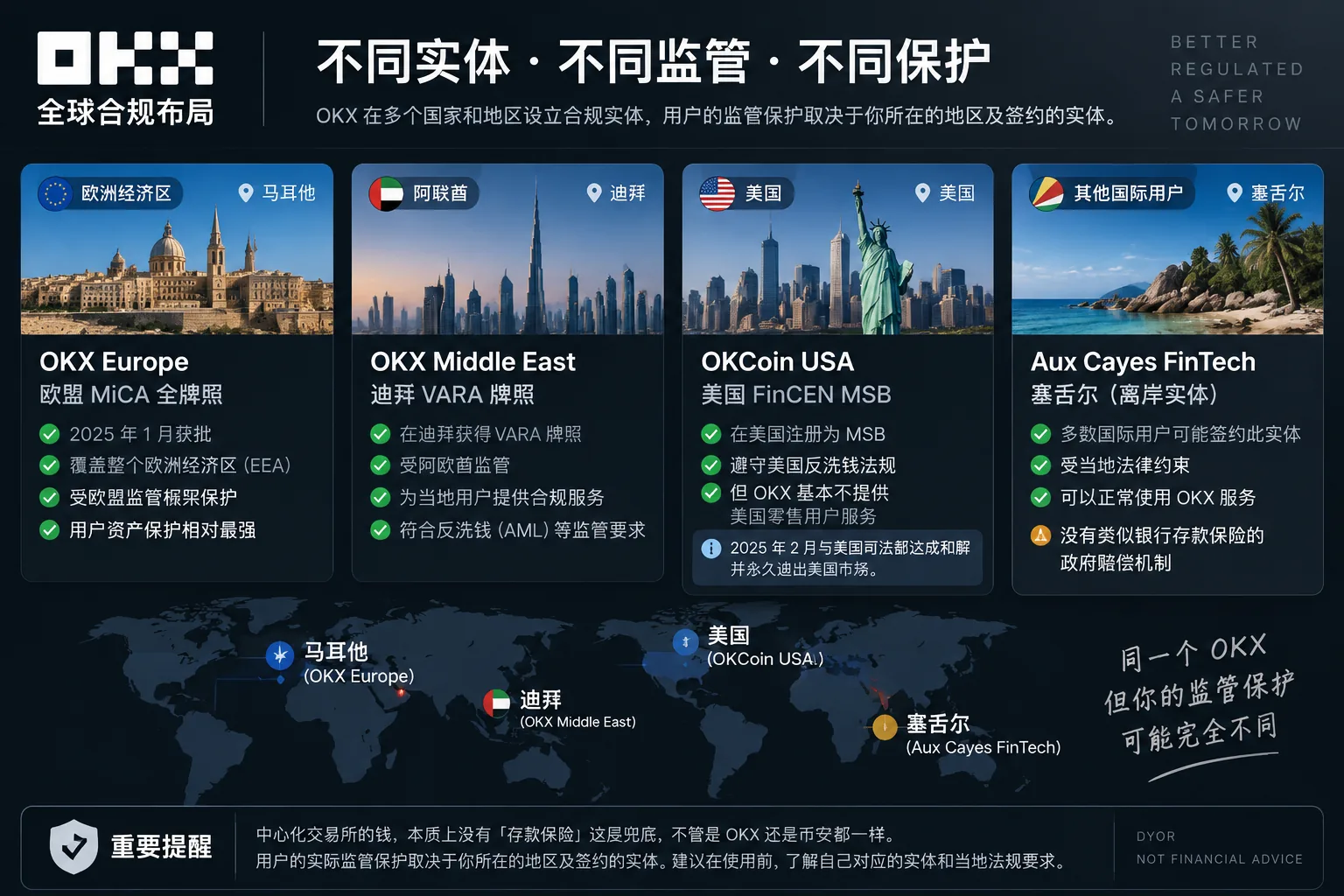
There is a key point you should know: many international users who register on OKX may be assigned to an offshore entity, such as the Seychelles one. Seychelles has no compensation mechanism for crypto similar to bank deposit insurance — meaning if OKX did reach an extreme situation, the government would not step in to compensate you.
Here is the mapping by region:
| Your region | Possible entity | Regulatory protection |
|---|---|---|
| European Economic Area | OKX Europe (Malta) | MiCA regulation, the strongest protection |
| UAE | OKX Middle East (Dubai) | VARA regulation |
| Other international users | An OKX offshore entity (e.g. Seychelles) | Varies; most have no government backstop |
This is not saying OKX will fail; it's so you understand a boundary: money on a centralised exchange essentially has no "deposit insurance" layer, no matter which one it is. Binance and OKX are both like this; don't be led astray by "big platform = absolutely safe".
A few things that can't be avoided
To assess whether an exchange is "reliable", you can't just look at how it is now; you also have to look at what it has done. These are things that really exist in OKX's compliance record and are worth knowing:
1. In February 2025, a settlement of more than $500 million with the US Department of Justice. The DOJ accused OKX of failing to establish adequate compliance controls, allowing about 32,000 US users to trade on the platform (involving about $4.2 billion in funds). OKX settled with the DOJ, paid more than $500 million in related costs, and permanently exited the US market. It is one of the largest settlements in crypto exchange history.
2. It was drawn into the investigation into laundering of Bybit's stolen funds. In 2025, European regulators investigated whether OKX's Web3 wallet / DEX aggregator was used to launder part of the funds stolen from Bybit. OKX denied it and proactively suspended the related DeFi services to cooperate with the investigation.
3. A €1.05 million fine in Malta. In 2025, the Malta Financial Services Authority (MFSA) fined OKX's European entity about €1.05 million for anti-money-laundering issues — relating to historical problems before the MiCA license was approved.
4. From September 2026, tighter rules on "gambling-linked" funds. OKX announced a crackdown on deposits from high-risk addresses such as gambling platforms and Telegram escrow deals; once an anti-money-laundering (AML) review is triggered, account functions and funds may be restricted, with reviews lasting 15 days or more.
How to read all this? My judgement is: the first three are "historical compliance problems", not "fund safety problems" — they show that OKX did compliance sloppily in its early years, but the settlement, the fine and cooperating with investigations are precisely evidence that it "acknowledges the books and is regulated". Compared with a platform that has no regulation at all and refuses to cooperate with investigations, accepting regulatory review, paying penalties and adjusting the compliance system usually indicates the platform is moving into a more standardised phase of operation. What you really need to watch is point 4 — it affects you directly: if your money comes from gambling, grey-market activity or third-party transfers of unknown origin, it may well trigger a risk-control freeze.
What really makes you lose money is usually these two things
The most overlooked — and most important — point when assessing security is: the vast majority of ordinary users who lose money do so not because "the exchange got hacked", but because of the following two things.
The first: fake apps, fake support and phishing links
This is the highest-risk area of all. Scammers build highly convincing "OKX apps", send SMS messages saying "your account is abnormal, click this link to unfreeze it", and pose as official support in chat groups. Once you enter your seed phrase or verification code, or log in through a fake link, your coins are gone — and this has nothing to do with whether OKX itself is secure; it happens to anyone.
Remember one iron rule: official OKX support will not message you privately, will not ask for your password or verification code, and will not ask you to "transfer funds to verify". Download the app only from the official site, and don't click any "exclusive download link" from SMS or private messages.[2]
The second: an account frozen by risk controls
As mentioned, OKX's risk controls are tightening. If you're inactive for a long time and then suddenly move large amounts in and out, change devices frequently, or receive funds from a flagged high-risk address, your account may be temporarily restricted and you'll need to submit documents to unlock it. The process is slow and the experience is poor; many of the bad reviews on Trustpilot come from this kind of "frozen account" experience.
What the two have in common: neither means "OKX wants to swallow your money", but both cause you real losses and hassle. So the answer to "is OKX safe" depends largely on how you use it.
How to verify it yourself, instead of taking my word (or anyone's)
Rather than trusting a review, check two things yourself. This is also the universal approach to any "is this exchange reliable" question:
1. Check the proof of reserves. On OKX's official site, find the "Proof of Reserves" page; there you can see the latest reserve ratios and use the tool to verify whether your assets are covered. Look at two things: whether the reserve ratios of major coins are ≥100%, and whether it is updated regularly every month.
2. Check the licenses. On the EU ESMA's MiCA license register, or the Dubai VARA website, you can check the licensed status of the corresponding OKX entity. When you do, look carefully at "which entity" — the Malta entity holding a license does not mean the Seychelles entity you signed with is equally protected.
Once you've done these two steps, your judgement of "is it reliable" will be firmer than reading ten reviews.
If you decide to use it, don't skip the security settings
If you decide to use OKX, do these things the same day; they block most of the risk:
Turn on 2FA and the anti-phishing code: use something like Google Authenticator for 2FA, not just SMS; the anti-phishing code makes official emails carry a marker you set yourself, so you can spot fake emails at a glance.
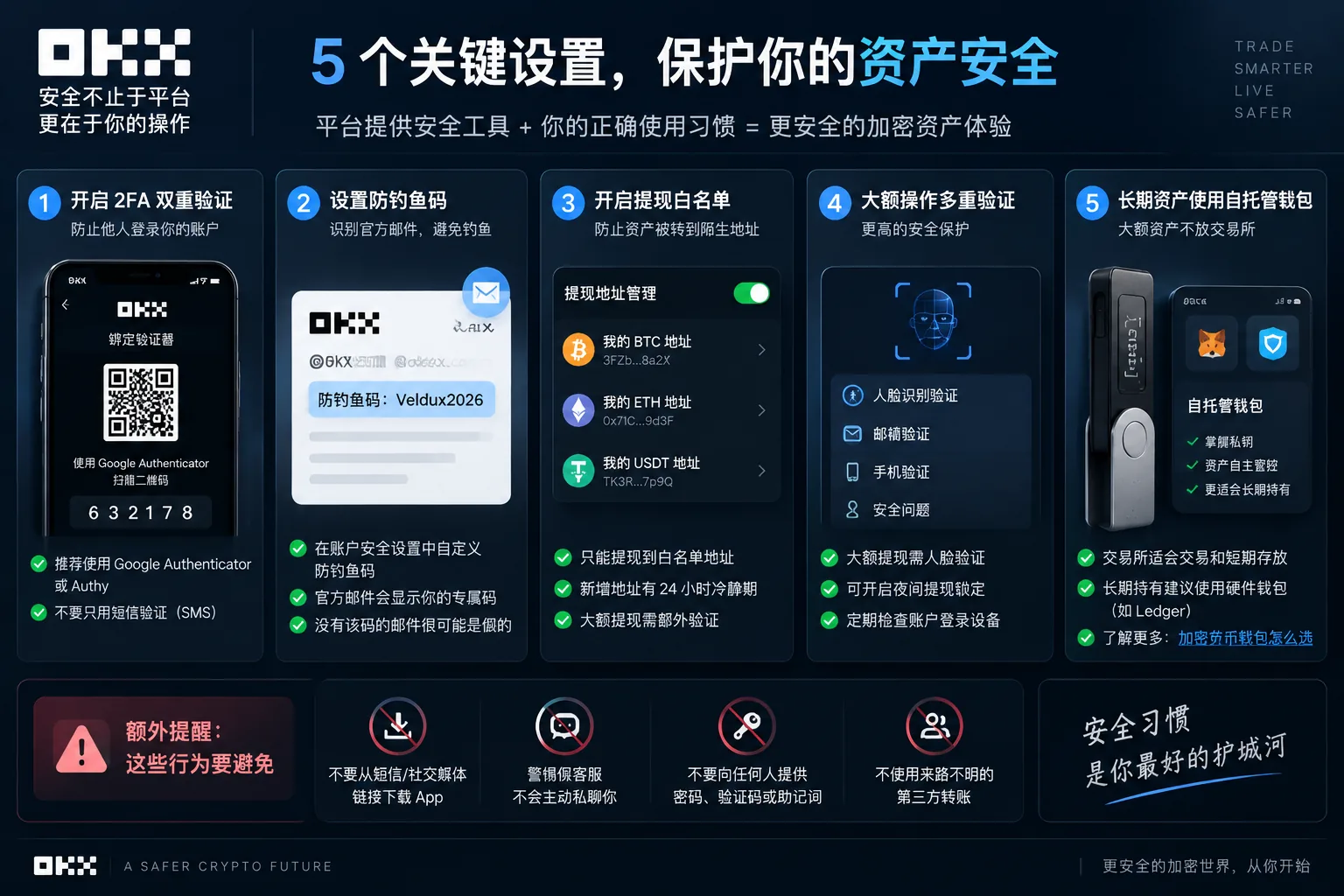
Set a withdrawal whitelist: withdrawals can only go to addresses you registered in advance; new addresses have a 24-hour cooling-off period, which slows an attacker down if your account is compromised.
Move assets you won't touch long term to a self-custody wallet: the exchange is suited to trading and short-term storage; coins you hold for years are safer in a hardware wallet you control. For how to choose a wallet, see how to choose a crypto wallet.
Don't use third-party "one-click login" sources: download the app only from the official site and log in only through the official entry.
If you haven't decided between Binance and OKX yet, read the "OKX vs Binance: which is safer" comparison below before deciding, and don't choose based only on "which is safer".
Who should use it and who should be careful
| Your situation | Recommendation |
|---|---|
| You want a legitimate exchange with proof of reserves | OKX is suitable; technical security and transparency are top-tier |
| You mainly trade spot/futures and accept centralised custody | Fine, with security settings in place |
| Your funds come from gambling, grey markets or unknown third parties | Use with caution; risk-control freezes are likely |
| You want "government backstop, deposit insurance" | No centralised exchange can provide it; do self-custody |
| You just want to buy some crypto and hold it long term | Use the exchange as a pass-through and move long-term assets to a wallet |
| You have no security habits and worry about complexity | Fine, but turn on 2FA and the withdrawal whitelist first |
OKX vs Binance: which is safer?
Many people hesitate between Binance and OKX, and security is one consideration. To be clear first: both are top-tier exchanges, both have first-tier technical security, and there is no fundamental gap on this item; what really separates them is products, fees and what you want to do.
| Dimension | OKX | Binance |
|---|---|---|
| Global scale | Top tier | Among the largest globally |
| Proof of reserves | Yes | Yes |
| User protection mechanism | Mainly relies on the platform's security system | SAFU fund |
| Compliance footprint | Clear presence in Europe and Dubai | Broader global coverage |
| Product character | Web3 ecosystem | Liquidity and product breadth |
If you mainly care about liquidity and global coverage, Binance has a clear edge; if you care about the Web3 ecosystem and product integration, OKX has the edge. For a complete comparison beyond security (fees, experience, registration), see the Binance vs OKX comparison.
FAQ
Q1: Is OKX a scam? Will it run off with the money? It is not a scam, and there are no signs of it running off. It is one of the world's top crypto exchanges, with regulatory licenses and compliance entities in multiple regions, and it has paid a huge settlement and accepted regulatory review — behaviour that is the opposite of "running off". But centralised exchanges all carry operational and custody risk; there is no 100% safety.
Q2: Are funds on OKX safe? Is there insurance? No publicly disclosed breach of the core wallet holding custodied assets, and a monthly proof of reserves (22 coins with ratios ≥100%). But there is no government backstop similar to bank deposit insurance, and the Seychelles entity most international users sign with has no statutory compensation mechanism. So "safe" is relative; long-term assets should go to self-custody.
Q3: Can US users use OKX? Basically no. After the 2025 settlement OKX permanently exited the US retail market and does not serve US residents.
Q4: Is the OKX Web3 wallet safe? The OKX Web3 wallet is a self-custody wallet: the private key is in your hands and security responsibility is mainly yours. It is a separate matter from your exchange account — funds in the exchange account are custodied by OKX, funds in the Web3 wallet are self-custodied by you. In 2025 OKX's Web3 DEX aggregator was drawn into the Bybit money-laundering investigation, and OKX has suspended the related services to cooperate with regulators.
Q5: What do I do if my account is frozen? First confirm whether risk controls were triggered (frequent device changes, receiving from high-risk addresses, long inactivity followed by a sudden large in-and-out, etc.). Normal users can usually unlock by submitting identity documents and cooperating with the review. If the funds themselves are compliant, there's no need to worry excessively; if the source is problematic, the freeze is the platform fulfilling its anti-money-laundering obligations.
Q6: How do I judge whether an exchange is reliable? Look at three things: licenses (which entity, who it protects), proof of reserves (whether it is regular and whether ratios are sufficient) and security history (has it been hacked, and how was it handled). OKX has verifiable information on all three; the method is in "How to verify it yourself" above.
Q7: What happens to my coins if OKX goes under? Centralised exchanges have no government deposit insurance, and top platforms are no exception. Even on a top platform, don't keep more than you can bear to lose for the long term — coins you hold long term are safer in self-custody (see "If you decide to use it, don't skip the security settings" above).
Q8: If OKX freezes my account, is it trying to swallow my money? No. Risk-control freezes mostly come from anti-money-laundering (AML) reviews; it is the platform fulfilling compliance obligations, not confiscating assets. Normal users who submit identity documents through the official process and cooperate with the review can generally unlock; this is a different matter from "the platform running off with the money".
Q9: Which entity am I actually signing with when I register on OKX? Is the offshore entity protected? Most international users who register on OKX actually sign with an offshore entity (such as Aux Cayes FinTech in Seychelles). It operates normally and is bound by local law, but it does not have MiCA regulation like the EU entity, nor a government compensation mechanism similar to deposit insurance — put simply, the offshore entity "works normally, but with one layer less protection". So for large long-term assets, self-custody is recommended; don't keep all your money there just because "OKX is a big platform".
Summary
Is OKX reliable? Technical security is reliable, compliance has baggage, and user-side risk is up to you to defend against. It has not publicly disclosed a core-wallet security incident causing large-scale losses of custodied user assets, publishes proof of reserves monthly and has established regulated entities in multiple regions — it is a legitimate top-tier exchange. But it has paid a $500 million settlement, was drawn into the Bybit money-laundering investigation, most users sign with a Seychelles entity with no government backstop, and with tighter risk controls an account can be frozen. Conclusion: for users who comply with local regulations and are willing to manage account security properly, it can be considered as one of the top-tier exchanges to use; but understand the boundaries — set up security, self-custody long-term assets, and don't touch funds of unknown origin.
Final check before you register
| Your situation | Recommendation |
|---|---|
| You've decided to use OKX | Register through the entry below, then turn on 2FA and set the withdrawal whitelist the same day |
| You're still choosing between Binance and OKX | Read the comparison first; don't decide on "a feeling of safety" alone |
| You just want to understand | Remember two things: download the app from the official site, and official support won't message you privately |
If you decide to use OKX, you can register through the entry below:
- Register on OKX through this site (the code AMY568 fills in automatically at registration, with a fee rebate)
- You can also go directly to okx.com and register without a code; the features are the same, just without the rebate
The first link above is an affiliate link: registering through it may generate revenue for us, but it doesn't affect this article's objective conclusions. More in advertising and affiliate disclosure.
Keep reading these articles
- How to use the OKX referral code: filling in AMY568 and the 20% fee rebate — if you decide to register, fill in the rebate code while you're at it
- How to buy USDT on OKX: a complete P2P buying tutorial — the first step after registration is approved is buying USDT
- Which charges lower fees, Binance or OKX? A 2026 comparison of spot, futures and real trading costs — beyond security, fees are another hard criterion for choosing a platform
Data verification note
The key facts in this article were checked on 2026-10-16, one by one:
- Proof of reserves: OKX publishes proof of reserves every month; the latest edition (period 46, August 2026) covers 22 major coins, with all reserve ratios ≥100%, including BTC 111%, ETH 101%, USDT 106% and USDC 101%, verifiable by users. Source: OKX official proof of reserves page.
- Official download channels: the official download entry for the OKX app is okx.com/download; official channels are the official website and the official app stores. Source: OKX official app download page.
Disclaimer
This article is an objective review of the security of the OKX exchange and an explanation of risks. It does not constitute investment advice, financial advice, a trading recommendation, or any guarantee about OKX's safety.
Crypto asset prices are highly volatile, and trading carries platform, market, cybersecurity and operational risk. Every centralised exchange carries custody risk and does not enjoy bank deposit insurance. Users should judge carefully according to their own risk tolerance and comply with the laws of their jurisdiction. People under 18 should not trade crypto.
Exchange operations · USDT · Wallet security
Responsible for researching and organizing content on Binance, OKX, USDT transfers, withdrawals and wallet security. The steps and key data in this article are verified according to the content type, using real operation records, official platform documentation and public sources. Interfaces, fees and regional rules may change, so the article is reviewed and updated continuously.
Status: manual review · Last verified 2026-10-16
Reviewed by: Veldux editorial team
- OKX official proof of reserves pageOKX publishes proof of reserves every month; the latest edition (period 46, August 2026) covers 22 coins with reserve ratios all ≥100%, verifiable by users
- OKX official app download pageThe official download entry for the OKX app is okx.com/download; official channels are the official website and the official app stores
- 2026-10-16UpdateAdded the evidence-chain superscripts and the "Data verification note", and updated the fact-check date for key facts.
Editorial principles ineditorial policy,corrections policy。