
How do Binance futures work? Leverage, liquidation and fees (2026)
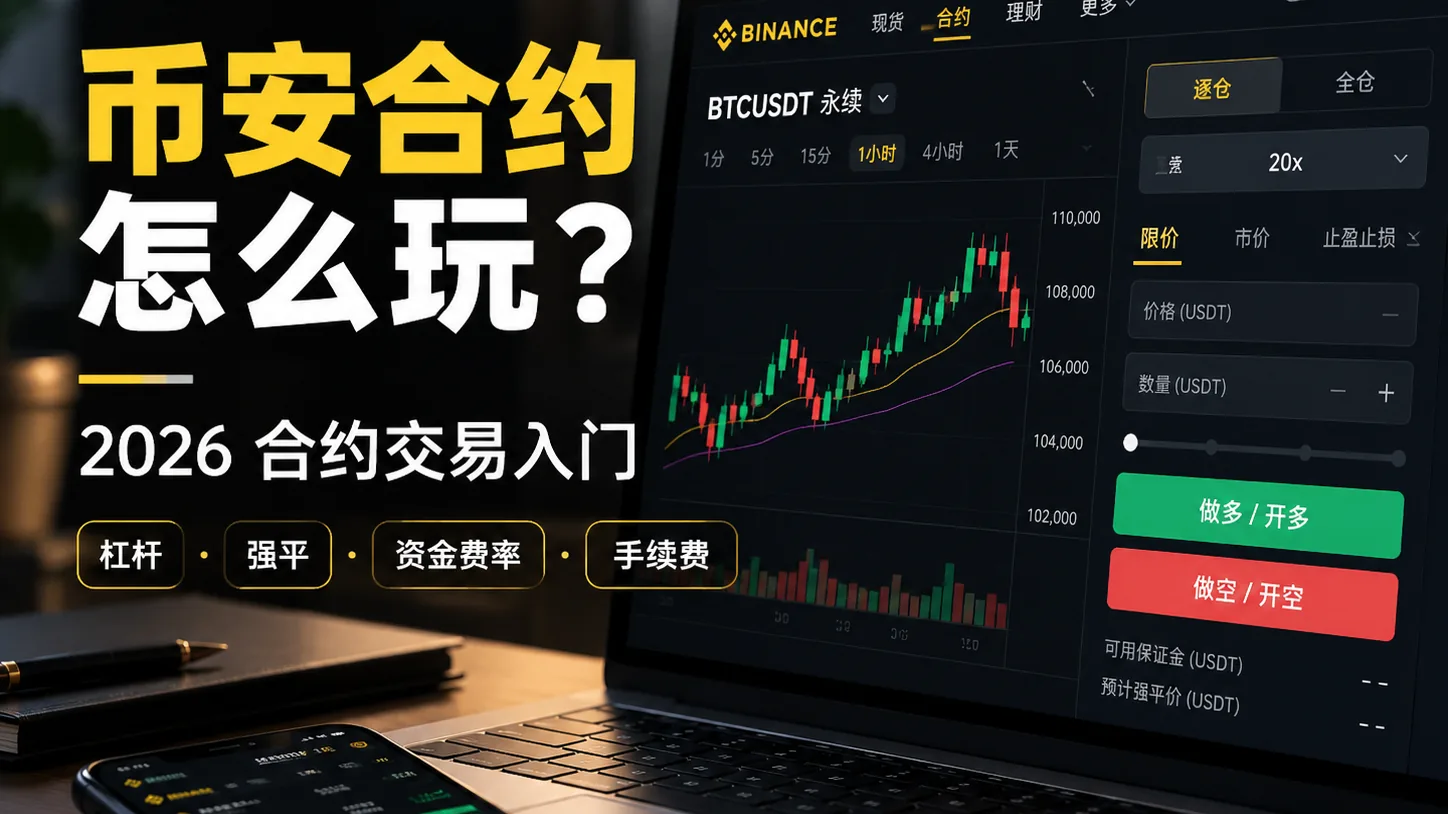
Table of contents

Binance new-user benefit
20% fee rebate
Official Binance sign-up · You must complete identity verification (KYC) to trade and withdraw
How do Binance futures work? A beginner needs to understand seven actions: open the Binance futures page, transfer USDT in, choose the BTCUSDT pair, set isolated or cross margin and leverage, choose long or short, set take-profit and stop-loss, and finally manage and close the position on the positions page.
The first time you open the futures page in the Binance app and see "5x / 10x leverage", "margin" and "liquidation price", the easiest thing to get wrong is this: how much margin you put in is not the same as how large a position you actually open.
For example, with 100 USDT of margin at 10x leverage you open a notional position of about 1,000 USDT. If the underlying price rises 1%, a long's theoretical gross profit is about 10 USDT; if it falls 1% against you, the theoretical gross loss is about 10 USDT, before any fees or funding.
If the price keeps moving against you, the position can be forcibly closed before the margin is fully gone.
So the first time you touch futures, you don't just need to know where "long" and "short" are; you need to understand isolated versus cross margin, liquidation price, take-profit and stop-loss, and how much a trade actually costs.
Below, following the order you use the Binance app, this guide covers opening and closing, leverage, liquidation, funding rates and fees end to end, and works the numbers through with a 100 USDT example.
Risk warning: futures trading can cause serious financial loss. This article only explains the operations and the trading mechanics; it is not investment advice.
Quick overview: how do Binance futures work?
| What you want to know | Direct answer |
|---|---|
| What Binance futures are | Margin-based derivative positions; you can go long or short |
| How to open a position | Choose the pair, margin mode, leverage, direction and quantity |
| How much can 100 USDT open | Depends on leverage, available margin and the pair's rules |
| Isolated vs cross | Isolated manages margin per position; cross shares the eligible balance |
| How much can you lose at 10x | With the same margin, notional size scales up, and so does the P/L from a price move |
| Can futures be liquidated? | Yes; insufficient margin can trigger forced liquidation |
| How are fees calculated | On the notional value traded and the actual fee rate |
The table above is the basic relationship between operations and risk in Binance futures. Before placing a real order, the most important things to see are the position's notional value, the margin mode and the liquidation price.
1. What's the difference between Binance futures and spot?
Spot trading means buying crypto assets such as BTC or ETH directly.
For example, you buy BTC spot with 100 USDT; if BTC falls 10%, the book value of your BTC drops by about 10 USDT. As long as there is no borrowing or other margin arrangement, ordinary spot does not trigger futures-style liquidation just because the price falls.
Futures are different.
Futures are derivative trading: you don't need to hold the corresponding amount of BTC to open a position tied to BTC's price movement.
With futures you can go long, go short, and use leverage.
Binance spot versus futures
| Item | Spot / futures difference |
|---|---|
| What you hold | Spot holds the actual asset; futures hold a derivative position |
| Direction | Ordinary spot mainly buys then sells; futures can go long or short |
| Leverage | Ordinary spot has no leverage; futures can use it |
| Forced liquidation | Ordinary spot has no futures-style liquidation; futures carry that risk |
| Trading cost | Spot mainly means the trading fee; perpetuals also involve funding fees |
The biggest difference is not whether you can profit from a price rise. It's that futures let you open a position larger than your initial margin, while taking on the risk of liquidation if the margin runs short.
What do long and short mean?
Long: you expect the price to rise and open a buy-side position. If the price then rises, the position usually shows a floating gain; if it falls, a floating loss.
Short: you expect the price to fall and open a sell-side position. If the price then falls, the position usually shows a floating gain; if it rises, a floating loss.
Suppose you open a futures position worth 1,000 USDT:
| Price move | Theoretical long P/L | Theoretical short P/L |
|---|---|---|
| Up 5% | +50 USDT | -50 USDT |
| Down 5% | -50 USDT | +50 USDT |
The calculation above excludes fees, funding and slippage.
Going short does not guarantee a profit from a falling market. As long as the price moves against you, both longs and shorts can take large losses.
2. How do you trade futures in the Binance app? 7 steps from open to close
Below I use the BTCUSDT USDⓈ-M perpetual as the example, following the typical order in the Binance app.
Note that futures service can be limited by your location, account eligibility and app version. Page names and button positions may also change between versions.
Step 1: open the Binance futures page
Open the official Binance app and sign in.
In a trading interface that supports the feature, find the "Futures" entry in the bottom bar or trading menu, and go into the USDⓈ-M futures page.
If it's your first time, Binance may ask you to complete a risk questionnaire, accept agreements or go through another onboarding step.
If you don't see a futures entry, first check whether your account is eligible for the service.
Step 2: transfer USDT into the futures account
If you have USDT in the spot account but the futures page shows insufficient available margin, first check whether the funds are in the right account.
Typical transfer flow:
- Open "Assets" and go to "Transfer".
- Choose the source account, for example the spot account.
- Choose the destination account, for example the USDⓈ-M futures account.
- Choose USDT and enter the amount.
- Check the accounts and amount, then confirm.
Internal transfers between Binance accounts normally incur no on-chain network fee.
Note: transferring funds is not opening a position. A position is only created once a futures order actually fills.
Step 3: choose the BTCUSDT perpetual
In the futures pair list, find the BTCUSDT perpetual.
BTCUSDT means the contract price is tied to BTC, with USDT as the quote and settlement unit.
When choosing the pair, check first:
- That it is the BTCUSDT perpetual, not another coin or a delivery contract.
- The current mark price.
- The current funding rate and the next settlement time.
- The allowed leverage range and the order quantity requirements.
Different contracts can have different leverage caps, risk tiers and minimum order sizes.
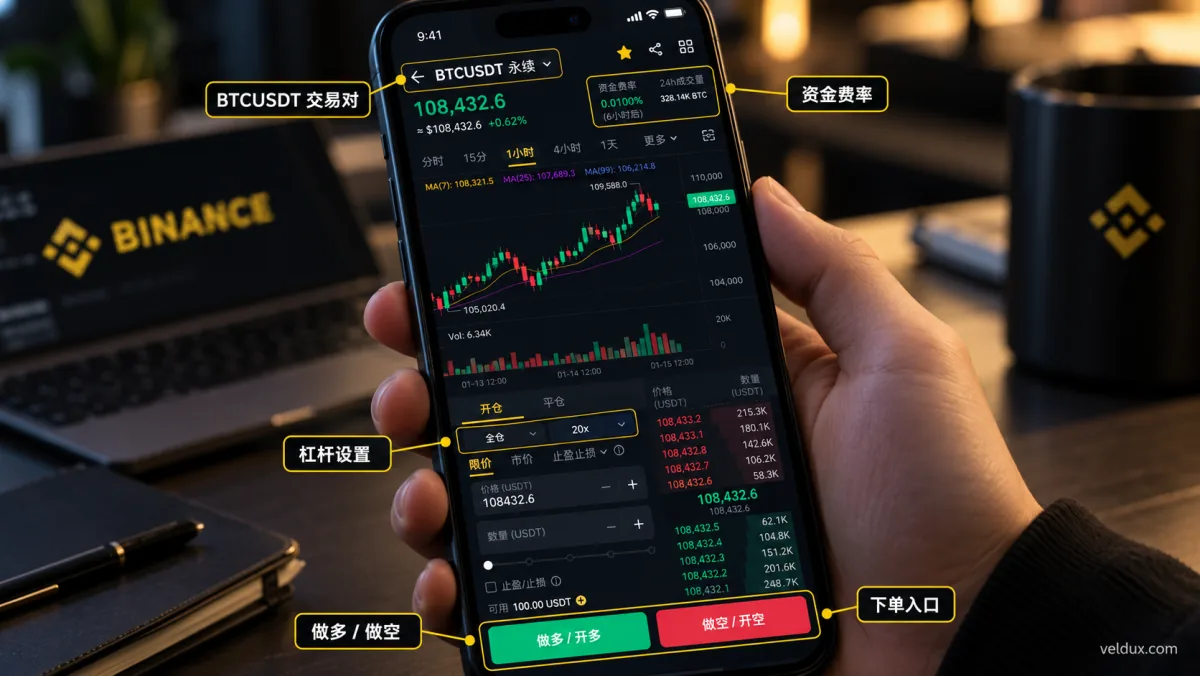
Figure 1: the Binance BTCUSDT perpetual trading page. You can see the pair, funding rate, leverage and the long/short areas. The image illustrates the layout; actual buttons and figures depend on the current Binance app.
Step 4: set isolated or cross margin, and leverage
Go to the futures order screen and find the "Isolated / Cross" and leverage settings.
Isolated: allocates relatively independent margin to a specific position.
Cross: positions that meet the rules can share the margin balance.
Then check the leverage setting, for example 5x or 10x.
Suppose you use 100 USDT of initial margin, ignoring fees:
| Leverage | Theoretical notional position |
|---|---|
| 1x | 100 USDT |
| 5x | 500 USDT |
| 10x | 1,000 USDT |
| 20x | 2,000 USDT |
The higher the leverage, the larger the notional position the same initial margin can support, and the more a price move is amplified relative to that margin.
The table only explains the leverage relationship; it does not mean every account can actually open those amounts.
Step 5: choose a market or limit order
The common order types in Binance futures are the market order and the limit order.
| Order type | How it executes |
|---|---|
| Market order | Executes against the available order book; may suffer slippage |
| Limit order | Executes at the specified price or better, but is not guaranteed to fill |
For example, suppose BTCUSDT is currently trading at 100,000 USDT.
If you submit a market buy, the actual average fill depends on the order book at that moment and won't necessarily be exactly 100,000 USDT.
If you place a limit buy at 99,500 USDT, it only executes when the market meets that condition, and it may stay unfilled.
Also note: a limit order does not always pay the maker fee. If a limit order immediately takes liquidity from the book, it can be charged the taker rate.
Step 6: choose long or short, and set take-profit and stop-loss
On the order page, choose long or short and enter the order quantity or cost parameter the page supports.
Before submitting, check the direction, leverage, margin mode and actual notional value.
If the page supports it, you can set take-profit and stop-loss when opening; you can also add them in the positions area after the fill.
Take-profit tries to close a winning position once a condition is met; stop-loss tries to limit further loss once a condition is met.
For example, suppose a BTCUSDT long is opened at 100,000 USDT; you could use 98,000 USDT as a teaching example of a stop-loss trigger price.
But the price reaching 98,000 USDT does not guarantee a fill at exactly that price.
A stop-market order can suffer slippage; a stop-limit order may fail to execute because the price condition isn't met.
When setting them, also distinguish:
- Trigger on mark price
- Trigger on last price
- Order quantity versus remaining position quantity
- Whether the take-profit/stop-loss order was actually submitted
A stop-loss helps manage your exit conditions, but it cannot guarantee you avoid forced liquidation.
Step 7: review the position and liquidation price, then close
Once the order fills, go to the "Positions" area of the futures page.
Focus on these figures:
| Position metric | Meaning |
|---|---|
| Entry price | The actual average entry price of the position |
| Mark price | The key price for calculating liquidation risk |
| Liquidation price | The price expected to trigger liquidation under current conditions |
| Unrealised P/L | Book profit or loss not yet closed |
| Margin ratio | Reflects the margin risk state of the position |
When you want to end the position, use the close function in the positions area and choose the quantity and order type.
After submitting a close order, confirm that it actually filled.
If you close with a limit order, it may remain unfilled or partially filled.
Also check whether the remaining position quantity has gone to zero, and whether any conditional orders are still open.
Don't treat an opposite-direction order as the same thing as closing. In one-way and hedge position modes, an opposite order can produce different results.
3. What's the difference between isolated and cross margin?
Isolated and cross margin determine how margin is allocated, and how far a loss on one position can reach into the rest of your account.
Isolated: margin managed per position
Suppose the futures account holds 500 USDT in total, and you allocate only 100 USDT to one isolated position.
Without adding margin, auto-margin or another special arrangement, that position bears risk mainly with the allocated margin.
Even if that position is liquidated, it does not mean the rest of the account balance is automatically added to it.
But the margin allocated to the position can still be lost entirely.
Cross: multiple positions share margin
Cross mode lets positions that meet the rules share the margin balance.
When one position is losing, other available margin may keep maintaining it.
If the market keeps moving against you, the loss can affect other funds in the shared margin pool.
Isolated versus cross
| Item | Isolated / cross difference |
|---|---|
| Margin scope | Isolated allocates separately; cross shares the eligible balance |
| Loss impact | Isolated mainly affects its own margin; cross can affect the shared balance |
| Margin adjustment | Isolated is usually adjusted per position; cross follows shared rules |
| Liquidation risk | Both modes can be liquidated |
Cross does not mean you can't be liquidated, and isolated does not mean you're safe.
Neither margin mode has a fixed profit advantage; the difference is how capital is allocated and how risk is transmitted.
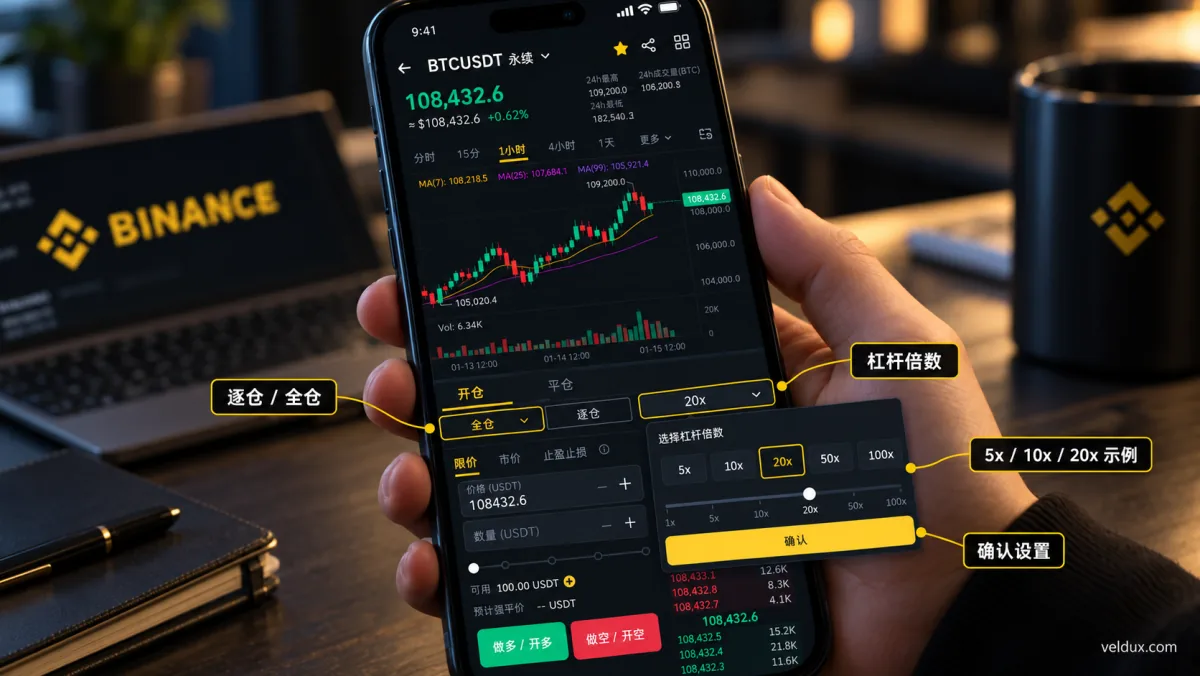
Figure 2: isolated margin, cross margin and leverage settings. You can see the margin mode and leverage on the futures order screen. This is a teaching illustration; the actual app interface depends on the current Binance version.
4. How is futures leverage calculated? How much can you make or lose with 100 USDT?
Leverage itself does not change the market price.
Its role is to let you open a larger notional position with a given initial margin.
The basic relationship:
Theoretical notional position = initial margin × leverage
For example:
100 USDT × 10 = 1,000 USDT
That means opening a position worth about 1,000 USDT with about 100 USDT of initial margin.
A real order also has to account for a fee buffer, the pair's rules and the account's margin requirements.
With 100 USDT of margin, how much do you lose at different leverages?
Suppose you open everything long, and the price then falls 1%.
| Leverage | Notional position | Theoretical loss |
|---|---|---|
| 1x | 100 USDT | 1 USDT |
| 5x | 500 USDT | 5 USDT |
| 10x | 1,000 USDT | 10 USDT |
| 20x | 2,000 USDT | 20 USDT |
These numbers show that with the same margin, the larger the notional position, the larger the P/L from a price move.
But if the notional position stays fixed at 500 USDT, then whether you use 5x or 10x, the same 1% price move still produces a theoretical P/L of about 5 USDT.
So what determines how much a price move earns or costs you is the position size and notional value, not the leverage number itself.
Long and short P/L formulas
For linear contracts quoted in USDT:
Long P/L = (closing price − entry price) × position quantity
Short P/L = (entry price − closing price) × position quantity
For example:
Suppose BTCUSDT has an entry price of 100,000 USDT and the position's notional value is 500 USDT.
The corresponding BTC quantity:
500 ÷ 100,000 = 0.005 BTC
If you are long and BTC later rises to 102,000 USDT:
(102,000 − 100,000) × 0.005 = 10 USDT
The theoretical gross profit is 10 USDT.
If BTC falls to 98,000 USDT, the theoretical gross loss is 10 USDT.
Fees, funding and other costs are not deducted here.
5. How is the liquidation price calculated? Why do positions get liquidated?
Liquidation, also called forced liquidation, is the risk-management mechanism in futures trading.
When a position's margin cannot satisfy the maintenance margin requirement, the system may start the forced-liquidation process.
Liquidation does not wait until the initial margin has been exactly used up.
Why doesn't 10x liquidate exactly on a 10% drop?
Suppose you use 100 USDT of initial margin to open a long position of about 1,000 USDT.
If the price moves 10% against you, the simplified theoretical loss is:
1,000 × 10% = 100 USDT
But that is only the mathematical relationship ignoring maintenance margin and fees; it is not the real liquidation-price formula.
Actual liquidation on Binance depends on:
- The current margin balance
- The maintenance margin rate
- The position's notional value
- The mark price
- Isolated or cross mode
- The position's risk tier
- Trading fees and funding already incurred
So liquidation can happen before the initial margin is theoretically exhausted.
What's the difference between mark price and last traded price?
| Price type | Main role |
|---|---|
| Last traded price | Reflects the most recent trade in the futures market |
| Mark price | Used for position risk and liquidation calculations |
Binance uses a mark-price mechanism to reduce the impact of brief abnormal trades on liquidation decisions.[1]
For example, one trade that briefly causes a violent move in the last price does not mean liquidation will necessarily trigger at that last price.
But the mark price still moves with the market, so it cannot guarantee your position won't be liquidated.
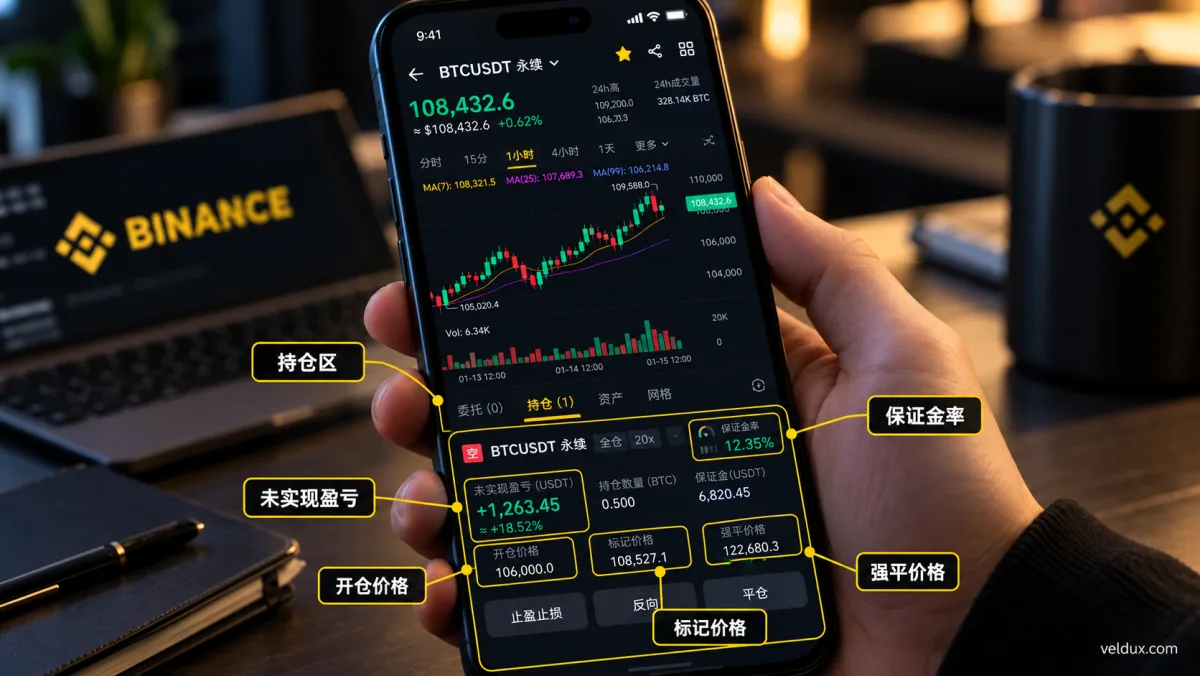
Figure 3: the Binance BTCUSDT perpetual position screen, showing entry price, mark price, liquidation price, unrealised P/L and margin ratio. Teaching illustration, not real account data; the actual interface depends on the Binance app.
What happens after liquidation?
When a position meets the liquidation conditions, the system may cancel related orders, reduce the position's risk, and execute partial or full forced liquidation under the applicable rules.
The actual process depends on position size, margin mode, market liquidity and the liquidation rules.
If liquidation occurs, a liquidation fee may also apply.
In addition, the liquidation price shown in the account can adjust as margin, position size and risk parameters change.
Does adding margin prevent liquidation?
Adding margin to an isolated position can change the estimated liquidation price.
But adding margin does not mean the trade direction was right, and does not mean the loss won't keep growing.
Likewise, changing leverage, adding margin and reducing the position quantity are three different actions; don't conflate them.
6. How are Binance futures fees calculated? Are they charged on open and close?
Binance futures trading is not just a single fee at opening.
According to the official fee explanation, there are three main types.[2]
What fees do Binance futures involve?
| Fee type | When it arises |
|---|---|
| Trading fee | When an opening or closing order fills |
| Funding fee | When a perpetual position passes a funding settlement point |
| Liquidation clearance fee | When a position is liquidated and the relevant rule applies |
Opening and closing normally involve the trading fee, plus funding when applicable. If the position is forcibly liquidated, there may be additional liquidation costs.
Binance futures maker and taker rates
Below is the standard base-rate reference for a regular user:[3]
| Contract type | Maker | Taker |
|---|---|---|
| USDⓈ-M futures | 0.02% | 0.05% |
| COIN-M futures | 0.01% | 0.05% |
Different contracts, user tiers and campaigns may have different rules. USDC-margined products in particular should not simply inherit the rates of all USDⓈ-M futures.
Maker is the order that provides liquidity to the order book; taker is the order that crosses with existing book orders and consumes liquidity.
A market order is usually taker; a limit order may be maker or taker depending on how it actually matches.
Where conditions are met, some futures fees can also benefit from a BNB discount; check your account's current settings and the fee page.
100 USDT of margin at 5x: how much are the fees?
Suppose:
- Initial margin: 100 USDT
- Leverage: 5x
- Notional position: 500 USDT
- Open: market order
- Close: market order
- Taker rate: 0.05%
If the notional value is 500 USDT at both open and close:
Opening fee
500 × 0.05% = 0.25 USDT
Closing fee
500 × 0.05% = 0.25 USDT
Total round-trip fee: 0.50 USDT.
So even if the price doesn't move, completing two chargeable fills already creates a trading cost.
If BTC rises 2%, how much is left after fees?
Continuing the example:
Suppose the long position's initial notional value is 500 USDT, BTC then rises 2%, and you close everything at market.
Theoretical gross profit:
500 × 2% = 10 USDT
Opening fee:
500 × 0.05% = 0.25 USDT
After the price rises, the notional value at closing is about 510 USDT.
Closing fee:
510 × 0.05% = 0.255 USDT
After the round-trip fees:
10 − 0.25 − 0.255 = 9.495 USDT
| Fee item | Amount |
|---|---|
| Theoretical gross profit | +10 USDT |
| Opening fee | -0.25 USDT |
| Closing fee | -0.255 USDT |
| P/L after fees | +9.495 USDT |
After trading fees, this simulated trade has a theoretical profit of 9.495 USDT; if funding, slippage or other costs also occurred, the final result changes further.
How is the liquidation clearance fee calculated?
Under Binance's liquidation rules, a fee may be charged on liquidation based on the position's notional value and the applicable liquidation rate.
The specific rate depends on the contract specification and trading rules; it is not calculated like an ordinary maker/taker fee.
The liquidation fee may appear in the account's trade history as "Liquidation Clearance" and similar entries.
To look further at spot, futures, BNB discounts and other charges, read How much does Binance charge? Spot, futures and deposit/withdrawal fees.
7. What is the funding rate? How often is it settled?
The funding rate is an important mechanism in perpetual futures.
Because a perpetual contract has no fixed expiry date, the funding rate helps keep the perpetual price linked to the underlying spot market price.
Funding is generally settled between long and short holders, and is not the same thing as an ordinary trading fee.
What do positive and negative funding rates mean?
| Funding rate | Payment direction |
|---|---|
| Positive | Longs pay shorts |
| Negative | Shorts pay longs |
For example, when the funding rate is positive, a user holding a long position usually pays the corresponding amount to shorts.
But when the rate is negative, shorts paying funding does not mean longs are necessarily profitable, because the loss from a price move can be far larger than the funding received.
How is the Binance funding fee calculated?
A common simplified formula:
Funding fee = notional position value at settlement × funding rate
Suppose a funding rate of +0.01% and a long position with a notional value of 1,000 USDT at settlement.
Funding fee:
1,000 × 0.01% = 0.10 USDT
That settlement costs about 0.10 USDT.
| Notional position | Funding fee per settlement |
|---|---|
| 500 USDT | 0.05 USDT |
| 1,000 USDT | 0.10 USDT |
| 5,000 USDT | 0.50 USDT |
The table assumes a +0.01% rate throughout, only to explain the calculation; it does not mean the real rate is fixed.
How often is the funding rate settled?
Some Binance perpetuals use an 8-hour funding settlement cycle, but different products may use 4 hours, 1 hour or another interval.[4]
The settlement cycle and funding parameters can change.
When trading, check the funding rate, next settlement time and countdown shown on the contract page.
If there is no qualifying position at the settlement point, that funding charge usually does not arise.
How much extra does holding for a long time cost?
Suppose a contract settles every 8 hours, and in this teaching example the rate stays at +0.01% for three consecutive settlements.
If the long position's notional value is 1,000 USDT at each settlement:
Each charge is 0.10 USDT.
After three settlements:
0.10 × 3 = 0.30 USDT
That is only the funding total, excluding opening and closing fees.
In real trading the rate, the interval and the notional value can all change, so don't treat a single rate as a fixed long-term cost.
8. What's the difference between USDⓈ-M and COIN-M? Do perpetuals expire?
Binance futures can be distinguished along two dimensions:
One is margin and settlement: USDⓈ-M and COIN-M.
The other is whether there is a fixed expiry: perpetual and delivery contracts.
USDⓈ-M and COIN-M
| Item | USDⓈ-M / COIN-M |
|---|---|
| Margin asset | USDⓈ-M usually uses an eligible stablecoin; COIN-M usually uses crypto such as BTC |
| P/L denomination | USDⓈ-M usually settles in stablecoin; COIN-M in the related crypto |
| Main difference | COIN-M margin is itself affected by that coin's price |
USDT-margined linear contracts are easier to calculate in USDT, while COIN-M contracts calculate margin and P/L differently.
COIN-M is not inherently safer, nor does it eliminate market risk.
Perpetual and delivery contracts
| Item | Perpetual / delivery difference |
|---|---|
| Expiry | Perpetuals have no fixed expiry; delivery contracts have a set schedule |
| Funding | Perpetuals usually have a funding rate; delivery contracts usually don't use the same periodic mechanism |
| How it ends | Perpetuals are closed by you; delivery contracts also settle at expiry |
For someone learning futures for the first time, start with the quoting, margin and P/L rules of the USDⓈ-M perpetual, then move on to the other contract types.
9. 6 common operational problems for futures beginners
1. Treating margin as the actual trade size
Using 100 USDT of margin at 10x does not mean opening a position worth only 100 USDT.
The actual theoretical notional value is about 1,000 USDT.
P/L from a price move should be calculated on the actual notional position.
2. Not understanding isolated versus cross
Isolated manages the margin of its own position separately; cross can let multiple positions share funds.
If you don't understand the scope of the margin, you can misjudge how much of the account a loss can reach.
3. Believing the liquidation price never changes
Margin adjustments, position changes, funding settlements and risk-rule changes can all affect the estimated liquidation price.
Don't check it once at opening and never again.
4. Believing a stop-loss prevents liquidation
A stop-loss order needs both the trigger and the fill conditions to be met.
In fast moves, a stop-market order can suffer slippage and a stop-limit order may not fill.
Setting a stop-loss does not guarantee the final loss amount.
5. Ignoring closing fees and funding
Futures trading usually doesn't charge only once, at opening.
Closing can charge again, and holding a perpetual across a settlement point can generate funding.
If liquidation occurs, there may be additional liquidation costs.
6. Assuming an opposite order closes the original position automatically
In one-way and hedge position modes, an opposite order can produce different results.
If you only want to close, check whether the close order actually filled and what quantity remains.
10. What risks do Binance futures carry?
Futures risk comes mainly from leverage, price volatility, the margin mechanism, execution and the platform service itself.
Liquidation risk: insufficient margin can lead to forced liquidation, causing partial or total loss of the margin.
Slippage risk: in violent moves, a market order may not fill at the price shown on screen.
Funding risk: holding a perpetual can generate funding charges multiple times.
Liquidity risk: some contracts have thin order books, which can raise execution costs.
Operational risk: mistakes in direction, quantity, leverage, margin mode or conditional orders can cause extra losses.
Platform and account risk: network, system, account security and regional service restrictions can also affect futures trading.
Futures trading should not be decided on the profit multiple alone. Users who aren't yet comfortable with spot, margin and liquidation rules can first understand the risk through simulated trading or paper calculations.
FAQ
Q1: How do Binance futures work the first time?
Provided the account is eligible, you normally open the futures page, transfer margin, choose the pair, set isolated or cross margin and leverage, then choose the order type and long or short direction.
Once the order fills, use the positions area to check the liquidation price, P/L and funding, and manage the close as needed.
Q2: With 100 USDT at 10x, how much do I make or lose on a 1% move?
Suppose you open a notional position of about 1,000 USDT; a 1% move in your favour gives a theoretical gross profit of about 10 USDT; a 1% move against you gives a theoretical gross loss of about 10 USDT.
The actual result also depends on trading fees, funding and the real fill price.
Q3: Isolated or cross — which has the wider loss impact?
Isolated bears risk mainly with the margin allocated to the position; cross can use the shared margin balance to maintain eligible positions.
So cross risk can reach a wider range of the account's margin, but both modes carry liquidation risk.
Q4: Without leverage, can futures still be liquidated?
It's possible.
1x does not mean the contract has no maintenance margin requirement.
Whether liquidation triggers depends on the actual position, margin balance, mark price and the applicable risk rules.
Q5: Are futures fees charged on both opening and closing?
Usually yes.
As long as opening and closing actually fill, a trading fee may be charged on the notional value.
For example, at a 0.05% taker rate, with 500 USDT notional at both open and close, the round-trip fee is about 0.50 USDT.
Q6: How often is the Binance funding rate charged?
Some contracts use an 8-hour cycle, and others may use 4 hours, 1 hour or another interval.
In practice, go by the next funding settlement time shown on the current pair page.
Q7: I set a stop-loss, why was I still liquidated?
A stop-loss needs to trigger and then execute successfully.
If the market gaps quickly, the order can't fill, or the liquidation condition is met before the stop-loss executes, the position can still be liquidated.
So a stop-loss cannot guarantee a close at the specified price.
Summary in one sentence
How do Binance futures work? The basic flow is to open the futures page, choose the pair, transfer margin, set isolated or cross margin and leverage, choose long or short, then manage take-profit, stop-loss and the close based on the position.
What you really need to understand is three relationships:
- Leverage and notional value: determines how large a position the same margin can open.
- Mark price and maintenance margin: affects liquidation risk.
- Trading fees, funding and liquidation costs: affects the final money outcome.
Knowing how to open a position is only the start; understanding position risk and the real cost is the point of learning how futures work.
Next step
- How much does Binance charge? Spot, futures and deposit/withdrawal fees — maker/taker, the BNB discount, funding and other charges
- How to register on Binance (2026) — account registration, the official app, KYC and account security
- How to buy USDT: a complete beginner tutorial (2026) — buying USDT, receiving it and using the account
- Binance vs OKX: which is better? — compare the features, fees and conditions of the two platforms
- Is Binance safe? — the basics of platform, account and asset security
Data verification note
The key facts in this article were checked on 2026-10-16, one by one:
- Liquidation and mark price: Binance futures use mark price for position risk and liquidation calculations, to reduce the impact of brief abnormal trade prices; mark price is not the last traded price. Source: Binance futures liquidation mechanism.
- Futures fee types: Binance futures involve three main fees — trading fees, funding fees and liquidation clearance fees; the trading fee arises when an opening or closing order fills. Source: Binance futures fee explanation.
- Futures maker/taker rates: regular-user reference — USDⓈ-M futures maker 0.02% / taker 0.05%, COIN-M futures maker 0.01% / taker 0.05%. Source: Binance USDⓈ-M futures fee rates.
- Funding settlement cycle: some perpetuals use an 8-hour cycle, and others may use 4 hours, 1 hour or another interval; what the contract page shows in real time applies. Source: Binance funding rate explanation.
Disclaimer
This article explains the basics of Binance futures operations, margin, leverage, liquidation, fees and funding rates; it is not investment or trading advice.
Crypto futures are high-risk derivatives; price volatility and leverage can cause serious financial loss, and in some cases the loss of the entire margin.
Futures service is subject to the laws of your jurisdiction, account eligibility and platform rules; go by the service and rules actually available to you.
Exchange operations · USDT · Wallet security
Responsible for researching and organizing content on Binance, OKX, USDT transfers, withdrawals and wallet security. The steps and key data in this article are verified according to the content type, using real operation records, official platform documentation and public sources. Interfaces, fees and regional rules may change, so the article is reviewed and updated continuously.
Status: manual review · Last verified 2026-10-16
Reviewed by: Veldux editorial team
- Binance futures liquidation mechanismBinance futures use mark price to assess position risk and liquidation; mark price is not the same as the last traded price
- Binance futures fee explanationBinance futures fees include trading fees, funding fees and liquidation clearance fees
- Binance USDⓈ-M futures fee ratesRegular user USDⓈ-M futures maker 0.02% / taker 0.05%; COIN-M futures maker 0.01% / taker 0.05%
- Binance funding rate explanationFunding settlement interval for perpetual futures; some contracts use 8 hours, others 4 hours, 1 hour or another interval
- 2026-10-16UpdateAdded the evidence-chain superscripts and the "Data verification note", and updated the key-fact verification date.
Editorial principles ineditorial policy,corrections policy。