
Is Binance safe in 2026? Licenses, the SAFU fund and real risks
Table of contents

Binance new-user benefit
20% fee rebate
Official Binance sign-up · You must complete identity verification (KYC) to trade and withdraw
Is Binance reliable?
First, the conclusion:
Binance is not a scam. It is still one of the largest cryptocurrency trading platforms in the world, and it publicly provides proof of reserves, the SAFU user asset safety fund and several account security mechanisms.
But that does not mean "money left on Binance is absolutely safe".
To judge whether a centralised exchange is safe, you can't just look at "has it ever been hacked" or "is it big". You need to split it into at least four layers:
- whether the platform keeps operating normally and whether its public reserves cover user assets;
- who custodies user assets, and what the custody and clearing structure looks like;
- whether there is an extra risk buffer after a platform-level security incident;
- which entity actually provides the service you use, and where it is regulated.
In 2026 Binance is much more transparent on these points than it was a few years ago: Binance.com has entered the ADGM regulatory structure, proof of reserves is published continuously, and SAFU currently sits at around $1 billion.
But it also has risks that can't be ignored: a history of serious compliance violations, the state of its EU MiCA authorization, centralised custody risk, and the problems ordinary users run into most — phishing, fake support agents and account risk controls.
Note: this article discusses exchange security, regulation and user risk. It is not investment advice, and it is not any guarantee about the safety of assets on Binance. Every centralised exchange carries custody, operational, regulatory and cybersecurity risk.
First, the answer: is Binance safe or not?
| Question | Conclusion |
|---|---|
| Is Binance a scam? | No. It is currently one of the largest crypto trading platforms in the world |
| Will Binance run off with the money? | There is no public evidence of an FTX-style insolvency or bank run |
| Are user assets backed by reserves? | Yes. Proof of Reserves lets you verify that major user assets are covered 1:1 |
| Is there a user protection fund? | Yes, SAFU, an emergency fund of around $1 billion |
| Does it have licenses? | Yes, including the ADGM global platform regulatory structure and several regional licenses/registrations |
| Is there bank deposit insurance? | No. SAFU is not government deposit insurance |
| Can it still be used normally in Europe? | MiCA changed a lot in 2026; you need to confirm by country |
| Is it suitable for long-term holdings? | Keeping all your long-term assets on an exchange beyond your risk tolerance is not recommended |
So "is Binance safe" is not a simple "safe" or "unsafe".
A more accurate way to put it:
Binance's exchange-level security infrastructure is fairly complete, but users still carry centralised custody, regulatory change, account risk-control and personal operational risk.
1. How far does Binance's technical security go?
Binance really is large.
According to data Binance published in July 2026 for its ninth anniversary, it has more than 323 million registered users worldwide, and cumulative trading volume since launching in 2017 has passed $156 trillion, including about $11.4 trillion in the first half of 2026 alone.Binance
Size alone does not prove an exchange is absolutely safe, but it does mean Binance has to maintain very complex custody, wallet, clearing and risk-control infrastructure.
The security mechanisms that can be publicly verified today are mainly these.
1. Proof of Reserves (PoR)
Binance publishes its Proof of Reserves (PoR) continuously.
The core official commitment is:
User assets on the platform are covered 1:1, with an additional reserve held on top.[1]
Binance currently uses:
- Merkle Tree;
- zk-SNARKs;
- verifiable wallet addresses;
- a mechanism for users to verify their own balances.
You can check from your own account whether your balance is included in the proof of reserves.
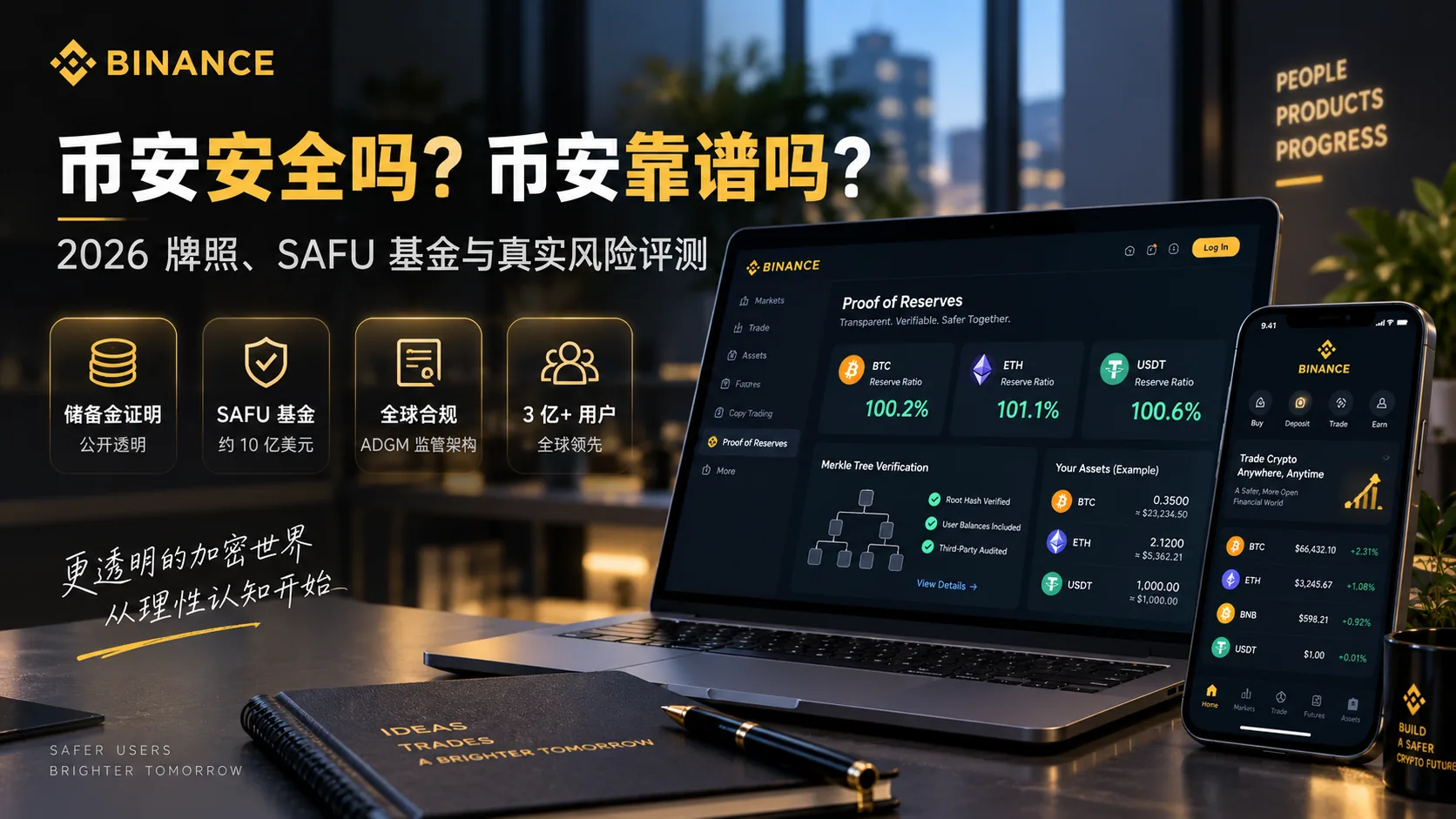
Image: Binance's Proof of Reserves, Merkle Tree verification and how account asset security works.
One distinction matters here:
Proof of Reserves ≠ a bank audit ≠ deposit insurance.
The question it mainly answers is:
"Do the platform's public on-chain assets cover the user balances included in the proof?"
It cannot by itself prove the full financial position of a company, and it does not remove future operational, litigation, regulatory or hacking risk.
So PoR is an important transparency tool, but it should not be read as "this can never fail".
2. In 2026 Binance also changed how PoR is calculated
In January 2026 Binance specifically adjusted how it presents proof of reserves.
Binance explained that some earlier calculations may have made the reserve ratio look higher by including the platform's own assets, and that the new method is meant to reflect the relationship between account balances and reserves more accurately.
But the core principle is unchanged:
User account assets should maintain 1:1 coverage.Binance
That is actually more worth noting than quoting a single month's "BTC reserve ratio of 100.25%".
Because the reserve ratio keeps changing.
To judge Binance's current reserve position, open the latest PoR rather than citing one historical snapshot for months.
2. What is SAFU, and can it really pay out?
SAFU stands for:
Secure Asset Fund for Users
Binance set up this emergency fund in 2018, initially by setting aside part of its trading fees.
SAFU is an emergency reserve fund Binance created to provide extra protection for user assets in extreme cases such as security exploits or platform-level incidents. Whether SAFU is used, which losses it covers and how compensation is handled depend on the plan and the rules Binance publishes when the event happens.
As of 2026, Binance's public materials show SAFU's asset value at around the $1 billion level.
There is one important change to note:
SAFU's asset composition changed in 2026.
Binance's February 2026 FAQ said about $1 billion in crypto assets; by the updated Binance Academy material in September 2026, SAFU had been converted to roughly $1 billion worth of BTC.Binance[2]
SAFU is currently custodied and managed by:
Nest Clearing and Custody Limited
That entity is regulated by the Financial Services Regulatory Authority (FSRA) of Abu Dhabi Global Market (ADGM) and carries part of the clearing and custody role within Binance's global regulatory structure.Binance
But again:
SAFU is not bank deposit insurance
It is an emergency fund set up by Binance, not statutory deposit insurance provided by a government.
So it should not be read as:
"If anything happens to Binance, every user will definitely be fully compensated."
Whether SAFU is used, which losses fall within coverage and how it is handled all depend on the nature of the event and Binance's rules at the time.
The reasonable interpretation is:
SAFU adds an extra layer of risk buffer for Binance, but it does not eliminate exchange custody risk.
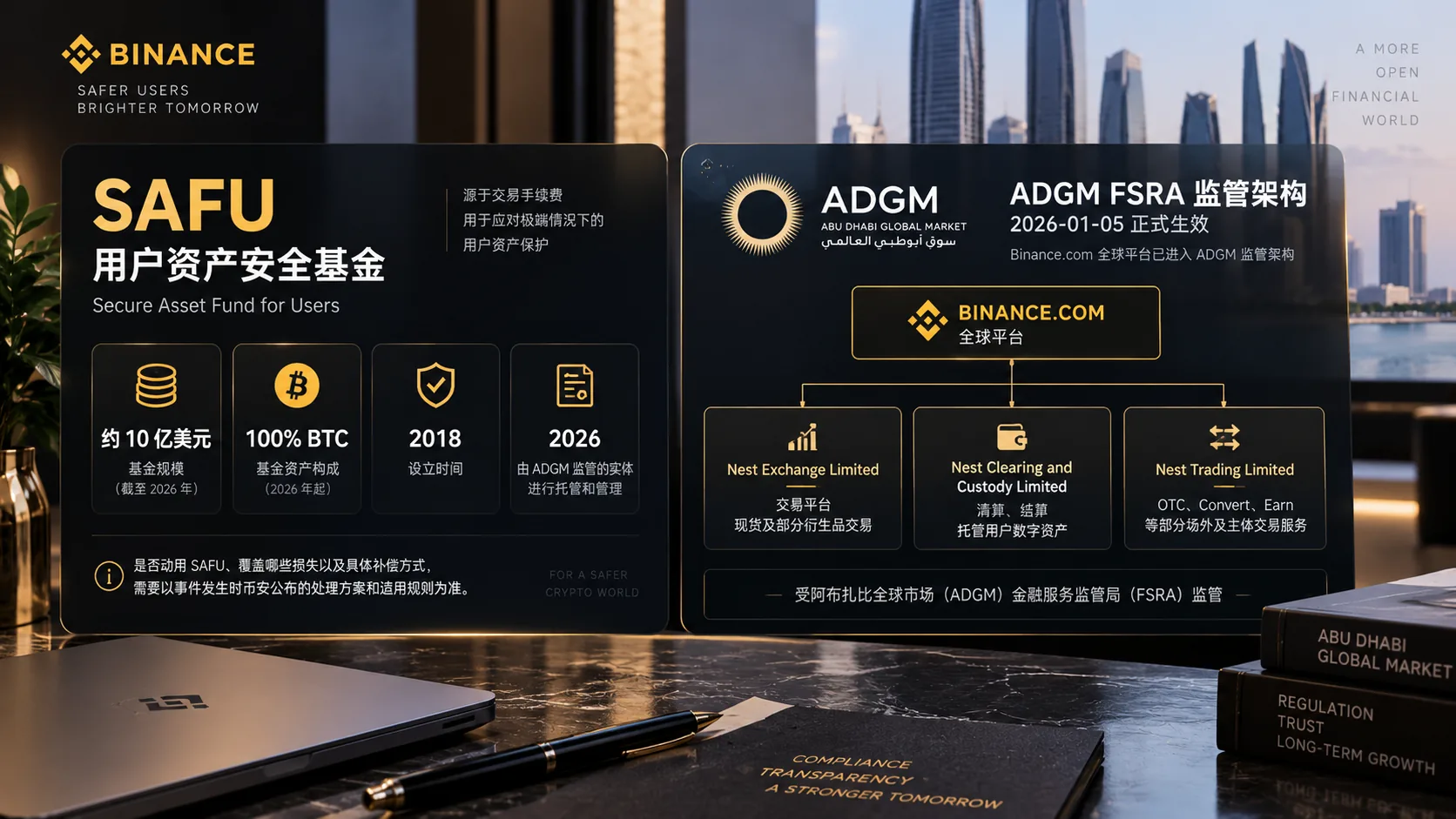
Image: Binance's SAFU user asset safety fund at around $1 billion, and the ADGM FSRA regulatory structure of Binance.com in 2026 with the three Nest entities.
3. Binance's biggest change in 2026: the ADGM global regulatory structure
This part matters a lot.
Many older articles still say:
"Binance has no headquarters."
Or:
"Binance.com is mainly an offshore entity."
By 2026 that description is no longer accurate.
From January 5, 2026, the global Binance.com platform formally moved to the regulatory structure of Abu Dhabi Global Market (ADGM).
Binance announced three main entities:
| Entity | Main responsibility |
|---|---|
| Nest Exchange Limited | Trading platform, including spot and some derivatives |
| Nest Clearing and Custody Limited | Clearing, settlement and custody of user digital assets |
| Nest Trading Limited | OTC, Convert, Earn and other off-exchange and principal trading services |
All three operate within the ADGM FSRA regulatory framework.Binance[3]
Nest Trading Limited's active regulatory status can also be checked in ADGM's official public register.Abu Dhabi Global Market
This means:
When assessing Binance's regulation in 2026, ADGM can no longer be treated as just an ordinary regional license; it is part of the regulatory structure of Binance's global platform.
That is a very big change from a few years ago.
4. How many licenses does Binance hold?
Binance holds licenses, registrations or other forms of regulatory authorization in multiple countries and regions. At the same time, since January 5, 2026, the global Binance.com platform has adopted the ADGM FSRA regulatory structure.
But "having licenses in many regions" should not be simplified into:
"Users worldwide get exactly the same legal protection."
That is not the case.
Across regions, the following can all differ:
- the service entity;
- the product scope;
- the regulatory requirements;
- KYC;
- eligibility for derivatives;
- complaint mechanisms;
- the rules for handling user assets.
So what you really need to confirm is:
Which Binance services your country or region allows you to use, and which specific entity provides them to you.
5. What exactly happened with MiCA in Europe in 2026?
This is very easy to get wrong.
The accurate description is not:
"Binance lost its MiCA license."
Because Binance did not hold a MiCA license at that point.
The sequence was:
Binance had applied for MiCA authorization through Greece's Hellenic Capital Market Commission (HCMC).
But on June 24, 2026, Binance announced it was withdrawing the Greek MiCA application and preparing to apply in another EU member state.Binance
At the same time, the EU's MiCA transition period ended at the end of June 2026.
Because Binance did not obtain MiCA authorization before the deadline, from July 1, 2026 its services were restricted in parts of the EU market, and it began making adjustments for affected users.Financial Times
So the more accurate summary is:
Binance did not have a MiCA license revoked; it failed to obtain MiCA authorization before the transition period ended and withdrew its Greek application.
That is a regulatory setback, but it is different from "the regulator revoked its license".
6. What serious compliance problems has Binance had?
To judge whether an exchange is reliable, you can't only look at the present; you also have to look at what happened before.
1. The 2023 $4.3 billion US settlement
This is the most important regulatory event in Binance's history.
In November 2023, Binance Holdings Limited pleaded guilty to violations involving:
- the Bank Secrecy Act;
- operating an unregistered money transmission business;
- US sanctions regulations.
Binance agreed to pay about $4.316 billion in fines and forfeiture.
Founder Changpeng Zhao (CZ) also pleaded guilty to failing to maintain an effective anti-money-laundering program and stepped down as CEO.US Department of Justice[4]
This cannot be softened into ordinary "regulatory friction".
It is a real and serious compliance history.
But from a security-assessment angle, two questions need to be kept separate:
A compliance violation does not mean the exchange is insolvent.
It shows that Binance had serious problems with AML, sanctions and US market access in the past, not that user assets were unreserved at the time.
2. The 2026 A$10 million Australian penalty
In March 2026, the Australian Federal Court ordered Binance Australia Derivatives to pay an A$10 million penalty.
ASIC's published information shows that between July 2022 and April 2023 the company misclassified more than 85% of its Australian clients as wholesale clients.
524 retail investors were exposed to high-risk crypto derivatives without the retail protections they were entitled to.
Related losses and costs exceeded A$12 million.
ASIC had also overseen about A$13.1 million in compensation paid to affected clients.ASIC[5]
Note again:
This case concerns client classification and onboarding at Binance Australia Derivatives, not a Binance.com reserve shortfall.
But it still shows:
A large exchange can also make serious compliance and user-protection failures.
7. Has Binance been hacked before?
Yes.
In May 2019 Binance disclosed a major security incident: attackers withdrew about 7,000 BTC from a hot wallet. Binance said at the time that the affected wallet was one hot wallet, roughly 2% of its BTC holdings at the time, and that other wallets were unaffected.Binance
Binance did not make users bear the loss; it covered it from its own security reserve.
That is the historical case often mentioned today when people talk about SAFU.
So the correct interpretation is not:
"Binance has never been hacked."
It is:
Binance has had a major security incident, and it built and kept strengthening a protection system for handling platform-level risk.
No centralised exchange can guarantee that a hack will never happen.
8. What risks does an ordinary user actually face?
For most beginners, what actually causes asset losses is usually not "the whole exchange gets hacked", but their own account being compromised first.
Pay particular attention to these.
1. Fake Binance apps
This is the most dangerous category.
Scammers make:
- fake Binance apps;
- fake download pages;
- fake APKs;
- sites imitating the official one;
- phishing pages in search ads.
The interface can look almost identical to the official Binance app.
The safest approach is simple:
When downloading the Binance app, only enter through Binance's official website or the official app stores.
Do not download a supposed "Binance installer" from:
- Telegram;
- WhatsApp groups;
- private chats;
- SMS;
- unknown tutorial sites.
2. Fake support agents
The most common scripts scammers use include:
"Your account is suspected of money laundering."
"You need to lift a risk control."
"Transfer to a safe account."
"Submit the verification code to verify your identity."
The one thing to remember is:
Be highly suspicious of any supposed support agent who asks for your password, 2FA code or seed phrase, or asks you to transfer crypto to "verify funds".
3. Account risk controls
An account being frozen or a withdrawal being reviewed does not necessarily mean Binance wants to take your money.
Situations that can trigger risk controls include:
- a sudden change of login device;
- an unusual IP;
- a sudden large inflow of funds;
- transactions with high-risk addresses;
- a disputed P2P trade;
- KYC information that needs re-verification;
- a freeze requested by a court or regulator.
In that situation, what you should do is:
Submit documents only through the support entry in the Binance app or official website.
Do not look for a supposed "Binance unfreeze support" on Telegram, WhatsApp or in search engines.
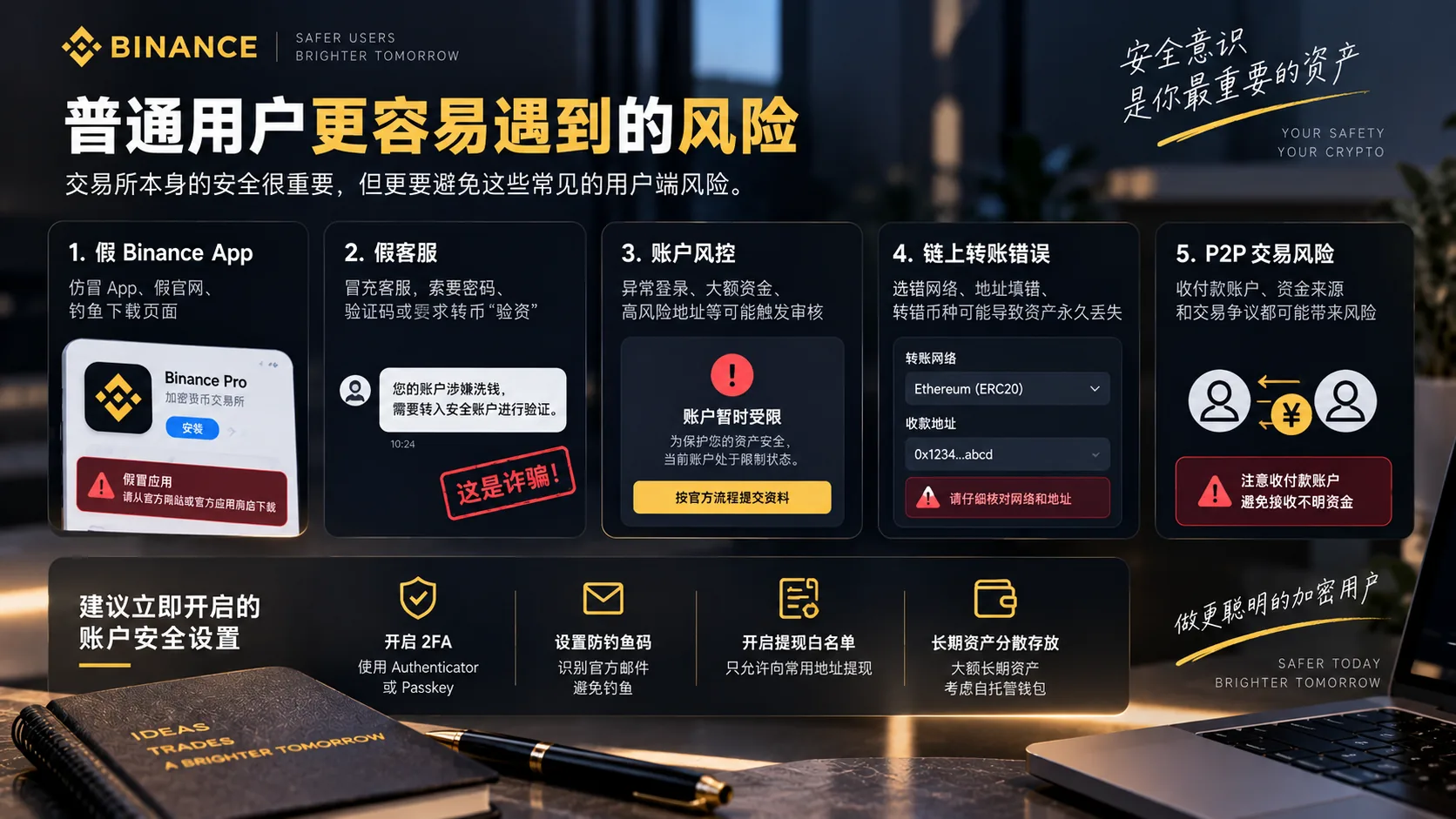
Image: the risks ordinary Binance users meet most often include fake apps, fake support, account risk controls, transfer errors and P2P risk; enabling 2FA, an anti-phishing code and a withdrawal whitelist is recommended.
9. How to judge for yourself whether Binance is reliable
Don't just take this article's word for it.
Checking two pages yourself gives you a lot of information.
First: Proof of Reserves
Go to Binance's official site:
Proof of Reserves
Focus on:
- the latest update date;
- major assets such as BTC, ETH and USDT;
- user net balances;
- platform reserves;
- whether 1:1 coverage is reached;
- whether you can verify your own account.
Binance's official PoR page still states clearly that user assets are covered 1:1.
Second: the regulatory entity
For example, through ADGM's public register you can directly check the Nest entity corresponding to Binance.
Don't stop at:
"Such-and-such exchange has dozens of licenses."
What really matters is:
Which entity provides your service, and what regulates that entity.
10. If you decide to use Binance, turn these security settings on
If you register on Binance, I recommend doing these four things on day one.
Turn on 2FA
Prefer secure methods such as an authenticator app or a passkey; don't rely only on SMS codes.
Set an anti-phishing code
Once set, some official Binance emails will include characters you chose yourself.
If an email arrives without the correct anti-phishing code, raise your guard.
Enable the withdrawal whitelist
Add the wallet addresses you use regularly to the whitelist.
Even if your password leaks, this makes it harder for an attacker to withdraw assets immediately.
Don't keep all long-term assets on the exchange
Binance is suited to buying, selling, converting, trading and temporary custody.
If an asset is long-term and you don't plan to trade it, and the amount already exceeds what you could bear to lose, look further into self-custody wallets; for how to choose one, see how to choose a crypto wallet.
The core principle is not:
"Binance is definitely dangerous, so withdraw everything."
It is:
Don't concentrate all your asset risk on one centralised platform.
11. Who should be especially careful?
| Your situation | What to watch more closely |
|---|---|
| You trade spot often | Turn on 2FA, the anti-phishing code and the withdrawal whitelist |
| You trade P2P often | Watch your receiving and payment accounts, disputes and the source of funds |
| You make on-chain transfers often | Check the network and address |
| You hold large assets long term | Consider self-custody to reduce exchange concentration risk |
| Your source of funds is complex | You are more likely to trigger AML / risk-control reviews |
| You have no security experience at all | Learn account security first, then scale up amounts |
| You are an EU resident | Confirm local Binance services and MiCA status first |
12. Binance or OKX: which is safer?
If we only discuss security, the two have a lot in common:
| Dimension | Binance | OKX |
|---|---|---|
| Proof of reserves | Yes | Yes |
| Zero-knowledge proof | zk-SNARKs | Has a comparable PoR verification system |
| Global scale | Larger | Global top tier |
| Emergency fund | SAFU | Has its own risk management and protection system |
| Account security tools | Complete | Complete |
| Centralised custody risk | Yes | Yes |
| Self-custody alternative | Supports withdrawals | Supports withdrawals |
When actually choosing, it's not advisable to ask only:
"Which one is absolutely safer?"
Because neither can eliminate centralised exchange risk.
More practical comparison dimensions include:
- whether your region is supported;
- trading fees;
- liquidity;
- P2P;
- deposits and withdrawals;
- Web3;
- number of products;
- customer support;
- account risk controls;
- what functions you actually need.
You can continue with: Binance vs OKX comparison.
FAQ
Q1: Is Binance a scam?
No.
Binance is one of the largest crypto asset trading platforms in the world; as of July 2026 its officially reported registered users exceed 323 million.
But "not a scam" does not mean "no risk".
Binance has paid about $4.3 billion in fines and forfeiture to US authorities over serious anti-money-laundering, US market access and sanctions compliance problems.US Department of Justice
Q2: Will Binance run off with the money?
As of this article's update date, there is no public evidence that Binance has entered a severe insolvency state like FTX did.
Binance continues to publish Proof of Reserves and states that user account assets maintain 1:1 coverage.
But no centralised exchange should be understood as "it will never fail".
So long-term assets should still consider spreading platform risk.
Q3: Does Binance have insurance?
More precisely, Binance has the SAFU user asset safety fund.
As of 2026 its scale remains around the $1 billion level, and current public materials show it mainly holds BTC.Binance
But:
SAFU is not government deposit insurance.
It should not be understood like bank deposit insurance.
Q4: Does Binance have licenses?
Yes.
In 2026 the global Binance.com platform has entered the ADGM FSRA regulatory structure, with Nest Exchange Limited, Nest Clearing and Custody Limited and Nest Trading Limited handling trading, clearing and custody, and other business respectively.Binance
Binance also holds licenses, registrations or regulatory authorizations in multiple jurisdictions.
Which products you can use depends on where you are.
Q5: Did Binance lose its MiCA license?
Strictly speaking, no.
Binance had applied for MiCA authorization in Greece but did not obtain a license.
On June 24, 2026, Binance announced it was withdrawing the Greek application and preparing to seek authorization in another EU member state.Binance
So it should be described as:
It failed to obtain authorization before the MiCA transition period ended, not as "its license was revoked".
Q6: Has Binance been hacked before?
Yes.
In 2019 there was a hot-wallet security incident involving about 7,000 BTC.
So there is no basis for saying "Binance will never be hacked".
What matters more is how the platform handles an incident afterwards, whether it has reserves, and whether users end up bearing the loss.
Q7: Why does a Binance account get frozen?
Common causes include:
- KYC needs re-verification;
- unusual login;
- high-risk addresses;
- P2P disputes;
- source-of-funds review;
- AML risk controls;
- a court-ordered freeze.
An account going through risk controls does not mean the assets are already lost.
Just submit your documents through the official process in the Binance app or website.
Q8: Can US users use Binance.com directly?
Generally they cannot use Binance.com the way an ordinary international user does.
The US market has a separate Binance.US, with products and a regulatory structure that differ from Binance.com.
Q9: What happens if Binance goes under?
That is exactly why SAFU cannot be understood as bank deposit insurance.
If a centralised exchange reaches an extreme situation, how much users can eventually recover depends on:
- how assets are segregated;
- the custody structure;
- legal proceedings;
- the jurisdiction;
- the platform's available assets;
- how regulators handle the resolution.
So the simplest risk management principle remains:
Don't leave all assets beyond your risk tolerance on one exchange for the long term.
Summary: is Binance reliable?
If the question is broken into parts, my conclusion is:
Binance is still a centralised exchange that operates normally, at enormous scale, with high reserve transparency and fairly complete security infrastructure.
It has:
- 1:1 Proof of Reserves;
- Merkle Tree;
- zk-SNARKs;
- the SAFU emergency fund;
- the ADGM global regulatory structure;
- 2FA;
- an anti-phishing code;
- a withdrawal whitelist;
- a large-scale risk-control system.
But it also has problems that can't be ignored:
- the major 2023 US criminal settlement;
- CZ's guilty plea and resignation as CEO;
- the 2026 Australian penalty against its derivatives business;
- failure to obtain EU authorization before the 2026 MiCA deadline;
- centralised custody risk itself.
So the most accurate answer to "is Binance safe" is not:
Absolutely safe.
Nor:
Binance is about to run off with the money.
It is:
Binance is currently one of the largest centralised exchanges in the world, with fairly complete security infrastructure, but centralised custody, regulatory change, account risk controls and personal operational errors remain real.
For someone who complies with local laws and is willing to set up account security properly, Binance can be considered as one of their trading platforms.
If you only want to hold assets long term, there is no need to leave all of them on any single centralised exchange.
Final check before you register
| Your situation | Recommendation |
|---|---|
| You have decided to use Binance | Right after registering, turn on 2FA, the anti-phishing code and the withdrawal whitelist |
| You're still choosing between Binance / OKX | Compare fees, deposits and withdrawals, products and regional support |
| You're a beginner and haven't bought crypto yet | You don't need to deposit funds to register |
| You only plan to hold long term | Learn about wallets and self-custody first |
| You're an EU user | Check the latest local service status first |
Registering on Binance does not require you to deposit funds first.
After completing registration and identity verification, you can decide whether to fund the account when you actually need to trade.
If you decide to register through this site's entry, you can use the Binance referral code AMY568:
- Register on Binance through this site (the code AMY568 fills in automatically at registration)
- You can also go directly to binance.com and register without a code; the features are the same
Using a referral code may give you the fee discount or rebate shown on the registration page; the final percentage and eligibility depend on what the registration page actually shows at the time.
The first link above is an affiliate link: registering through it may generate a commission for us, and it does not raise your normal trading fees. See advertising and affiliate disclosure for details.
Keep reading
- How to register on Binance: account opening and KYC step by step (2026)
- How to use the Binance referral code: rebate percentage and what to check
- How to withdraw from Binance to a wallet: which network to choose
Data verification note
The key facts in this article were checked on 2026-10-16, one by one:
- Proof of Reserves (PoR): Binance publicly commits that user account assets are covered 1:1 with an additional reserve held on top, and users can verify with Merkle Tree, zk-SNARKs and similar tools whether their balance is included in the proof. Source: Binance proof of reserves page.
- SAFU scale and asset composition: as of 2026 SAFU remains at around the $1 billion level; in 2026 it was converted to roughly $1 billion worth of BTC, custodied by Nest Clearing and Custody Limited under ADGM FSRA regulation. Source: Binance SAFU user asset safety fund FAQ.
- ADGM regulatory structure: from January 5, 2026, the global Binance.com platform moved to the ADGM FSRA regulatory structure, with Nest Exchange Limited, Nest Clearing and Custody Limited and Nest Trading Limited handling trading, clearing and custody, and other business respectively. Source: Binance ADGM regulatory structure announcement.
- 2023 US settlement: Binance Holdings Limited pleaded guilty and agreed to pay about $4.316 billion in fines and forfeiture; founder CZ pleaded guilty and stepped down as CEO. Source: US Department of Justice announcement.
- 2026 Australian penalty: Binance Australia Derivatives was ordered by the Australian Federal Court to pay an A$10 million penalty; more than 85% of its Australian clients were misclassified as wholesale clients, affecting 524 retail investors. Source: Australian ASIC penalty announcement.
Disclaimer
This article only introduces Binance's platform security, reserves, regulatory system and common risks. It does not constitute investment advice, financial advice, a trading recommendation, or any guarantee about Binance's safety.
Crypto asset prices are highly volatile, and centralised exchanges carry custody, cybersecurity, liquidity, regulatory, operational and account risk-control risks.
Every user should make their own judgement based on their situation and comply with the laws of their jurisdiction.
Whether long-term assets should be moved to a self-custody wallet depends on the amount, your security knowledge and your personal risk tolerance.
Exchange operations · USDT · Wallet security
Responsible for researching and organizing content on Binance, OKX, USDT transfers, withdrawals and wallet security. The steps and key data in this article are verified according to the content type, using real operation records, official platform documentation and public sources. Interfaces, fees and regional rules may change, so the article is reviewed and updated continuously.
Status: manual review · Last verified 2026-10-16
Reviewed by: Veldux editorial team
- Binance proof of reserves pageUser account assets are covered 1:1 with an additional reserve held on top; users can verify their balance themselves with Merkle Tree and zk-SNARKs
- Binance SAFU user asset safety fund FAQSAFU is around the $1 billion mark; in 2026 it was converted to roughly $1 billion worth of BTC, custodied by Nest Clearing and Custody Limited
- Binance ADGM regulatory structure announcementFrom January 5, 2026, the global Binance.com platform moved to the ADGM FSRA structure, with three Nest entities handling trading, clearing and custody, and other business respectively
- US Department of Justice Binance settlement announcementIn November 2023 Binance pleaded guilty and paid about $4.316 billion in fines and forfeiture; CZ pleaded guilty and stepped down as CEO
- Australian ASIC penalty announcementBinance Australia Derivatives was ordered by the Australian Federal Court to pay an A$10 million penalty over misclassifying 524 retail investors as wholesale clients
- 2026-10-16UpdateAdded the evidence-chain superscripts and the "Data verification note", and updated the fact-check date for key facts.
Editorial principles ineditorial policy,corrections policy。