
Binance referral code re-binding for existing users (2026)
Table of contents

Binance new-user benefit
20% fee rebate
Official Binance sign-up · You must complete identity verification (KYC) to trade and withdraw
You forgot to enter a referral code when you signed up for Binance — can an existing user still bind one now?
Yes, but you first have to work out which case you're in.
In 2026, Binance added Rebind Applications to the Affiliate Referral Pro system. Existing users who meet the conditions and currently have no referrer at all can re-establish a referral relationship through Rebind.[1]
There are currently three main paths:
- You registered recently, never bound a code and haven't deposited or traded: check first-time self-binding for the new account;
- You have an older account, no current referrer and no more than $5,000 in 90-day volume: check the long-term Rebind, and bind formally after passing the 30-day volume assessment;
- The account is over 90 days old and you haven't used Binance products in the last 90 days: check the official Recall Program and confirm the binding through an invitation link.
But if your account is already bound to another referrer, you normally can't change it directly to AMY568.
This article uses AMY568 as the example code; the corresponding fee rebate is 20% on spot and 20% on futures.
Note: this article explains Binance referral codes, referral relationships and the fee-rebate mechanism, and is not investment advice. Don't deliberately increase trading frequency, use high leverage or make trades you don't need just to pass the Rebind assessment. The eligibility check takes a few minutes; the two things that usually trip people up are treating Rebind as a free code swap, and inflating volume to hit the threshold.
First, work out which case you're in
| Account situation | Can you bind? | What to do |
|---|---|---|
| Registered recently, never bound, no deposits or trades | You can check | Self-binding, enter AMY568 |
| Older account, no current referrer, 90-day volume ≤$5,000 | You can apply | Use Rebind, reach $150,000 of volume in 30 days |
| Registered >90 days ago, never bound, no Binance product use in 90 days | You can check | Use the Recall Program |
| Already bound to another referrer | Normally no | Can't change it directly to AMY568 |
| 90-day volume >$5,000 | Usually not eligible for Rebind | Go by the eligibility shown on the page |
| Thinking of closing the account and re-registering for a new code | Not recommended | Can create KYC and risk-control problems |
The order of judgement is simple:
First check whether you have a referrer, then the account's activity and its 90-day volume.
First-time binding, Rebind, Recall and switching are not the same thing
A lot of articles label all of these as "changing the referral code", which isn't accurate.
First-time binding
You registered on Binance without entering a referral code and have never had any referral relationship.
Now you bind a code to the account for the first time.
In essence:
No referrer → create a referral relationship
Rebind
Rebind is a long-term feature currently offered in Binance's Referral Pro.
It mainly targets:
Accounts that are already Binance users but currently have no referrer.
If you meet the conditions, you can submit an application through the Rebind link the affiliate provides.
Note:
Rebind is not switching referrer A for referrer B.
What it solves is:
No current referrer → re-establish a referral relationship
Recall
The Recall Program is a separate existing-user recovery mechanism.
It suits older accounts that haven't used Binance for a long time.
It usually requires:
- Being registered on Binance;
- No current referrer;
- The account being more than 90 days old;
- Not having used the restricted Binance products in the last 90 days.
If you qualify, you enter through the affiliate's current invitation link, and the system checks eligibility and prompts you to confirm the binding.
Real switching
If your account was already bound:
To referrer A
and you now want to change it:
To referrer B, which corresponds to AMY568
that is what real switching means.
Binance currently has no regular, permanently open entry that lets an ordinary user delete their existing referrer and freely choose another.
So:
Rebind is for re-establishing a referral relationship for existing users who "currently have no referrer"; it is not a way for an account that already has one to switch freely.
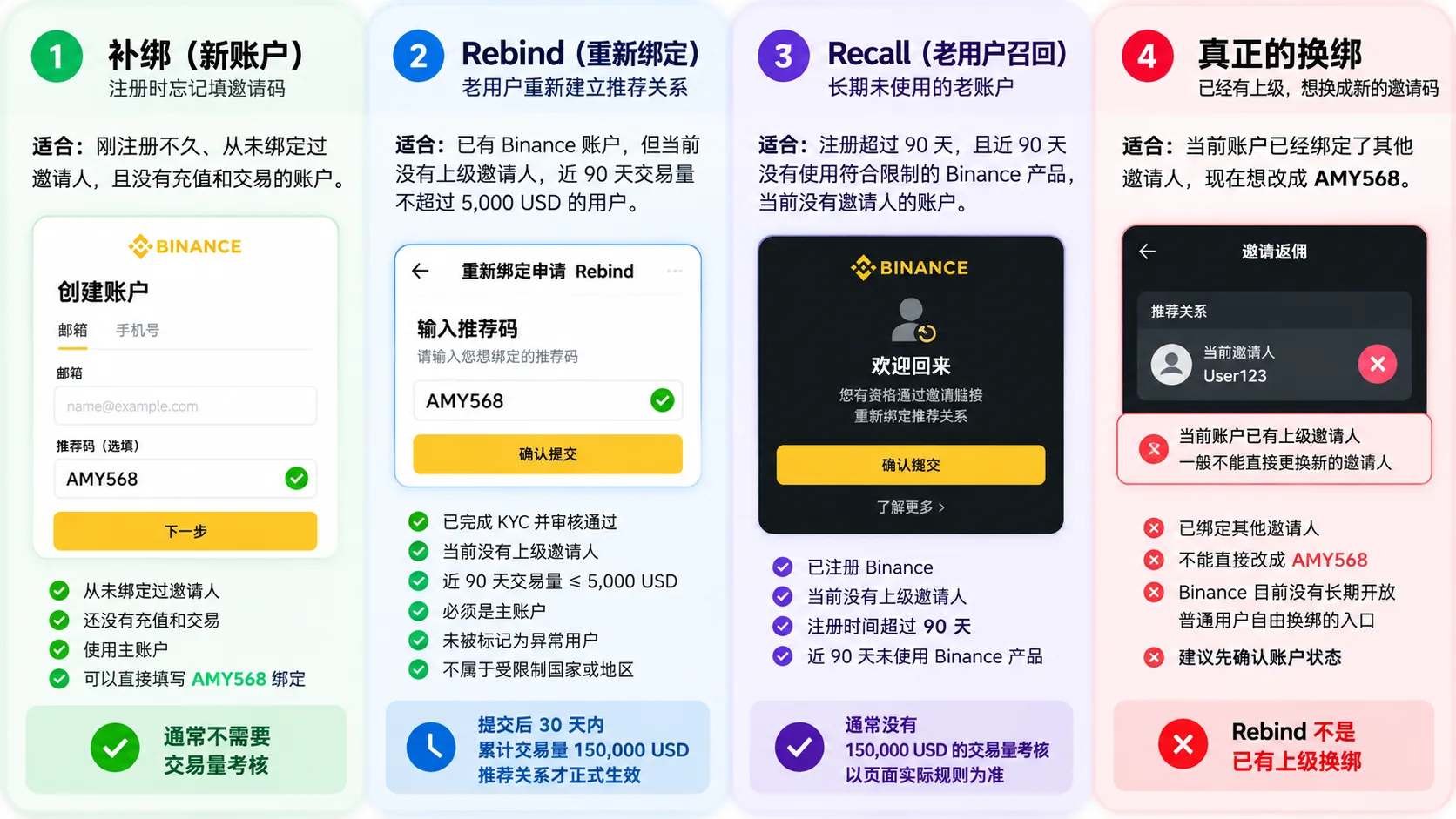
Figure: the four common referral-code situations on Binance: first-time binding on a new account, Rebind for existing users, Recall for long-inactive accounts, and real switching once you already have a referrer.
Registered recently: check first-time self-binding
If you signed up recently, skipped the code and haven't really started using the account, this is usually the simplest case.
Typical conditions include:
- A short time since registration;
- Never bound to any referrer;
- No deposit yet;
- No trading yet;
- Using the master account;
- No abnormal risk-control status on the account.
If the account qualifies, you can reach the binding page through Binance's self-service binding entry or a support prompt.
In the referral-code field, enter:
AMY568
then submit as the page instructs.
This kind of new-account binding usually does not require the later $150,000 volume assessment.
Why bind before depositing and trading?
Because once the account has deposit or trading records, it may no longer qualify for the simple new-account binding.
So the more sensible order is:
Register → check the referral relationship → bind → then deposit and trade
rather than:
Register → deposit → trade → come back looking for a code
Rebind for existing users: now a long-term feature
For users who registered a while ago but still have no referrer, Rebind is the main thing to check.
Binance has added to the Affiliate Referral Pro dashboard:
Rebind Applications
An affiliate can generate Rebind links from the dashboard and invite eligible existing users to re-establish a referral relationship.
It's better understood now as a long-term feature of the Referral Pro system, not a one-off campaign.
What conditions does Rebind require?
The main requirements today include:
| Condition | Current requirement |
|---|---|
| KYC | Identity verified and approved |
| Referral relationship | No current referrer at all |
| Account type | Must be the master account |
| 90-day volume | No more than $5,000 or equivalent |
| Risk-control status | Not flagged as an abnormal or wash-trading user |
| Region | Not in a restricted country or region |
The most critical one:
In the 90 days before applying, total volume must not exceed $5,000.
If you're already past that threshold, you generally don't qualify for the current Rebind.
In the end, go by the actual eligibility shown on the Rebind page after you sign in.
How do you do a Rebind?
This feature is usually initiated by the affiliate.
The affiliate can, in:
Super invite dashboard → Invited users → Rebind Applications
generate the Rebind link.
When the user opens the link:
- Sign in to your Binance account;
- Enter the Rebind page;
- Enter the referral code manually;
- Type AMY568;
- Check the referral relationship and rebate rate shown on the page;
- Click to confirm and submit.
There is an important distinction here:
Submitting an application does not mean the referral relationship is established.
A volume assessment follows.
After you submit, there is a 30-day assessment
The biggest difference between Rebind and a new user entering a code is the evaluation period.
The current rule requires:
Accumulating $150,000 or equivalent of trading volume within 30 days.
Once that is reached, the referral relationship takes formal effect.
The full flow can be read as:
Existing account with no referrer → open the Rebind link → enter AMY568 → submit the application → 30-day assessment → complete $150,000 of volume → referral relationship formally established
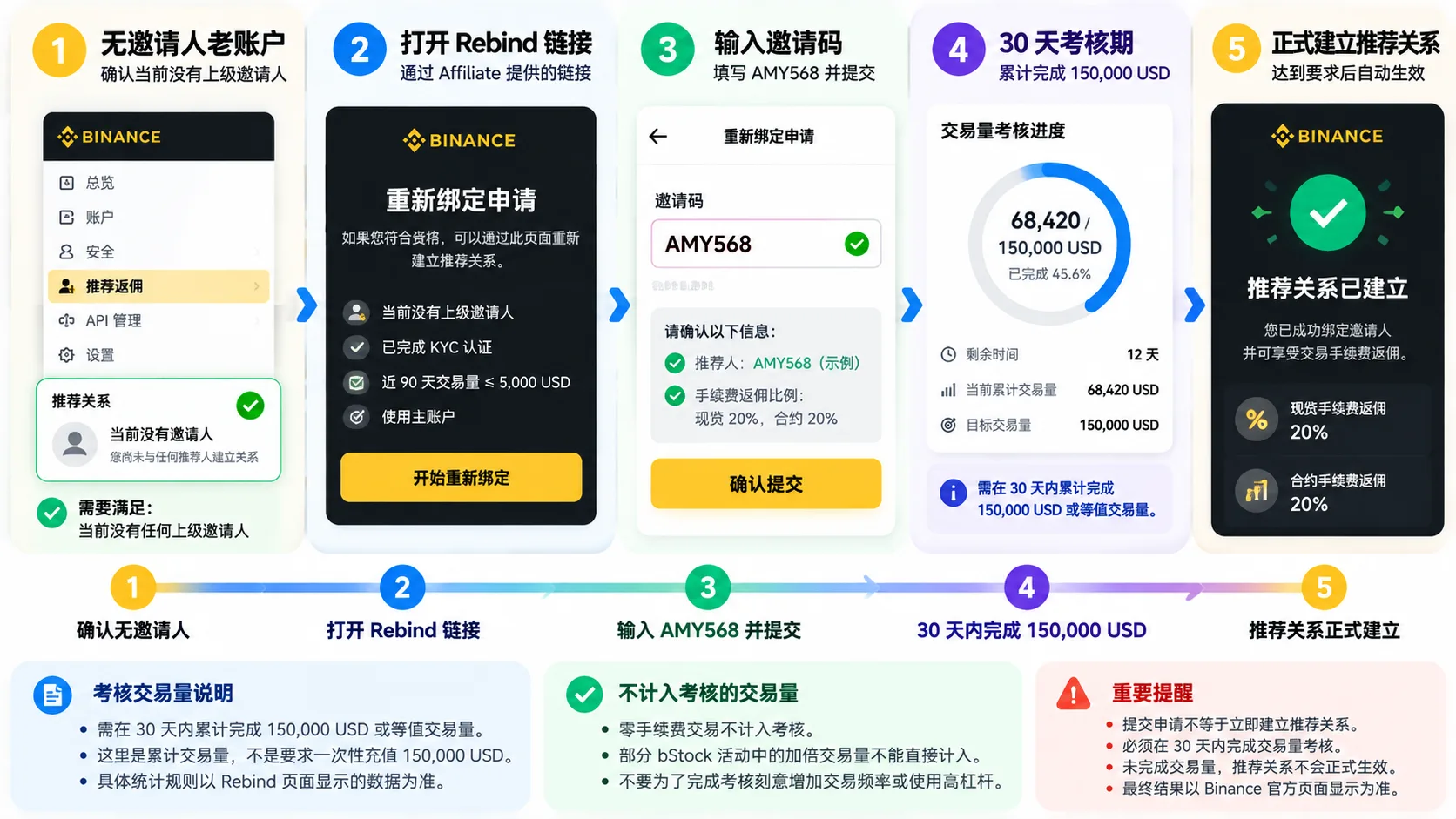
Figure: the full Rebind flow for existing Binance users. An older account with no referrer submits AMY568 and must complete the equivalent of $150,000 in volume within 30 days; once reached, the referral relationship is formally established.
Note carefully:
The $150,000 is cumulative trading volume, not a requirement to deposit $150,000 in one go.
Which trading volume doesn't count?
Rebind volume has its own counting rules.
Zero-fee trades don't count
If certain pairs are currently in a zero-fee campaign, their volume usually doesn't count towards the Rebind assessment.
So you can't complete the $150,000 through a large number of zero-fee trades.
Some bStock campaign volume doesn't count
Some bStock campaigns may use 2x or 3x volume multipliers, but those multipliers don't apply directly to Rebind.
The safest way to know how much volume you've actually done is to check the figure shown on the Rebind page.
Is it worth increasing volume just for Rebind?
If you already have a genuine need for large trades, Rebind is something you complete along the way.
But if you normally trade only a few thousand dollars a month and push your volume to $150,000 just to get the fee rebate, you need to redo the maths.
Because the process also involves:
- Fees;
- Spread;
- Slippage;
- Market volatility;
- Futures liquidation risk.
The rebate, in essence, only lowers trading costs you would have incurred anyway.
If getting the rebate means creating a lot of extra trades, it may not be worth it.
In particular, don't use high leverage just to complete the task.
If a Rebind application fails, can you reapply?
Yes, you can submit again.
But the system re-reviews eligibility, including:
- Whether you still have no referrer;
- KYC status;
- 90-day volume;
- Whether it's the master account;
- Risk-control status;
- Regional eligibility.
So reapplying doesn't mean approval is guaranteed.
If you've submitted an application but don't want to continue, you usually need to contact Binance official support to cancel it.
After a successful Rebind, can you change the code again?
Generally no.
Once the assessment is complete and the new referral relationship is formally established, the account goes from:
No referrer
to:
Has a referrer
At that point, wanting another code is real switching.
So before submitting a Rebind, confirm:
- That the code is AMY568;
- What rebate rate the official page shows;
- That the current referral relationship is correct.
Confirm everything before you submit.
Registered over 90 days and inactive: check the Recall Program
Besides Rebind, Binance has another path for existing users:
Affiliates Recall Program
It targets long-dormant accounts.
The main conditions today include:
- Being registered on Binance;
- No current referrer;
- The account being more than 90 days old;
- Not having used the restricted Binance products in the last 90 days.[2]
Before 2026-03-24, those two thresholds were:
180 days
Binance later adjusted them to:
90 days
So saying "you must have been inactive for six months" is no longer accurate.
How does Recall binding work?
Recall works differently from Rebind.
Eligible users need to enter through the affiliate's current Binance invitation link or QR code.
The typical flow is:
Open the AMY568 invitation link → sign in to the existing account → the system checks eligibility → a binding confirmation page appears → the user confirms
Recall suits genuinely long-inactive Binance accounts.
The difference from Rebind:
| Item | Rebind | Recall |
|---|---|---|
| No current referrer | Required | Required |
| Status in the last 90 days | Volume ≤$5,000 | Essentially unused |
| Account older than 90 days? | Not necessarily | Yes |
| How it's done | Rebind link + enter the code | Current invitation link / QR |
| Follow-up assessment | 30 days, $150,000 | Usually no equivalent volume test |
Simply put:
If you still trade a little, look at Rebind.
If you haven't used it for a long time, look at Recall.
Can an account aged 31–90 days still bind?
Yes, you can check Rebind.
You can no longer simply say:
Past 30 days, you just have to wait until 90.
If your account:
- Has no current referrer;
- Has completed KYC;
- Has no more than $5,000 in 90-day volume;
- Meets the other conditions too;
then even if registration was 31–90 days ago, you can check Rebind.
So that window isn't a dead end.
If you have already traded, can you still bind?
It depends on volume, not just on whether you've traded.
If it was light use and:
Total volume in the last 90 days is ≤$5,000
you can check Rebind.
If the account is more than 90 days old and hasn't been used at all in the last 90 days, you can check Recall.
If 90-day volume is clearly above $5,000, you generally don't meet the current low-volume Rebind condition.
A few things that are easy to misread
Rebind is not changing the code whenever you want
Rebind is aimed at existing users who currently have no referrer.
If your account already has someone else's code and you want to change it to AMY568, that is real switching, and today it generally isn't supported.
Past 30 days doesn't mean you must wait for 90
With Rebind now available, accounts aged 31–90 days may also have a path.
The key is not registration age alone, but:
Whether you have a referrer + KYC + 90-day volume.
$150,000 is volume, not a deposit amount
It refers to cumulative traded value.
But even if it isn't a lump-sum deposit, real trading still generates fees, spread and market risk.
Closing and re-registering doesn't guarantee a new code
Binance identifies accounts not only by email and phone number, but also by KYC identity data, account history and risk-control records.
Closing the account and registering again does not guarantee the new referral relationship will take effect.
If the original account works normally, there's no need to churn accounts just for a fee rebate.
How to check whether you currently have a referrer
Before binding, the most important step is to confirm:
Does my account currently have a Referral Relationship or not?
You can check in two ways.
Method 1: look at the Referral page
After signing in to Binance, go to the personal centre or the Referral page and see whether it shows:
- Referral Relationship;
- Referrer;
- Rebate Rate.
The entry may differ slightly between app and web versions.
Method 2: ask Binance support directly
You can ask official support:
Does my account currently have a referrer or a Referral Relationship?
Confirm the status and you're done.
Never give the following to any third party:
- Login password;
- Email verification code;
- SMS verification code;
- Google Authenticator;
- Passkey;
- API Secret.
What rebate do you get after binding AMY568?
The code this site currently uses is:
AMY568
For the invitee, it corresponds to a trading-fee benefit, not a lump-sum reward at sign-up.
The fee rebate for AMY568 is:
20% on spot, 20% on futures.
It is a fixed rebate rate, with no difference between spot and futures.
Note that other third-party pages may advertise 20%, 30%, 40% or even 50%; those are different codes or exaggerated claims, not the actual AMY568 rate from this site.
A few things to confirm before you start
Use only Binance's official website or app for Rebind, Recall, KYC and code confirmation.
A normal binding does not require giving anyone:
- Your password;
- SMS verification codes;
- Email verification codes;
- Google Authenticator;
- Passkey;
- Seed phrase;
- Private key.
Don't hand your account to someone else to trade for you, control remotely or "generate volume" either.
If someone claims:
Give me your UID and I can force a referrer change Pay me and I can unbind it from the inside Send me the verification code and I'll switch it for you
you should stop the operation.
FAQ
Q1: Can an existing Binance user still bind a referral code?
Yes, but the usual precondition is having no current referrer.
With no more than $5,000 in 90-day volume you can check Rebind; with an account over 90 days old and essentially unused for 90 days, you can check the Recall Program.
Accounts already bound to another referrer generally can't be changed directly to AMY568.
Q2: What conditions does Rebind require?
The main requirements today include:
- KYC completed;
- No current referrer;
- Master account;
- No more than $5,000 in volume in the 90 days before applying;
- Not flagged as an abnormal or wash-trading user;
- Not in a restricted region.
After applying, you also need to complete the equivalent of $150,000 in volume within 30 days.
Q3: Past 30 days since registration, can you still bind a code?
You can check Rebind.
It can no longer be simplified as "past 30 days, you just have to wait for 90".
If you have no referrer and meet the KYC, volume and other conditions, even an account aged 31–90 days may use Rebind.
Q4: I already have someone else's code — can I change it to AMY568?
Usually not.
Rebind solves:
No current referrer → create a new referral relationship
not:
Already bound to A → change to AMY568
Q5: Is the $150,000 in Rebind a $150,000 deposit?
No.
It means reaching cumulative trading volume equivalent to $150,000 within 30 days, not a lump-sum deposit of $150,000.
But real trading does generate fees, spread and market risk; don't deliberately increase trading frequency just to complete the binding.
Q6: What rebate do you get after binding AMY568?
After binding AMY568, the fee rebate on spot and on futures is 20% for both.
That is AMY568's fixed rebate rate, with no difference between spot and futures.
Summary in one sentence
In 2026, binding a referral code as an existing Binance user comes down to three cases:
Registered recently and the account is unused → check first-time binding;
No current referrer and 90-day volume ≤$5,000 → check the long-term Rebind, complete $150,000 of volume in 30 days and the relationship is formally bound;
Account over 90 days old and unused in the last 90 days → check the Recall Program.
Whichever path you take, the most important precondition is:
You currently have no other referrer.
If you're already bound to another referrer, you generally can't change it directly to AMY568.
Next step
- How to use the Binance referral code: the 20% rebate and key points — how new users enter AMY568 at registration
- How to register on Binance: account setup and KYC — your first Binance account, from creation to identity verification
- How to buy USDT on Binance: a complete P2P tutorial — once the account is set up, the USDT buying process
- Binance vs OKX: which has lower fees? — beyond the rebate, compare spot, futures and withdrawal costs
- Is Binance safe? Licences, the SAFU fund and real risks — the rebate is only part of your cost; account and fund safety matter more
Data verification note
The key facts in this article were checked on 2026-10-16, one by one:
- Rebind Applications mechanism: Binance now offers Rebind Applications within the Affiliate Referral Pro system; eligible existing users with no current referrer can re-establish a referral relationship through a Rebind link, and after submitting must complete a 30-day volume assessment before it takes effect. Source: Binance official FAQ — Affiliate Referral Pro usage.
- Recall Program account conditions: you must be registered on Binance, have no current referrer, have an account more than 90 days old, and not have used the restricted Binance products in the last 90 days; the 90-day threshold replaced 180 days on 2026-03-24, so "must have been inactive for six months" is no longer accurate. Source: Binance official FAQ — existing-user Recall program.
Disclaimer
This article only shares experience and explains the mechanics of binding and switching Binance referral codes, and is not investment, financial or trading advice.
Crypto asset prices are highly volatile, and trading carries platform, market, cybersecurity and operational risk. Binding and switching rules can change with platform policy; go by Binance's latest official rules. Users should judge prudently according to their own risk tolerance and comply with the laws of their jurisdiction. People under 18 should not trade crypto.
Exchange operations · USDT · Wallet security
Responsible for researching and organizing content on Binance, OKX, USDT transfers, withdrawals and wallet security. The steps and key data in this article are verified according to the content type, using real operation records, official platform documentation and public sources. Interfaces, fees and regional rules may change, so the article is reviewed and updated continuously.
Status: manual review · Last verified 2026-10-16
Reviewed by: Veldux editorial team
- Binance official FAQ — Affiliate Referral Pro usageThe Affiliate Referral Pro dashboard offers Rebind Applications, used to re-establish a referral relationship for existing accounts that currently have no referrer
- Binance official FAQ — existing-user Recall programRecall eligibility requires a registered account, no current referrer, more than 90 days since registration and no Binance product use in the last 90 days; the 90-day threshold replaced 180 days on 2026-03-24
- 2026-10-16UpdateAdded the evidence-chain superscripts and the "Data verification note", and updated the key-fact verification date.
Editorial principles ineditorial policy,corrections policy。